


Key takeaways
- Cross-sell emails recommend complementary products based on customer purchase or browsing behavior.
- They are most effective when triggered by real actions, not sent as generic promotions.
- Sending cross-sell emails within 24-72 hours after purchase leads to stronger engagement.
- The goal is to increase average order value (AOV) and customer lifetime value (CLV).
- Best practices include keeping recommendations relevant, limiting the number of products, and ensuring clear CTAs.
Imagine you’re ordering fries at McDonald’s. When you’re about to check out, the cashier asks if you’d like to add ketchup. That’s an everyday example of cross-selling — an effective marketing strategy that helps businesses get more from each customer. Want to start using it? Email is a perfect channel for that!
Cross-sell emails often outperform standard generic promo campaigns precisely because they target customers who have already shown intent. Read this article to learn about cross-sell emails, see effective examples from real brands, and get a guide on setting up your first cross-selling campaign.
What are cross-sell emails?
Cross-sell emails are targeted campaigns that promote complementary products to customers based on their purchases.
They aim to increase sales and make people buy more thanks to relevant product recommendations.
This strategy works across industries, from e-commerce to SaaS or even real estate.
For example, a fashion brand might recommend buying a scarf to a customer who bought a coat. A quiz-making software company might offer subscription buyers additional templates or special add-on features.
Cross-selling vs. upselling: Key differences
Both cross-selling and upselling involve product recommendations, but they are two distinct strategies.
Cross-sell emails offer buyers additional products that can work together with what they are purchasing.
Upsell emails, on the other hand, aim to make customers purchase more expensive, premium products instead of the ones they’re considering. In our McDonald’s example, upselling would be if the cashier tried to persuade you to buy a large portion of fries instead of a medium one, or some special promo fries instead of the regular ones.
Here’s a quick comparison table, so you could get an even clearer picture:
| Email strategy type | Tactic | Goal/Outcome | Number of purchases | Original product | Recommended product |
| Cross-sell emails | Recommending complementary products | The customer makes additional purchases or adds items to their order | Multiple | iPhone 17 | Phone case |
| Upsell emails | Recommending a more expensive product | The customer opts for a premium version of the product they considered | One | iPhone 17 | iPhone 17 Pro |
How cross-selling and upselling can work together
You do not have to choose one tactic for every lifecycle campaign. Use upselling when the customer is likely to benefit from a better version of the same product, and use cross-selling when they need something that complements what they already bought, viewed, or activated.
For example, a SaaS company might upsell a higher plan when a user reaches usage limits, but cross-sell onboarding, templates, extra seats, or an integration when those additions help the user get more value from the plan they already chose.
Role of cross-sell emails in customer journey
We’ll talk about what makes cross-sell emails important and effective in the next section, but here’s a quick look at them from the customer’s point of view.
At each stage of the customer journey, cross-selling supports the buying process, improves the shopping experience, makes it easier to discover interesting products, and increases customer satisfaction. People enjoy relevant promotions and may become more loyal to the brand that does them well. This, in turn, increases repeat purchases.
Benefits of cross-sell emails
Sending cross-sell emails is a great strategy for any business. Read on to learn why they are a staple in email marketing and how they can benefit your company.
Increasing revenue without extra acquisition costs
Cross-sell emails are all about monetizing existing customers by recommending complementary products at high-intent moments, which means you don’t spend money on acquisition, improving the ROI of your marketing efforts. Acquisition is costly and time-consuming, with prospects requiring several touchpoints before conversion. Campaigns sent to existing customers usually generate higher engagement than ones sent to cold audiences.
Plus, cross-sell emails can be automated. Set up a cross-selling email scenario once, and it will continue working without major human intervention. This lowers your marketing spend.
Boosting average order value (AOV) & repeat purchases
When you recommend relevant products, your customers are likely to buy them. Timed just right, cross-sell emails can motivate adding more to an order, increasing sales and the average order value.
If you’re using cross-sell emails in your post-purchase sequences, you’re stimulating repeat purchases and getting more revenue out of existing customers. This, in turn, improves customer lifetime value (CLV). Marketers often observe that even a small increase in AOV from cross-selling can have an impact on total revenue, especially at scale.
Improving customer experience & personalization
Cross-sell emails are targeted and relevant. As product recommendations are based on previous purchases and other data, they are personalized and make your customers feel seen.
These emails anticipate customer needs and make the customer experience more intuitive. Plus, they ease the product discovery process and seamlessly introduce your audience to your offerings that they might have otherwise overlooked.
Retaining customers
Customer loyalty naturally follows a good buying experience. Showing your audience that you value their time and helping them find solutions to their problems, you encourage them to stay with your brand.
12 best cross-sell email examples
In this section, we’ll show you some of the most effective strategies to use in your cross-sell campaigns. They showcase patterns that work across industries, like relevance over volume, timing over frequency, and personalization over generic offers.You’ll find creative emails across different industries and customer journey stages that can inspire you.
1. Fashion brand suggesting accessories
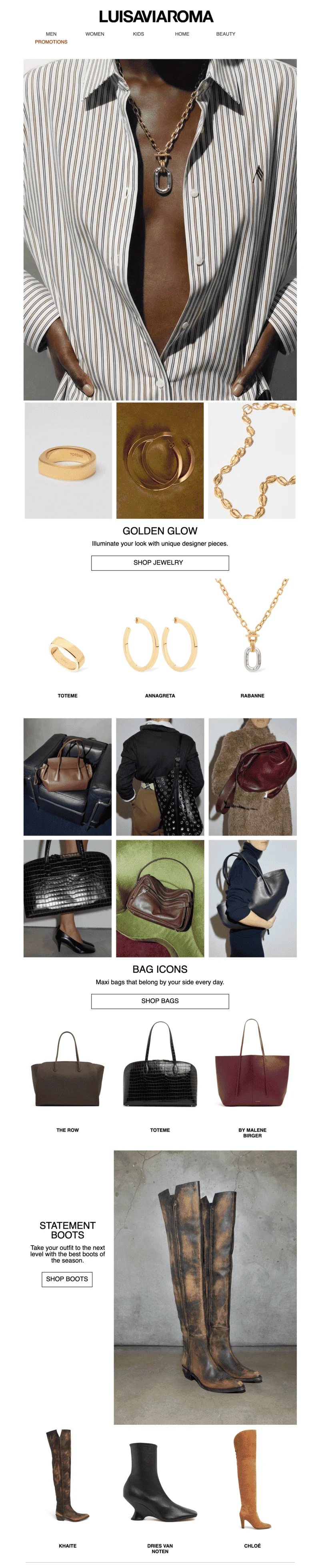
In this email, fashion brand Luisa Via Roma recommends jewelry, bags, and shoes to complete the look. The layout includes a combination of real-life product photos and the catalog ones to give subscribers a clear understanding of the items’ quality.
This is a great campaign to send both after a purchase and as a follow-up after a browse abandonment.
Ideas to adopt:
- Include several product categories in one cross-sell email.
- Offer diverse recommendations if the customer’s preferences are unclear.
- Provide links to the whole catalog section, so customers can look through more options.
2. Skincare products bundling email
Offering bundles with a discount is one of the most effective cross-sell strategies.
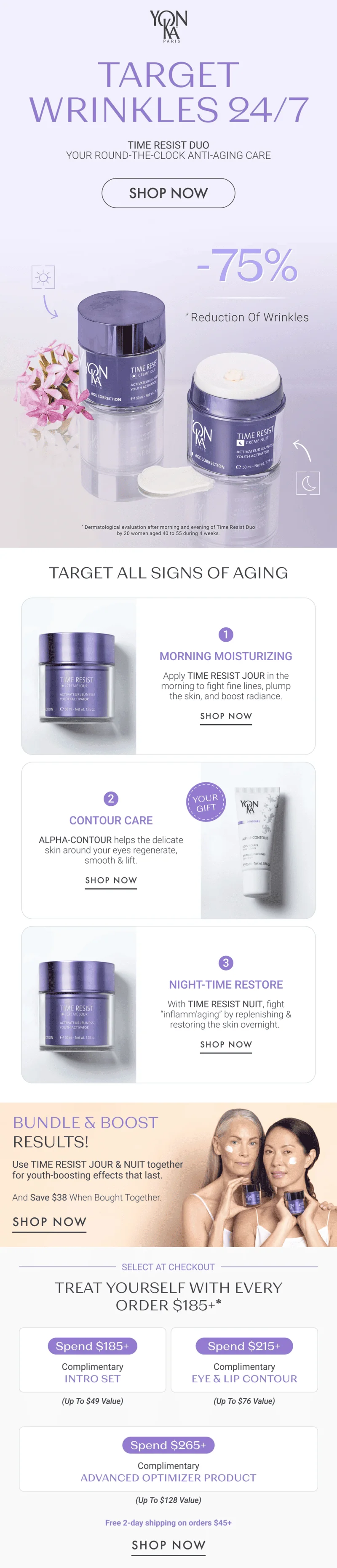
Yon-Ka Paris promotes two creams that complete an anti-age routine and includes several offers to motivate customers to spend more to get free products.
Ideas to adopt:
- Bundle products that go together at an attractive price.
- Include social proof, like the results of clinical trials of the products.
- Add multiple CTA buttons to make the path to purchase as easy as possible.
3. Wishlist reminder with recommendations
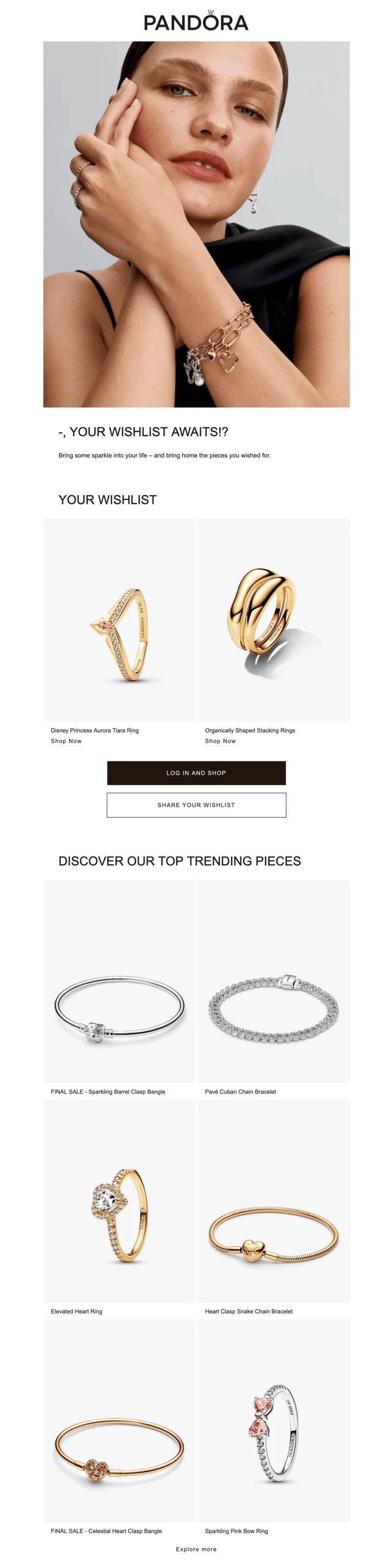
If your store has a wishlisting or favorite option, you can send automated emails with the items your customers added to their lists.
To make the campaign even more effective, recommend other similar products. This way, something is bound to catch the subscriber’s attention!
Ideas to adopt:
- Personalize your email greeting with the customer’s name, and don’t forget to set up a general greeting when you don’t have it.
- Recommend the best, new, or trending products to excite the reader.
- Add cross-selling elements to your other automation scenarios, like wishlist emails or cart abandonment emails.
4. Fitness accessories recommendations
Accessory-focused emails work great across industries. For example, they are useful for fitness equipment brands.
Note how short and sweet the campaign below is. It clearly states the value of every recommended product and saves subscribers’ time.
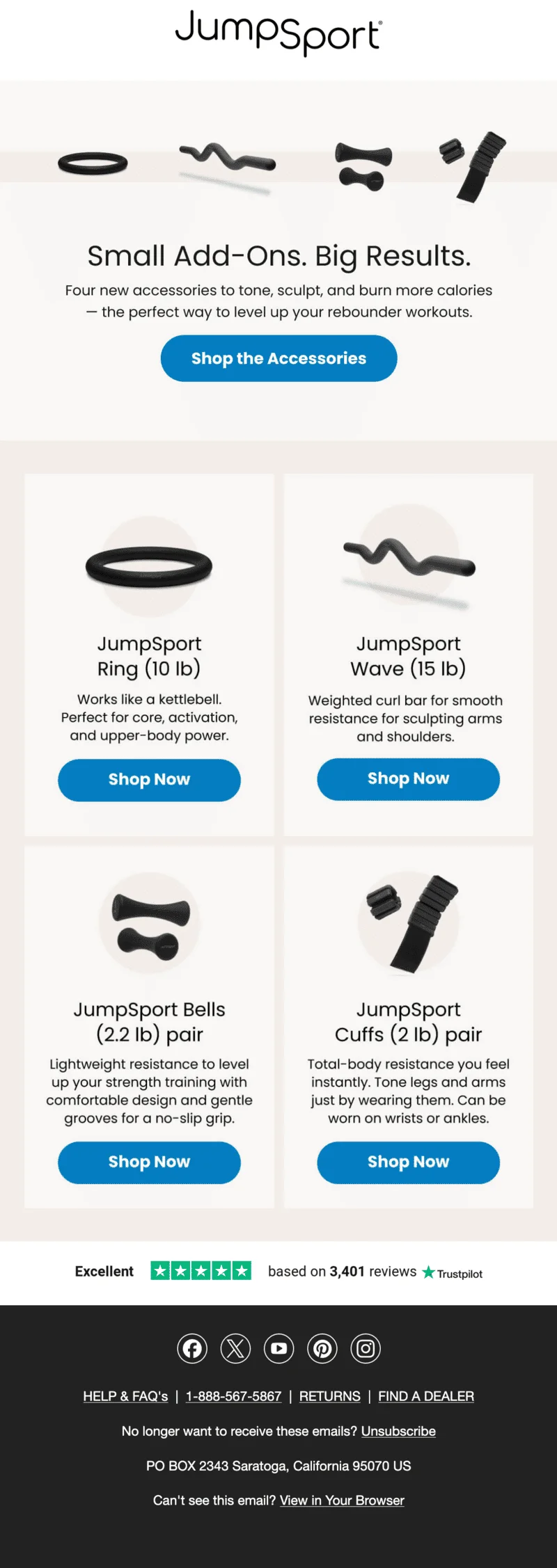
Ideas to adopt:
- Cross-sell emails can be minimalistic — that doesn’t make them less appealing.
- Provide short product descriptions to give customers an idea of what you’re recommending.
- Make CTA buttons big and easily clickable.
5. Educational post-purchase email
Cross-selling can be a natural addition to your nurturing and product tutorial emails. Here, Merit sent a how-to guide based on a customer’s recent purchase and included a subtle recommendation.
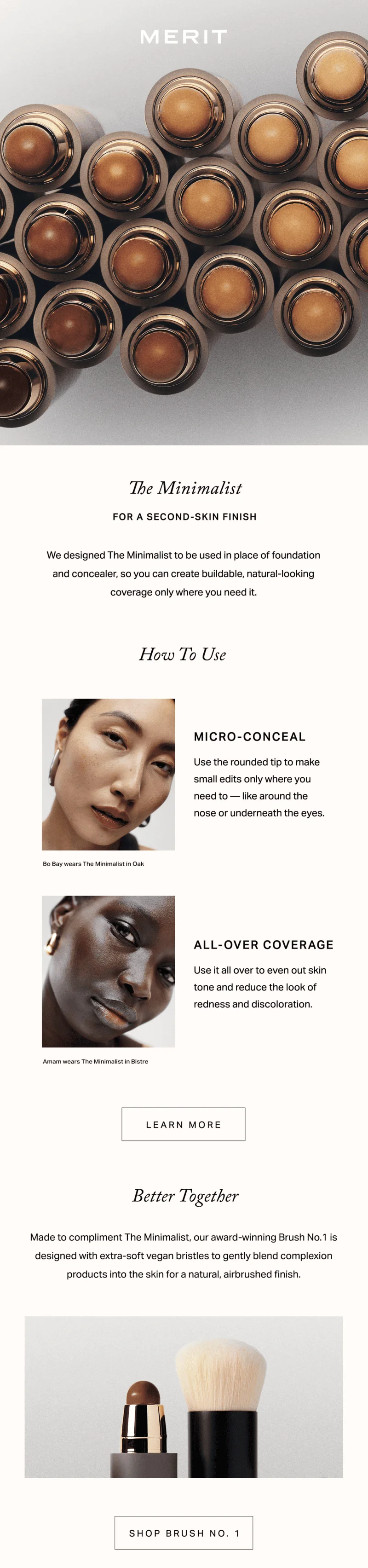
Ideas to adopt:
- Add educational emails to your post-purchase sequences and use this opportunity to naturally cross-sell.
- Don’t make your nurturing emails overly salesy; this can make you sound pushy and detract the customers.
- State all the unique qualities of the product you’re recommending, from its award-winning status to its design and effects.
6. Post-purchase and pre-delivery cross-sell email
For e-commerce brands, post-purchase sequences are prime real estate for cross-selling. You can even add unique promotional messages in between the transactional ones.
This helps to continue the conversation beyond just one purchase and strengthens the relationship with your customer.
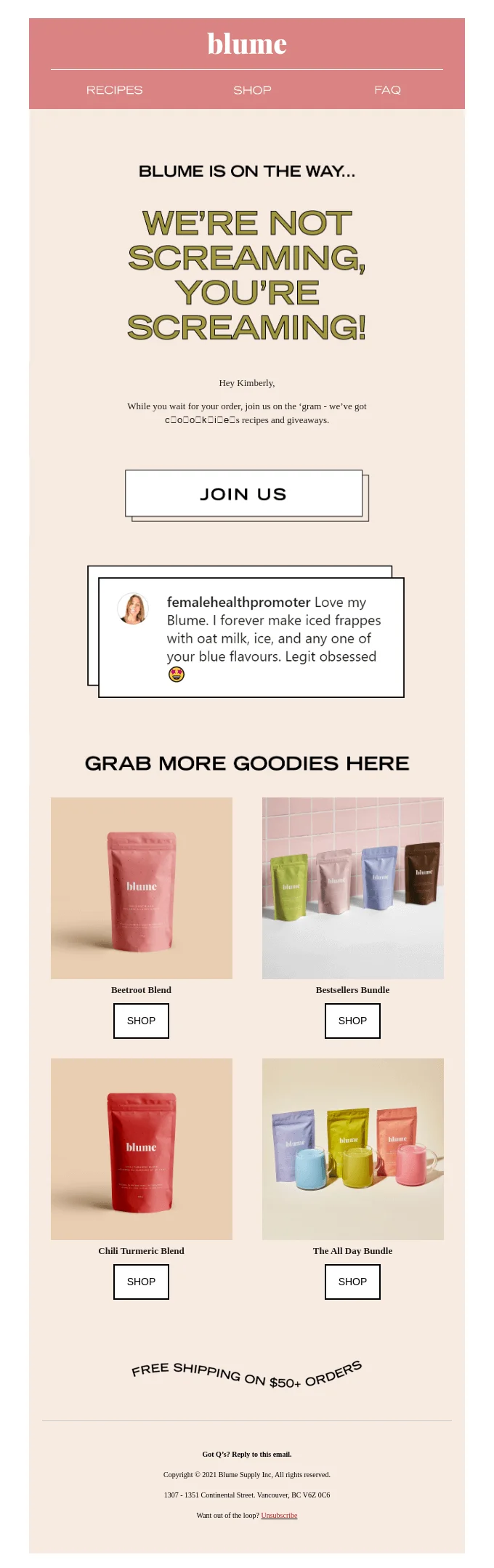
Ideas to adopt:
- Add a “while you’re waiting” email to your order flow to maintain interest and recommend more products.
- Include product reviews to build excitement.
- Ask subscribers to join your social media to build a loyal community.

7. Subscription upgrade email
If you’re running a subscription-based business, regularly promote add-ons.
For example, Dollar Shave Club ventured into hair care and recommends adding a shampoo and styling products to subscribers’ packages for convenience.
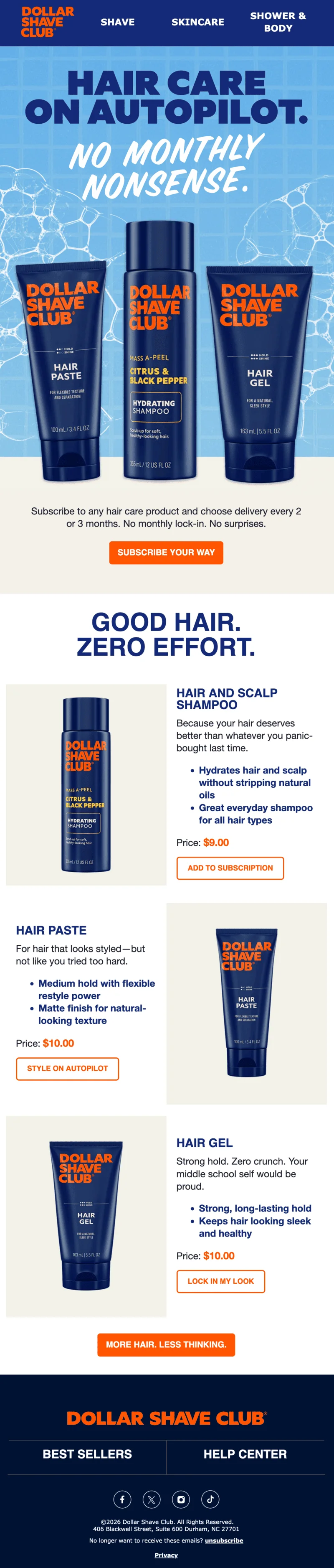
Ideas to adopt:
- Provide prices to help your customers budget.
- Experiment with different CTA wording for each button to keep your readers’ attention.
- Use bold and bullet points to visually structure information.
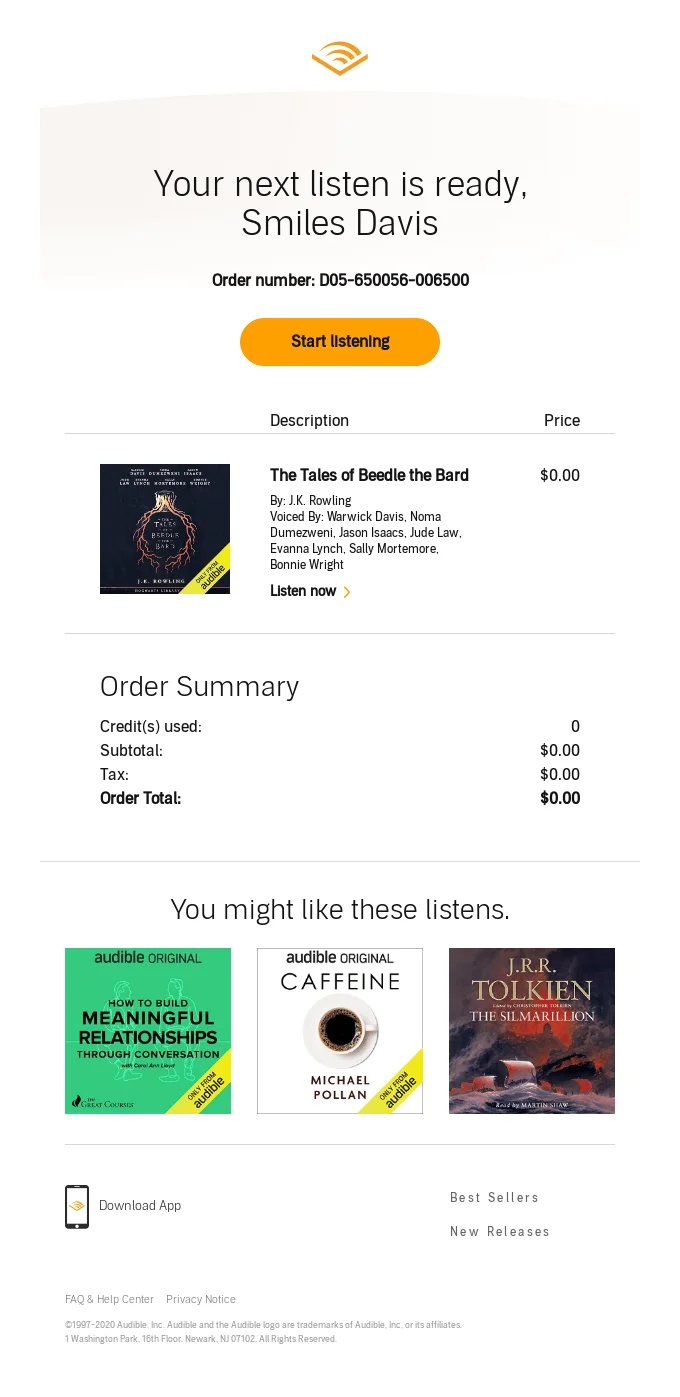
8. Confirmation email with personalized recommendations
Order confirmation and thank you emails are great for cross-selling, as they include product information that you can use to make your recommendations more personal and targeted.
In the example below, the essential order details are on top, so the campaign effectively serves its purpose. The suggestions are closer to the bottom and aren’t distracting, just complementing the message.
Ideas to adopt:
- Promote your exclusive products, like audiobooks that are only available on your platform.
- Don’t let the recommendations take away from the main goal of an email, especially a transactional one.
- Highlight the personalized nature of the recommendations, focus on the reader’s need or desire. For example, instead of “our bestsellers,” opt for “you might like these” or “picked for you.”
9. Limited-time offer cross-sell campaign
Fear of missing out (FOMO) is a big sales driver, so why not use it in your cross-sale campaign? Depending on your brand guidelines, you can be bold and upfront or adopt a subtle approach, like in the example below.
Note the strategic use of red to show the discount and the price. This design choice grabs attention and effectively communicates the value.

Ideas to adopt:
- Recommend one item in different colors to show the product range.
- Include CTAs that don’t imply immediate purchase, like “back to wishlist” or “take a look.”
- Add an element of intrigue, for example, hide the top recommendation under a question mark.
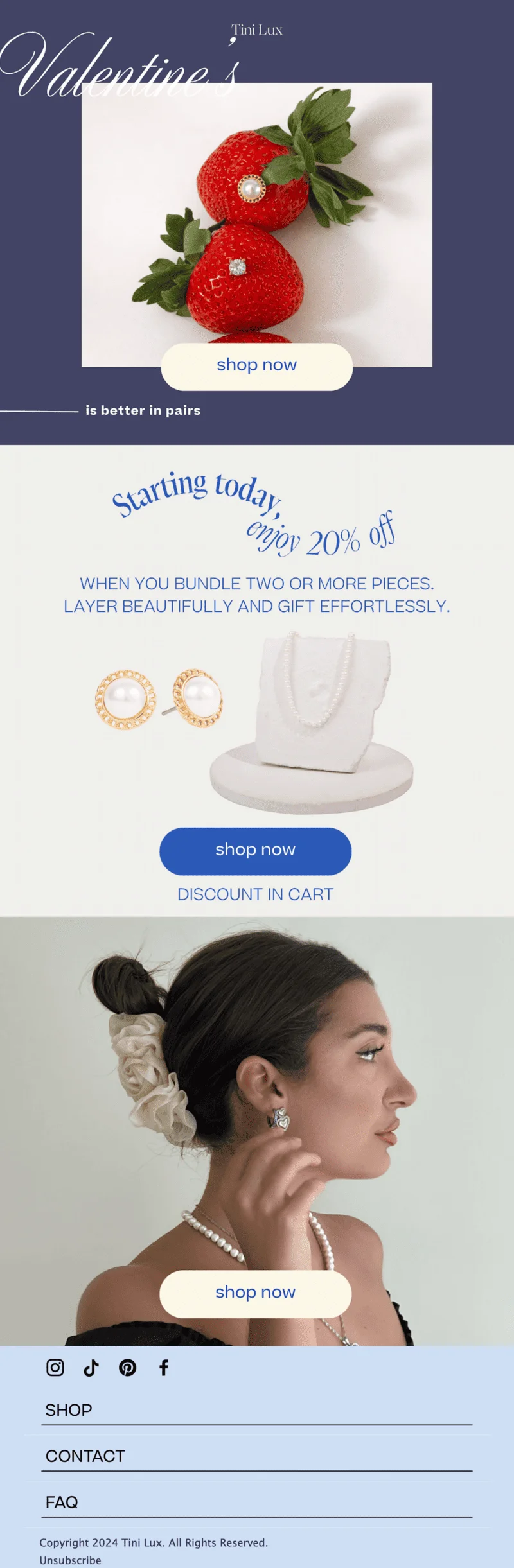
10. Seasonal cross-sell promotion
On holidays, your customers are likely shopping not only for themselves, but for their friends and family, too.
Bundles, combos, and kits are perfect marketing strategies to use gift-giving to your advantage and increase sales.
Ideas to adopt:
- For seasonal emails, recommend products that make good gifts.
- Suggest more than one use case for buying more products, like layering and gifting for jewelry pieces.
- If you offer a discount, make it easy for customers — apply it automatically when the conditions are met.
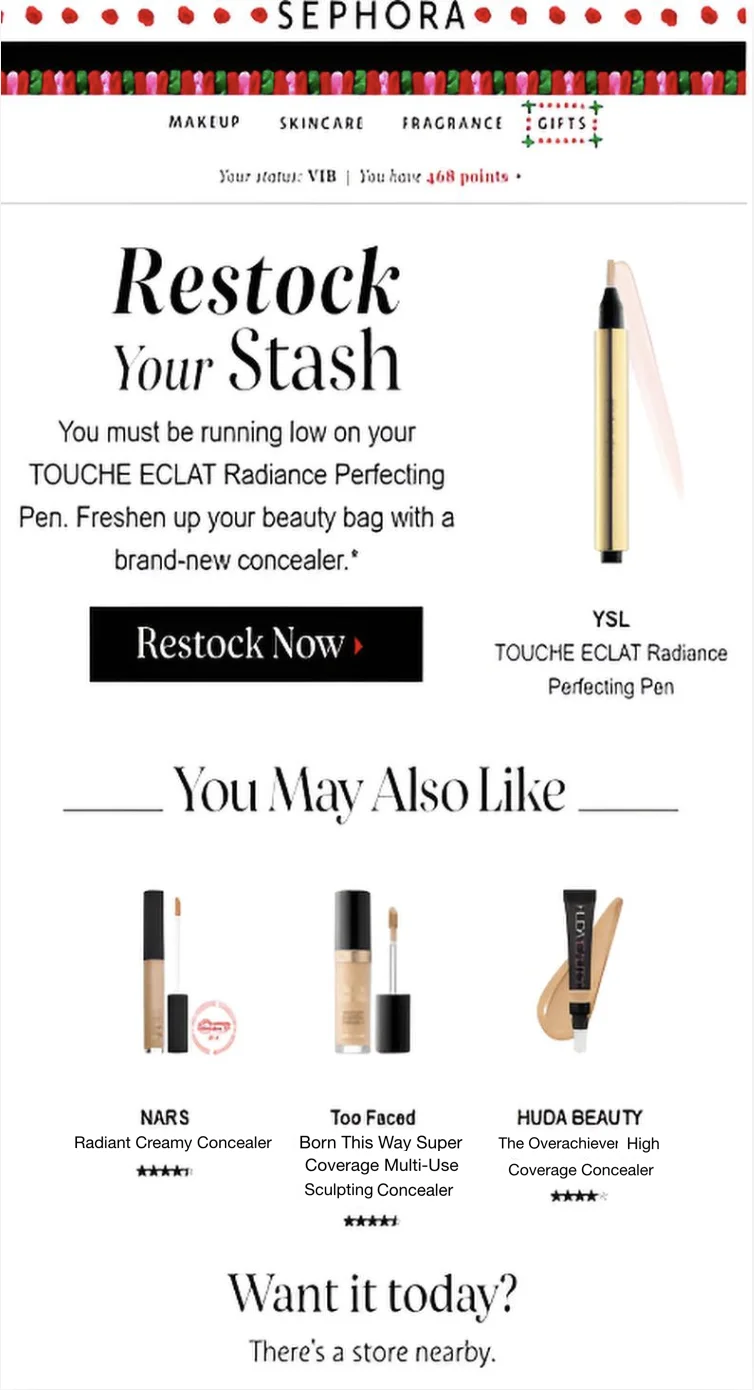
11. Replenishment reminder with cross-sell suggestion
Your cross-sell campaigns can be time-bound. Approximate when a product someone purchased is about to run out and send an email suggesting they buy some more.
Of course, the customer’s preferences might have changed over time, so it’s also a good moment to suggest alternative options and cross-sell.
Ideas to adopt:
- Find the right time for a replenishment email to anticipate your customers’ needs.
- If you have the information, suggest the product they’ve already purchased.
- Recommend both complementary options and possible replacements to cover all bases.
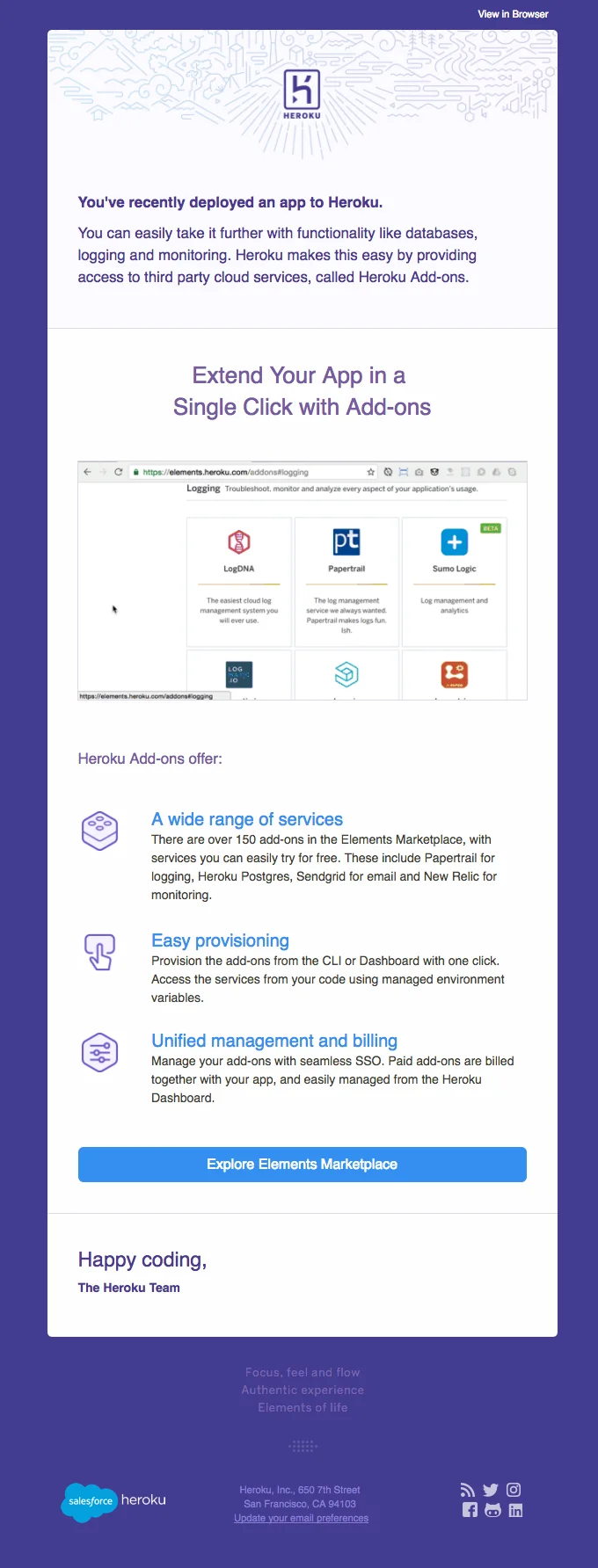
12. SaaS feature expansion email
When a user has benefited from one feature or service, you can offer them more. It’s a great strategy for any digital product and helps to increase adoption and raise awareness about all the platform’s capabilities.
Ideas to adopt:
- Find a good moment to cross-sell, like when the customer has completed their first major action in your product.
- Explain how the additional features or services can enhance user experience.
When to send cross-sell emails
Timing is everything when it comes to effective campaigns. Messages sent too late often miss the intent, while those that are sent too early can feel irrelevant. Successful cross-sell strategies focus more on behavioral triggers than on fixed schedules.
Learn about the best time to send emails in our dedicated article and discover the specifics of cross-selling campaigns below.
After the purchase
One of the best opportunities for a cross-sell email is right after the purchase. For example, you can include a small product recommendation block in your thank-you campaign.
Alternatively, wait for 1-3 days after the purchase because this is when the strongest engagement happens for many brands. During this time window, customers are still thinking about their order and are more receptive to recommendations.
This way, you’ll keep transactional messages separated from marketing ones and still use the momentum for additional promotions.
During onboarding or activation
This option is great for SaaS businesses and digital product sellers, as it is a natural way to showcase platform features and encourage your clients to make the best out of it.
Offer complementary add-ons, paid guides, onboarding, and other services right when you’re introducing your customer to the product.
Seasonal or event-driven opportunities
Offering bundles or kits is a great way to cross-sell during big e-commerce events, like Black Friday or Cyber Monday, and holidays, like Christmas or Valentine’s Day.
During these times, recommendations can include more than just relevant products. For example, you can promote a gift wrapping service, personalization, or postcards, no matter the purchase.
Based on customer behavior & segmentation
If a customer made a purchase and then viewed other products on your website, it’s a great opportunity for cross-selling. For example, instead of sending a browse abandonment email, combine the browsing and purchase data for a targeted cross-sell email.
Predictive analytics also helps to find the right timing for a message. Based on customer behavior data, it can identify the most likely moment for conversion and initiate the campaign.
Segmentation plays a role, too. You can recommend different types of products to different customer groups. For example, luxury buyers might get a premium belt recommendation for their trouser purchase, while regular buyers can receive a more affordable one.
When recommendations are tied to recent browsing or purchase signals, they feel more like helpful suggestions than promotions, which increases clicks and downstream conversions.
Cross-sell email triggers and segments to test
Cross-sell emails work better when they respond to a real signal. Start with one or two simple triggers, measure them, and expand only when the logic is clear.
- Purchase completed: recommend accessories, setup items, or a small add-on while the product is still top of mind.
- Product viewed after purchase: combine browsing and order data to suggest items that match current interest.
- Wishlist or favorite saved: suggest similar products, matching items, or trending alternatives.
- Replenishment window reached: remind customers to restock and add complementary products or replacements.
- Onboarding milestone completed: for SaaS and digital products, introduce templates, integrations, training, or add-on features.
- Seasonal event: recommend bundles, gift options, personalization, wrapping, or limited-time kits.
How to set up a cross-sell email campaign
Ready to put what you’ve learned into practice? We’ll walk you through the process of creating a simple cross-sell campaign that you can adjust and expand as needed.
Step 1. Define your goals & customer segments
First, set clear objectives for your campaigns and identify KPIs. If your goal is to sell more and boost revenue, you note it as “increase AOV by 2%” or “double the current number of repeat purchases.”
You can also aim to sell some specific categories of products or services, like accessories, spare parts, extended warranties, etc.
Apart from a global campaign goal, define other parameters of success. These can be click-through rate (CTR), open rate (OR), or conversion rate (CR). Here, it’s helpful to look at your own campaign benchmarks and industry averages. These granular targets can help you understand which elements of your cross-selling email were successful and which require tweaking. For example, if your campaign had a low CTR, your call-to-action buttons might be to blame.
Second, think about the customer segments you want to target. If this is your first time launching a cross-sell campaign, you might consider testing out the waters on a group of customers rather than aiming at your subscriber base as a whole.
Brands that start with a narrow test segment usually get clearer insights faster than those that launch site-wide from day one. So testing the logic of a cross-sell campaign on a smaller audience first lets you save resources and effort before you scale.
Step 2. Choose the right products to cross-sell
How to choose products for a cross-sell email
The strongest cross-sell recommendations are not random add-ons. They solve an adjacent need that appears naturally after a purchase, signup, or product-use milestone. Before you build the email, decide which relationship connects the original product and the recommendation.
- Complementary use: an item that helps the customer use the original product, such as a phone case for a new phone.
- Accessory or setup: a product that completes the experience, such as jewelry for an outfit or a brush for a skincare routine.
- Replenishment: a product the customer may need again after a predictable time window.
- Bundle or kit: products that are more useful together, especially for seasonal campaigns or gift guides.
- Service or add-on: support, onboarding, templates, integrations, extra seats, or features that increase product adoption.
If the connection is hard to explain in one sentence, the recommendation probably needs a narrower segment or a different trigger.
This step will be different, depending on your business offerings and the marketing tools you use.
Let’s say you’re creating a cross-sell email strategy for a small e-commerce business selling only a handful of products. Maybe you’re also using a simple email service provider that doesn’t allow for integrations with e-commerce platforms. In that case, you can review your product catalog and manually pair up complementary items. For example, customers who bought a specific bag from you might benefit from a matching strap. As your options are limited, the more precisely you make the matches, the better.
Alternatively, if you’re using an advanced email automation software, like Selzy, you can set up dynamic product recommendations based on customer behavior, past purchases, or personal data like location. This can be done using integrations between your email marketing platform, CRM, and e-commerce store. You can also leverage segmentation and contact tags to provide more general recommendations based on customer interests, like “electronics,” “books,” “stationery,” etc.
Step 3. Create automation scenarios
One of the best parts of an email cross-selling strategy is that it can be automated. This way, post-purchase and other email sequences can be set up once and continue working on their own.
Plan your cross-sell marketing campaign and set up the scenario in your ESP. For example, here’s a basic one we made in Selzy.
Subscribers who got the “first-purchase” tag receive an email with product recommendations. Then, if they haven’t opened it in 7 days, they get another email.
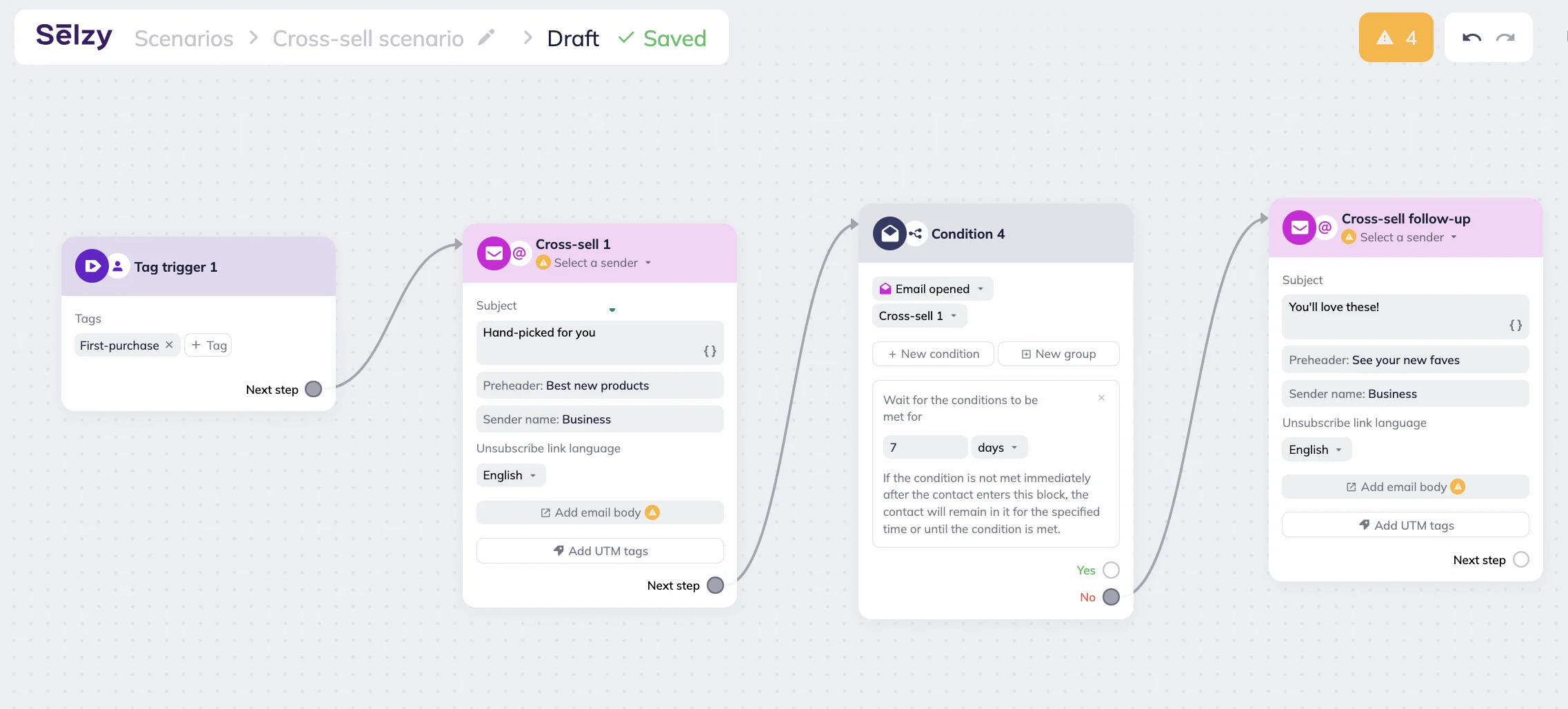
Don’t make your first post-purchase scenario too complicated— simple automation flows often outperform complex ones early on. Perfect the emails and logic of the conversation, analyze the results, optimize, and only then add more elements, if needed.
Step 4. Write compelling copy and subject lines
It’s not a secret that a good subject line is important for your email’s success. Make sure your subject line is concise and fits the limits (aim for 30-70 characters), clearly states the value, and uses personalization. You can reference the customer’s name, recent purchase, or a discount inside to make it more persuasive.
Here are some examples to take inspiration from:
- [Name], reveal your new faves
- Complete your [product type or name] setup
- A few add-ons picked for your order 🌟
- Complete your look 😻
- Recommendations picked for you
- [Name], make the most of your new [product]
- Perfect bundles for [holiday]
- Get a gift for yourself and your bestie 🎁
- Add-ons that pair well with [product]
- Last chance: 15% off on sets
When it comes to body copy, make sure your email content and recommendations are relevant, targeted, and personalized. Use as much customer data as you can to show that you care about them and understand their needs and preferences.
Clearly explain why the subscriber should care about what you’re selling them. Whether it’s the product’s benefits, high rating, or features that add to their previous purchase, state them upfront. Add social proof, like reviews or mentions in media, to make your pitch even more appealing.
Step 5. Add CTAs
Call-to-action links and buttons are the main conversion-driving elements of your marketing emails. Make sure that your customers can easily purchase what you are selling — make the CTAs big and attractive. Add several ones throughout the message to seize every opportunity, but don’t overdo it. Place one button on the first screen and two more further down.
After you are done with your email content, run the cross-sell automation scenario you created and get your first results. After enough time has passed, compare what you achieved to the KPIs and iterate to improve performance.
How to measure cross-sell email performance
A cross-sell email can get clicks and still fail if customers do not buy, adopt, or stay engaged. Track both email engagement and business outcomes.
- Revenue per email: how much sales value each sent email generates.
- Conversion rate: how many recipients buy or activate the recommended add-on.
- Click-through rate: whether the offer and creative are relevant enough to earn interest.
- AOV and repeat purchase rate: whether the campaign increases basket value or brings customers back.
- Unsubscribes and spam complaints: whether recommendations feel helpful or too pushy.
When possible, compare results with a similar segment that did not receive the cross-sell offer. This helps you see whether the campaign created extra revenue or only captured purchases that would have happened anyway.
FAQ about cross-sell emails
What is a cross-sell email?
A cross-sell email is a targeted campaign that recommends complementary products based on a customer’s purchase or browsing behavior. Its goal is to encourage additional purchases by showing relevant items that work well with what the customer already bought or viewed.
How is cross-selling different from upselling?
Cross-selling recommends additional products that complement the original item, while upselling suggests a more expensive or premium version of the product the customer is considering. In short, cross-selling adds to the order, and upselling upgrades the order.
When should you send a cross-sell email?
Cross-sell emails work best when they are triggered by real customer actions rather than sent as generic promotions. The article says sending them within 24–72 hours after purchase is the best way to drive stronger engagement.
What are good examples of cross-sell emails?
A fashion brand recommending a scarf to someone who bought a coat is a classic example. In SaaS, a company might suggest templates, add-on features, onboarding help, extra seats, or an integration after a user subscribes or activates a plan.
How many products should a cross-sell email include?
Keep the number of recommendations limited so the email stays focused and relevant. The best practices call for showing only a few products and making the call to action clear.
Do cross-sell emails work outside e-commerce?
Yes. The strategy can work across industries, including e-commerce, SaaS, and even real estate, as long as the recommendations are relevant to what the customer already purchased or engaged with.
How do you measure cross-sell email performance?
The main goals are to increase average order value (AOV) and customer lifetime value (CLV). Performance should also be judged by engagement and whether the email leads to additional purchases or added items in the order.
 New and noteworthy on our blog