


Key takeaways
- FOMO email marketing is based on stimulating the fear of missing out, which can boost conversions and reduce abandoned carts.
- FOMO involves three psychological effects: Social Proof, Urgency, and Scarcity.
- Choose the right FOMO tactic for your campaign based on the goal, such as driving immediate purchases, moving low-stock products, rewarding loyal subscribers, recovering demand, boosting seasonal revenue, or making incentives stronger.
FOMO email marketing uses genuine urgency, scarcity, exclusivity, or social proof to help subscribers decide whether to act now. When the deadline, quantity, access rule, or demand signal is real and clearly explained, FOMO can make an offer easier to evaluate without misleading the reader. In this guide, you’ll see 13 examples and learn how to adapt each tactic honestly.
What is FOMO email marketing?
FOMO email marketing, like all FOMO marketing, is based on stimulating the feeling known as FOMO, or fear of missing out, which is the anxiety we face when we feel like we’re being left out or missing out on something important or valuable. Email messages that evoke this feeling can help brands boost conversions and reduce abandoned carts. Although this may sound manipulative, it isn’t really that bad because FOMO emails also inspire hesitant and potential customers to get proactive and try something new.
The FOMO effect became obvious with the start of the social media era when people got the unprecedented chance to observe others’ social lives in detail 24/7. Remember the feeling you get when you see all your friends except you enjoying themselves at some party? Or when your colleague boasts a new luxury bag she bought half-price at a sale you knew nothing about? That’s FOMO.
FOMO is so powerful because it involves three psychological effects: Social Proof, Urgency and Scarcity. The Social Proof effect was discovered by behavioral scientists and shows how humans tend to value social norms more than common sense. The Urgency effect shows how we choose to perform urgent tasks with short completion windows. The Scarcity effect shows how we tend to value limited items.
Urgency concerns time, scarcity concerns quantity or availability, exclusivity concerns who can access an offer, and social proof shows visible demand or adoption. A campaign may use one mechanism or combine several. The key is honesty: good FOMO emails rely on real deadlines, real limits, real eligibility, or relevant proof—not fake pressure. Here’s how this works in real-life campaigns.
A credible FOMO email formula: use a real constraint, a clear benefit, the exact deadline or condition, one primary action, and a useful fallback for people who miss the offer.
Choose the right FOMO tactic for your campaign
Not every FOMO email needs the same pressure point. Start with the goal of your campaign, then choose the tactic that matches the customer situation.
| Goal | FOMO tactic | Best fit | Risk to watch |
| Drive immediate purchases | Deadline offer | Short promos, flash sales, launch windows | Using fake urgency or unclear end times |
| Move low-stock products | Scarcity or limited stock notice | Popular items with genuinely limited availability | Overstating scarcity when inventory is not actually limited |
| Reward loyal subscribers | Exclusive or single-use offer | VIP segments, early access, private deals, unique codes | Using the same “exclusive” offer for everyone |
| Recover demand | Back-in-stock notice | Products people waited for or previously viewed | Sending too late, after intent has cooled down |
| Boost seasonal revenue | Seasonal or holiday sale | Black Friday, Christmas, end-of-season campaigns | Blending in with every other seasonal promo |
| Strengthen a simple incentive | Free shipping with a genuine threshold or deadline | Cart recovery and short promotional windows | Training customers to wait for discounts |
13 effective FOMO email marketing examples and tips
Most of us have experienced FOMO email marketing and even got used to some common FOMO-based marketing methods. Now, let’s explore some of the best FOMO email marketing examples that illustrate how you can use these techniques in your own marketing strategy.
Limited stock or availability
There was a famous experiment conducted in 1975 by Adewole, Lee and Worschel. Psychologists asked participants to rate the desirability of cookies in two jars: a full one and a nearly empty one. The nearly empty jar was more desirable. No need to say that the cookies were identical.
Marketers often use this effect to stimulate FOMO. When a banner says “2 items left in stock” in an online shop, a customer is much more likely to purchase the product immediately. That’s because the banner makes them feel the product is popular, plus the scarcity makes the item more desirable.
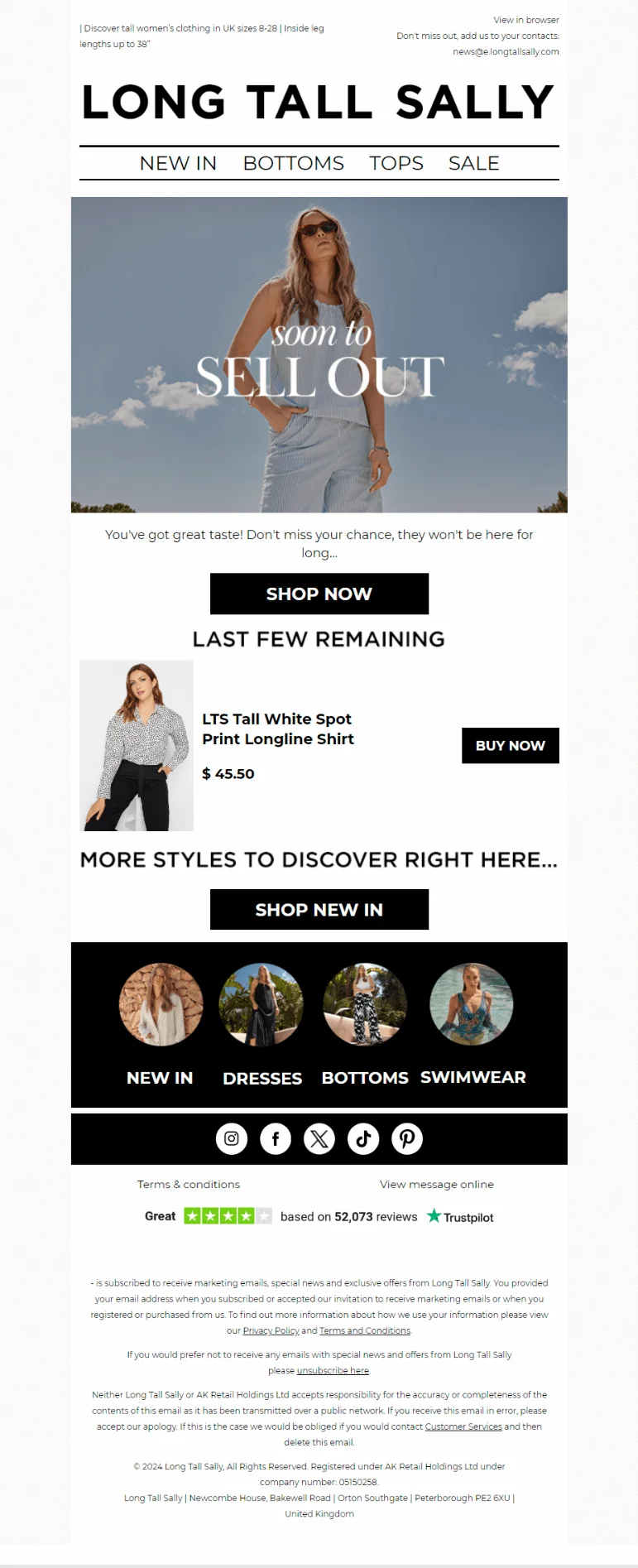
This approach works great in online stores too, when a seller lets customers know that stock levels are low. In the email below, the item’s limited availability is highlighted by the “Soon to sell out” line in the hero image. This is reinforced by the “Last few remaining” line right under the CTA, which ensures the FOMO effect will be as strong as it gets. Use this tactic only when availability is genuinely limited: false scarcity can quickly hurt trust.
Exclusive offer
Another great FOMO technique is presenting your best offers to the customer as exclusive deals with limited access.
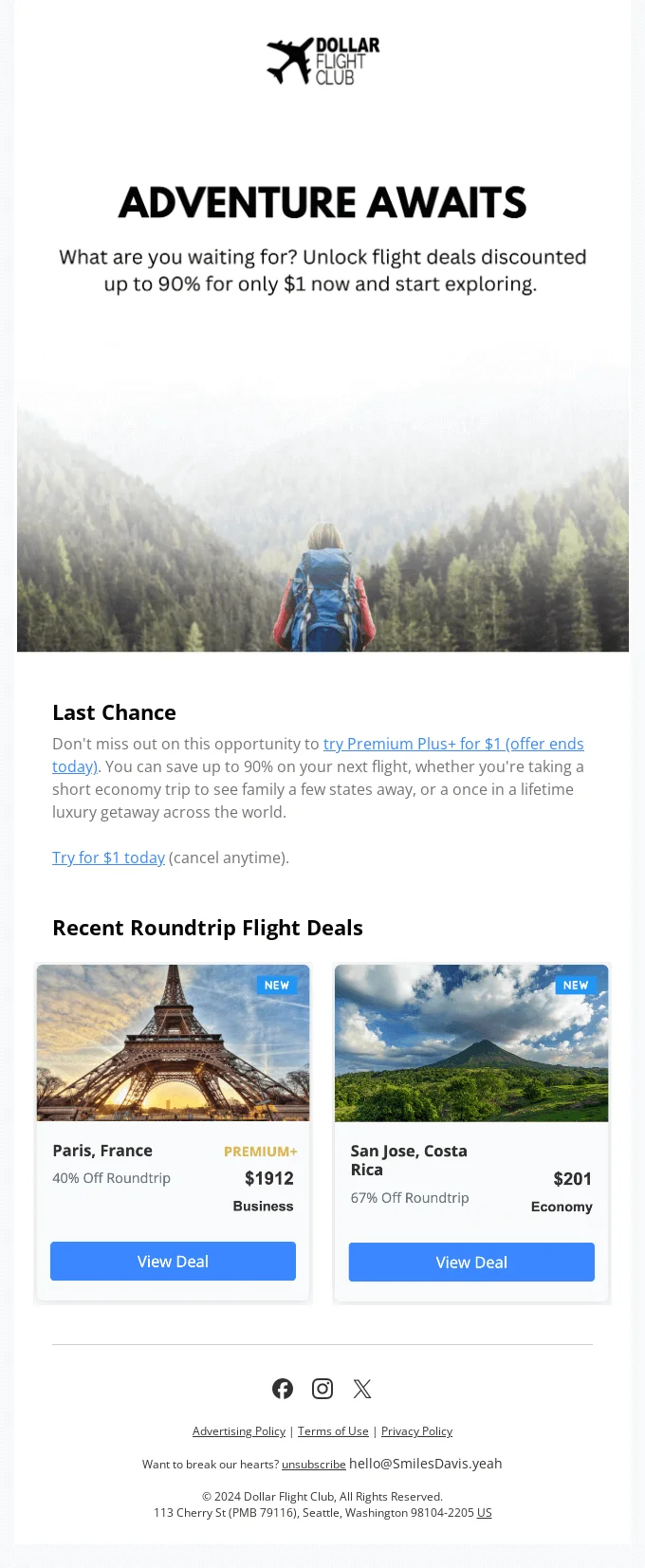
Check this email from Dollar Flight Club which encourages subscribers to try Premium Plus+ only for $1. The deal is available for the next 6 hours and unlocks flight deals discounted up to 90%. The newsletter contains some delicious deals for flights available on the Premium Plus+ Plan. Wouldn’t you seize the opportunity?
Special offer with a deadline
Time-limited sales are super typical. They help brands and stores to get rid of the products reaching their expiration date, cut down storage costs, and simply sell more.
The opportunity to purchase a valuable product at the best price if you catch the time window with other first buyers really boosts the FOMO effect. In the example below, Brooklinen goes even further and promises that the prices offered are the best for the decade to come. Plus there also are some limited edition products to check out in the email, along with the links to the respective website pages. The useful lesson here is clarity: the stronger the deadline claim, the clearer the offer and conditions should be.

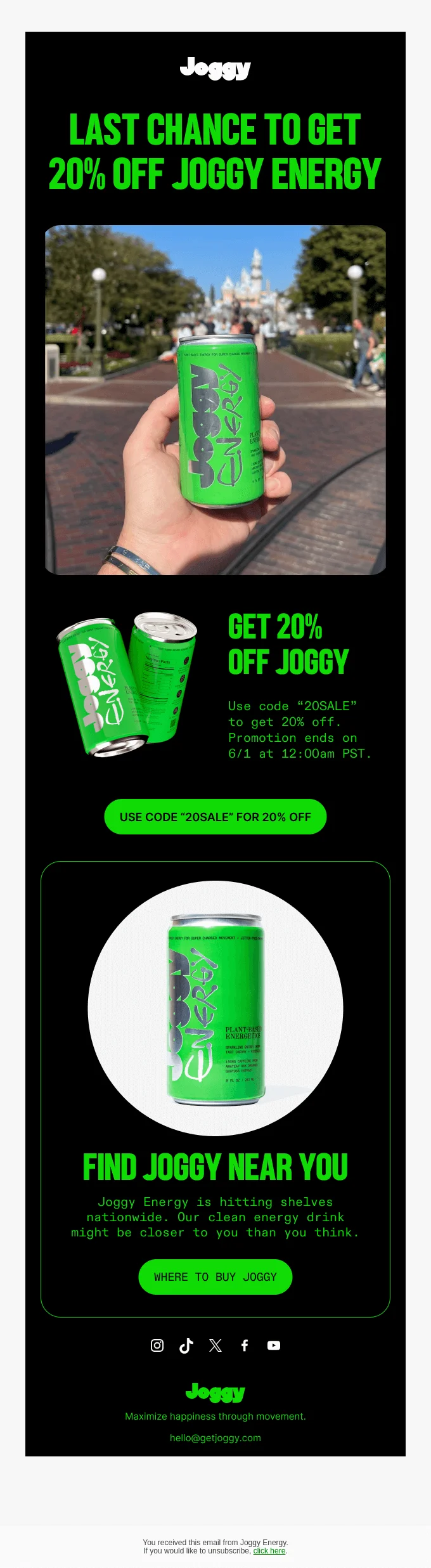
Here’s another nice example of a limited-time offer email. Here, the offer is very simple: use the promo code on time and get 20% off your energy drink.
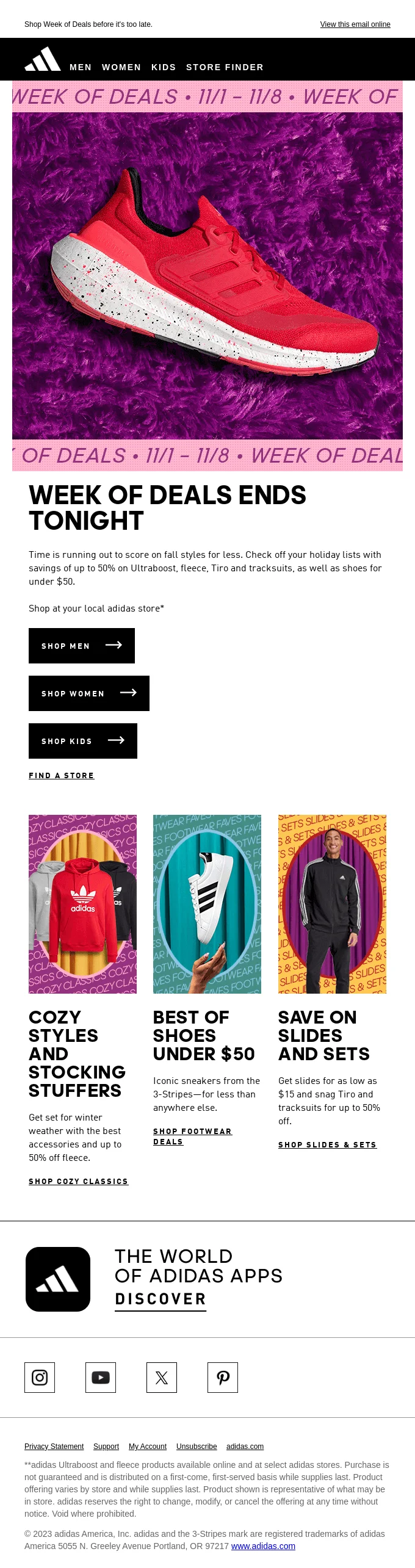
Compelling visual design
More trendy pictures, less text. Use visual design to make your offer simple and bright. Large high-quality pictures, big font sizes for your brief offer, and a prominent call-to-action are welcome if you want to make the most of your email design.
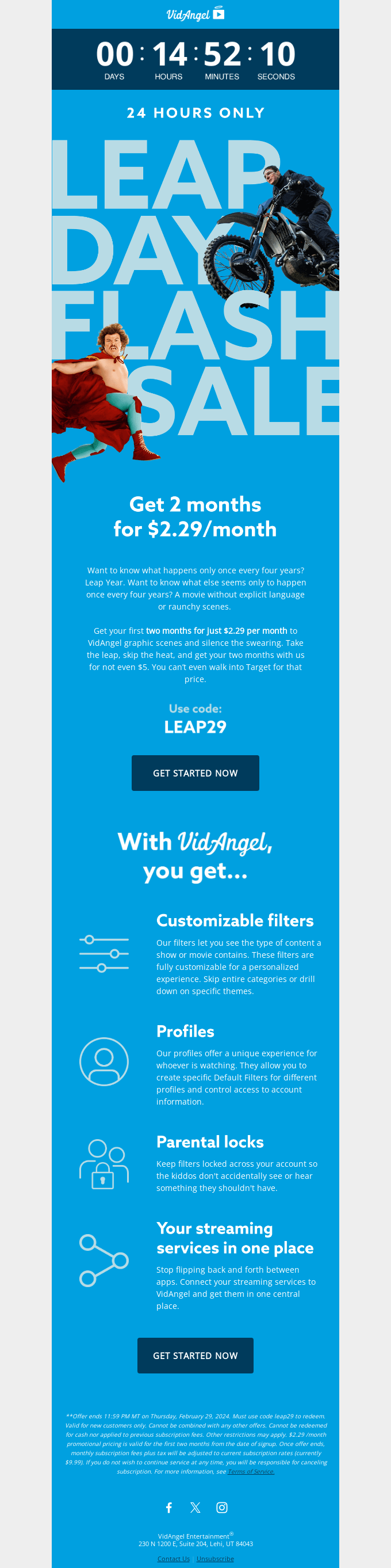
Countdown timer
The FOMO effect works great when you offer a good discount for a limited time, and emails can deliver this offer to your customers when it is most relevant. Adding a countdown timer to your promotional email can boost the sense of urgency, make the deadline as obvious as possible, and encourage impulse purchases. Countdown timers work best when the deadline is simple, visible, and repeated near the CTA.
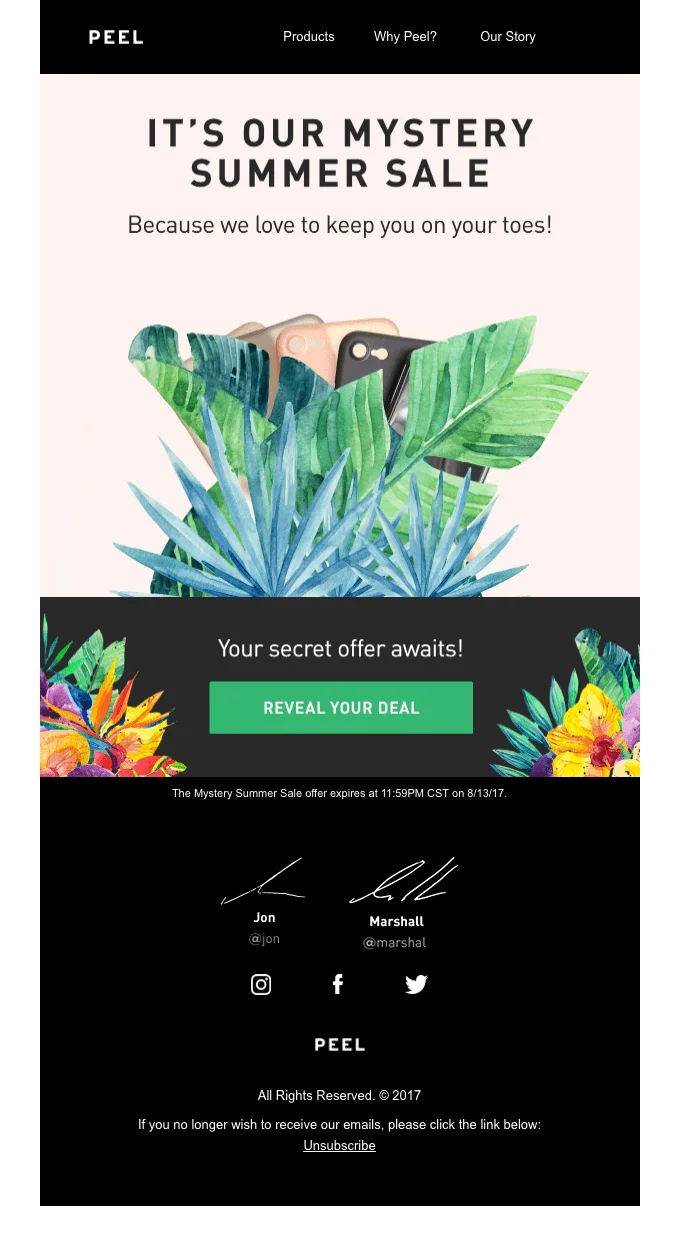
Seasonal sale
Seasonal sales let businesses make certain products appear more special. For example, pumpkin latte in the fall or mulled wine in the winter are something hard to find during other seasons, which makes them more desirable.
From the businesses’ perspective, end-of-the-season sales give a great opportunity to get rid of the products not relevant for the upcoming season. The email below promoting the end-of-summer sale with a delicious visual is a good example of using this strategy. Because the email itself is so focused on the image, the FOMO effect is implemented in the subject line that says “Inside: a big end-of-summer treat (for two days only)”.

Adding FOMO in subject lines as well as in the emails themselves is an effective approach that marketers often use to reinforce their FOMO-based email campaigns. Here’s more on catchy subject lines to help you increase open rates.
A marketer can also add some extra FOMO effect to the summer sale by providing secret offers and creating intrigue. The mystery summer sale promoted in the email below is also limited in time which makes it FOMO as hell.
Free shipping
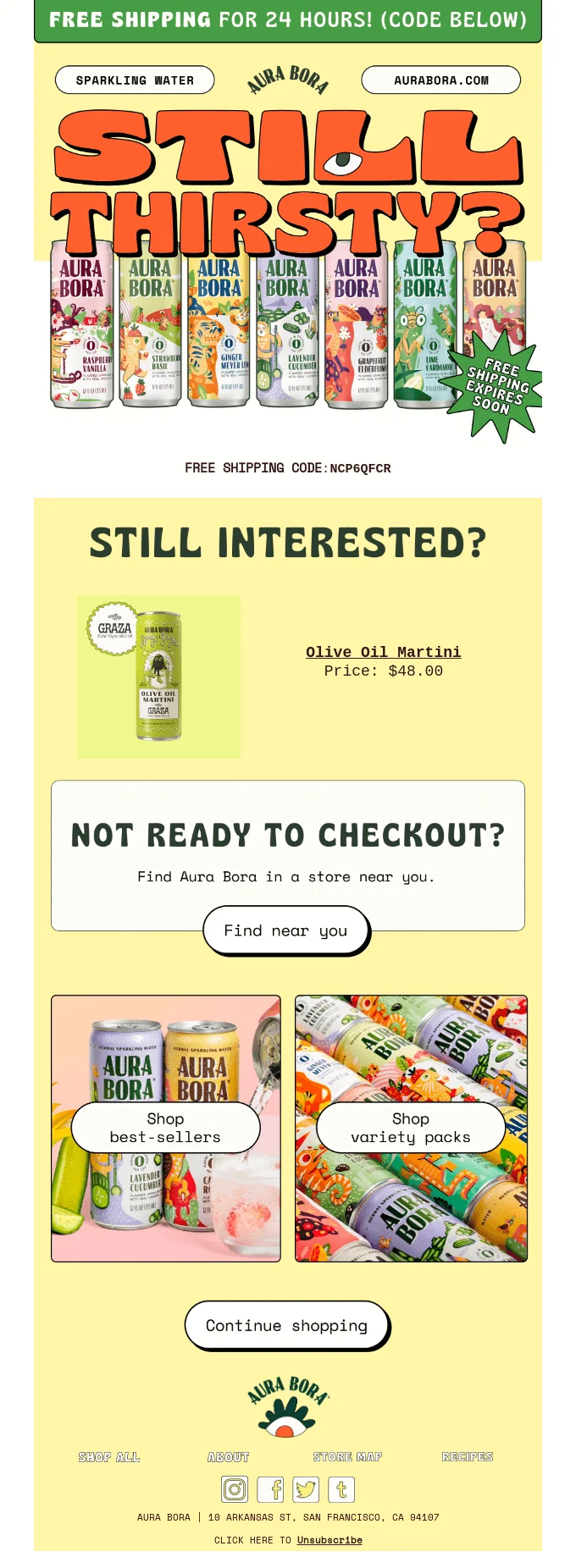
Free shipping can also increase conversion in online shopping. And free delivery that is limited in time motivates customers to purchase immediately. Check out this bright and super trendy example of an email that offers a free shipping code that is only available for the next 24 hours.
Offer that is valid one time only
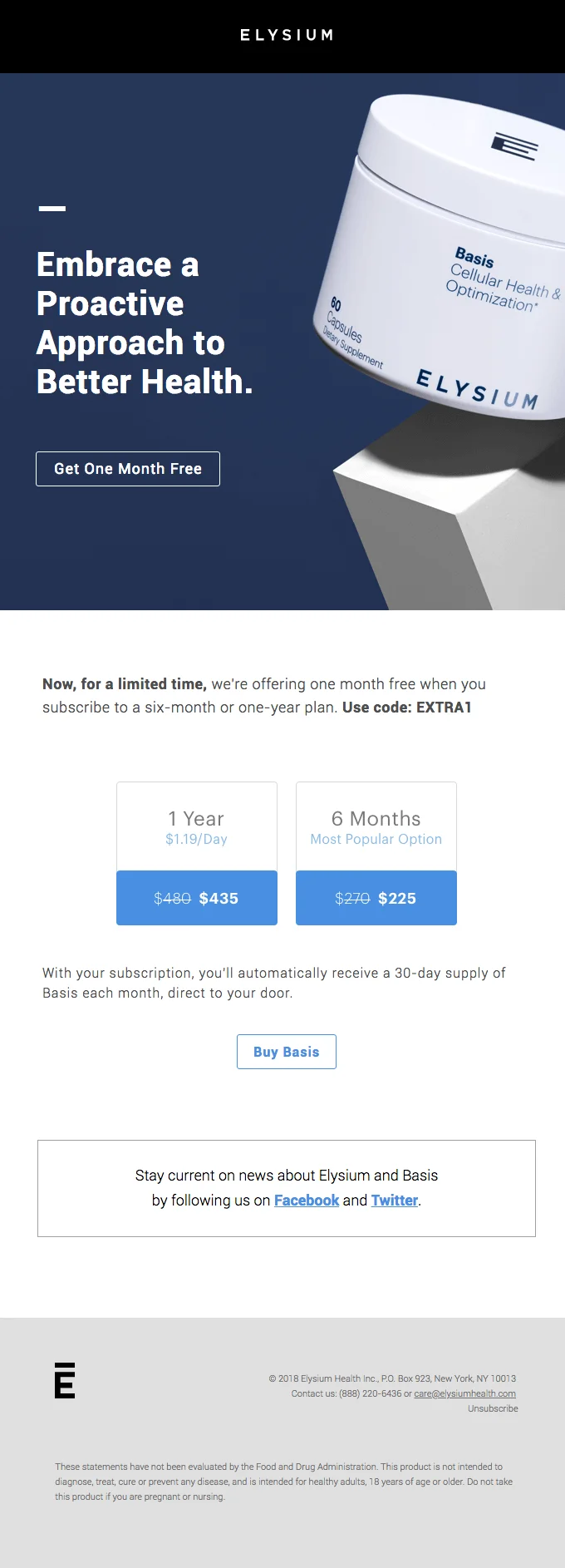
Another great FOMO method is providing a single-use offer — i.e., a compelling offer that can only be used once. In the example below, Elysium and Basis promise a whole free month of subscription to those who opt for a 6-month or a 1-year plan within a limited time period using a promo code provided in the email. To make sure subscribers see the offer, they also emphasize it in the subject line that reads “A One-Time Offer. Reorder Basis Now”.
Back-in-stock notice
Back-in-stock notifications can persuade customers that the product is very popular and people have been waiting for it to be back. It also stimulates the sense of scarcity and can make customers think the brand is offering unique items that might be out of stock again soon. This works especially well when the email is triggered quickly after restock and points to the exact product the subscriber wanted.
The email below has a great trendy design, contains huge high-quality product photos, demonstrates the product in natural situations, tells the product legend, and provides customer reviews all at once.

Customer reviews or testimonials are also a part of effective FOMO marketing, as FOMO actually means fear of missing out on something that others have. Including customer reviews in your email also helps add a personal touch and provides social proof to highlight your product’s value.
Holiday sale
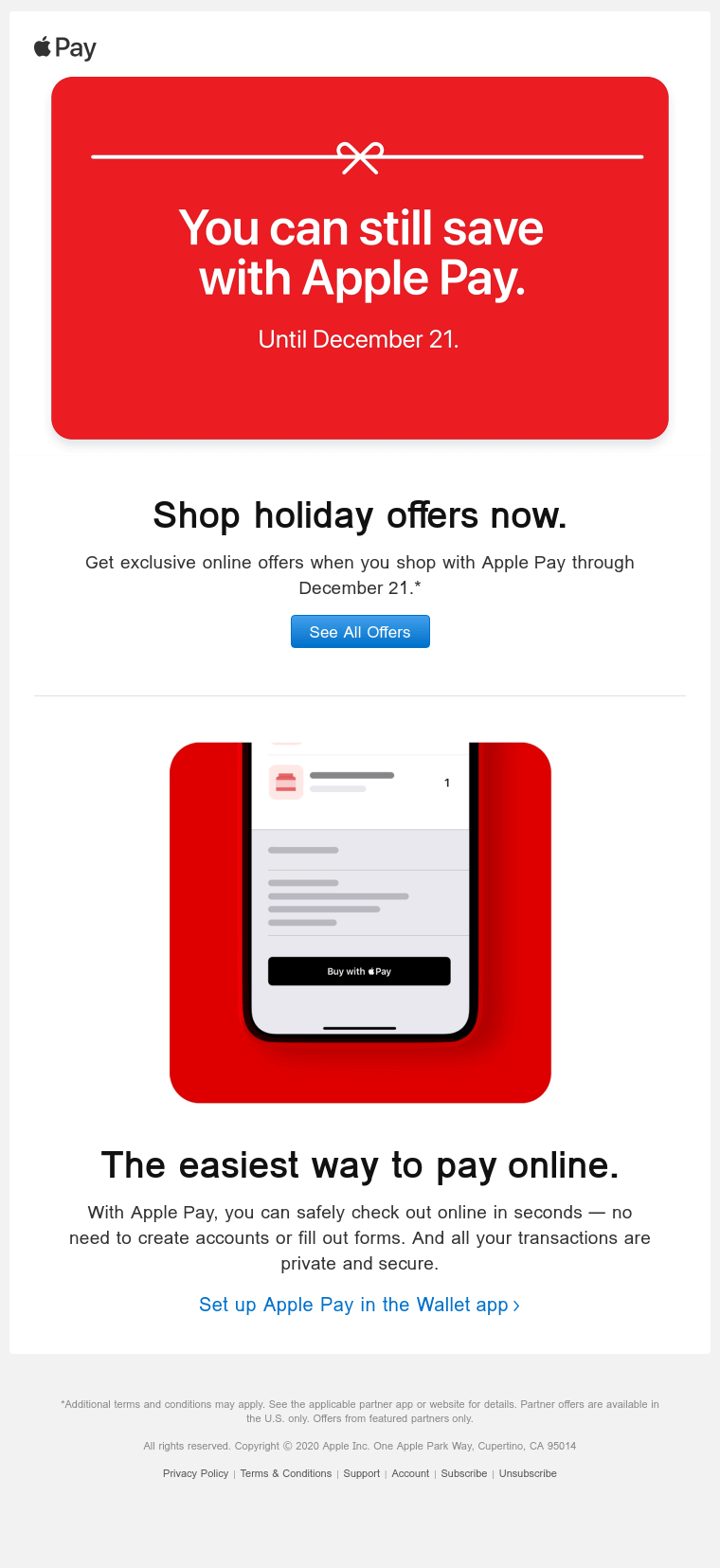
Holiday sales are similar to seasonal sales but might be even more effective since people are looking for presents around the holidays. The Christmas sale promo email from Apple shown below promotes a time-limited sale that ends soon and promises some exclusive online shop offers. There is a note about an option to use Apple Pay without registrations or filling out any forms, which makes the idea of clicking on the CTA button that reads “See All Offers” even more compelling.
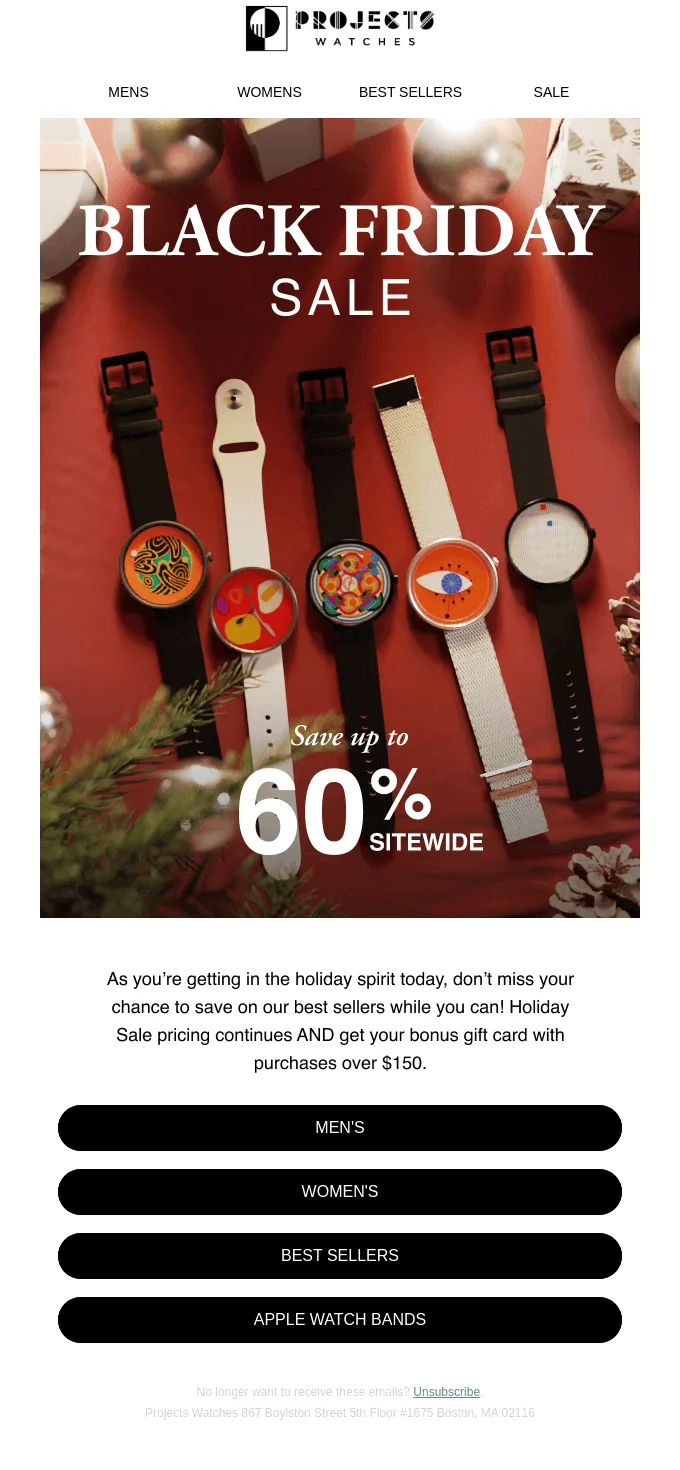
Black Friday is not exactly a holiday, but it marks the beginning of holiday sales in many countries — and it is also the real FOMO celebration for marketers. You get numerous great deals and they all are available for just one weekend. It stimulates spontaneous purchases dramatically and gives businesses a great opportunity to increase sales.
The email below contains a high-quality detailed picture of the watches the business offers. The entourage shows that it’s Christmas, and the delicious 60% discount is in focus. There are also buttons for several product categories at the top and at the bottom of the email, which is another good way to potentially increase conversion and sales.
Need more inspiration? Check out other outstanding examples of Black Friday campaigns — email and beyond.

How to use FOMO in emails without overdoing it
Before sending a FOMO-based campaign, check whether the pressure you create is useful for the subscriber, not just convenient for the brand.
- The offer is genuinely limited by time, stock, access, or audience segment.
- Countdowns do not reset, low-stock notices reflect inventory, “last chance” offers actually end, and popularity claims can be supported.
- The subscriber segment is relevant to the product or promotion.
- The deadline, quantity, or condition is easy to understand.
- The CTA tells readers exactly what to do next.
- The email does not hide key conditions, exclusions, or renewal terms.
- After the campaign, you check clicks, conversions, revenue per recipient, unsubscribes, and complaints.
- Purchasers are suppressed from reminders, overlapping countdowns are avoided, and last-chance follow-ups are limited.
FAQ
What is FOMO in email marketing?
FOMO email marketing uses the fear of missing out to encourage action, such as buying now or completing a cart. It works by creating a sense of social proof, urgency, or scarcity so subscribers feel they may miss a valuable opportunity. When used honestly, it can boost conversions and reduce abandoned carts.
Is FOMO email marketing manipulative?
It can feel that way, but the article says it is not necessarily bad if it is used honestly. Good FOMO emails rely on real deadlines, real scarcity, or a genuinely relevant offer rather than fake pressure. The goal is to help hesitant customers act on something useful, not to mislead them.
Which FOMO tactics work best for ecommerce emails?
The best tactic depends on the campaign goal. Deadline offers work well for immediate purchases, scarcity or limited-stock notices fit genuinely limited products, and back-in-stock messages help recover demand. Exclusive offers can reward loyal subscribers, while seasonal sales and free shipping or single-use offers can strengthen promotion and cart recovery.
How do you create urgency in an email without sounding pushy?
Use urgency based on real conditions, such as clear end dates, limited availability, or a legitimate promo window. Match the message to the customer situation and avoid fake deadlines or unclear time limits. The article also suggests keeping the offer relevant and choosing the right tactic for the campaign goal.
What are the best FOMO email examples to use in campaigns?
Effective examples include limited-stock or availability emails, deadline offers, exclusive offers for VIP subscribers, back-in-stock notices, seasonal or holiday sales, and free shipping or limited promo codes. These work because they combine urgency, scarcity, or social proof with a clear reason to act now. The strongest examples are tied to real demand and genuine constraints.
Measure the tactic, not just the send. Compare clicks, conversion rate, revenue per recipient, unsubscribes, complaints, and incremental lift with a similar non-FOMO campaign. Treat opens as directional, and test one major variable at a time—such as deadline framing, proof placement, CTA, or reminder timing.
Final thoughts
Choose the FOMO mechanism that matches a real condition, then make the benefit, constraint, and next step easy to understand. Keep one primary CTA, suppress people who already acted, and do not turn every campaign into a last chance.
The best FOMO email helps a relevant subscriber make a timely decision while protecting trust. Measure conversions and revenue alongside unsubscribes and complaints, then use what you learn to improve the next campaign.
 New and noteworthy on our blog
