


Key takeaways
- Email sequences are automated messages sent to contacts based on triggers or time, allowing for targeted communication.
- They can be based on triggers like browsing habits, product purchase, or time-based events like anniversaries.
- Email sequences are more dynamic than drip campaigns, responding to customer behavior and requiring segmentation.
- They are essential for nurturing leads, increasing conversion rates, and turning prospects into loyal customers.
When every customer counts and everyone is striving to draw their attention, marketers look for an edge and a way to compete while not straining the budget. How not to be forgotten amidst this sea of content, and moreover, how to stand out? Although using an autoresponder is a good strategy, sometimes you just need more than one automated reply to convert those leads. Enter the email sequence, a cost-effective way of nurturing your contacts, generating website traffic, increasing conversion rates, and providing your customer base with personalized content at great ROI rates.
In this blog post, we will answer the question: What is an email sequence? We’ll also explain how to write an effective one and share the most important email marketing sequences to improve your results.
What is an email sequence?
Email sequences are a series of automated messages sent to your contacts, normally triggered by behavior or time. They rely on email marketing automation and allow you to target several audiences on a set schedule. Let’s get into these factors a bit more.
First of all, email sequences can be based on triggers and behavior, such as:
- Browsing habits
- Downloaded content
- Product purchase
- Abandoned carts
- Subscriptions
Abandoned carts are one of the most common email sequence examples. Customers sometimes simply forget to finish a purchase, be it because of an interruption or anything else. An abandoned cart email sequence might start with a reminder email, and after some time, a discount offer for the customer.
Email sequences can also be based on time, including:
- A certain amount of time after purchase or after cart abandonment
- The anniversary of subscribing
- Special dates, such as commercial holidays
An effective email sequence requires planning, a good understanding of customer behavior, relevant content for each segment, and last but not least, good timing.
Why are email sequences so important? Let’s leave the email universe for a bit and imagine that your company offers a service, and a customer asks you for a price quote. If you take too long to reply, they will drop you for a competitor. While certain requests need to be answered by a human, many customer actions can be addressed with automation and a well-made email sequence. That’s what makes them so useful and important for anyone who is looking to nurture leads, increase conversion rates, and then turn prospects into loyal customers.
Email sequencing vs drip campaigns: What’s the difference?
Email sequencing and drip campaigns are often mixed up, and the terms might be used interchangeably. The main difference between email sequencing and drip campaigns is that the latter are static instead of dynamic.
Let’s take an onboarding email, for example. In a drip campaign, all new subscribers are going to receive the same automated response welcoming them to the email list. The content of these responses does not change according to customer behavior, and you schedule them once.
Email sequencing, on the other hand, is dynamic — it responds to customer behavior, and each client segment is going to receive a sequence of messages based on the actions they have taken. That’s why it is more complex to set up and benefits more from segmentation.
Both email sequence and drip campaign work as reactions to something the customer did, but remember: email sequencing is dynamic, requires segmentation to shine, and is done through a series of messages; drip campaigns may involve a single automated response based on a trigger, and that response is the same for everyone.
Why use email sequences in your email marketing strategy
Email sequences are great when you have a large customer base. By setting them up properly, you can increase customer retention, engage with new customers, improve sales and marketing of your products, re-engage old customers, and stay on top of strategy.
Imagine having to do all that individually. Well, you don’t have to, and you shouldn’t. Your email sequences can do the job while you sleep, eat, and drink. In addition to that, you’ll be able to send out relevant content for each of your segments, scale your messages, and guide your contacts through their customer journey. Doing all that correctly requires hard work, and it may take some trial and error, but it will pay off, and even better than that, we are here to help you.
7 most important email marketing sequences (+ examples)
Let’s explore some of the essential email sequences you can start with.
Customer onboarding
When a customer decides to try a new product, it is important to welcome them, make them feel at home, and help them learn the ropes. To put it simply, if you receive a guest at your house, you will probably offer them something to drink or eat and engage in conversation, right? You are not going to let them wander around without a word (if you do, they will probably not come back), and the same situation applies to customers who are having their first experience with your company.
An onboarding sequence is great to educate them about your company and product, hold their hand, and essentially, take care of them. You can find a good example below:
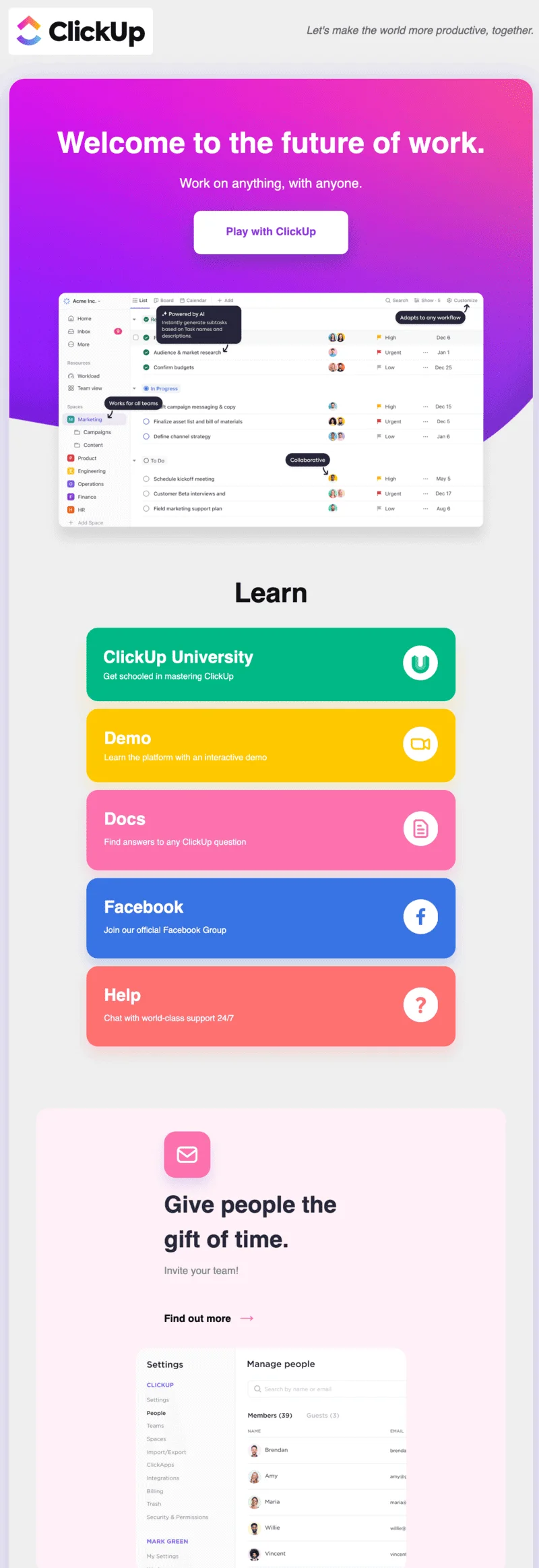
The first email already shows the interface, points out some important features, and has a bold slogan, “Welcome to the future of work.” Further down, it provides access to learning courses.
The follow-up emails in the sequence bring other important product functionalities, with more information about each one of them, as seen below:
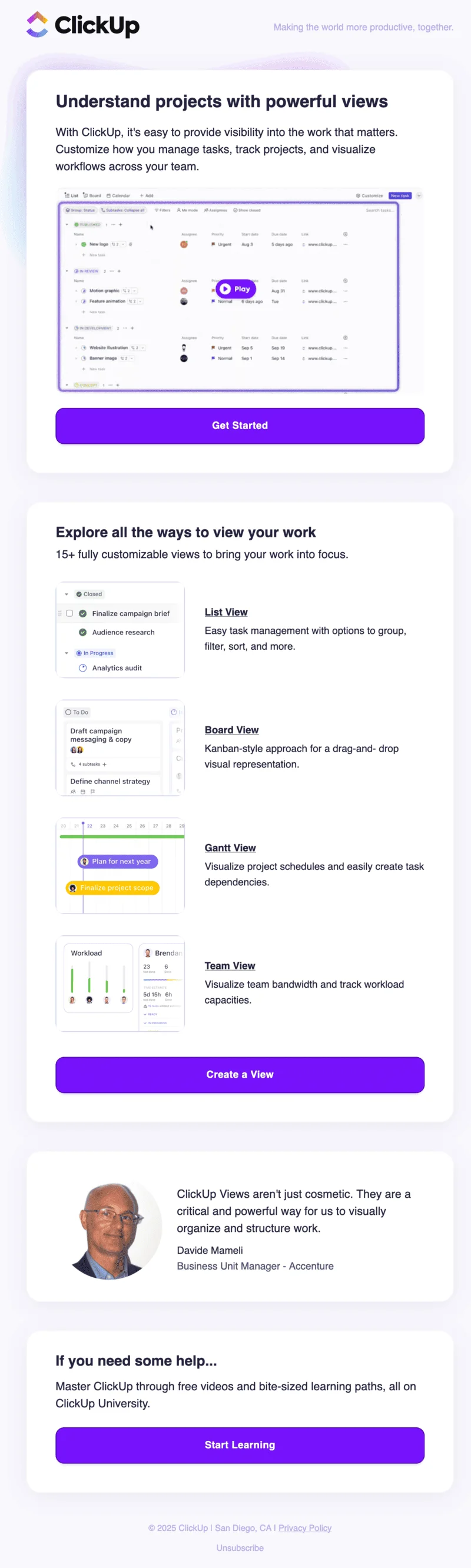
It is important to help customers feel at home when they take the first step. If you need more ideas, you can check our blog for comprehensive guides on how to write good welcome emails and onboarding emails.
Lead nurturing
Let’s imagine that someone consumed your content. Now, it is up to you to keep in touch with that person, drawing more of their attention and pushing them towards a purchase.
There are many ways to go about it — a welcome email followed by personalized content guiding them to explore your product, making sales offers, providing more information over frequently asked questions, and so on.
Nurturing sequences are important because they show the customer that you are interested in them, and even more so, that you know them (if you do personalization the right way).
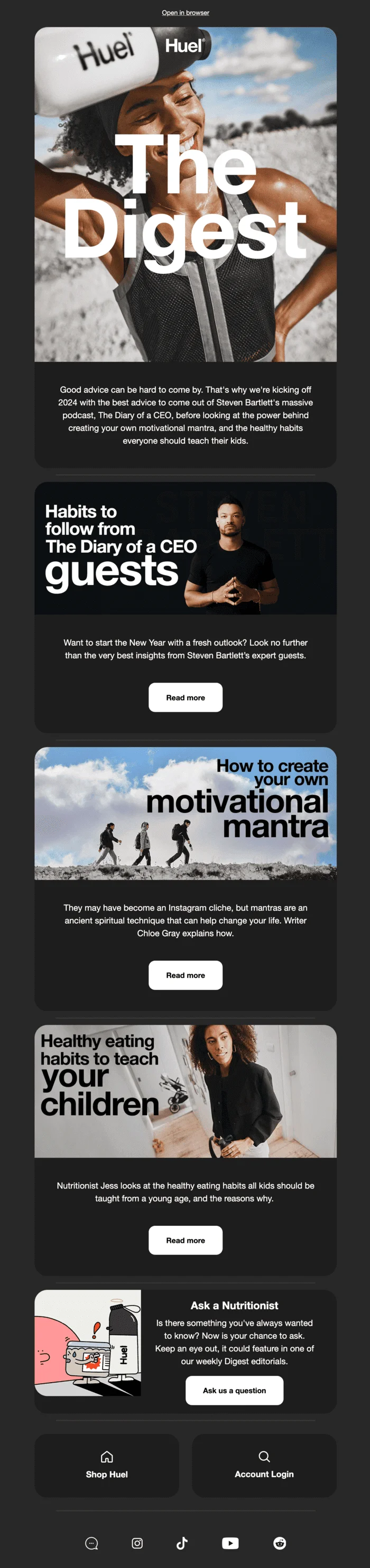
Take a look at how Huel did it, combining segmented content with a button for the user to contact the company:
Product launch
When launching a new product, you want to generate buzz and anticipation. While some companies have benefited from the so-called “shadow drop” (when you don’t announce a product and just release it as a surprise), this is better for the gaming and music industry. If you have something new coming up, let people know and make them excited. You don’t really want to go through all the marketing work after the product has already been released, as it might be a little too late.
In the same way movie studios release trailers and teasers for their upcoming films, you can do the same for your product through email sequences that show features and benefits and talk about the release date. Another idea is to offer discounts or other perks for customers who pre-order. Tailor your sequence to your customer’s needs and to each segment. Ideally, your sequence should have three stages: pre-launch, day of launch, and launch follow-up.
Take a look at the example below:
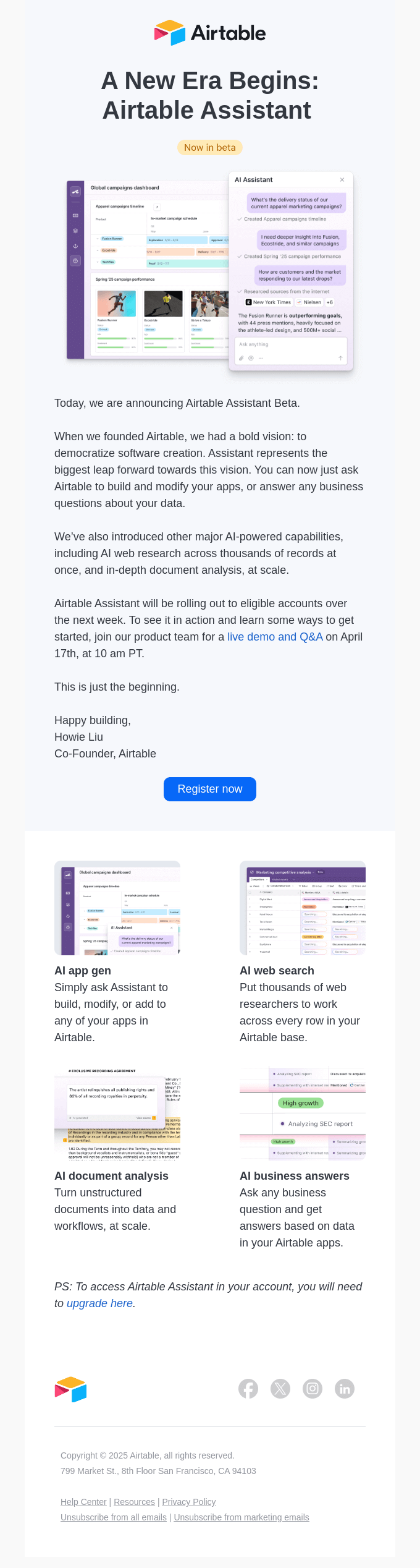
Airtable is even offering customers to participate in the development of the product through beta-testing, which also helps keep engagement high.
Checking an example of another company, this is how Figma tackled launch day:
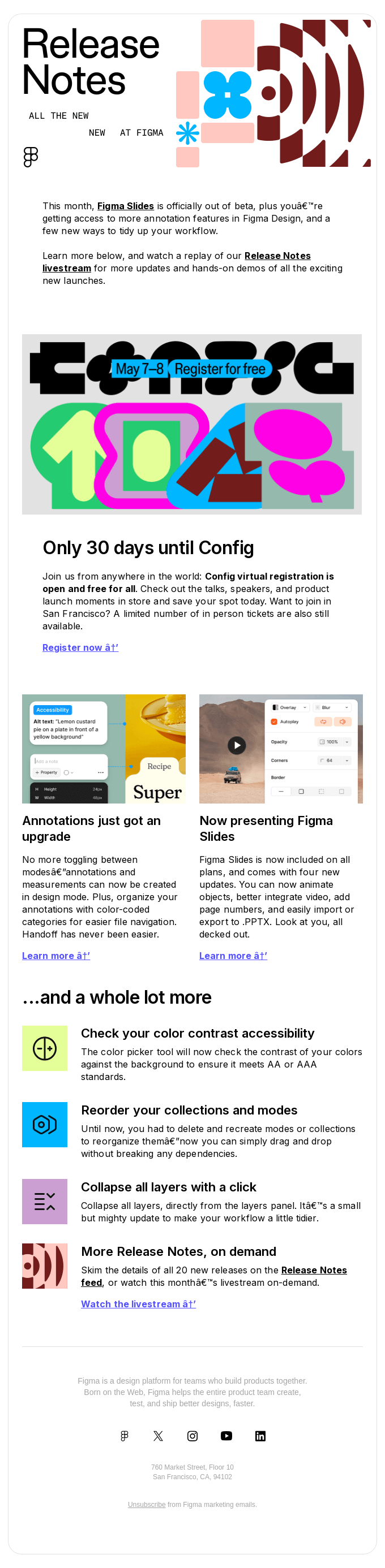
Once the product is launched, you can work on ways to generate more interest with email sequences that feature the functionalities of the product, special offers, and more.
Abandoned cart recovery
Abandoned carts are one of the most common problems for e-commerce businesses, and they can often lead to a lot of frustration. The average cart abandonment rate worldwide sits at 70.19%. There are many reasons for that, including extra costs (for example, shipping fees), slow delivery time, lack of trust in the website, complicated checkout process, etc. We advise you to address these issues and, of course, work on ways of closing the deals.
An effective email sequence for abandoned carts involves timed messages, usually at intervals of 24 hours for the first reminder, another one after 48 hours, and the next one after 72 hours. Note that you should not send the same message for the second and third reminders. You can offer the customer a possibility for feedback in the second one, and then a special discount for the third one.
Take a look at a good example from Athletic Brewing, where the company provides user reviews in order to encourage the customer to go through with the purchase:
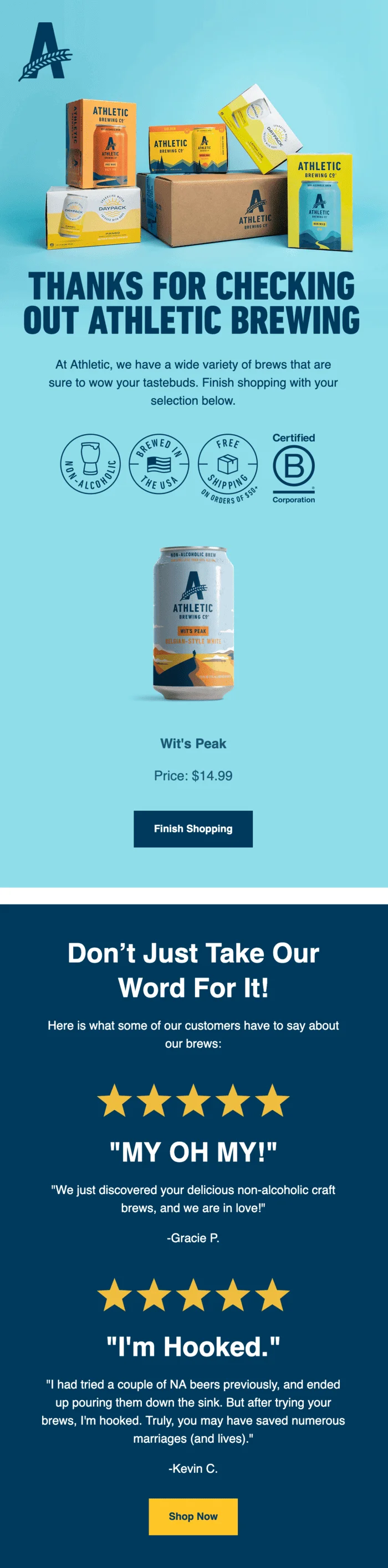
Quick tip: don’t overdo it. Some customers might feel pressured or think your tactics are too aggressive, which might prevent them from doing business with you in the future. If the last reminder with a special offer doesn’t work in your favor, it might be time to reassess and try to re-engage that customer at a later time.
Re-engagement campaign
Sometimes, customers engage with your content and show interest, only to vanish after a certain amount of time. The purpose of a re-engagement campaign is to bring those customers back. Even though the end game is to improve sales, the main target here is to get their attention again to move towards more concrete goals later.
Re-engagement campaigns can target customers who haven’t interacted with your content in a set amount of time (decided by you!). Send them a gentle reminder of what you have to offer or what’s new since they last interacted with your company.
It’s possible to start with informative emails and ramp up the sequence from there, finally making one-time offers such as redeemable coupons, for example. Notice how you can inform the customers about what’s new, market your new products, and even lead them to purchase something new.
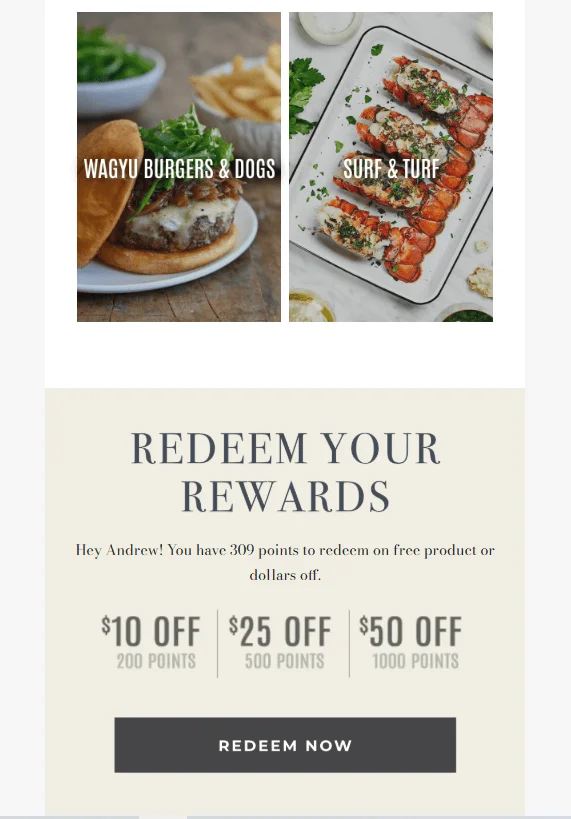
Here’s a good example from Snake River Farms, split into two pictures for better viewing:
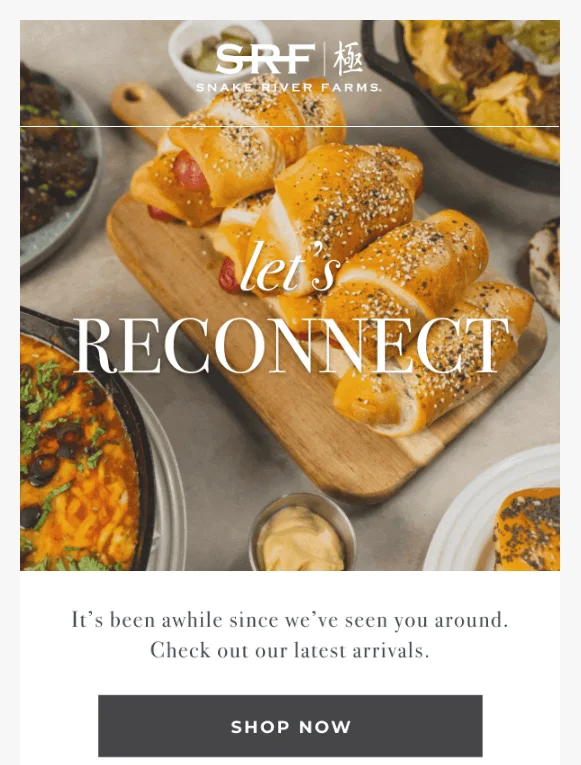
In this email, the company lets the customer know about new products and offers a CTA button inviting them to visit the online store. Further down below, Snake River Farms also provides a redeemable discount, based on a points system:
Event promotion
Email sequences are a great marketing tool to promote events as well. There are two important phases for event promotion: the pre-event and post-event sequences. Pre-event emails build anticipation, help your target audience save the date, and provide information about what is going to happen. Take a look at the image below:
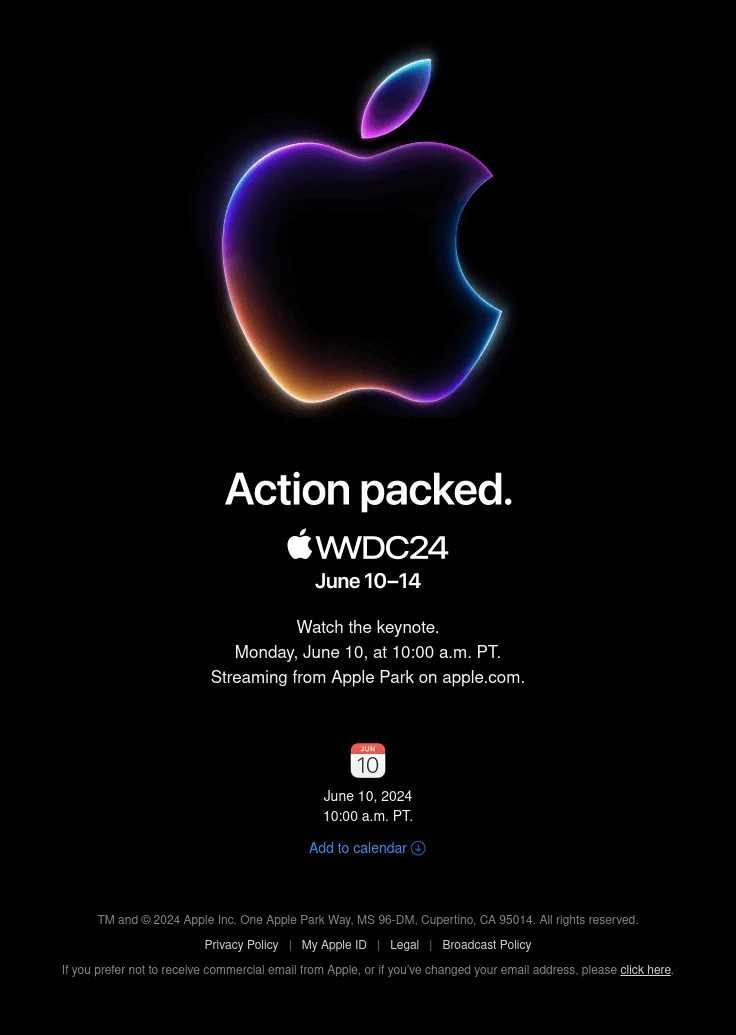
At first glance, the email only communicates the date and the name, but it also offers an “add to calendar” link, so that the user can integrate it into a scheduling app, and a catchy slogan. The strategy here is minimalistic, but warranted — this is an annual event held by Apple for software developers, and it generates a lot of buzz in the tech world. Add to that the fact that the company usually announces its own new products during the event, and voilá: the conference gets a lot of press, whether it is before or after the event.
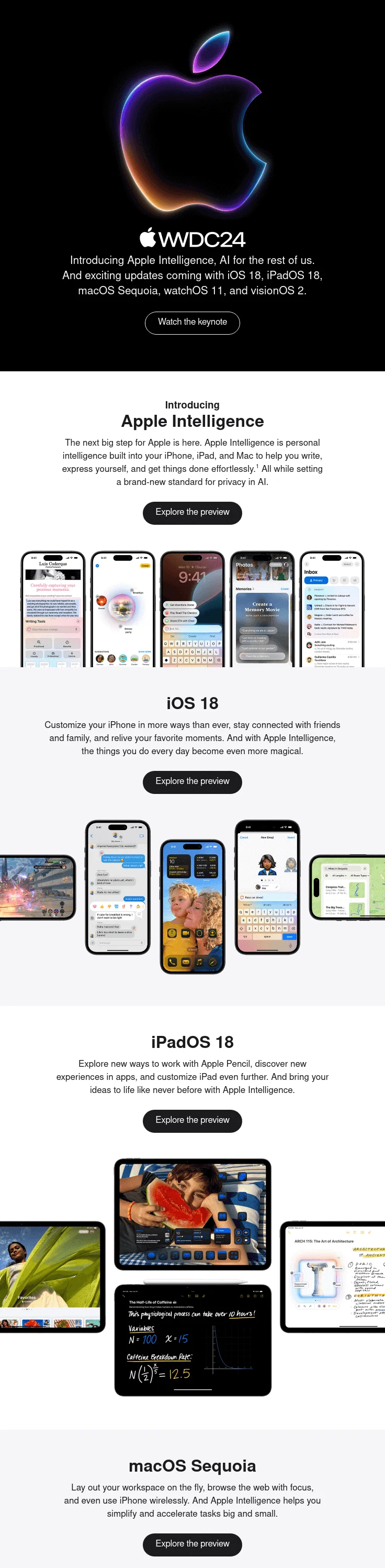
When all is said and done, you can use post-event sequences to wrap it up, let people know what happened, and even generate future sales. Apple offers a summary of what happened to its contact base and provides additional information, and delves into each one of the announced features:
Post-purchase follow-up
Getting back to the analogy of a guest entering our house, it is polite, kind, and caring to thank them for their visit and check if everything was ok. In the marketing realm, after-sales service is vital for customer retention. Essentially, you are doing the same: thanking customers for their purchase, providing extra help to clients who contracted your service, gathering feedback, and making sure they are satisfied and inclined to do business with your company again.
Athletic Brewing’s following email sequence is a good example of how this can be done in several steps:
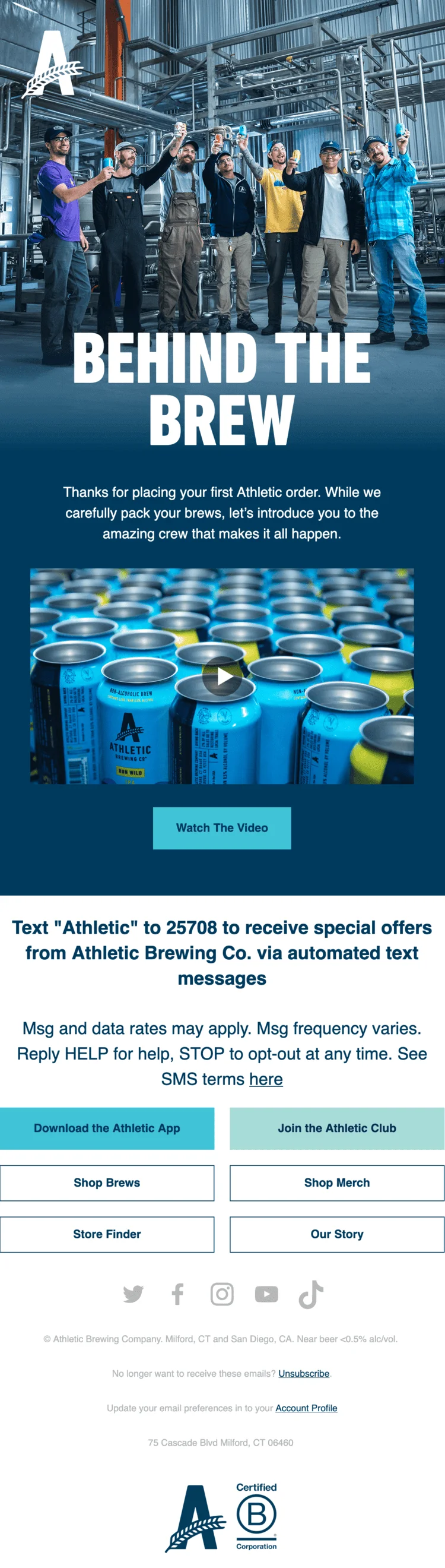
The email acknowledges the purchase while offering the customer an opportunity to feel closer to the company by watching a video that shows how the product is made. It also offers subscription opportunities, working on customer loyalty from the get-go.
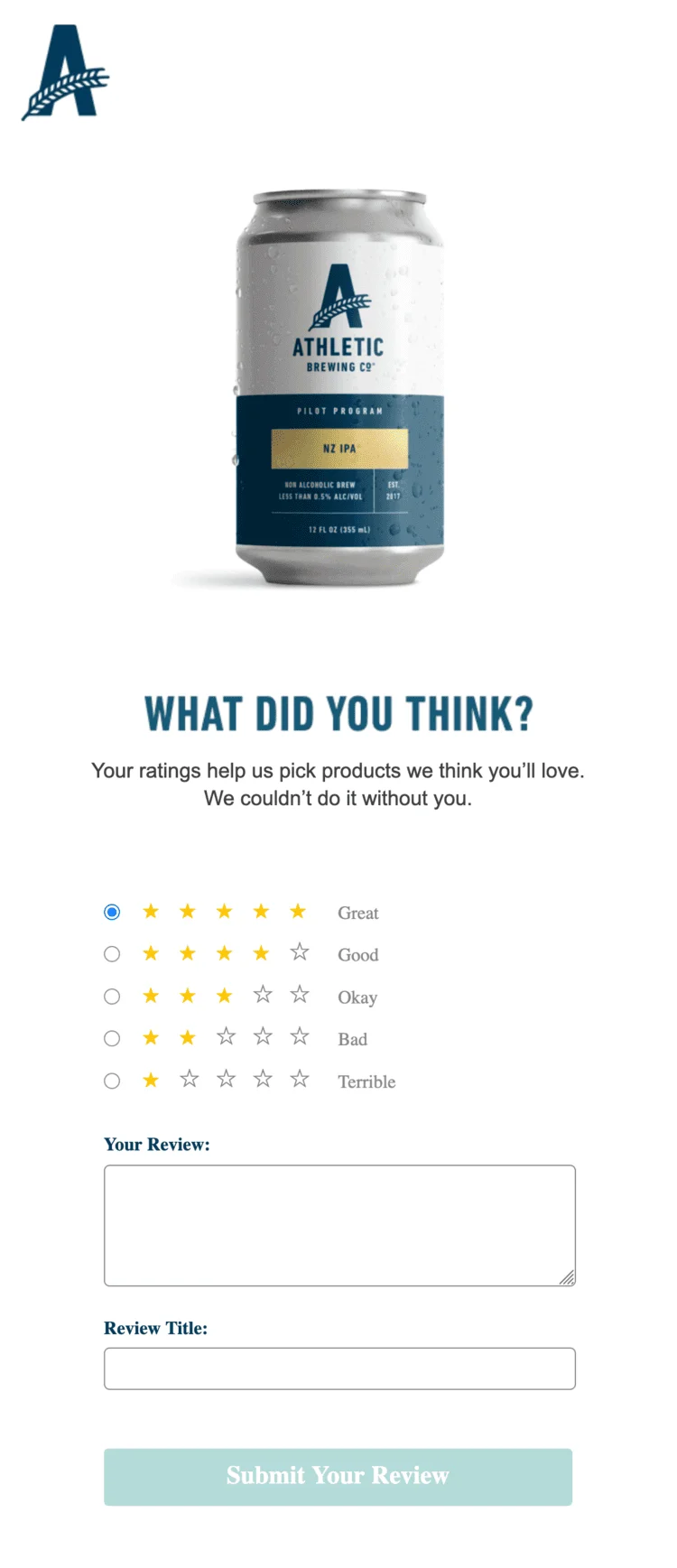
Using a five-star rating system, the company asks for feedback regarding a previously purchased product, trying to garner relevant information and showing they care about their clients’ opinions.
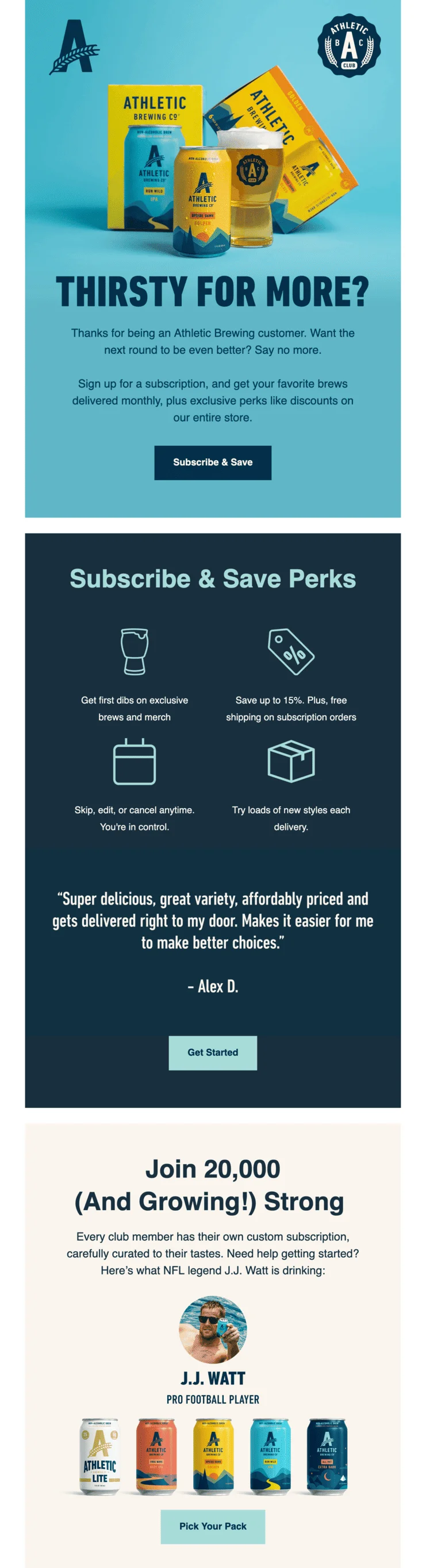
Last but not least, the next email in the sequence offers more subscription opportunities, explains the perks of subscribing, and brings positive reviews to the table. It aims to retain new customers and motivate those who are not subscribed:
How to write an effective email sequence
Now that you’ve seen some good examples, we’re going to share how you can follow in the others’ footsteps.
Define your goal and target audience
Sometimes one can get lost amidst so many possibilities. The point is that any email sequence should have a goal and a target audience. Email automation is there to help you, but you need to take time to develop it, so make sure your messages are going to the right recipients and serving the right purpose.
To illustrate, consider an email sequence for abandoned carts. Abandoned carts mean deals on the brink of being closed, so a feasible target would be to increase sales by a certain percentage. Your target audience is going to be users who didn’t finish a purchase. Then, you can create a sequence with reminders, ramping up to feedback and a final discount offer for customers. Track the data and try to understand where it’s going south, and repeat. Make sure your goals are realistic as well, as much as we’d love to convert 100% of abandoned carts into sales, that’s not going to happen.
Plan your sequence structure
Every email sequence should have a defined structure that leads towards your ultimate goal. Now that you know what you want to achieve and who you are sending the emails to, think of how to begin that journey, what happens between the start and the finish line, and how to conclude the cycle successfully.
For instance, if you are trying to re-engage the customers, your first email from a sequence might go for a “what’s new” and “what happened since you last visited us” approach. After that, you can try to engage them in many different ways, even offering the opportunity to unsubscribe (after all, you don’t want your company to be seen as a nuisance). In case they don’t, great, this is a sign you can continue the sequence and try to win them back with a special offer or discount coupon.
Each sequence works differently and their length also varies, but make sure the ramp-up makes sense from a chronological standpoint, and most importantly, don’t spam your customers.
Craft compelling content
Through automation and well-done segmentation, you should send relevant and attractive email content to your customer base, regardless of the type of email sequence you are working with. That might look like webinar invitations, guides, articles relevant to the product or service you are trying to sell, and many others to make the customer feel inclined to click.
An important reminder: make sure the content stays relevant. Except for product launch, event, or abandoned cart sequences, the other content you develop for your products shouldn’t fall out of use too soon or require too many updates. Of course, new features and functionalities should be marketed, but work on emails that can be sent in January or June all the same, for example.
You have to strike a balance here — create new content when needed (and personalize it!), but also try to make every piece of content have a long-lasting impact and no particular expiration date.
Set up appropriate timing and triggers
Let’s be real here: automations are what make email sequences possible. Answering every possible action manually and setting reminders to do so wouldn’t work, after all. However, for the automation to do its work, you need to make sure you are setting it up for success.
First of all, identify what kind of email sequence you are working with, and then fine-tune the timing. Taking the re-engagement sequence as an example, you have to understand how much time should pass before you send your contacts the first re-engagement email. Imagine not interacting with content from a company and receiving a “we miss you” email after a week…sounds a bit too much, doesn’t it? Again, it is all about optimizing the process and understanding that you might lose the client if you are rushing or stalling. The timing needs to be appropriate for the situation.
When it comes to triggers, make sure you set them up accordingly as well. Every time we sign up for something, there is a confirmation email, and not too long after, the onboarding sequence begins. The signup action is the trigger for the confirmation email, a response to the confirmation email is a trigger for the subsequent onboarding sequence, and the timing is all about when the messages are sent and how spaced out they are.
New to automation? Check out our Help Center guides for a detailed walkthrough on making automated email sequences, personalizing the emails, viewing campaign results, and more!
Design and optimize for various devices
Nowadays, everyone uses their smartphones for everything, and that includes checking their email inbox. When designing your email and content, make everything mobile-friendly, because otherwise, the content won’t be experienced the way you expected. Your message may look beautiful and readable on a computer monitor, but it has to look the same on a smartphone or tablet, too.
To make your emails mobile-friendly:
- Pay attention to font sizes and image quality.
- Ensure that CTA buttons and other links are readable and clickable on mobile platforms.
- Keep a clean design.
To put it shortly, the user experience should be uniform and positive all across the board. If you fail to do so, you may miss out on leads because they couldn’t be bothered to open the message again on their computer.
Test and refine your sequence
You can and should always strive to improve your email sequence for maximum results. Use A/B testing to compare different subject lines and types of content for each one of your segments, work on the timing and triggers, look for the optimal number of emails in any given sequence, consider your design choices, and so on. Analytics is your ally, so don’t be afraid to change something when necessary.
A good tip: observe open rates for all the emails in a sequence. In case there’s a big dip, check that email and try to understand the reasons behind lower engagement. Email sequences are not something you set up once and forget, so look for opportunities to improve.
Tips and best practices to ensure success
If you follow all the steps and tips found in this guide, you are already in a very good position for growth. We understand it might be a lot to soak in, so here is a summary, plus a few golden tips, too:
- Deliver what you promised at the time of subscription.
- Offer relevant content and allow your customer to learn something new.
- Take care of triggers and timing.
- Offer customers an opportunity to unsubscribe.
- Keep messages short, concise, and clear.
- Have a content flow, so that emails aren’t disconnected from one another.
- Respect your contacts’ time and attention span: set the right frequency.
- Set up appropriate KPIs.
- Ensure there are no compatibility issues with devices.
- Work on segmentation and personalization.
- Offer clear and visible call-to-action and call-to-value buttons.
- Test and improve your sequence where necessary.
Conclusion
Email marketing is still one of the best ways to reach your customers, and that is not going to change anytime soon. Email sequences help improve sales, retain customers, and obtain new ones while making smart use of everyone’s time.
Using automations, triggers, and timing, you can add another layer to your campaigns and stay in touch with your contacts throughout many different stages of their journey. Whether they are just joining in, looking for more, disengaged, or nearly finishing a purchase, customers will benefit from the guidance, information, and offers of a proper email sequence.
We hope our tips help you and your company reach new heights. Work smart, and good luck!
 New and noteworthy on our blog
