


Key takeaways
- Dental practices underutilize their patient database for marketing purposes, which can reduce no-shows, fill recall gaps, reactivate lapsed patients, and drive cosmetic bookings through patient education.
- Automated appointment reminders can reduce missed appointments by up to 30%, and a 3-email recall sequence typically books 25–40% of overdue patients without staff involvement.
- There are 13 email marketing platforms evaluated for dental practices, split into general email marketing tools and dental-specific tools for clinical communication tied to the practice management system (PMS).
Most dental practices are sitting on one of their most valuable marketing assets and barely using it. Your patient database — built over years of cleanings, procedures, and check-ins — is a direct line to people who already trust you. A well-run email marketing platform for dentists reduces no-shows, fills recall gaps without your front desk making calls, reactivates lapsed patients, and drives cosmetic bookings through patient education. Automated appointment reminders alone can reduce missed appointments by up to 30%, and a 3-email recall sequence typically books 25–40% of overdue patients without any staff involvement. The problem is that most email tools were built for e-commerce, not healthcare.
This guide covers 13 platforms in two tiers: six general email marketing tools for newsletters and broadcast campaigns, and seven dental-specific tools for clinical communication tied to your PMS. Most practices need one of each — they do different jobs. All 13 are evaluated for ease of use, HIPAA compliance, automation capability, PMS integration, and pricing that holds up when you have thousands of patient records accumulated over years of operation.
Important Selzy is a GDPR-compliant email marketing platform. Transmission of Protected Health Information (PHI), medical records, or health-related personal data through Selzy is not permitted under our Terms of Use and Privacy Policy. Selzy does not offer HIPAA certification or Business Associate Agreement (BAA) execution. Healthcare providers subject to HIPAA should consult their compliance advisor before using any email marketing platform for patient communications.
TL;DR: Best email marketing platforms for dentists at a glance
| Platform | Best for | Key advantage | Free plan | Starting price, billed monthly |
| Selzy | Non-PHI dental marketing | Easiest to use; affordable at any database size | ✅ 100 contacts, 1,000 emails/mo | $7.5/month |
| ActiveCampaign | Complex automation; multi-location groups | Most powerful automation; BAA (Business Associate Agreement) available | ❌ 14-day trial | $15/month |
| HubSpot | Large/multi-location practices | Full CRM + email; BAA on Enterprise | ✅ Limited | $15/month/seat |
| Constant Contact | Simple practices; event marketing | Phone support; BAA available | ❌ 60-day trial | $12/month |
| Brevo | Email + SMS on a budget | Volume-based pricing; generous free tier | ✅ 300 emails/day | $9/month |
| Mailchimp | Basic non-PHI campaigns only | Largest template library | ✅ 250 contacts | $13/month |
| NexHealth | Modern patient engagement | Consumer-grade UX; works with major PMS | ❌ | Custom (~$350+/mo) |
| Weave | Unified phone + SMS + email | All-in-one practice communication | ❌ | Custom (~$249+/mo) |
| Solutionreach | Mature recall automation | 10+ years dental-specific features | ❌ | Custom (~$300+/mo) |
| Dentrix | Dentrix PMS users | Clinical-data-driven automated recall | ❌ | Bundled with Dentrix |
| Eaglesoft | Eaglesoft/Patterson users | Patterson ecosystem integration | ❌ | Bundled with Eaglesoft |
| Open Dental | Open Dental PMS users | Open-source PMS with built-in messaging | ❌ | Bundled with Open Dental |
| Curve Dental | Cloud-based practice users | Cloud-native PMS with integrated comms | ❌ | Bundled with Curve |
Dental email marketing benchmarks
Before comparing platforms in detail, it helps to know what strong dental email performance actually looks like. These benchmarks provide a useful baseline for evaluating recall workflows, engagement, and booking effectiveness.
| Metric | Dental average | What drives It |
| Open rate | 28–38% | Reminders and recall sequences perform best; newsletters hit the lower end |
| Click rate | 2–5% | Single CTA per email; online booking links drive the most clicks |
| Best send time | Tuesday–Thursday, 8–10am | Patients can act on booking requests in the morning |
| Recall booking rate | 25–40% | A well-structured 3-email recall sequence with a direct booking link |
Benchmarks for appointment reminders, recalls, and other patient-specific workflows assume use of a PMS or HIPAA-compliant platform with a signed BAA where PHI is involved. General ESPs such as Selzy should be used only for non-PHI marketing communications.
Tier 1: General email marketing platforms
1. Selzy — Best overall for dental practices
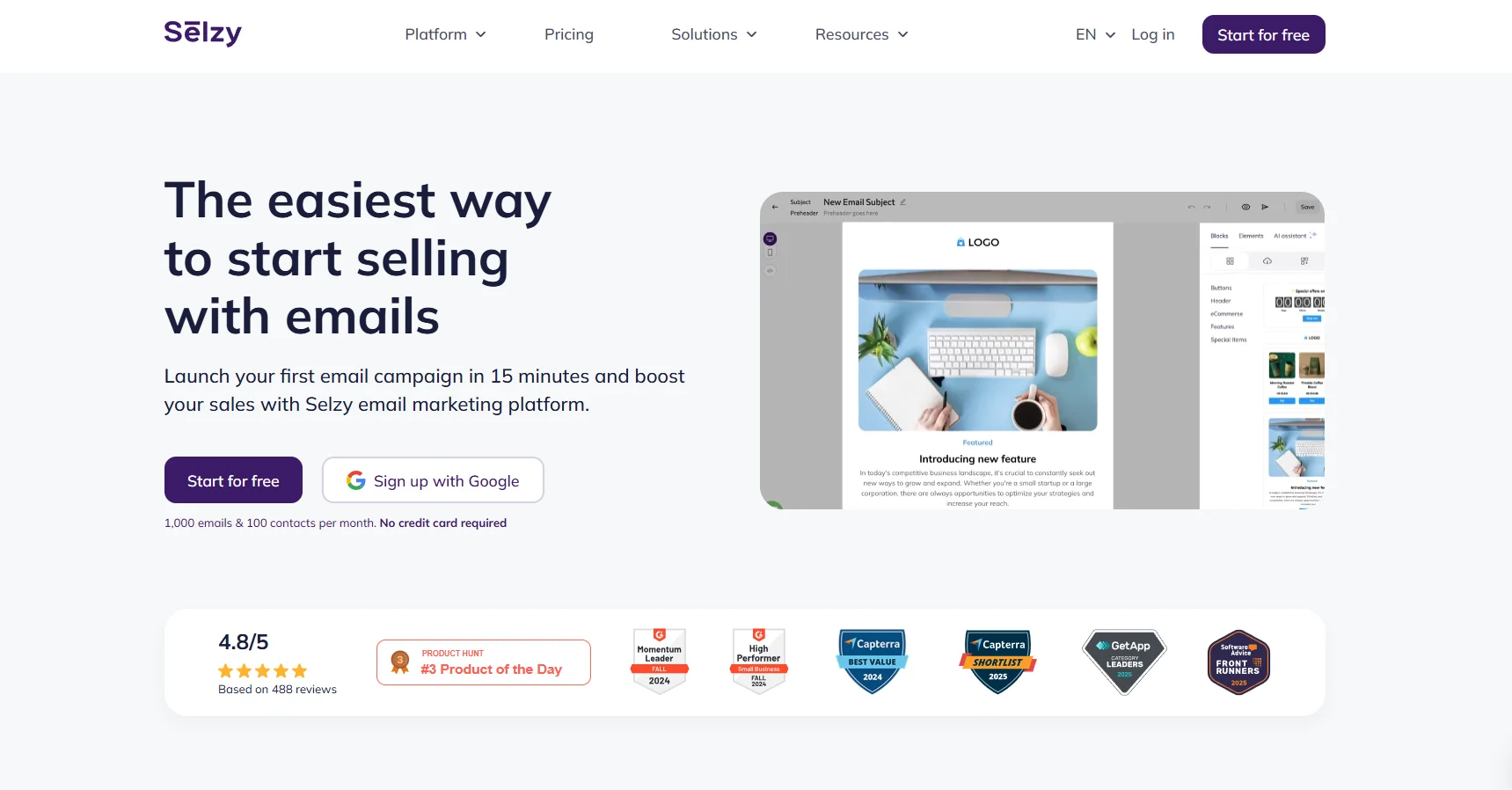
⭐ 4.8/5
Free plan: 100 contacts, 1,000 emails/month
Paid from: $7.5/month
BAA: ❌
Best for: Solo practices and growing practices sending non-PHI newsletters, educational content, and general promotions
Selzy ranks highly because it addresses two common issues for dental practices: ease of use for front desk staff and pricing that scales reasonably even with large patient databases.
Selzy offers pricing based on either contact count or email volume, giving practices flexibility in how costs are structured. For practices with large historical databases, the email-volume model may be more economical than platforms that charge solely by contact count. Paid plans with unlimited sends start around $7.5/month.
Selzy’s drag-and-drop editor includes templates that can be adapted for non-PHI newsletters, seasonal promotions, practice updates, general dental education, and cosmetic-service awareness campaigns. Automation can support general subscriber journeys, such as welcome emails for newsletter signups or educational nurture sequences, as long as they do not use or reference PHI, medical records, treatment history, appointment details, or health-related personal data. Selzy is not appropriate for appointment reminders, clinical recalls, post-procedure follow-ups, or any patient-specific workflow that depends on health data; use your PMS or a HIPAA-compliant platform with a signed BAA for those communications.
Selzy is best suited to broadcast marketing workflows. For appointment-specific emails referencing patient data, use your PMS or a BAA-signed platform.
Key features:
- 140+ templates adaptable for dental workflows
- Volume-based pricing — no penalty for large patient databases
- Automation for non-PHI newsletter signup, educational, and promotional sequences
- Segmentation by marketing engagement and consent-based subscriber preferences, excluding medical records, treatment history, appointment data, or other PHI
- A/B testing and real-time analytics
Pros:
- Easy to use
- Volume-based pricing suits large databases
- Generally reliable deliverability
- 24/7 support
- Paid plans with unlimited sends start from $7.5/month
Cons:
- No BAA
- Fewer native PMS integrations (Zapier bridges the gap)
Pricing:
The free plan covers 100 contacts and 1,000 emails/month.
Paid plans start around ~$7/month for 500 contacts with unlimited sends.
Why Selzy works well for many dental practices:
It covers the core broadcast marketing workflows most dental practices prioritize — recalls, newsletters, cosmetic promotions, and welcome sequences — at pricing that remains manageable even as patient databases grow.

2. ActiveCampaign — Best for complex automation and multi-location practices
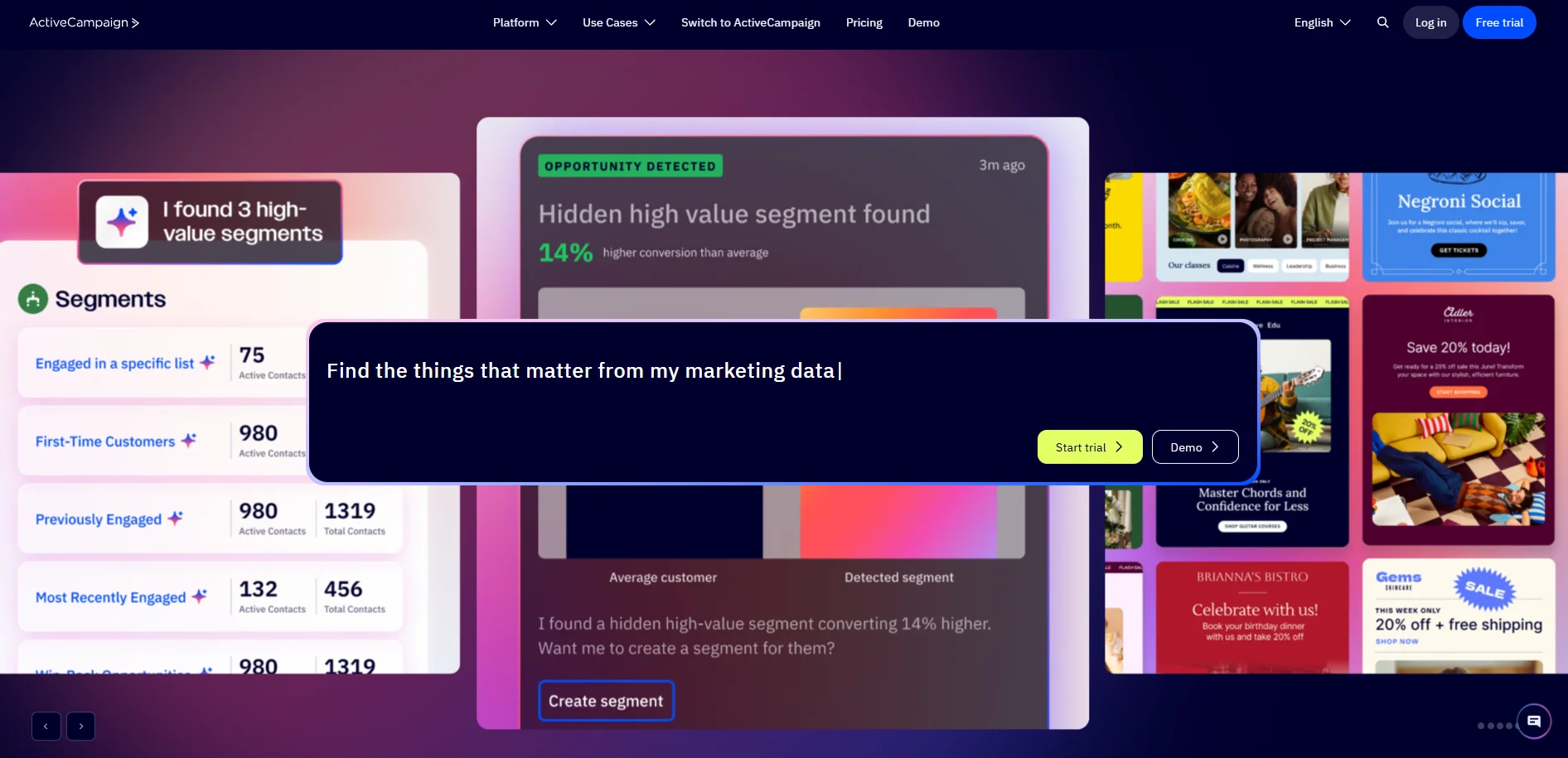
⭐ 4.5/5
Free plan: ❌ 14-day trial
Paid from: $15/month
BAA: ✅
Best for: Multi-location practices and specialty groups with dedicated marketing staff
ActiveCampaign offers some of the most advanced automation capabilities among the platforms reviewed here, and it’s one of the few general ESPs that signs a BAA — making it a potential option for practices that require HIPAA-compliant workflows when properly configured and covered by a signed BAA.
The automation depth is where it earns its place. You can build a workflow that automatically moves an implant consultation inquiry into a follow-up sequence if the patient doesn’t book within 14 days, scores contacts based on engagement to identify your most reactivation-ready patients, and triggers different recall sequences for general hygiene versus perio maintenance patients — all running simultaneously with minimal ongoing staff involvement. For a solo practice, that’s overkill. For a 3-location group with a marketing coordinator, it’s exactly what you need.
Note that the basic marketing CRM is included, but the full sales pipeline CRM is a paid add-on at $68/month.
Key features:
- Visual automation builder with conditional logic and branching workflows
- 500+ pre-built automation recipes
- BAA available for HIPAA-compliant campaigns
- Deep segmentation by treatment history, last visit, and engagement
- Predictive sending and contact scoring
Pros:
- Most powerful automation
- BAA available
- Excellent for multi-location groups
- Great deliverability.
Cons:
- Steep learning curve — not suitable for rotating or non-technical staff
- Full CRM is a paid add-on
- Expensive for smaller practices.
Pricing:
Starts at $15/month for 1,000 contacts (Starter).
Plus at $49/month, Pro at $79/month. All contact-based — factor this into cost calculations for large databases.
Why ActiveCampaign works for dental practices:
When you’ve outgrown simple recall sequences and need sophisticated multi-step patient journeys with a BAA attached, ActiveCampaign is the strongest general ESP on this list.
3. HubSpot — Best for large and multi-location dental groups
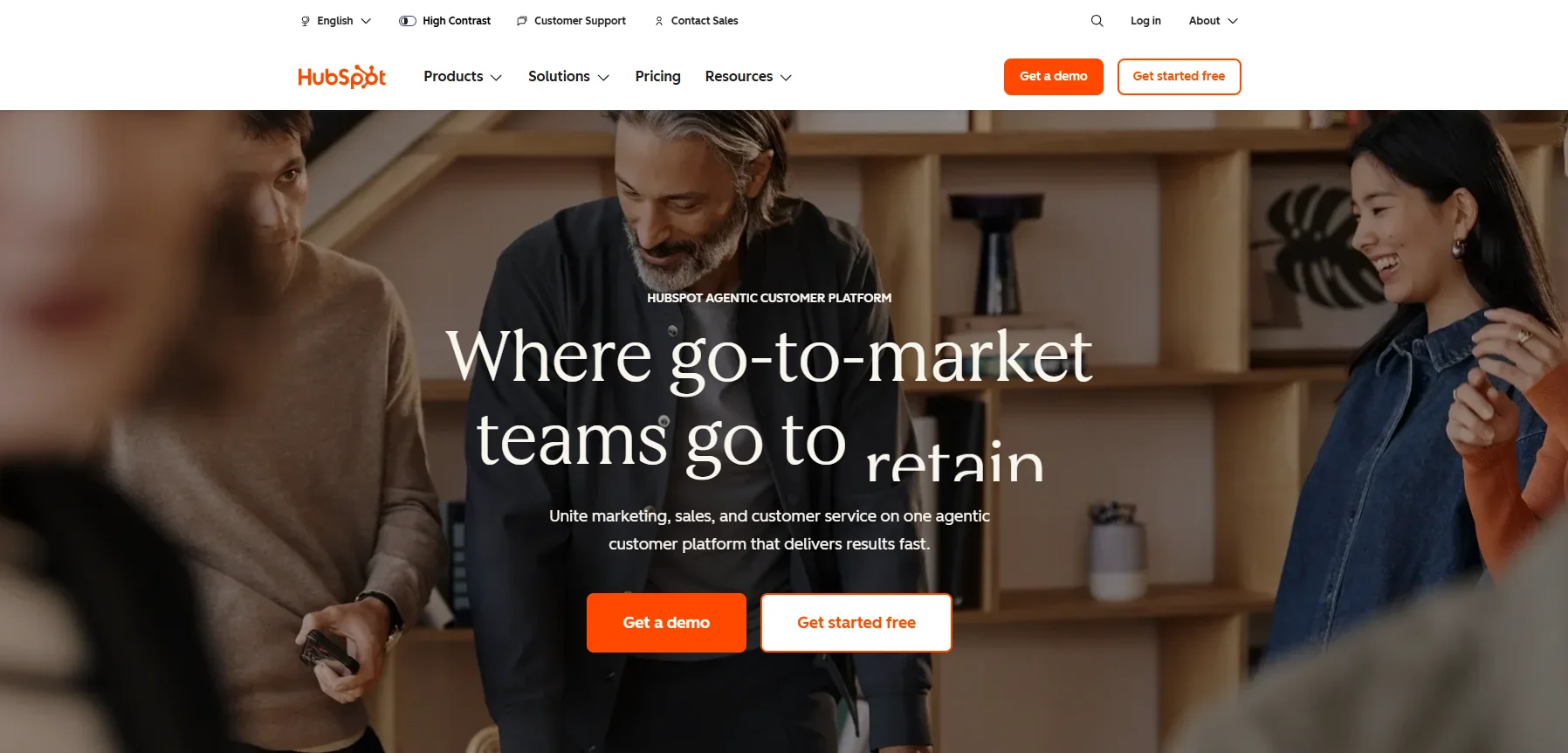
⭐ 4.4/5
Free plan: ✅ Limited (2,000 emails/month)
Paid from: $15/month/seat
BAA: ✅ Enterprise only
Best for: Multi-location dental groups with dedicated marketing staff
HubSpot’s value lies in its CRM integration — every patient interaction, across email, forms, and web, lives in one contact record. Integrations are available for major dental practice management systems including Dentrix, Eaglesoft, and Open Dental. For large dental groups tracking patient journeys across multiple locations and providers, that unified visibility is genuinely powerful.
A patient who downloads an Invisalign guide, visits your financing page twice, and opens multiple cosmetic-treatment emails can automatically enter a consultation follow-up workflow. That kind of cross-channel tracking and automation is where HubSpot stands out — and also why it tends to make the most sense for larger organizations with dedicated marketing staff.
The honest caveat: the BAA is only available on the Enterprise plan at $3,600/month. For solo practices or small groups, that’s difficult to justify when simpler tools cover most of the same workflows at a fraction of the cost.
Pros:
- Full CRM + direct PMS integration
- AI content generation
- Up to 40% nonprofit discount
- Excellent cross-location reporting
Cons:
- BAA only at Enterprise ($3,600/month)
- Overkill for fewer than 3 locations
- Complex setup
Pricing:
Free plan available. Starter at $15/month/seat. Professional at $800/month. Enterprise at $3,600/month (required for BAA access).
4. Constant Contact — Best for simplicity and BAA availability
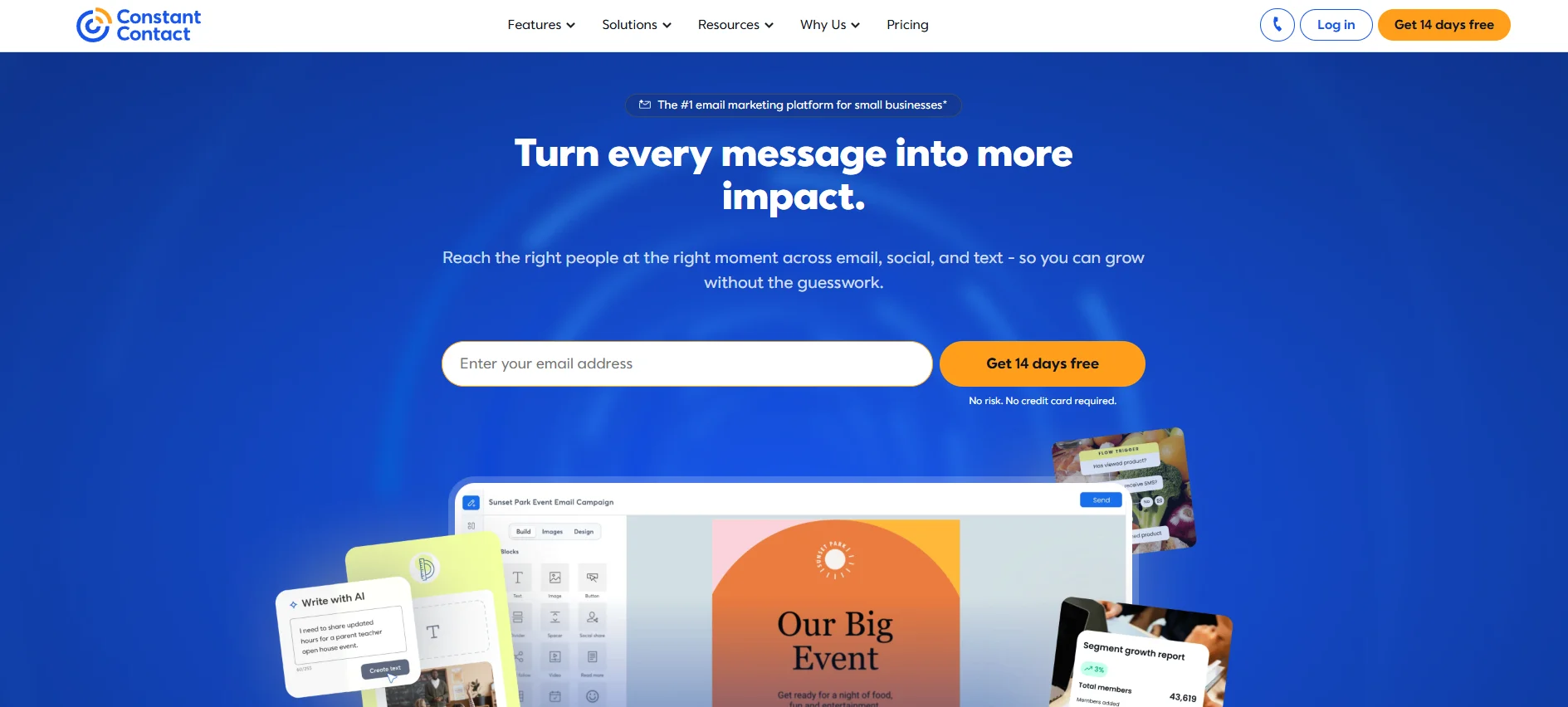
⭐ 4.1/5
Free plan: ❌ 60-day trial
Paid from: $12/month
BAA: ✅
Best for: Solo and small practices wanting a simple tool with a signed BAA
Constant Contact combines two things that are rarer together than they should be: genuine simplicity and BAA availability. For practices where the front desk manages email between patient calls, building and scheduling a recall campaign in under 15 minutes matters more than conditional workflow logic. Phone support on all plans means staff can call a person when something isn’t working — genuinely valuable when your team isn’t technical.
Automation covers the essentials: welcome sequences, recall reminders, birthday emails. The event management tools are a useful bonus for practices running patient education nights or open house events.
Pros:
- BAA available
- Easy to learn
- Phone support on all plans
- Built-in event RSVP tools
- 20–30% nonprofit discount
Cons:
- Basic automation only
- Templates feel dated
- No free plan
- More expensive than Selzy or Brevo for comparable features.
Pricing:
Lite from $12/month (500 contacts). Standard from $35/month. Premium from $80/month.
5. Brevo — Best for email and SMS on a budget
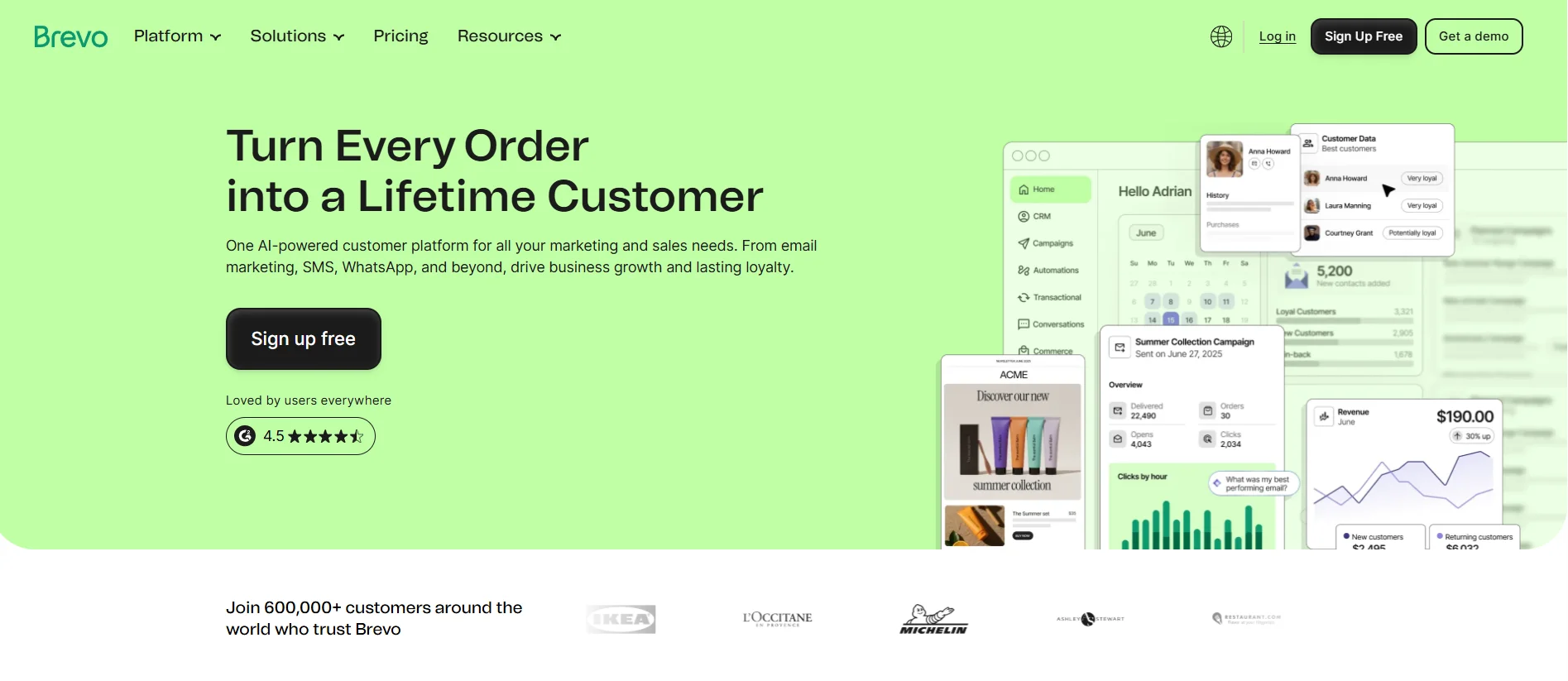
⭐ 4.3/5
Free plan: ✅ 300 emails/day, unlimited contacts
Paid from: $9/month
BAA: ❌ Enterprise only
Best for: Budget-conscious practices wanting email and SMS from one platform without per-contact pricing
Brevo uses volume-based pricing rather than charging solely by contact count. Pricing is primarily based on email sending volume rather than the number of stored contacts — because contacts are not capped on paid plans, practices with large databases may find the pricing model attractive compared with some contact-based platforms. The free tier alone (300 emails/day, unlimited contacts) covers a small practice’s recall and newsletter program at zero cost.
The built-in SMS adds real value: last-minute cancellation alerts and same-day reminders reach patients far faster via text. Brevo handles both channels from one automation workflow — email first, SMS follow-up if the patient doesn’t open within 24 hours. Brevo combines email, SMS, and volume-based pricing in a single platform.
Pros:
- Volume-based pricing suits large databases
- Email and SMS in one workflow
- Generous free tier
- Transactional emails included
Cons:
- Enterprise: custom pricing
- HIPAA/BAA support is not stated on the pricing page, and Brevo’s Terms of Service says the service should not be used where communications are subject to HIPAA
- Automation builder has a learning curve for new users; Brevo branding on free tier.
Pricing:
Free up to ~9,000 emails/month (300/day, unlimited contacts). Starter from $9/month. Business from $18/month. Enterprise (with BAA) at custom pricing.
6. Mailchimp — Popular, but limited for dental practices
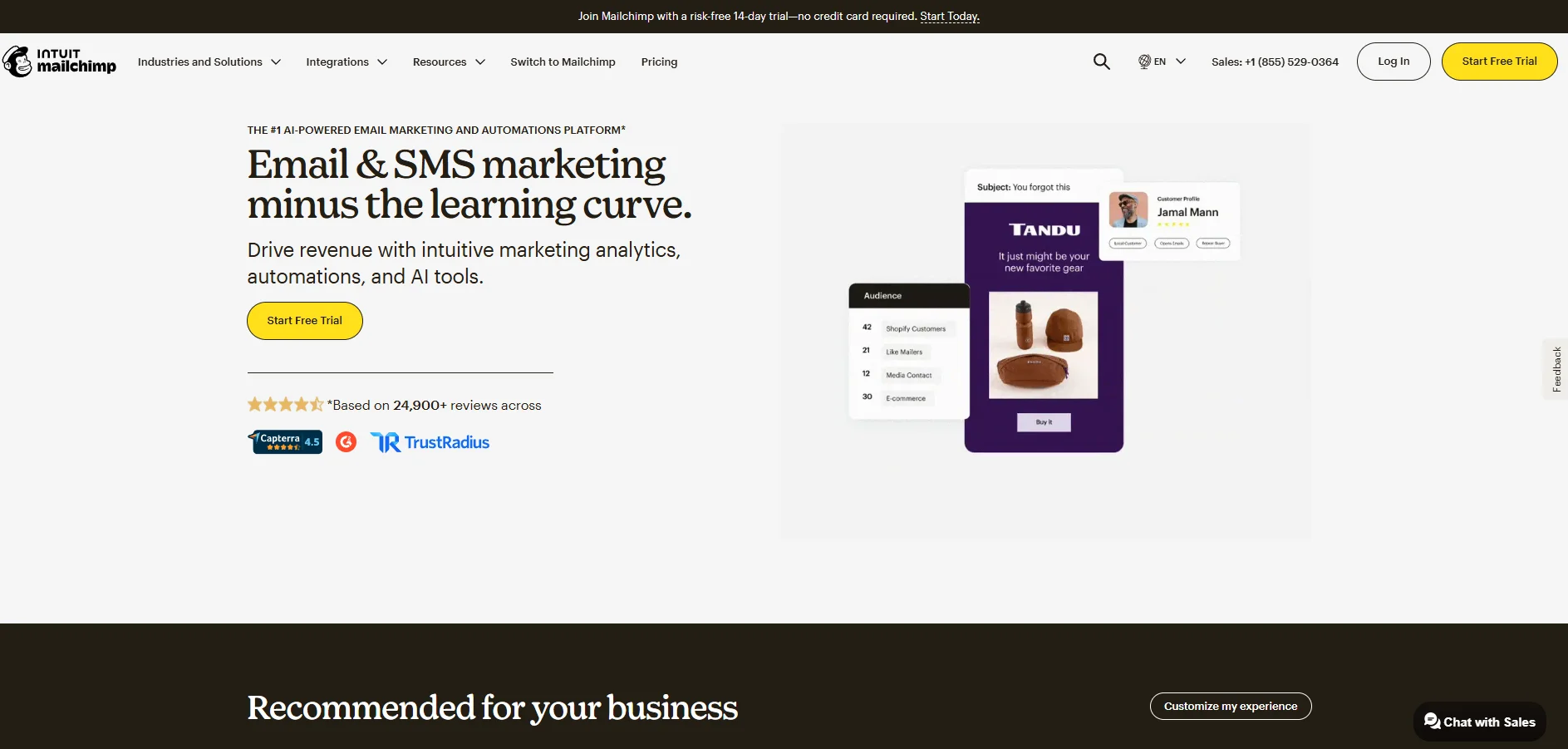
⭐ 4.3/5
Free plan: ✅ 250 contacts, 500 emails/month (no automation)
Paid from: $13/month
BAA: ❌
Best for: Basic non-PHI newsletters only — if your team already knows it
Mailchimp is the most recognized name in email marketing, and many practices start here. The template library is extensive and integrations are plentiful. For general newsletters and non-PHI promotional emails, it works.
The limitations are significant. Mailchimp does not offer a BAA under any plan. As of January 2026, the free plan was cut to 250 contacts and 500 emails/month with no automation — may be restrictive for practices that want automation or expect to grow beyond a few hundred contacts. Pricing escalates sharply with list size.
Pros:
- Largest template library
- Extensive integrations
- Familiar interface
Cons:
- No BAA under any plan
- Free plan now nearly unusable (250 contacts, no automation)
- Pricing escalates sharply with list growth
Pricing:
Free: 250 contacts, 500 emails/month, no automation. Essentials from $13/month. Standard from $20/month.
Tier 2: Dental-specific and operational tools
These platforms connect directly to your PMS and handle clinical patient communication — appointment confirmations, procedure-specific reminders, two-way SMS. They’re not broadcast marketing tools. Pair each with a general ESP for newsletters, promotions, and recall campaigns.
7. NexHealth — Best modern patient engagement layer
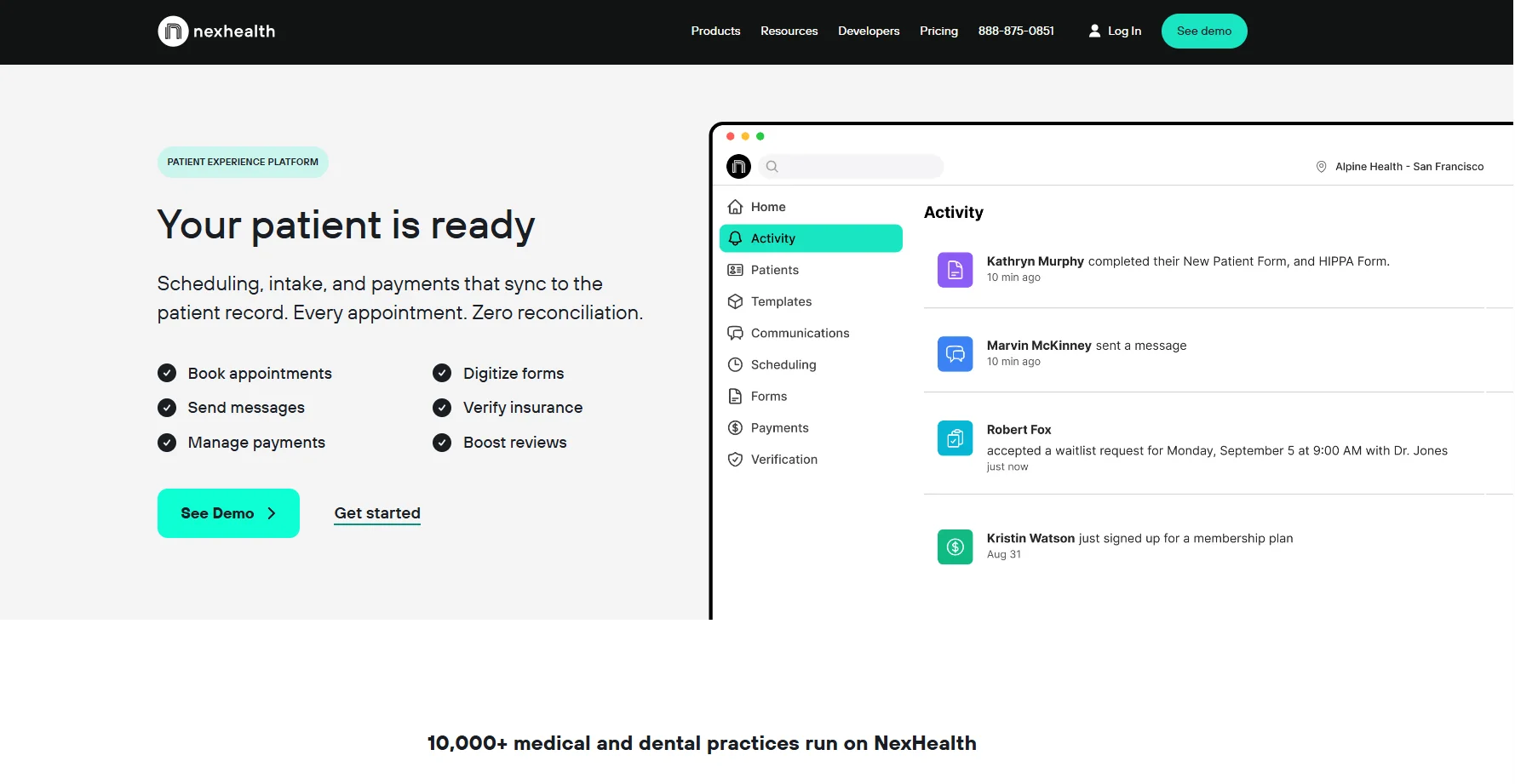
⭐ 4.8/5
Paid from: Custom (~$350+/month per location)
BAA: ✅
Best for: Growth-focused practices wanting consumer-grade engagement on top of their existing PMS
NexHealth sits between your PMS and your patients, pulling live data from Dentrix, Eaglesoft, Open Dental, or Curve and delivering a more modern patient-facing experience than many traditional PMS interfaces. Online booking, two-way SMS, digital intake forms, payments, and review requests work in real time, with completed actions flowing back into your PMS. The patient-facing interface feels like booking a restaurant — clean, mobile-native, immediate.
Key features:
- Real-time PMS sync (all major systems)
- Online booking
- Two-way SMS
- Digital forms and payments
- Automated review requests
- BAA signed
Pros:
- Modern patient-facing experience
- Works with all major PMS
- Strong review generation
Cons:
- Expensive per location
- Contract commitments
Why NexHealth works for dental practices:
For the clinical communication layer — confirmations, two-way SMS, review requests tied to actual PMS data — NexHealth delivers the most modern patient experience available. Pair it with Selzy for marketing.
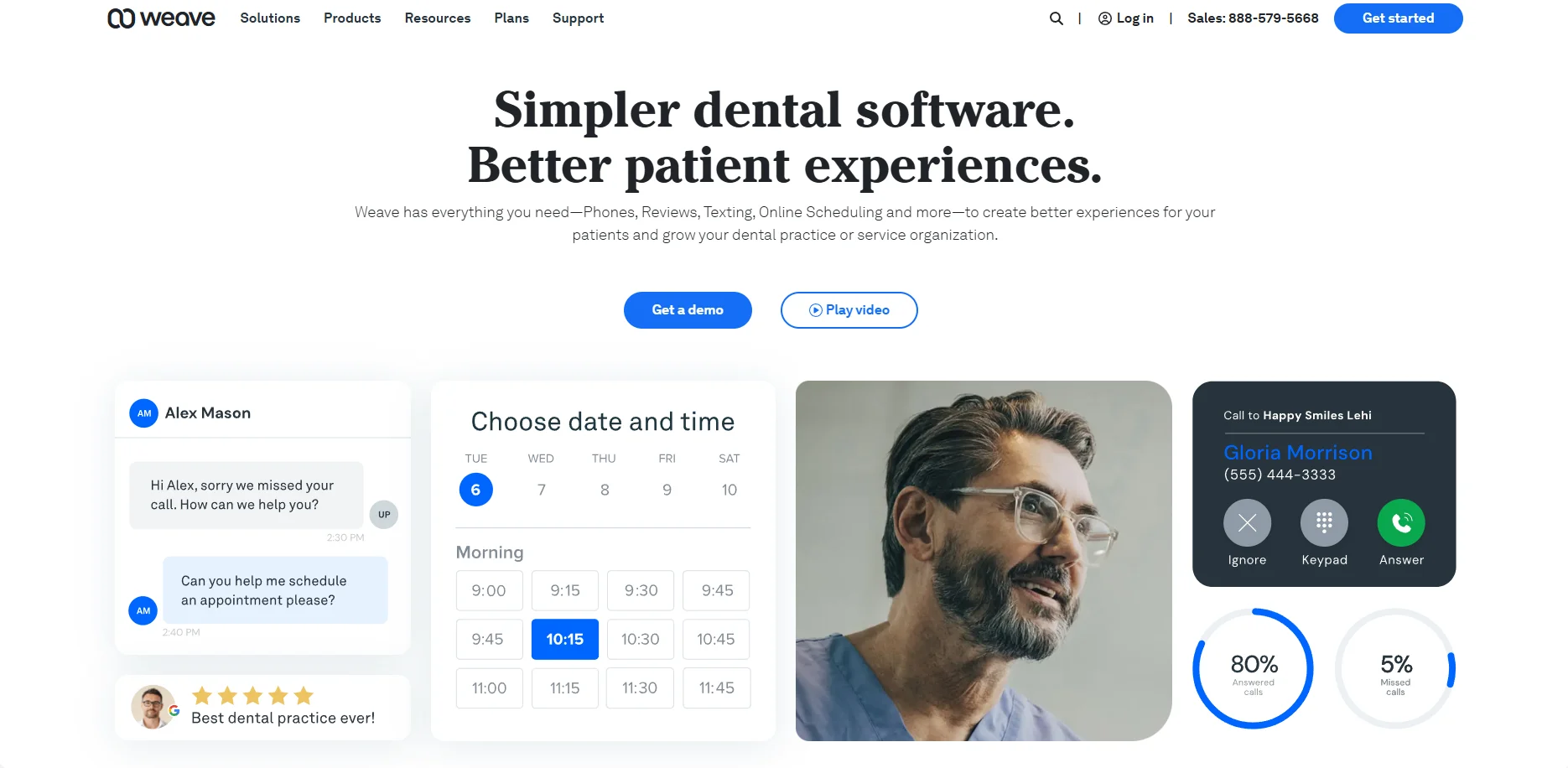
8. Weave — Best unified practice communication platform
⭐ 4.6/5
Paid from: Custom (~$249+/month)
BAA: ✅
Best for: Practices wanting phone, SMS, and email unified under one HIPAA-compliant infrastructure
Weave started in dental and replaces your practice phone system while adding SMS, email, payments, and review management in one platform. Every patient interaction — whether it starts as a call, a text, or an email — is tracked in one place. For front desks handling heavy inbound call volumes alongside scheduling and insurance questions, unified communications reduce friction significantly.
Key features:
- VoIP phone system with patient data overlay
- Two-way SMS
- Automated reminders
- Integrated payments
- Review automation
- Mobile app
- BAA signed
Pros:
- Unified phone + SMS + email
- Strong dental adoption
- Payments included
Cons:
- Expensive
- Contract commitments
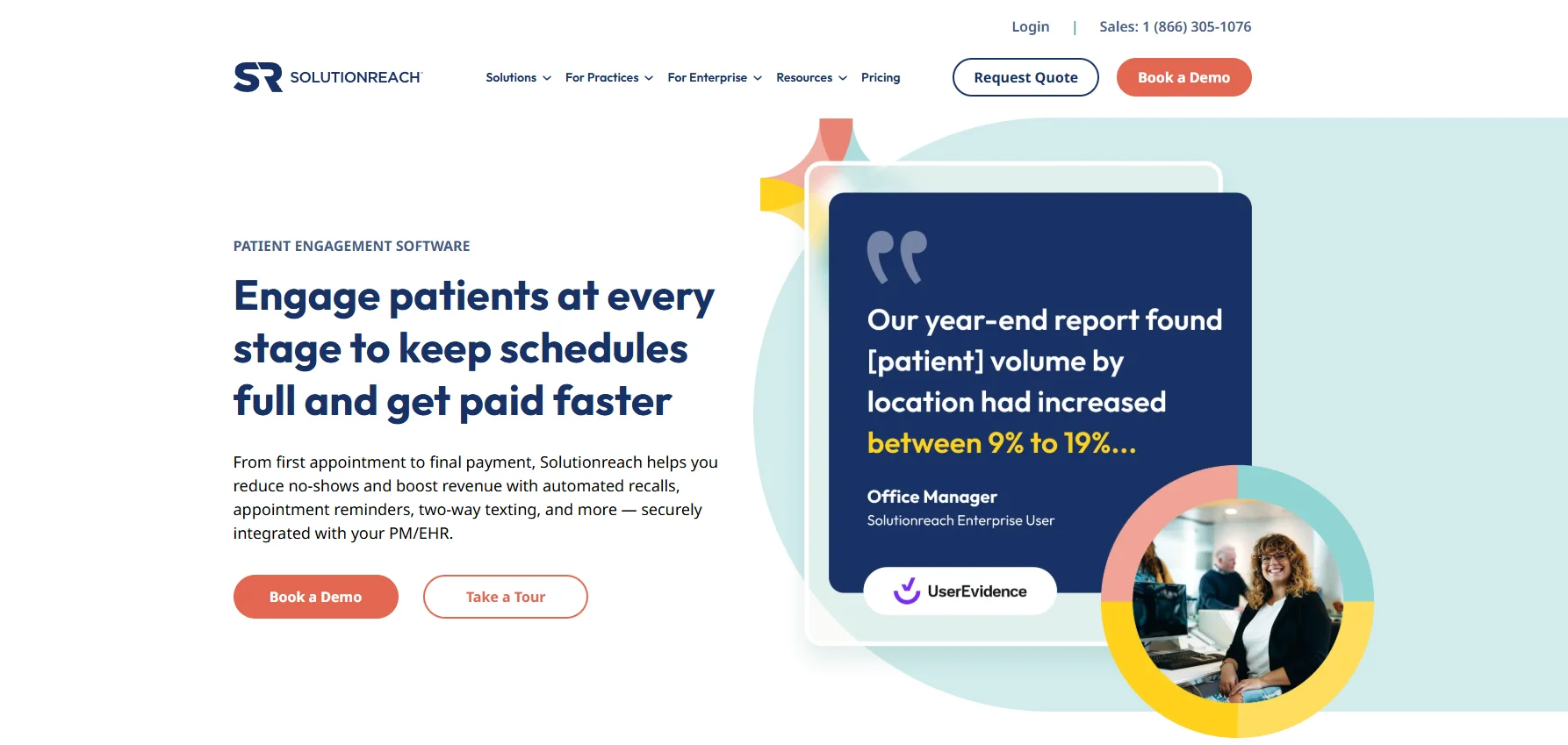
9. Solutionreach — Best mature dental patient engagement platform
⭐ 4.3/5
Paid from: Custom (~$300+/month per location)
BAA: ✅
Best for: Established practices wanting a proven recall and patient engagement system
Solutionreach has been in dental-specific patient engagement for over a decade. That experience shows in the depth of its recall logic — multi-specialty recall based on actual treatment records (period maintenance at different intervals than general hygiene, ortho retainer reminders, implant follow-ups), something general ESPs can’t replicate. Connects with Dentrix, Eaglesoft, and Open Dental.
Key features:
- Multi-specialty recall automation
- Two-way SMS and email
- Reputation management
- Patient satisfaction surveys
- PMS integration
- BAA signed
Pros:
- Proven dental focus
- Deep PMS integration
- Multi-specialty recall logic
- Strong reputation management
Cons:
- Contract commitments
- Dated UI in places
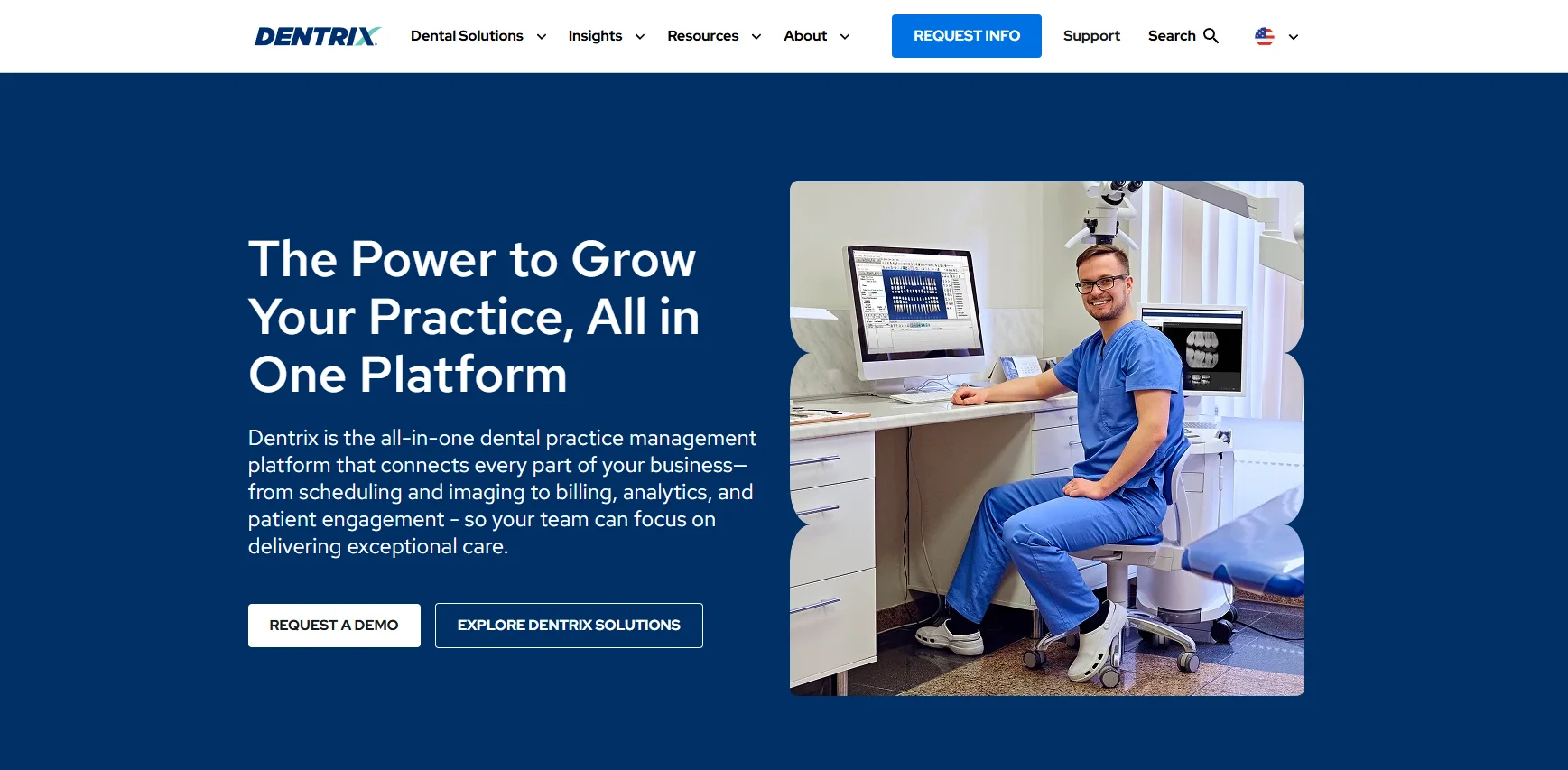
10. Dentrix — Best for practices running Dentrix PMS
⭐ 4.1/5
Paid from: Bundled with Dentrix
BAA: ✅
Best for: The majority of US dental practices already on Dentrix
Dentrix is one of the most widely used dental practice management systems in the United States, and its built-in Communication Manager handles recall, appointment confirmations, and post-visit follow-ups tied directly to the clinical record. Procedure-specific follow-ups trigger based on treatment history — no exports, no sync delays, no configuration required.
Pros:
- Native PMS integration
- Procedure-specific automation
- HIPAA-compliant by design
Cons:
- Only valuable on Dentrix
- Enterprise pricing
- Not a marketing tool
11. Eaglesoft — Best for practices in the Patterson Ecosystem
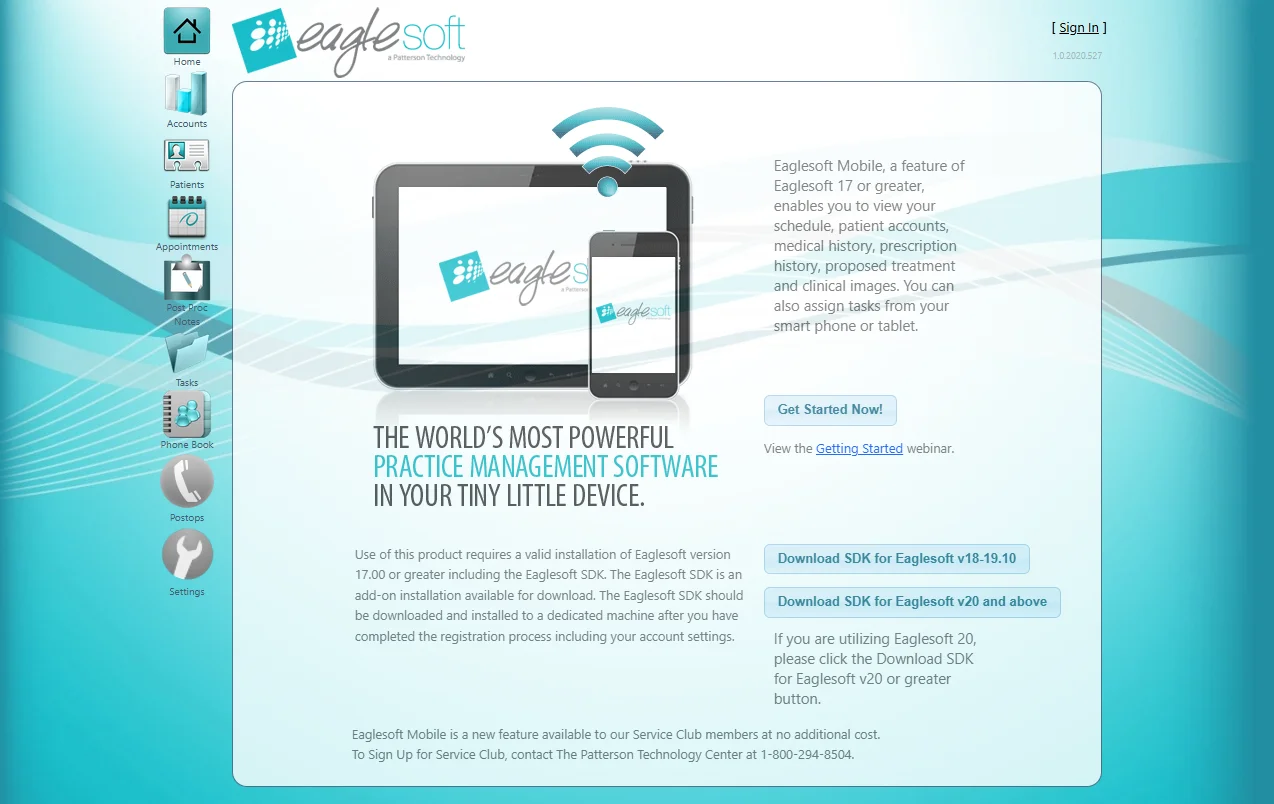
Eaglesoft competes with Dentrix for US market share, particularly among Patterson Dental customers. Integrated patient communication handles core recall and reminder automation tied to clinical records, with tight integration across Patterson PMS, imaging, and supplies.
Pros: Patterson ecosystem integration; clinical-record-driven automation; dental-industry standard. Cons: Only valuable on Eaglesoft; dated interface.
12. Open Dental — Best for cost-conscious practices wanting open-source flexibility
⭐ 4.3/5
Paid from: Bundled with Open Dental
BAA: ✅
Best for: Independent practices wanting lower PMS costs and broad third-party integration
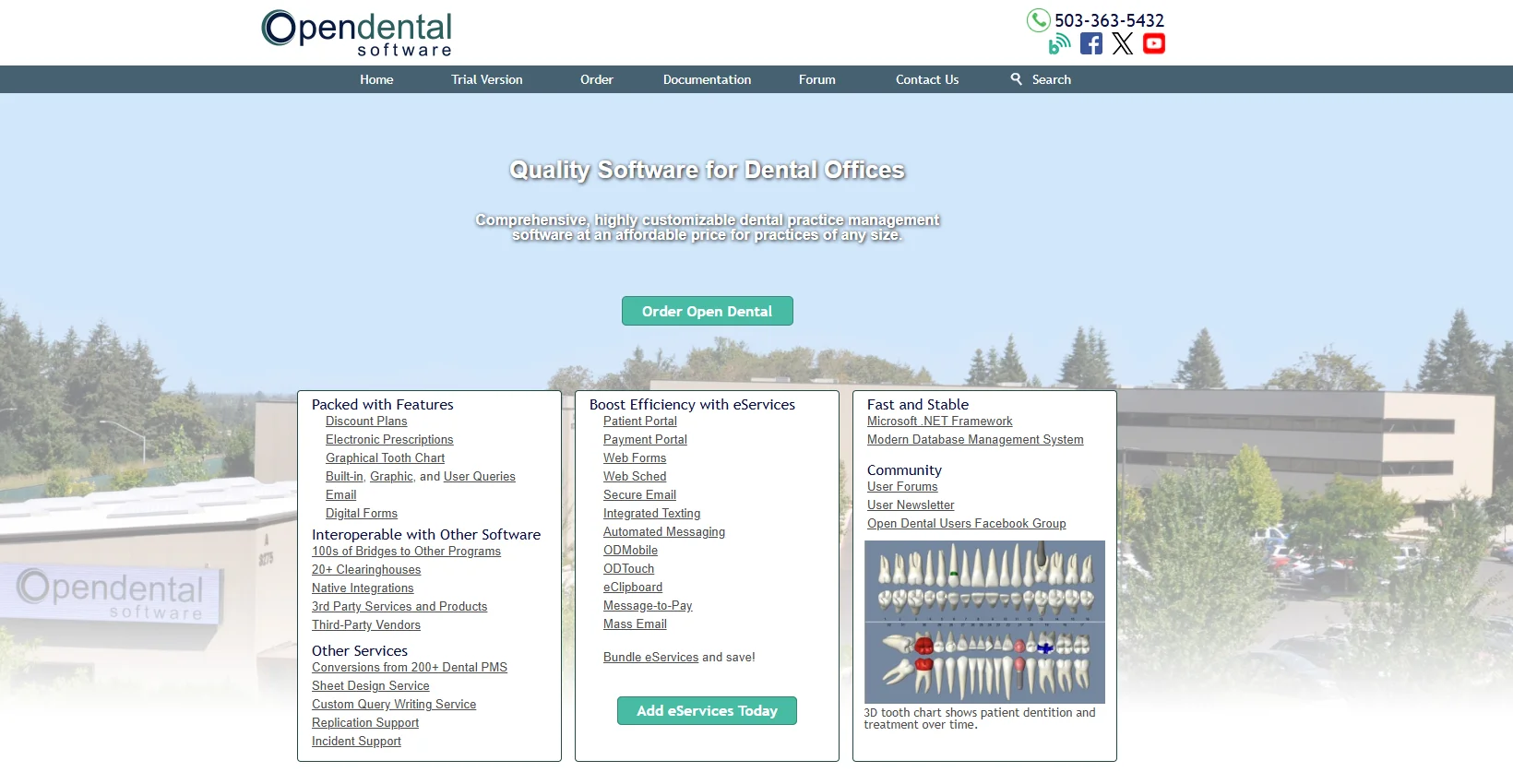
Open Dental is the leading open-source dental PMS. Its built-in messaging module handles appointment reminders and recall tied to clinical records. Its open-source architecture integrates with NexHealth, Solutionreach, and Weave more easily than proprietary alternatives — useful if you want a modern engagement layer without switching your PMS.
Pros:
- Lower cost
- Open-source flexibility
- Wide third-party integration support
Cons:
- More technical setup required
- Support less comprehensive than proprietary alternatives
13. Curve Dental — Best for cloud-based practices
⭐ 4.6/5
Paid from: Bundled with Curve
BAA: ✅
Best for: Practices running fully cloud-based infrastructure
Curve is a fully cloud-native dental PMS with no local servers, no on-site hardware, and access from any device. Its integrated communication module handles appointment reminders and recall tied to live clinical records. For new locations or practices moving to cloud-first infrastructure, Curve simplifies both practice management and patient communication.
Pros:
- Fully cloud-based
- No server maintenance
- Integrated patient communication
- HIPAA-compliant
Cons:
- Smaller market share than Dentrix or Eaglesoft
- Newer platform with less track record
Full comparison: All 13 platforms
| Platform | Free plan | Paid from | BAA | Automation | PMS integration | Best for |
| Selzy | ✅ 100 contacts | $7.5/mo | ❌ | ✅ | Via Zapier | Most practices (non-PHI marketing) |
| ActiveCampaign | ❌ Trial | $15/mo | ✅ | ✅ Advanced | Via Zapier | Multi-location groups |
| HubSpot | ✅ Limited | $15/mo/seat | ✅ Enterprise | ✅ Advanced | ✅ Direct | Large dental groups |
| Constant Contact | ❌ Trial | $12/mo | ✅ | ✅ Basic | Via Zapier | Simple practices + BAA |
| Brevo | ✅ 300/day | $9/mo | ✅ Enterprise | ✅ | Via Zapier | Budget + SMS + large databases |
| Mailchimp | ✅ 250 contacts | $13/mo | ❌ | ✅ Paid only | Via third-party | Non-PHI only |
| NexHealth | ❌ | ~$350+/mo | ✅ | ✅ | ✅ Direct | Modern patient engagement |
| Weave | ❌ | ~$249+/mo | ✅ | ✅ | ✅ Direct | Unified phone + SMS + email |
| Solutionreach | ❌ | ~$300+/mo | ✅ | ✅ | ✅ Direct | Mature recall automation |
| Dentrix | ❌ | Bundled | ✅ | ✅ | ✅ Native | Dentrix PMS users |
| Eaglesoft | ❌ | Bundled | ✅ | ✅ | ✅ Native | Patterson ecosystem |
| Open Dental | ❌ | Bundled | ✅ | ✅ | ✅ Native | Open-source flexibility |
| Curve Dental | ❌ | Bundled | ✅ | ✅ | ✅ Native | Cloud-based practices |
HIPAA and email marketing: What dentists need to know
The key distinction: are you including Protected Health Information (PHI) in your emails?
Emails referencing PHI require a HIPAA-compliant platform — one that signs a Business Associate Agreement (BAA) and maintains encryption, access controls, and audit logging. This applies to emails that include patient names alongside appointment times, treatment details, or health data.
General marketing emails don’t require HIPAA compliance. Newsletters, seasonal promotions, educational content about cosmetic treatments, and birthday greetings contain no PHI and can be sent through any platform.
Most practices split this sensibly: a HIPAA-compliant platform or their PMS handles clinical communication; a general ESP handles broadcast marketing. Getting it wrong carries fines of $100 to $50,000 per incident — worth understanding before you choose a tool.
| Platform | BAA available | Safe for PHI emails |
| Selzy | ❌ | General marketing only |
| ActiveCampaign | ✅ | Yes, with signed BAA |
| HubSpot | ✅ Enterprise only | Yes, on Enterprise plan |
| Constant Contact | ✅ | Yes, with signed BAA |
| Brevo | ✅ Enterprise only | Yes, on Enterprise plan |
| Mailchimp | ❌ | General marketing only |
| NexHealth / Weave / Solutionreach | ✅ | Yes — built for healthcare |
| Dentrix / Eaglesoft / Open Dental / Curve | ✅ | Yes — built for healthcare |
What to look for in a dental email marketing platform
HIPAA compliance and BAA availability. If any emails will reference patient-specific health data, you need a signed BAA. Verify before signing up — you can’t fix this retroactively, and fines start at $100 per violation.
Automation for recall, reminders, and reactivation. These three sequences drive the most revenue for dental practices. Your platform should run them without manual input, ideally triggered by each patient’s actual last visit date rather than fixed calendar dates. A recall email that fires exactly 6 months after each patient’s cleaning runs itself — no staff scheduling required.
The database size problem. Dental practices accumulate thousands of records over years. Per-contact pricing platforms charge for every record, whether you email them or not — at 5,000 contacts that’s often $60–150/month even if you’re actively contacting only a fraction. Volume-based pricing (Brevo, Selzy) charges by emails sent, not records stored. Calculate cost at your actual database size, not the advertised starting price.
PMS integration. Direct sync with Dentrix, Eaglesoft, Open Dental, or Curve keeps data current and enables automation based on real clinical events — not manual data exports that go stale.
Ease of use for front desk staff. The person managing email at your practice is probably handling patient calls, scheduling, and insurance questions at the same time. If training takes more than an afternoon, it’s the wrong tool.
How dentists should segment their email list
For HIPAA-regulated practices, segmentation based on last visit, treatment history, procedure type, recovery stage, or appointment status should happen only inside a PMS or HIPAA-compliant platform with a signed BAA. In a general ESP such as Selzy, keep segmentation limited to non-PHI marketing engagement and consent-based subscriber preferences.
Most dental practices treat their list as one audience. The ones seeing real results split it into at least five groups:
Overdue hygiene patients (6–18 months since last cleaning) — recall sequences with a direct booking link and a mention of insurance benefits resetting.
Cosmetic-interested patients (opened emails about whitening or Invisalign, or previously inquired) — educational and promotional content targeted to high-value elective procedures.
Inactive patients (18+ months, no visit) — reactivation campaigns with a warm tone, a reference to their last visit, and a low-friction next step.
Families with children — back-to-school dental tips, pediatric service promotions, reminders around school form season.
Post-procedure patients — follow-up sequences specific to what they had done, timed around expected recovery milestones. Example: A whitening campaign targeting patients who visited in the last 12 months, opened at least one recent email, and have never booked a cosmetic treatment — sent with a time-limited offer and a single booking link — will consistently outperform a campaign sent to your entire list.
Keep your patient list healthy
Dental practices often accumulate thousands of patient records over years of operation, but not every contact remains active indefinitely. Continuing to email disengaged patients hurts deliverability, increases spam complaints, and inflates costs on platforms that charge by contact count.
Practices should regularly suppress or remove contacts who:
- Haven’t opened emails in 12–24 months
- Consistently ignore recall campaigns
- Or repeatedly bounce.
Healthy engagement rates help your emails land in inboxes instead of spam folders — especially for high-value campaigns like recalls and cosmetic promotions. Most modern platforms include basic engagement filtering and unsubscribe management tools to help maintain list quality.
What actually drives appointments from dental emails
Most dental email campaigns underperform for the same reasons: too many links competing for attention, no urgency, and no direct path to booking.
One CTA per email. Emails with a single booking link consistently outperform those with 3–4 competing options. Every email should answer one question: what do you want the patient to do next?
Online booking links, not phone numbers. A direct link to your scheduling page removes friction. Patients who have to call are more likely to close the email and forget.
Educational framing for cosmetic treatments. “Book a whitening consultation” performs significantly worse than “Here’s what teeth whitening actually involves — and who it works best for”, followed by a booking link. Understanding converts better than promotion.
Mobile-first formatting. Over 60% of dental emails are read on a phone. Short paragraphs, large buttons, and a single-column layout matter far more than design complexity.
Urgency that’s real. “Limited availability this month” works when it’s true. Manufactured urgency trains patients to ignore it.
Email sequences every dental practice needs
Set these up once and they run automatically.
Important The following appointment, recall, new-patient, and post-procedure sequences may involve PHI or health-related personal data. They should be run through a PMS or HIPAA-compliant platform with a signed BAA, not through Selzy.
1. Appointment reminder sequence
Trigger: Patient books an appointment
| Timing | Subject line example | Purpose | |
| Email 1 | Immediately | “Your appointment is confirmed — here’s what to bring” | Confirm date, time, location, cancellation policy |
| Email 2 | 3 days before | “Quick reminder: your dental visit is coming up” | Parking info and any prep instructions |
| Email 3 | 1 day before | “See you tomorrow!” | Final reminder with office hours and contact |
2. 6-month recall sequence
Trigger: 6 months after patient’s last cleaning
| Timing | Subject line example | Purpose | |
| Email 1 | Day 0 | “Time for your checkup, [First Name]” | Friendly recall with direct booking link; mention insurance benefits |
| Email 2 | Day 7 | “Your smile misses us” | Follow-up with urgency; highlight availability |
| Email 3 | Day 21 | “Last reminder before we lose your spot” | Final send with genuine urgency |
3. New patient welcome sequence
Trigger: Patient completes their first visit
| Timing | Subject line example | Purpose | |
| Email 1 | Same day | “Thanks for choosing us, [First Name]” | Welcome, visit recap, next steps, emergency contact |
| Email 2 | Day 3 | “How was your first visit?” | Feedback request; happy patients directed to Google review |
| Email 3 | Day 7 | “A few things to know as our patient” | Insurance tips, referral program, services overview |
4. Post-procedure follow-up
Trigger: After extraction, root canal, or implant placement
| Timing | Subject line example | Purpose | |
| Email 1 | Day 1 | “How are you feeling after yesterday?” | Aftercare instructions, what’s normal, when to call |
| Email 2 | Day 7 | “Quick check-in on your recovery” | Confirm healing; invite questions |
How to choose the right platform for your practice
Solo practice or small team. Use Selzy for non-PHI newsletters, practice updates, general dental education, and promotional campaigns. Use your PMS or a HIPAA-compliant platform with a signed BAA for appointment reminders, clinical recalls, post-procedure follow-ups, or any message that references patient-specific health information.
Growing practice (2–5 providers). Use Selzy or another general ESP for non-PHI broadcast marketing only. If your PMS’s built-in recall or reminder tools feel limited, consider a dental-specific patient engagement platform that supports HIPAA-compliant workflows and BAA execution.
Multi-location or group practice. Use platforms with signed BAA availability for patient-specific workflows. General ESPs should be limited to non-PHI marketing unless they are properly configured for HIPAA-regulated use and covered by a signed BAA.
Large historical databases. Avoid uploading medical records, treatment history, appointment details, or health-related personal data into general marketing platforms. For Selzy, use consent-based marketing contact data only and keep PHI in your PMS or another appropriate HIPAA-compliant system.
FAQ about email marketing platforms for dentists
Do dental practices need HIPAA-compliant email marketing software?
Only if your emails include PHI — patient names alongside appointment details, treatment history, or health data. General marketing emails (newsletters, promotions, dental tips, birthday greetings) don’t require it. Most practices use a general ESP for marketing and their PMS or a BAA-signed platform for clinical communication. When in doubt, keep health data out of your marketing emails entirely and the question becomes moot.
What’s the best free email marketing platform for dental practices?
Brevo’s free tier (300 emails/day, unlimited contacts) is the most useful for practices with large databases — you pay nothing and still reach your whole list. Selzy’s free plan (100 contacts, 1,000 emails/month) includes full features including automation, making it the best option for very small practices just getting started. Mailchimp’s free plan is now 250 contacts with no automation — no longer practical for most practices.
How often should dentists email their patients?
Two to four emails per month works well for most practices: one monthly newsletter with practice updates and dental tips, automated recall and reactivation sequences running in the background, and event-specific emails when relevant. Emailing more than weekly typically increases unsubscribes without producing proportional appointment bookings.
Can email marketing integrate with Dentrix or Open Dental?
HubSpot offers native integrations with Dentrix, Eaglesoft, and Open Dental on higher-tier plans. ActiveCampaign, Selzy, and most general ESPs connect via Zapier, which handles the most common use cases like syncing patient records and triggering recall sequences. Dental-specific platforms (NexHealth, Solutionreach, Weave) offer direct PMS integration for clinical communication and two-way data flow.
What types of emails drive the most appointments?
Recall sequences consistently produce the highest volume — 25–40% booking rate from a 3-email flow. Educational emails about cosmetic treatments (whitening, Invisalign, implants) drive the highest-value individual bookings because they address patient hesitation before the ask. Post-procedure follow-ups generate the most positive responses and reviews. Reactivation campaigns targeting patients inactive for 18+ months typically produce the strongest direct revenue per campaign relative to cost.
How much does email marketing software cost for dental practices?
General ESPs start at $7–15/month for small lists and scale based on volume or contact count. Practices with large patient databases pay significantly less on volume-based platforms like Selzy and Brevo compared to per-contact alternatives. Dental-specific operational tools (NexHealth, Weave, Solutionreach) run $300–$400+/month per location — a separate cost from your ESP that covers clinical communication rather than marketing.
The verdict
Best overall — Selzy. For most dental practices, Selzy handles non-PHI broadcast email marketing — newsletters, practice updates, general dental education, cosmetic-service awareness, and consent-based promotional campaigns — simply and affordably.
Best for HIPAA compliance and automation — ActiveCampaign. For practices needing a signed BAA alongside powerful automation. Right for multi-location groups and specialty practices with dedicated staff who can invest time in the platform.
Best for large dental groups — HubSpot. For groups with multiple locations, dedicated marketing coordinators, and a need for unified patient data across PMS and marketing systems. Requires Enterprise plan for BAA access.
Best for email + SMS on a budget — Brevo. Volume-based pricing and built-in SMS in one platform — the best choice for practices with large historical databases who want multi-channel reach without paying per contact.
Best operational tool — NexHealth. For clinical communication tied to your PMS — appointment confirmations, two-way SMS, and review requests based on actual treatment data. Pair with Selzy for non-PHI broadcast marketing only.
The right setup for most practices: Selzy for non-PHI broadcast marketing, and your PMS or a HIPAA-compliant platform with a signed BAA for appointment reminders, recalls, post-procedure follow-ups, and other patient-specific communications. Start with those three automated sequences — appointment reminders, 6-month recall, and new patient welcome — and add complexity only once those are running reliably.

Pricing and features are current as of early 2026 and may be subject to change. HIPAA-related capabilities, BAA availability, and permitted-use restrictions can change — always verify directly with each provider and your compliance advisor before sending patient communications.
 New and noteworthy on our blog