


Key takeaways
- Email marketing lists can see a decrease in opens and clicks over time due to various reasons.
- Re-engagement campaigns can help revive inactive subscribers.
- Steps for re-engagement campaigns include list cleaning, segmentation, strategy development, email creation, and analysis.
- Re-engagement campaigns improve sender reputation, reduce costs, and increase profits.
- Effective reactivation emails should have engaging subject lines, clear benefits for subscribers, and options for action.
- Constantly improve re-engagement campaigns by testing different offers and subject lines.
There are more and more subscribers in the lists but fewer and fewer opens and clicks, how could that be? Well, email marketing is a bit like gardening — without constant care, email lists’ capacities get depleted with time. It happens because people naturally lose interest and turn into sleeping contacts who don’t react and don’t engage. But it’s possible to make some of them active again with re-engagement campaigns. Let’s see how.
Re-engagement: what it is and why you need it
Imagine that a large part of your contacts don’t open your emails or click on links. Actually, you probably don’t have to imagine it. In an ideal world, every one of your subscribers is keen to hear from you. In reality, it’s usually only a small part that really likes to receive emails from you and click links. It is considered OK when 50-60% of subscribers are dormant. And sometimes, this figure might be up to 90% and this is where the problem starts.
There are many reasons why people stop engaging with emails:
- It’s no longer relevant. They changed their priorities or found an alternative.
- It’s not what they expected. You promised an informational newsletter but ended up promoting your educational course instead.
- It got caught among other emails. They bit off more than they could chew and don’t have time to read all emails but don’t want to unsubscribe either.
- It’s boring.
- It has too many ads.
- It’s difficult to read. Maybe your emails are not well-structured or mobile-oriented.
- It’s too frequent (read intrusive).
- It’s too seldom and irregular (read “Wait a sec, I don’t remember subscribing to this”).
So when you find out that a lot of subscribers are unengaged, you have 3 options:
- Leave it as it is
- Remove them from the lists
- Reactivate them.
Leaving everything be is not the best option, because subscribers who have been dormant for a long time, are unlikely to start interacting with you on their own.
Removing them works fine and makes your lists more active. List-cleaning is something email marketers do on a regular basis.
We get it, squandering away perfectly live contacts is hard. So before removing, try to re-engage them first.
Re-engagement (or reactivation, or win-back) in email marketing is the process of running special email campaigns targeted at subscribers that were once active but don’t read, click, or buy anymore and offering them something for their return.
A typical re-engagement email looks like this:
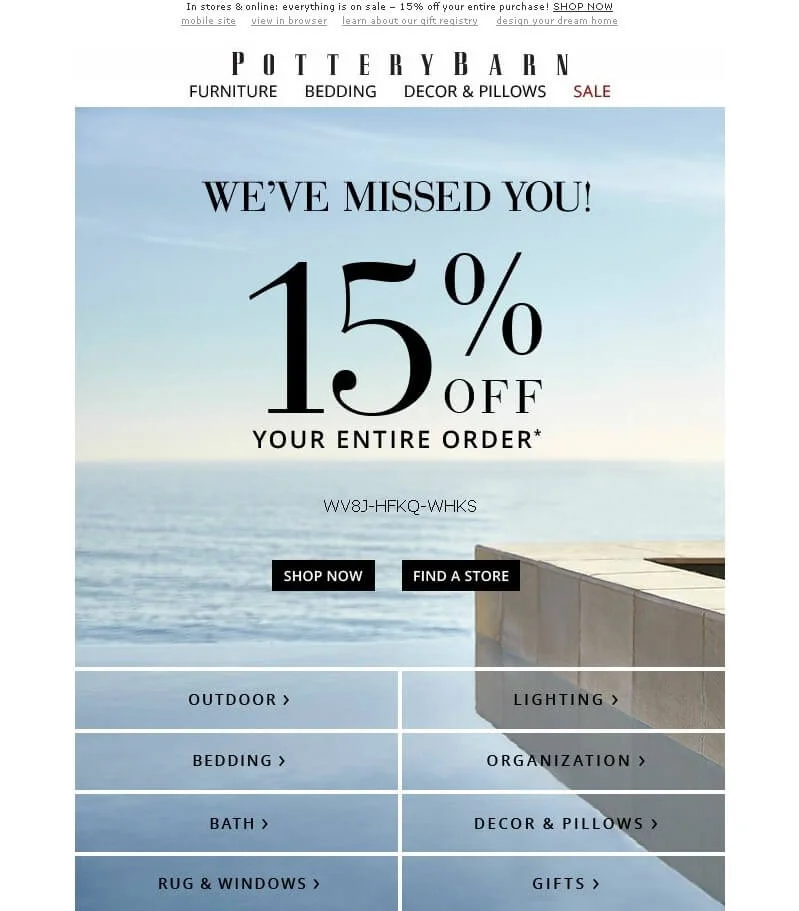
Pottery Barn uses a popular “we miss you” message and offers a discount to people who haven’t been active lately. Source: Email-Competitors
Reactivation is good for email marketing because:
- It improves your sender’s reputation. If only a fraction of your subscribers interact with your emails, services like Gmail may think that you’re sending unsolicited emails — i.e. spam.
- It reduces the cost per action. Email campaigns cost money. In terms of email marketing pricing plans, there’s a big difference between a 10K list and a 100K list. If only 10% of your 100K list reads your emails, it’s better to turn it into a smaller but more active list that costs much less to manage.
- It gets you extra profit. More active subscribers mean more traffic and more sales. Reactivating old fans is much easier and cheaper than attracting new loyal ones. According to this report by Return Path, 14% of previously unengaged subscribers read win-back emails. If just a part of them come back as customers, your re-engagement efforts will pay off.
Steps of email marketing reactivation
Moving on, where to begin? Re-engagement campaigns are carried out in four stages:
- Setting up segmentation. Identify subscribers who haven’t read messages and haven’t performed other targeted actions for a long time.
- Building a strategy. Plan specific mailings.
- Preparing emails. Develop templates and set up the sending logic.
- Analyzing results. Sum up the results of reactivation campaigns and plan further actions.
But first…
Step 0. Clean up your lists
Email lists often contain abandoned emails, addresses with typos, duplicates, and spam traps. So before you do anything else, clean your lists of dead and similar contacts who will not be active under any circumstances. For more details, read our article about email list cleaning.
Step 1. Segment your audience
To run re-engagement campaigns, identify contacts in your lists who:
- Do not open your emails
- Read emails, but don’t visit your website
- Read, click but don’t shop.
You can segment them out using a couple of options:
- By rating
Different ESPs have similar options on how you can segment your audience for re-engagement campaigns. A popular way is to sort them out by their rating. For example, in Selzy, your email list looks like this:
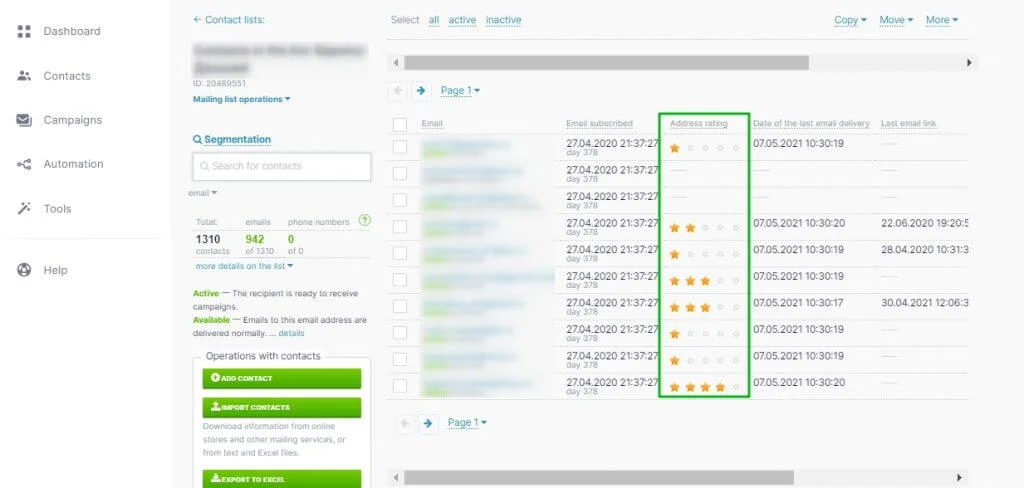
The stars you see near every contact are the indication of how active it is, ranging from never opening emails (⭐) to regularly clicking your campaigns (⭐⭐⭐⭐⭐). There’s more on rating and its uses in our knowledge base.
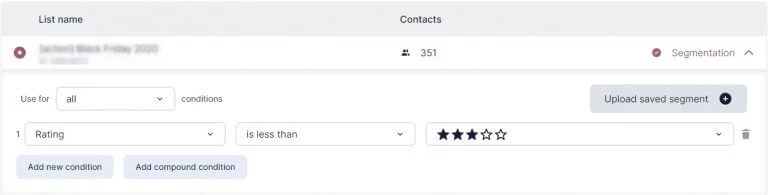
For re-engagement purposes, you need to filter out emails with 1-2 stars. That’s likely to be the majority of your lists. In your personal account, go to Contacts and segment those of them whose rating is less than 3 stars:
- By the date of the last targeted action
Another segmentation option is to sort out inactive contacts by indicating exact dates since when people didn’t open your emails or didn’t click:
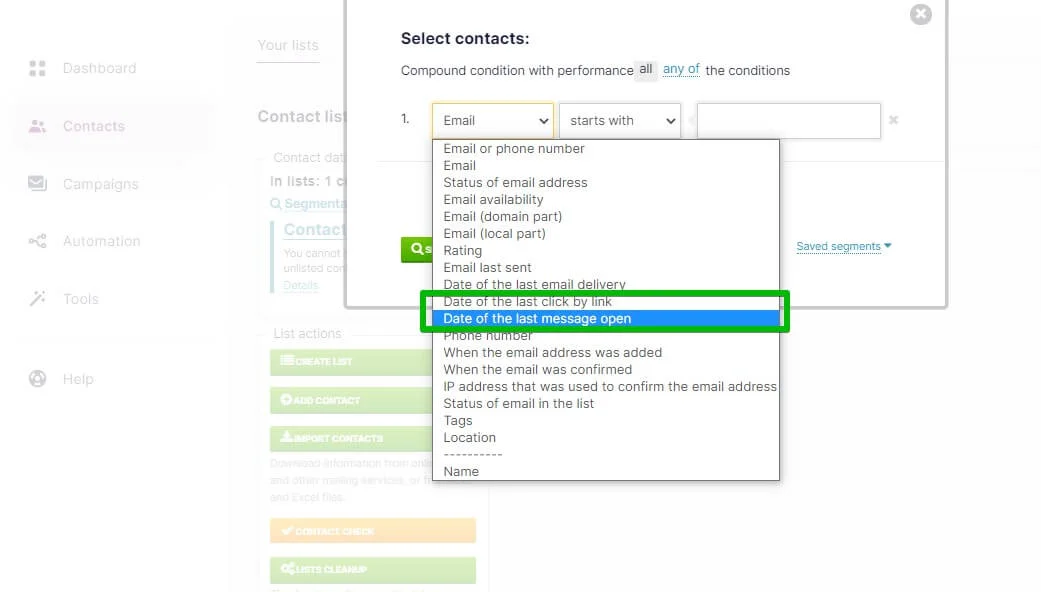
You can also filter out those contacts who didn’t make purchases for some time by integrating your ESP account with the software that contains the information about your business operations.
Step 2. Coming up with a strategy
Great, you’ve got a list! Now you need a plan of action, i.e. what to write about. It heavily depends on the reason why those particular people stopped interacting with you.
Check if they have something in common or whether you made a pivot recently that might have affected their behavior. What can you do to make them read, click, and buy again? If you’re out of ideas, a common and effective way to deal with this problem is to simply ask your subscribers about what might be wrong with your emails. You can offer a choice of options, for example, whether they want to receive your emails less often.
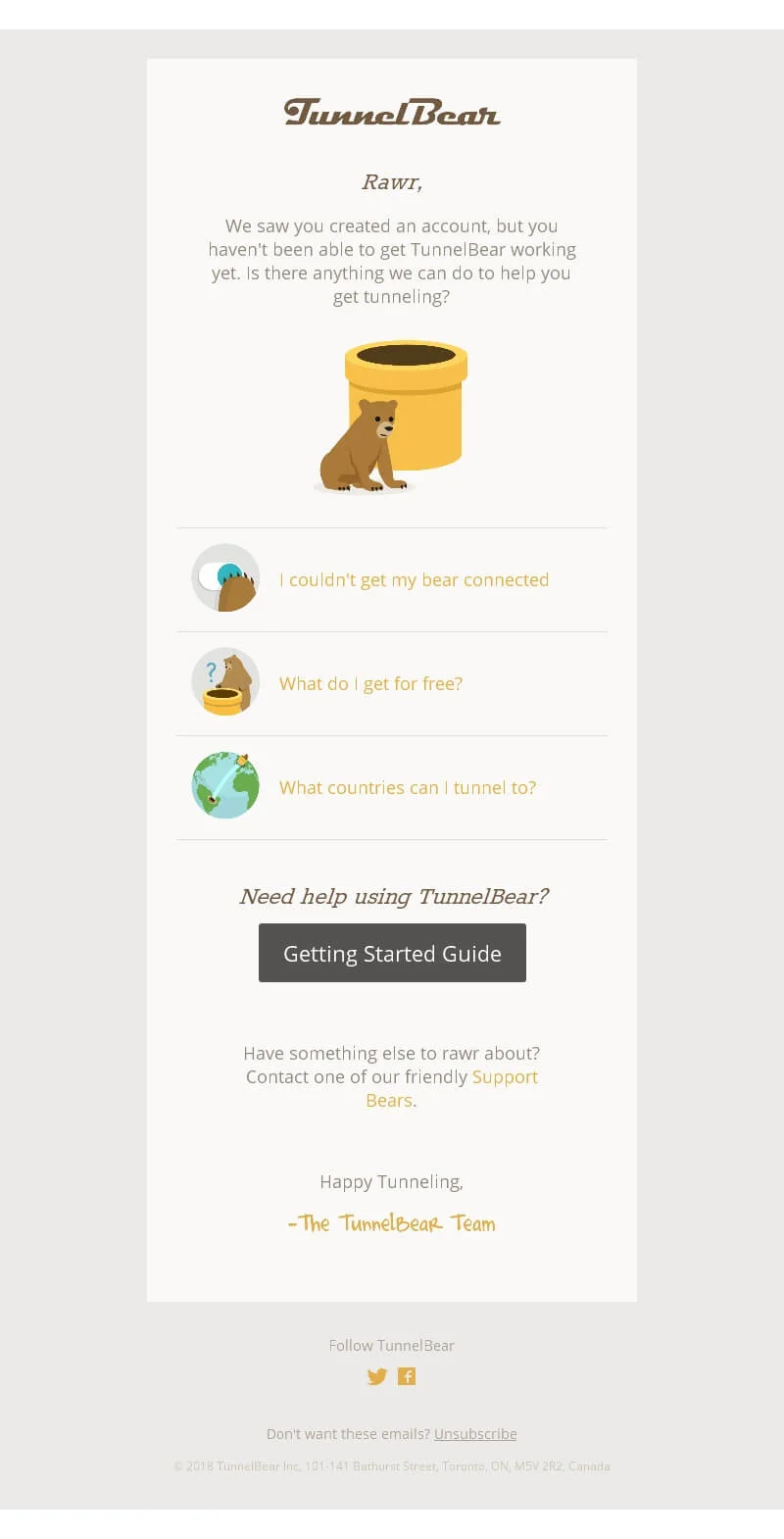
The TunnelBear VPN service wonders why some of their subscribers created an account but stopped right there and gives a list of possible issues to choose from. Source: Email-Competitors
Whatever the case, an effective re-engagement campaign usually consists of 2-3 emails and has a structure like this:
- You tell subscribers why you’re writing and that you practice unsubscribing those who are not interested.
Example
We see you don’t click on the content we send you. Is there anything we can do? If you don’t click in the future, we will have to unsubscribe you to keep our list clean.
- You give them reasons why they should read, click, or buy again. Promise gifts, useful content, or other kinds of benefits.
Example
Look at these perks we have for you!
- You tell them that your next move is to unsubscribe them.
“You didn’t click on any perks. We see you are not interested and we respect that. We had a great time together, but now it’s time to say goodbye”.
Example
You didn’t click on any perks. We see you are not interested and we respect that. We had a great time together, but now it’s time to say goodbye.
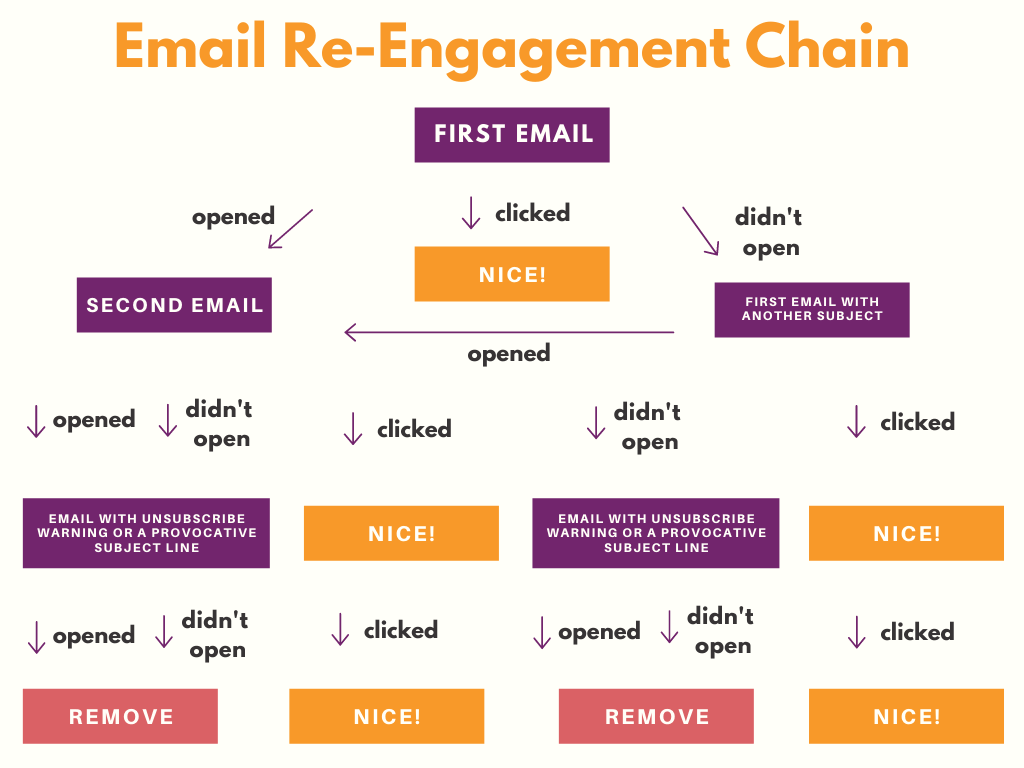
You’re also welcome to try different subject lines and offers along the way. Here’s an example of a re-engagement email chain with the goal to make subscribers visit a website:
Here are a few ideas on email content depending on the audience:
- What to write to those who do not open.
Work with the subject line, suggest responding to a survey (people like it when somebody wants to know their opinion), offer a bonus or discount.
- What to write to those who do not click.
Offer free and valuable content that subscribers can find on your website: a PDF, a book, a webinar.
- What to write to those who do not buy.
Use discounts, promotional codes, contests.
Step 3. Creating a campaign
Dormant subscribers are the result of a natural process that happens every day, so your reactivation efforts should be constant too. This is where you use the power of email marketing automation. Email service providers often have ready-made templates for re-engagement campaigns that you can use.
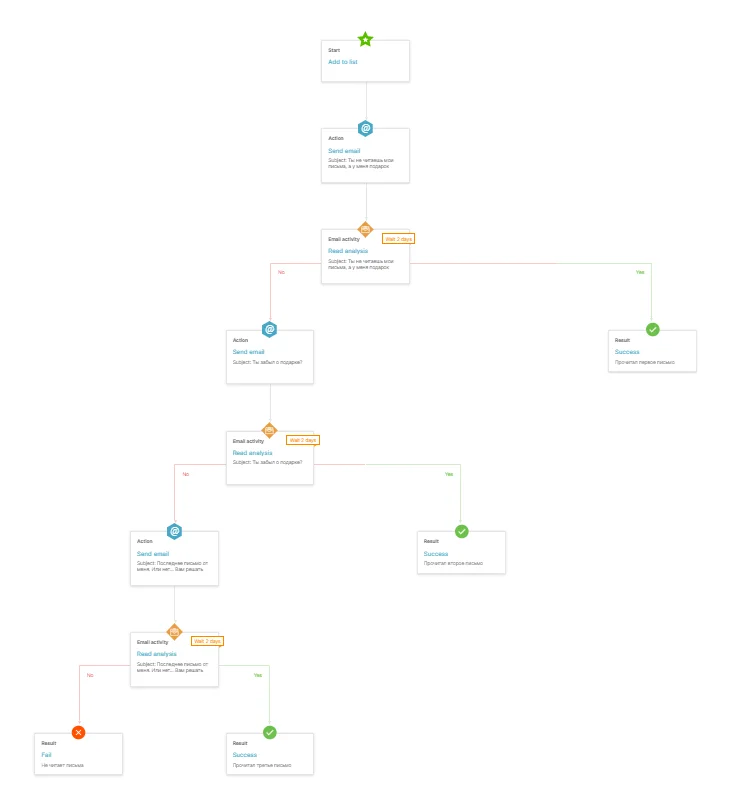
As for the time needed for each step of the process, then technically, you can set a couple of days for each email and in a week you’ll find out which subscribers no longer want to read your emails. We advise you to be more flexible though. The same report by Return Path claims that subscribers are seldom so quick. A good option would be to spread the process over several months.
Step 4. Testing and Analysis
Once you have your email chain ready, don’t start a campaign yet. Take your list of inactive contacts first and divide it into groups of 500 to 5,000 contacts. You need it for testing purposes. As re-engagement campaigns are usually more creative and on the brink of breaking the rules, there’s a chance you may go overboard and alienate people even more.
The number of groups doesn’t matter, the size of a group depends on the size of a list and how risky you are. You can also try splitting a list into groups according to their common features. For example, subscribers who have been inactive during the last 3/6/9 months.
Your plan of action:
- Divide a list into several groups of, let’s say, 1,000 contacts.
- Send a campaign to the first 1,000 contacts.
- See how they react. How many emails don’t exist or are otherwise unavailable? How many people report you as spam and do any of them send you angry feedback of how you had crossed the line with your provocative subject line?
- If there are no spam mass spam complaints or angry feedback, double the number and send to 2,000 contacts next. If there are issues, try another approach with the other 1,000.
- Rinse, repeat.
After you’re done with your campaign(s), study the results. Analyze subscribers’ behavior — what they like, what they don’t like and why, what they need, what gets a response. There’s an opinion that discounts with $ work better than discounts with %. Is it true in your case? Test it.
Don’t forget to transfer to active mailing lists those contacts that were successfully reactivated.
If some subscribers failed to read your emails no matter what or didn’t perform another targeted action after passing through the chain, remove them from mailing lists. Tough, but it’ll only make your lists stronger and more responsive.
Tips on making an effective reactivation email campaign
✅ The most important part of a reactivation email is its subject line. After all, the main problem is that people don’t open your emails so the subject of a re-engagement message should not only stand out among other messages but among your other messages also. Try unusual and creative approaches, humor, suspense, provocation even. Time for something unexpected if the usual ways don’t work. Just don’t forget to test it on a smaller group first.
Structure your subject line like this: tell what’s wrong and address a subscriber, try to describe your feeling, and trigger their feelings. By the way, we have an article about subject lines where we explore special techniques for creating them based on human weaknesses.
Some of the most converting examples:
- We miss you – 10% off everything
- We Miss You—Have You Seen What’s New?
- Hey Anna, it’s M&M’S. We miss you. Take 30% off now!
- OMG! 15% OFF Sitewide!
- Let’s start over
- Have you seen this weird picture?
- 3 awesome articles are waiting in your playlist
- I need to ask you something a little odd
✅ In the email body, tell your audience what to expect if they become active again. For instance, they get a gift, a discount, special treatment, or receive emails less frequently.
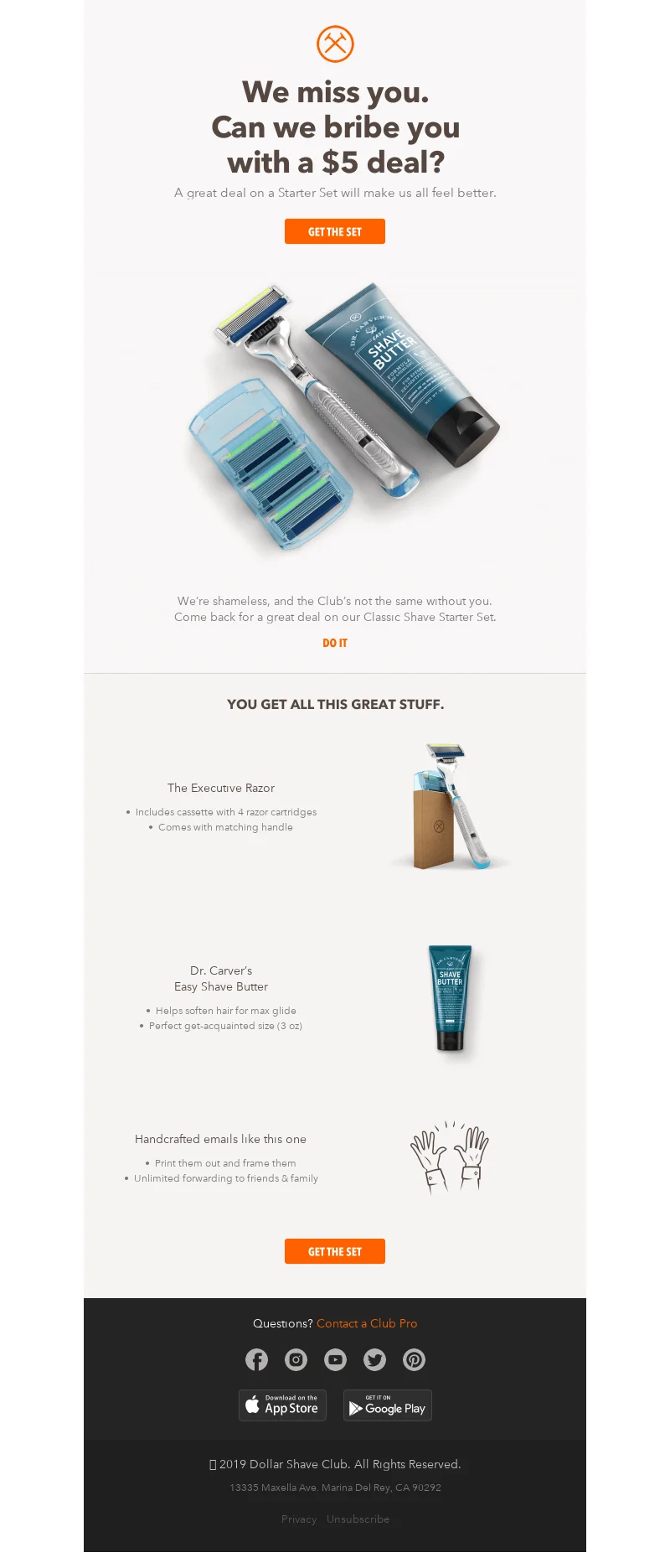
Dollar Shave Club’s reactivation email features a beautiful template and a persuasive offer. Source: MailCharts
✅ Provide additional options. Maybe your subscribers would be happier to follow you on Facebook instead of emails? Or they’d like a different kind of content? Or it’s best if they unsubscribe after all? But don’t overwhelm them with too many options or they’ll get confused.
✅ Make your copy funny and humorous.
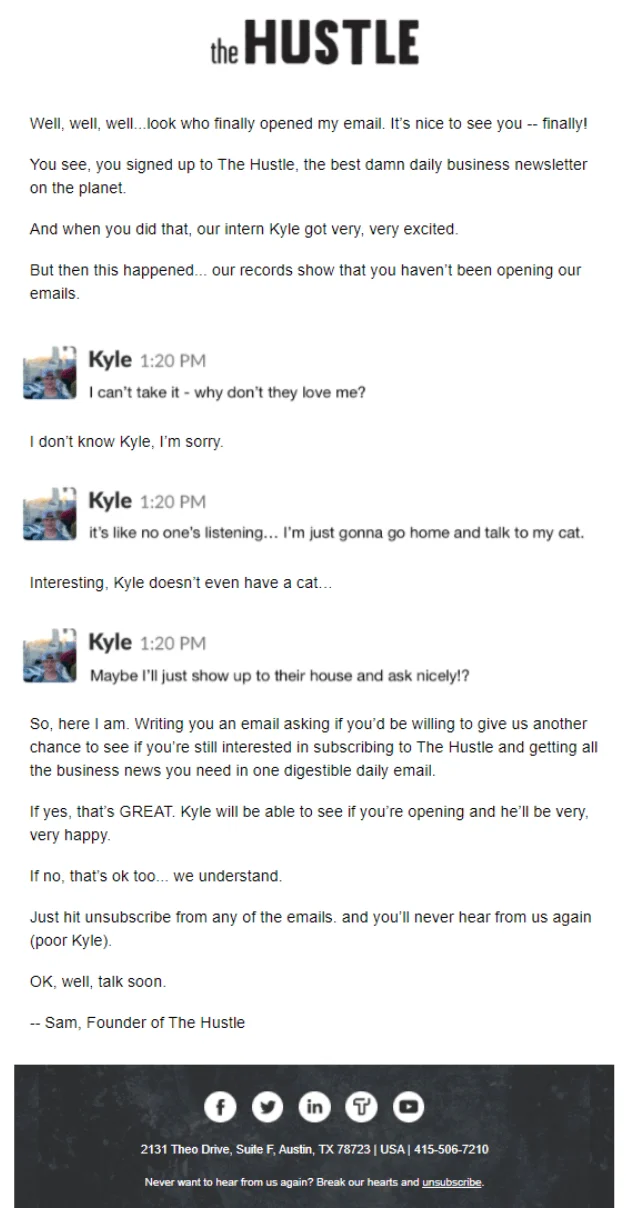
✅ Come up with new kinds of promotions and gifts, something that none of your subscribers have seen before.
✅ Personalize your message. It’s important that readers feel that you care and they are important to you.
✅ Make it easy to re-unite by giving a clear plan of action.
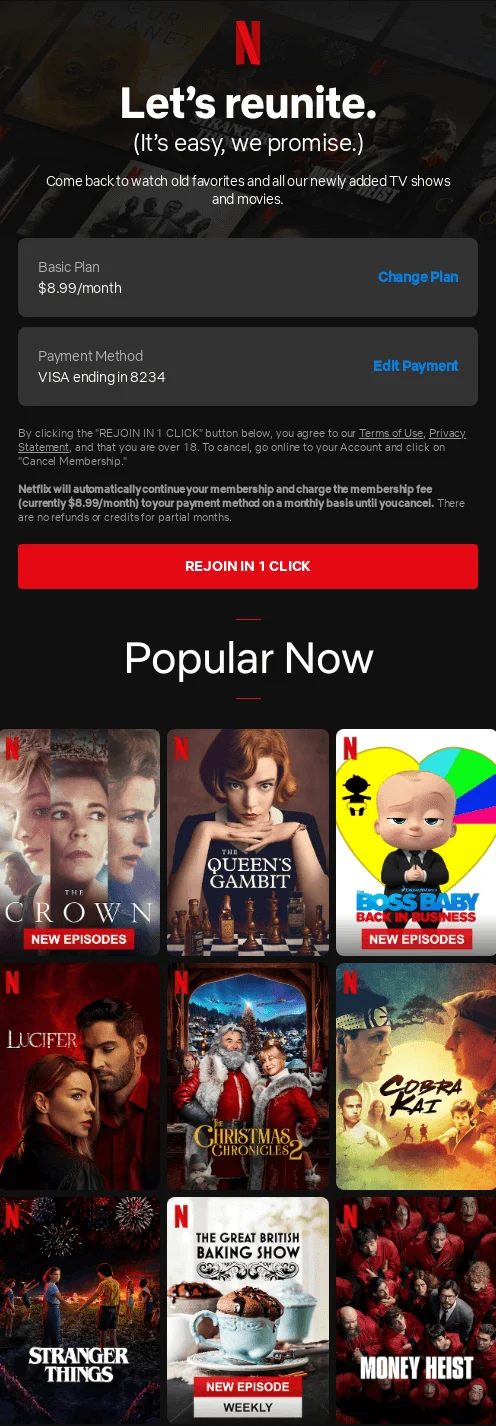
Just a click to rejoin Netflix. And look what you’ve been missing… Source: MailCharts
✅ Invite users to update their preferences.
✅ Ask questions, find out why they subscribed in the first place and what prevents them from actively participating now.
✅ Showcase capabilities that subscribers are about to lose if they unsubscribe.
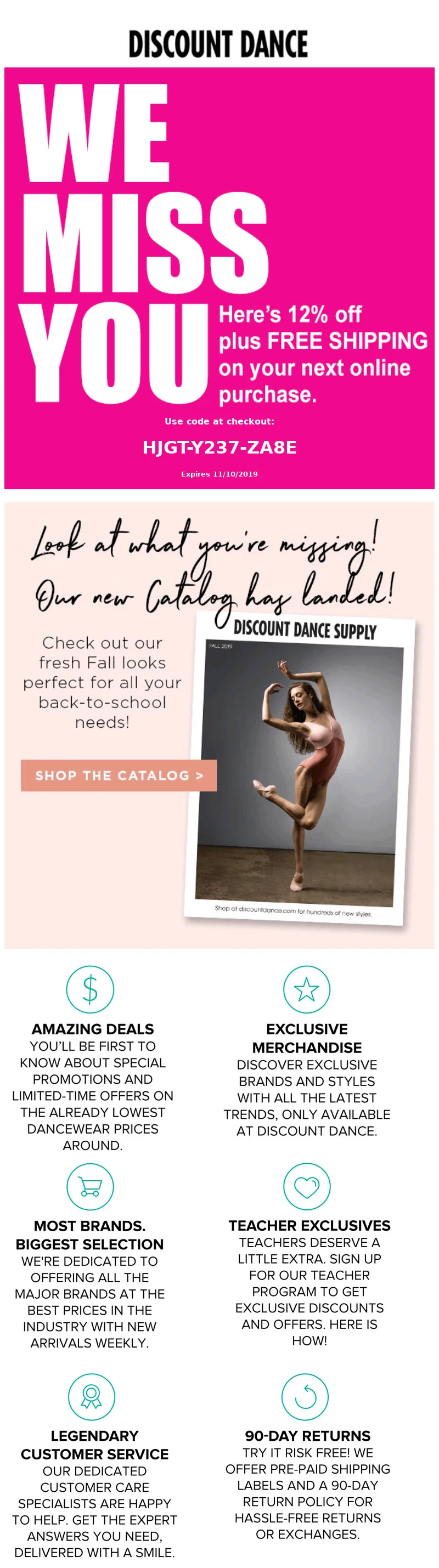
Discount Dance has an impressive set of features and is not afraid to show them. Source: MailCharts
✅ Make sure your content is really interesting. Put yourself in your readers’ shoes and try to imagine whether you’ll be OK with receiving messages from you.
✅ Try a different sending time. If your usual time is in the morning, try evening.
✅ Tell them what’s new and what has changed recently. Maybe all that your estranged readers needed is something that has been introduced only recently.
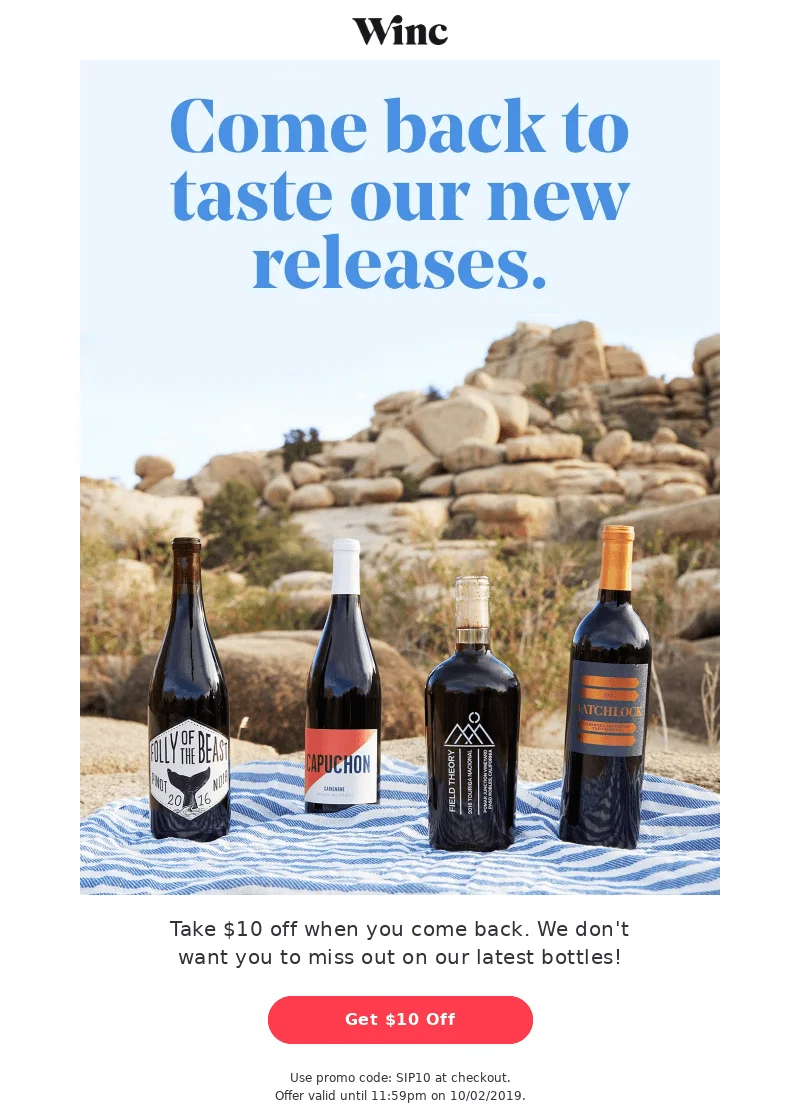
A straightforward message from Winc. Source: MailCharts
The point is that you should regard your emails as a standalone product with a value of their own, not as an extra. Emails should sell themselves and be of enough value. That’s why in reactivation emails, the best idea is to tell people why they should read and exactly how it will make their lives better.
When and how often to launch re-engagement campaigns
It depends on your mailing frequency, so the opinions of marketers vary. It’s one thing if you’re sending several times a day — then a week of inactivity looks wrong. It’s a different story if you’re into seasonal products — in this case, you’ll need about two years to pinpoint sleeping contacts.
In general, when segmenting, you might want to indicate a date 2-3 months before the current date. Other marketers advise on 3-6 months or calculate the period by the number of missed emails — for example, 11.
One more way to determine the ideal cadence is by multiplying your buying cycle by 2.5.
The important thing is that your re-engagement chains need to be constantly improved. Change offers and subject lines to reactivate more subscribers. Help them reconnect with your brand and they will reward you with regular purchases.
Email re-engagement case studies
Now let’s examine several cases that prove the importance of re-engagement campaigns:
1. CleverTap
CleverTap is a customer lifecycle management and engagement platform. In 2019, they decided to fix a situation when some of their clients signed up for a demo but failed to show any signs of activity after.
They came up with a 3-part re-engagement campaign and sent this sequence to about 500 people (swipe to see all):

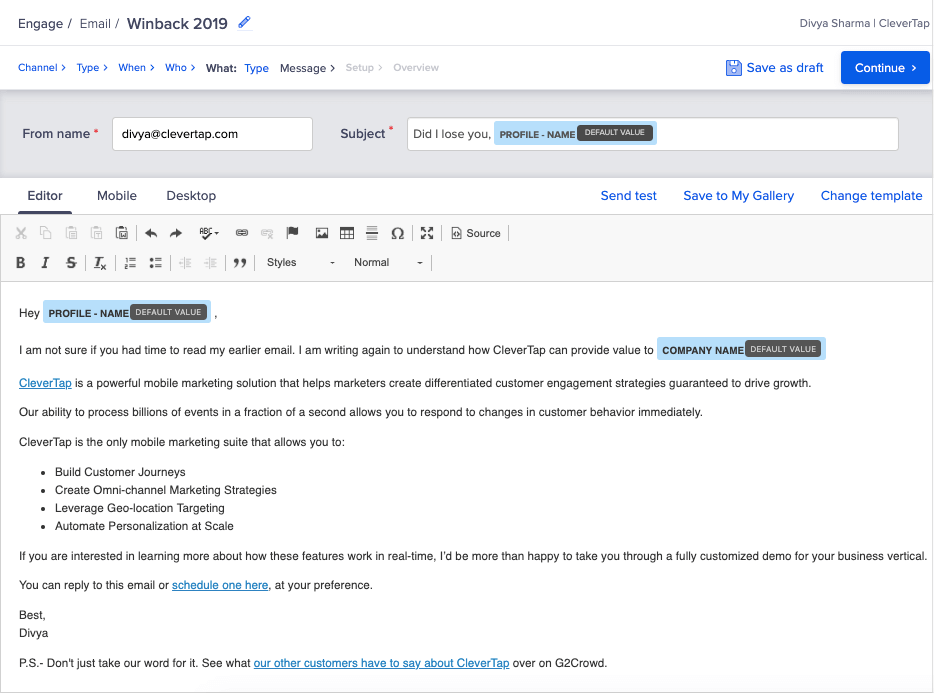
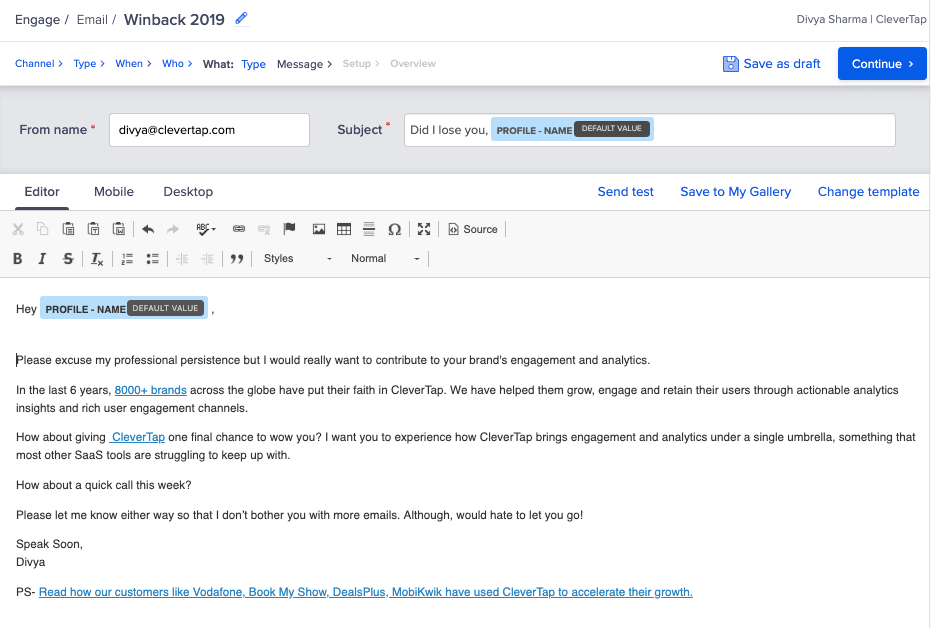
Results:
- 44% or 220 people opened the sequence.
- 27% or 135 people have clicked on one or more links.
- 35% or 175 people responded to emails.
- Over 45 prospects were re-engaged and went ahead with a demo and over 70 users sent their feedback.
2. SMG Richmond
SMG Richmond is a sports entertainment facility. They contacted the Etix ticketing service to help them launch an email reactivation campaign offering free tickets to theaters in Richmond, Virginia.
In the first email, they offered 2 free tickets and asked inactive subscribers to update their preferences. After a week’s time, they sent another message to recipients who hadn’t opened the previous email where they highlighted the incentive and used names in the subject lines. In the third email, they outlined the intention to unsubscribe those who do not update their preferences and it worked.
Results:
- The first email was sent to 61,247 recipients.
- Approximately 4,000 subscribers were re-engaged — about 6% of the original list of inactive subscribers.
3. CNET
MarketingSherpa describes the case of email re-engagement by CNET — an online platform that provides tech product reviews, news, prices, and more.
They had issues with the activity level of some of their subscribers and decided to launch a win-back campaign that consisted of 3 emails. Having identified inactives as anyone who had not opened or clicked in the last 120 days, they made a compelling sweepstakes offer their main attraction and tested various email subject lines and messaging.
Results:
- 8.33% of CNET’s user base was re-engaged.
Things to remember about email re-engagement
- Over time, some of the subscribers “fall asleep” and become inactive. Re-engagement email campaigns help to get them back to read, click, and buy again.
- Reactivation improves the sender’s reputation, reduces the cost per action, and gets extra profit.
- A reactivation campaign starts with segmentation and ends with result analysis.
- To create a reactivation campaign that works, study what pains and problems your clients have and be helpful.
- If some contacts don’t “come to life”, it’s better to remove them from the list.
 New and noteworthy on our blog