



Key takeaways
- T-shaped specialists have a diverse skill set, combining expertise in one area with knowledge in related fields.
- Benefits of being T-shaped include independence, better communication, and increased value to employers.
- Key T-skills for email marketers include email authentication, HTML/CSS, copywriting, UX writing, data analysis, graphic design, competitor analysis, and strategic planning.
- Learning these skills can enhance career prospects and adaptability in a changing job market.
- Beginners should focus on mastering email basics before diving into T-shaped skills.
So, you learned to craft and send mass emails in your favorite email marketing software — is that it? What can you do next? What to learn to earn more money, potentially switch careers, or improve your email marketing ROI?
If you find yourself asking these questions, you’re at the right place. Keep reading to learn what a T-shaped specialist is, how to become one, and which skills you need to make the most of your emails. Spoiler alert: not all of these skills are about emails!
Wait, what is a T-shaped specialist?
There are three types of employees based on their skill set. It’s easier to explain with an example — let’s take a look at these marketing specialists:
- Bobby has worked as a digital marketer in several small startups that didn’t even have a marketing department. She can write blog articles and scripts for short videos, send emails, set up automated responses on Instagram DMs, interpret metrics… She’s basically an entire team in a trench coat — but it’s a team of Juniors at everything. Bobby is a generalist.
- Ava is a copywriter specializing in blog articles about IT. She has a lot of writing experience and does a great job explaining complex topics in a digestible manner. But when a client asked her to write and design an email campaign, she failed miserably. She’s been in digital marketing for years but only knows how to write great blog articles. Ava is an I-shaped person — she’s an expert in one narrow niche.
- Tracey started as a freelance copywriter, and she still can do it pretty well. But she also did SMM, planned and sent email campaigns, and worked with push notifications. She also knows a little HTML and CSS, can design simple but cute visuals in Figma and Canva, and learned how to work in Meta Ads Manager. Tracey is a T-shaped person. She’s an expert in one niche and knows a thing or two about other niches that have something to do with her main specialization.
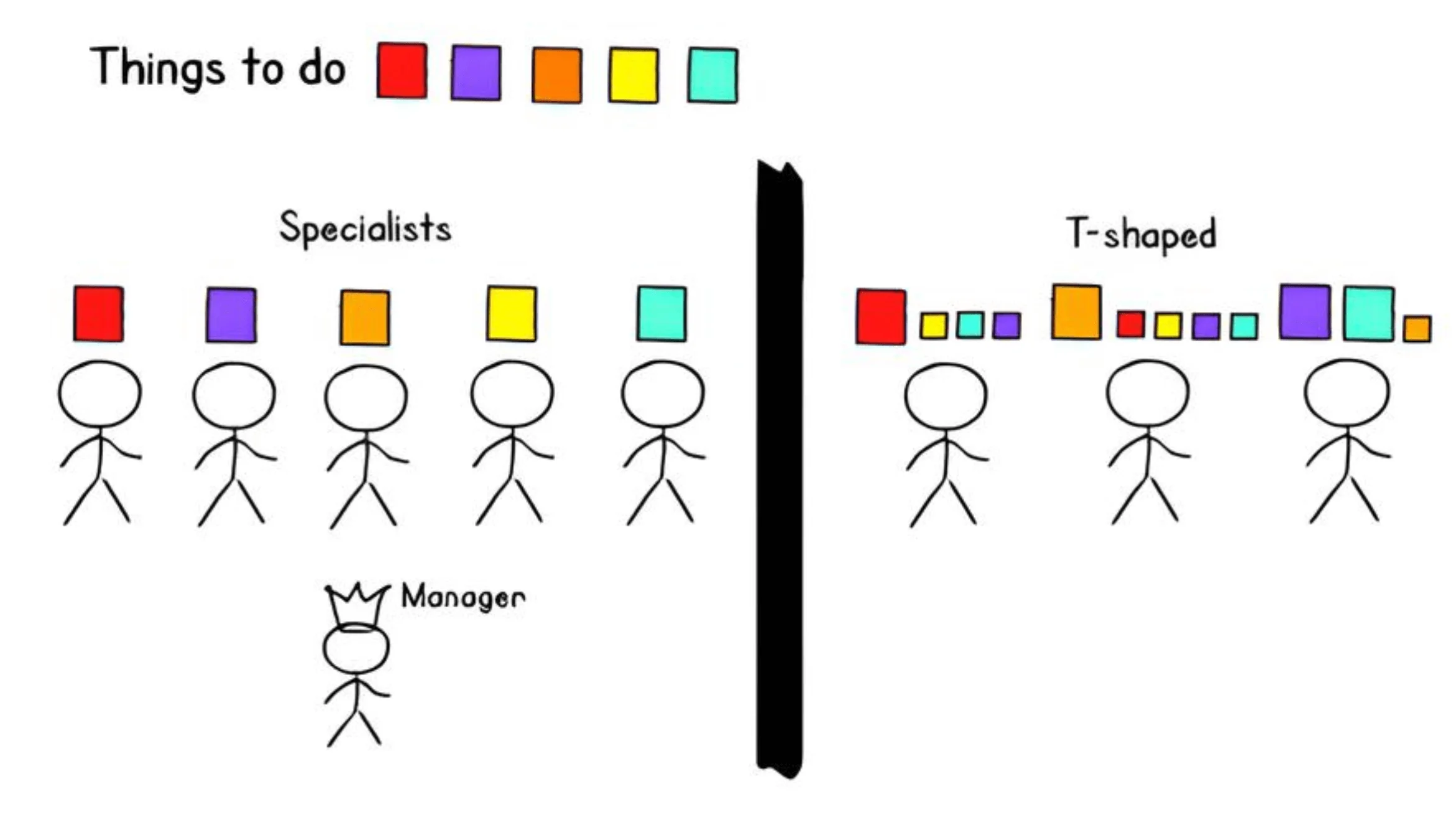
Being T-shaped doesn’t mean being capable of replacing an entire team, and it doesn’t mean being a “Jack of all trades, master of none”. Here’s what it actually implies:
- You’re more independent from the team. For example, an email marketer with some HTML background can quickly fix a broken email template without waiting for the staff developer to return from sick leave.
- You’re better at communicating with the team. For example, an email marketer who knows design basics can create a better brief for a designer or even craft a simple prototype in Canva. And a well-formulated task saves tons of time for both parties!
- You’re a more valuable player. For example, an email marketer with good copywriting skills can quickly finish tasks like creating a landing page copy while the in-house writer is overworked.
That’s why employers value T-shaped specialists. To help you become one of those this back-to-school season, we compiled a list of 8 T-skills that would be useful to an email marketer — and added some learning resources for each of them. Some of these skills are more related to emails, others are less. Don’t be dismissive, though! All of them will help you make the most of your email efforts, we promise.
Skill #1: Email authentication
Why learn it? DKIM, DMARC, SPF… All these scary abbreviations are the bodyguards of your email deliverability. You don’t have to gain detailed knowledge of how DNS records work. However, knowing the basic principles of email authentication and how to set it all up is a must for an email marketer who wants to land in inboxes, not spam.
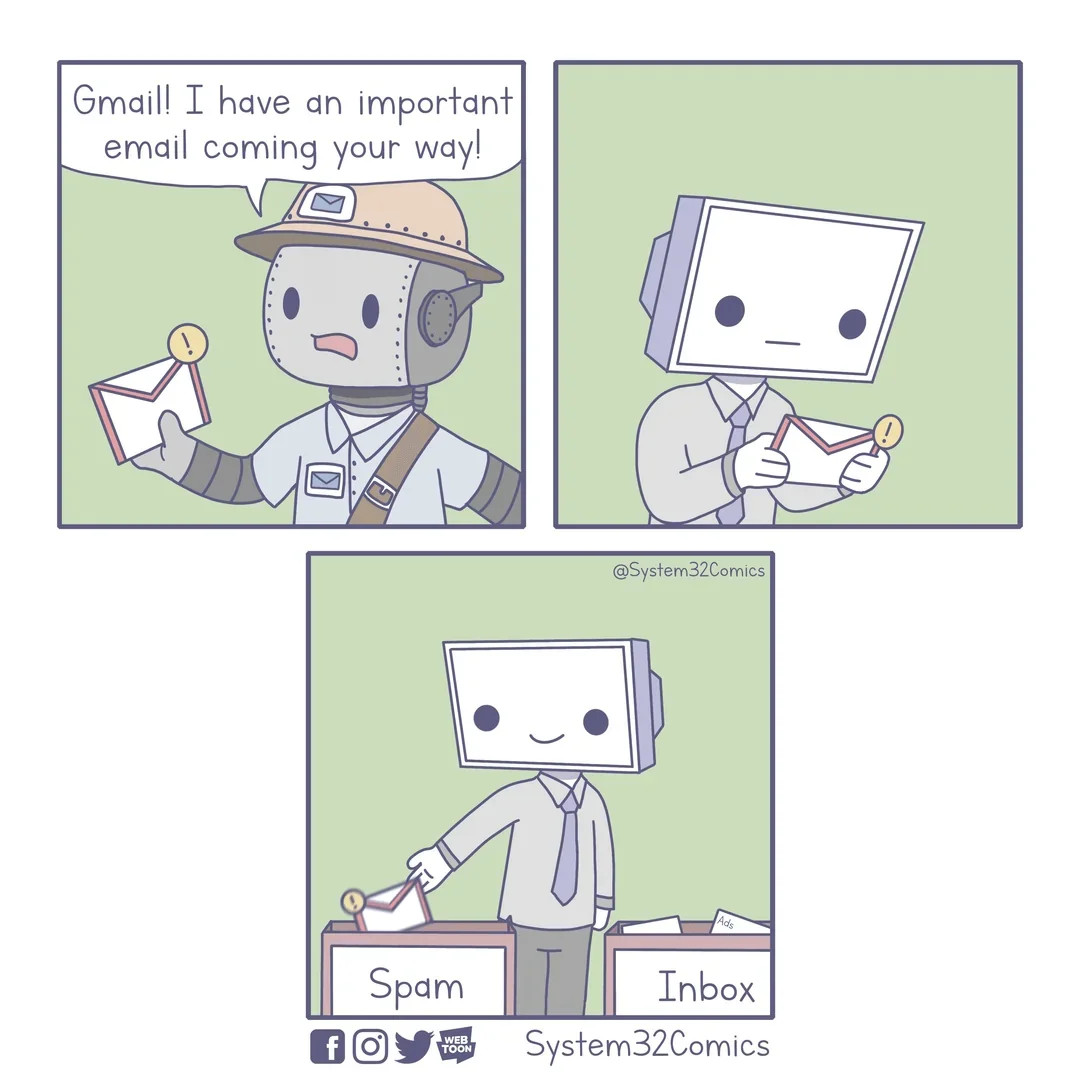
Where to learn it? Selzy has some useful guides on DMARC, SPF, DKIM, and email authentication in general. Also, we have a free deliverability course!
Scared of buying online courses because scams are everywhere? how to choose an online course and recognize questionable providers, self-proclaimed “experts”, and useless content.
Skill #2: HTML and CSS
Why learn it? You may wonder: Why do I need to learn coding if we have no-code email builders? While you’re not incorrect, knowing a thing or two about what’s under the email hood can help you a lot — here’s how:
- You can code unique HTML email templates that are not based on your builder’s templates and don’t look generic.
- You can switch to code mode and quickly fix your email template if you work in a buggy builder.
- You can create a template that is not dependent on the software and easily migrate between ESPs without having to build your email templates from scratch each time.
- You can customize the mobile view to the moon — it’s especially important since a lot of your customers read emails on their smartphones.

Where to learn? Start with HTML Basics and continue with this course on HTML email development.
Skill #3: Copywriting and storytelling
Why learn it? You may be a naturally good writer but it’s not enough to create a converting copy. If you learn how to sell with words and craft the story that will make your brand stand out, you’ll be able to:
- Not just convince people to buy your product but engage them emotionally with the narrative you’ve created.
- Write your emails quicker and easier instead of wasting hours on one line.
- Take care of your customers by writing easy-to-read and well-structured marketing emails.

Where to learn?
- To become a good writer: read The Elements of Style.
- To become a converting writer: The Copyhackers Copy School.
- To become a solid email writer: Selzy’s email marketing course has an amazing lesson on email copywriting — by the way, I wrote it 🙂
Skill #4: UX Writing
Why learn it? An email is a web page, which means it has an interface — and UX writing is all about writing the interface copy that is both convenient and keeps users engaged. If you’re an email marketer with at least some high-level knowledge of UX writing, you’ll be able to:
- Write better CTAs, which means more conversions.
- Design better experiments and A/B tests, which also means more conversions.
- Create better transactional emails, which means a better customer experience (and, possibly, more conversions).
- Look at emails through both marketing and UX lenses, and structure your email templates so they’re both readable and enticing, which means, you guessed it, more conversions.

Where to learn? Check out some free materials at UX Library.
Skill #5: Data analysis
Why learn it? If you’re working with emails, you’re working with numbers, and a simple comparison is not enough to make data-driven email marketing decisions. So, if you know at least the basics of statistics, you’ll be able to:
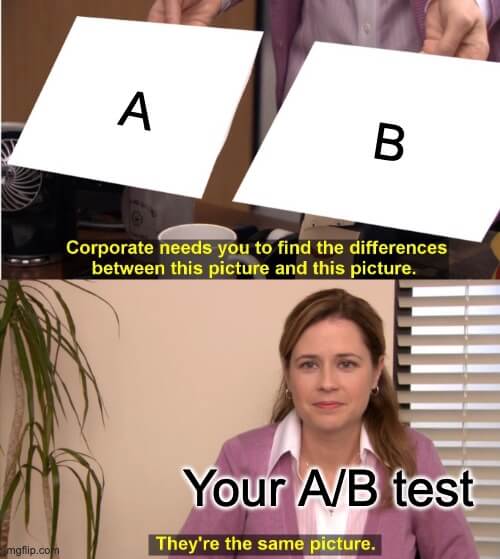
- Calculate A/B test results more accurately.
- Design more interesting and complex experiments that require regression analysis and other calculations.
- Set up more realistic KPIs for the future and get better at analyzing historical email campaign data.
Where to learn? Statistics Foundations on Coursera counts as a decent entry point.
Skill #6: Graphic design (the basics)
Why learn it? Ideally, you work in a company that practices the division of labor — there’s an email person, a writing person, a design person, and so on. But most likely, it’s not the case. Or, even if it is, here’s what you can do if you know at least some graphic design:
- Quickly create visual elements like hero images for emails if your company’s designer is overworked, currently unavailable, or non-existent.
- Set better tasks for designers in your company and create crystal clear visual briefs.
- Become more independent from your team members and more capable of handling all email production stages by yourself.
- Make better-looking emails, of course!

Where to learn? Figma’s library, Canva Design School, and Envato Tuts+ free video courses.
Skill #7: Competitor analysis
Why learn it? Simply subscribing to a bunch of your competitors’ newsletters is not enough to get a grasp of what’s going on in your niche — you also need to draw the right conclusions and use them in your work. If you know how to do it, you’ll be able to:
- Get and keep the intel that you actually need on your competitors.
- Draw inspiration from campaigns in your industry and put your own twist on others’ ideas.
- Find room for improvement in your email efforts.
Where to learn? Use this Semrush course and this Udemy course as a starting point.
Skill #8: Strategic planning
Why learn it? If you’re not thinking about what you’ll do with emails in the long run, you’ll only be able to plan your next campaign, and that’s it. Metaphorically speaking, you’ll build a house wall by wall, element by element, without seeing the full picture because you’ve never had a plan. Meanwhile, strategic planning will help you:
- Stay consistent with your brand positioning in every email campaign.
- Set and achieve email marketing goals and KPIs.
- Plan your work more effectively — you’ll know exactly what you need to do and when it should be ready.
- Achieve the marketing goals that are harder to measure like brand awareness.

Where to learn? HubSpot Academy has a short free course on email strategy — give it a shot!
Do I need this though?
The T-shaped skill set model is quite old — however, it’s been gaining more traction recently. For example, the CompTIA survey showed that 84% of employers use the model for workplace talent management. So, learning T-shaped skills in your field may increase your chances of getting a job or a raise. Especially in the post-ChatGPT era — according to WEF’s Future of Jobs report, employers estimate that 44% of workers’ core skills will change by 2027.
The T-shaped approach also protects you from skill inflation — it’s the phenomenon when there are more skilled workers than ever, so employers require more skills for the same positions. For example, a copywriter in the 2000s was good enough if they could write. Now, to get hired as a copywriter, you need to write in multiple genres and formats, do visual storytelling, generate memes, learn image editing and design software, no-code website or email building tools, and so on. So, many people can write emails — but way fewer people can write emails and code in HTML and inline CSS. This gives you a solid competitive advantage.

But what if I’m a newbie?
If you’ve just learned how to press the “Send” button, maybe learning T-skills will get you confused. What you need instead is to get a grasp on email-related basics. Emails are a lot, though: from design to analytics, these are so many skills — and you need the same amount of learning resources?! Fortunately, no.
 New and noteworthy on our blog
