


A no-code email builder lets you design responsive newsletters with drag-and-drop blocks instead of hand-coding HTML. The best option depends on what you need after the design is ready: sending and automation inside the same platform, or standalone template creation with export to another ESP.
In this updated guide, we compare 10 no-code email builders across templates, AI help, collaboration, exports, built-in email marketing features, and free-plan limits so you can choose the right tool faster.
Key takeaways
- No-code email builders allow designing responsive newsletters without coding HTML.
- Builders use drag-and-drop interfaces, making it easy to create emails without programming knowledge.
- Benefits include quick learning curve, complex design options, responsive templates, and cost savings.
- Two types of builders: ESP-bundled (e.g., Selzy, HubSpot, Mailchimp) and standalone (e.g., Stripo, Unlayer, Designmodo Postcards).
- Consider workflow, export options, mobile controls, collaboration needs, and AI features when choosing a builder.
What is a no code email builder?
A no code builder is a tool with a drag-and-drop interface that requires no programming or web design knowledge to create websites of any complexity, mobile apps — and, of course, emails.
“No code” doesn’t mean that there’s no coding involved. There’s still HTML under the hood but every block of code is represented visually. You don’t have to look through it unless it’s necessary — the source code is available if you want to tweak something by hand. Builders do the hardest part of the job, so you can freely focus on delivering quality content to your subscribers.
Your main building elements are blocks with which you create a responsive grid for your email. Basic blocks are HTML-based and let you add text, visual content or UI elements like buttons. These can be customized to your liking — you can change typography, color schemes, and more.
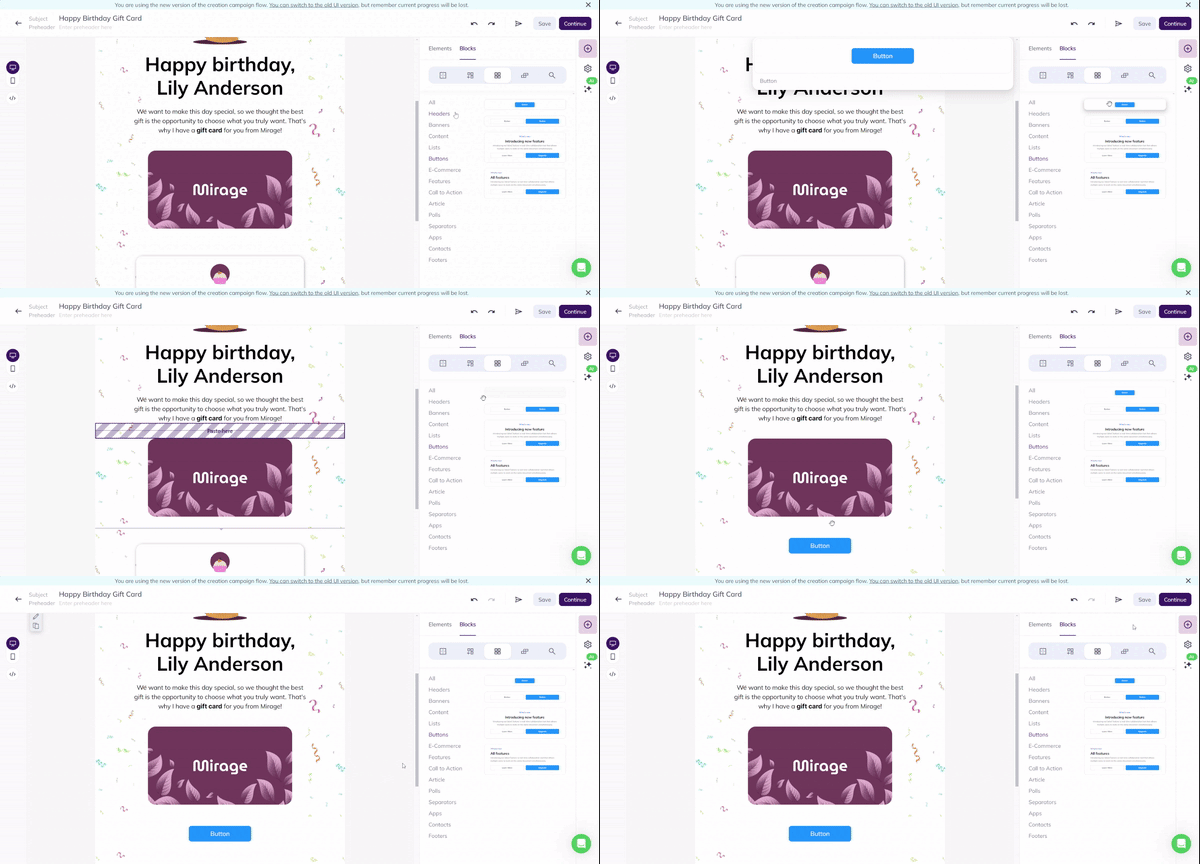
Some builders support AMP (Accelerated Mobile Page) blocks that allow you to add interactive elements — image carousels, forms, quizzes and so on. AMP allows users to perform some actions in the email itself, like giving their feedback or registering for an event. These responsive blocks may also improve engagement with gamification and other creative formats — a great alternative to making a separate landing page or integrating an app.
Here’s what you can do in no code builders:
- Set the layout. You can add and move around different types of responsive blocks that will mark down sections of your email — that’s where the content goes.
- Add content. After adding blocks, you fill them with text, images, and other content. Drag and drop a fitting element and then paste the prepared copy or media.
- Customize the design. Set the background color and text styles to make the template your own.
Benefits of no code email builders
Here are some benefits of no code email builders to consider if you’re still not using one:
- Email builders have a comfortable learning curve, allowing you to build your first email in a matter of minutes.
- You can make a rather complex email design with interactive elements, all looking at the same thing your recipients will see. Compare it with HTML where you can see the end result once you’re finished writing the code or when you create dozens of previews at every stage.
- The designs are responsive by default, so they look good both on desktop and mobile devices — and you can instantly check how your email looks on smartphone screens!
- You can create custom templates to keep all your branded emails consistent and build all your future campaigns a lot faster since you’re not starting from scratch.
- No code builders save money so you don’t have to hire a freelancer or a staff email designer.
The latter is especially important when you are doing marketing for non-profit companies. Professional designers cost money, so it’s crucial to use free and approachable tools when you’re on a tight budget. No code builders allow you to share the message without compromising the quality. And if you need other marketing instruments, be sure to check out the 50% discount on all Selzy plans that will help bring even more people to the cause.
10 best no code email builders and platforms
No-code email builders fall into two groups. ESP-bundled builders, such as Selzy, HubSpot, Mailchimp, Mailmodo, and Mailjet, are useful when you want to design, send, automate, and track campaigns in one place. Standalone builders, such as Stripo, Unlayer, Designmodo Postcards, Topol, and Beefree, are stronger when your team mainly needs template production, HTML export, integrations, or collaboration around email design.
Use this quick comparison before reading the full reviews.
| Builder | Best for | Builder type | Good to know |
| Selzy | Small teams that want design, sending, automation, segmentation, and stats in one platform | ESP-bundled builder | Useful if you want to launch newsletters without moving templates between tools |
| HubSpot | CRM-heavy teams that need email inside a broader marketing stack | ESP-bundled builder | Powerful, but pricing and feature tiers can become complex |
| Mailchimp | Small businesses that want a familiar email marketing platform with templates and basic automation | ESP-bundled builder | Check current free-plan limits before committing |
| Mailmodo | Interactive and AMP-style emails, guided campaign creation, and AI-assisted templates | ESP-bundled builder | Best when interactivity is central to the campaign |
| Mailjet | Teams that need collaborative email editing plus sending and deliverability tools | ESP-bundled builder | Good for review workflows inside a sending platform |
| Stripo | Template production, AMP elements, HTML export, and ESP integrations | Standalone builder | Strong choice when design flexibility matters more than built-in sending |
| Unlayer | Fast template editing, HTML download, team collaboration, and embeddable editor use cases | Standalone builder | Useful for agencies and product teams as well as marketers |
| Designmodo Postcards | Modular email design, reusable blocks, visual layer editing, and polished exports | Standalone builder | Feels closer to a design tool than a classic ESP editor |
| Topol | Simple template creation and downloading with a lower learning curve | Standalone builder | Good for basic production, less deep than some alternatives |
| Beefree | Template design, export workflows, team comments, approvals, and broad design inspiration | Standalone builder | One of the strongest standalone options for email teams |
Here are 10 options that we recommend for their quality, workflow, and fit for different email marketing setups.
Selzy
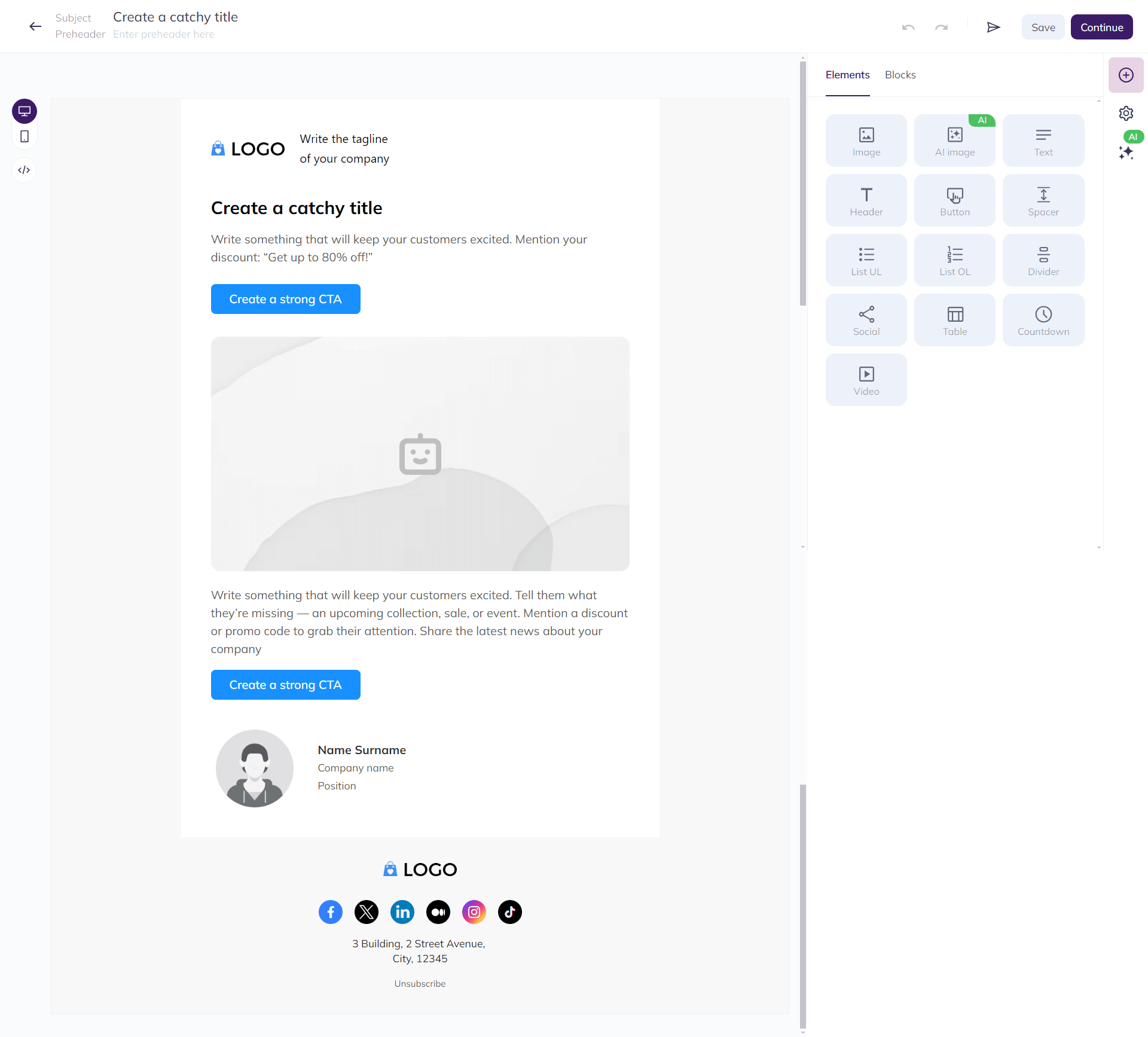
Selzy is a practical choice if you do not want the builder to be separated from the rest of your email marketing workflow. You can design a newsletter with ready-made blocks and templates, then send it, segment the audience, automate follow-ups, and check campaign stats in the same platform.
The updated Selzy builder includes AI tools for email copy and subject line ideas, plus visual options such as stock images, GIFs, saved blocks, countdowns, videos, and reusable design settings. This makes it useful for small teams that need polished emails without relying on an HTML specialist.
Learn more about the new Selzy email builder in our overview article.
Features: AI Assistant, stock image library, collection of customizable predesigned blocks and templates
Free plan: Limited to 1,000 emails and 100 contacts
Pricing: Starts at $7/month (billed annually)
Rating: 4.7 out of 5⭐
Link: Selzy Template Builder

HubSpot
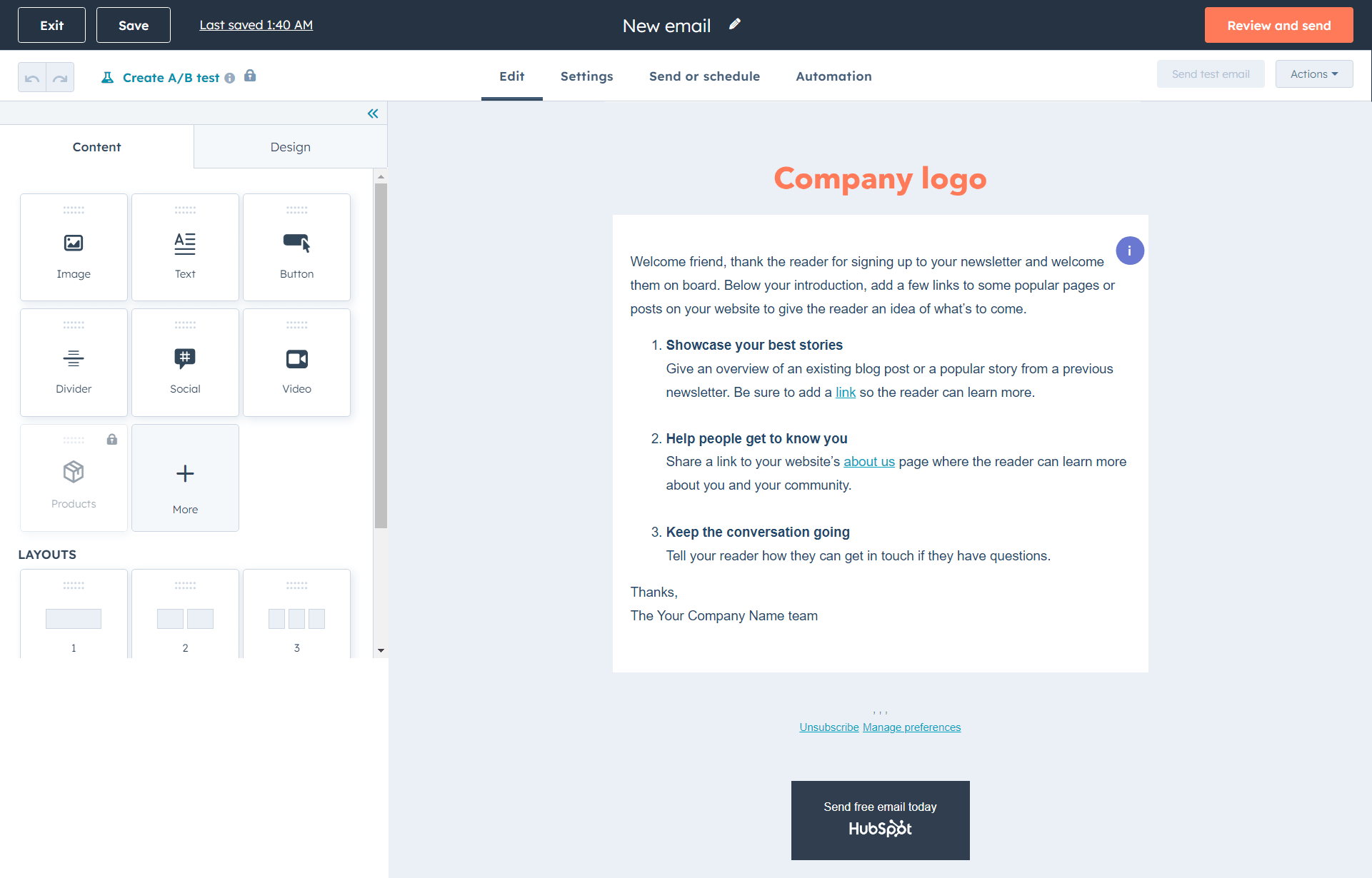
HubSpot offers a whole array of tools for digital marketing. Here you’ll find services for every step of your campaigns, including landing pages and email templates. Explore a drag-and-drop builder that is loaded with goodies like templates, responsive preview mode, and dynamic tokens based on your clients’ info.
You can collaborate with your team and set automation for what happens when your subscribers interact with the content. There are so many integrations and features that it can be hard to navigate at first, but it only adds to the overall usability.
Features: Templates shop, app integrations, full CRM functionality and built-in reporting
Free version: Limited to 2,000 recipients. Basic features only
Pricing: Email tools are included in a Marketing Hub subscription that starts at $18/month (billed annually). The full CRM Suite starts at $20/month (billed annually)
Rating: 4.4 out of 5⭐
Mailchimp
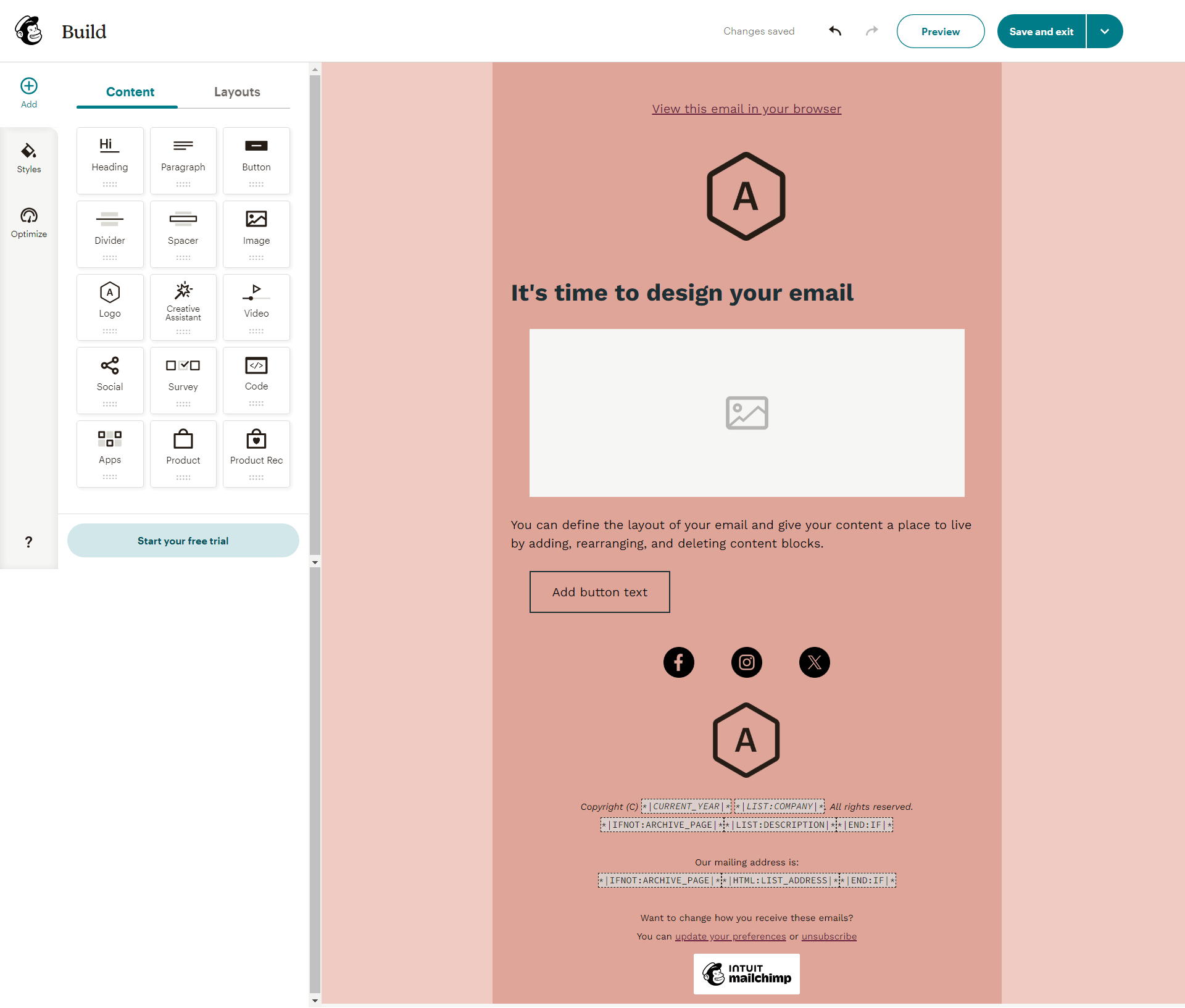
Mailchimp is a well-known name in marketing automation software that offers a simple and intuitive no code builder for emails and landing pages with 100+ templates. On top of that, you can also use the website builder to support your newsletters. There is a lot of room for personalization with merge tags to use in your content.
In addition to traditional elements, Mailchimp has several app integrations that allow you to embed social media posts, a calendar, or a playable video. And the most recent addition is Creative Assistant — an AI-based tool that generates visual content based on your own branding.
Mailmodo
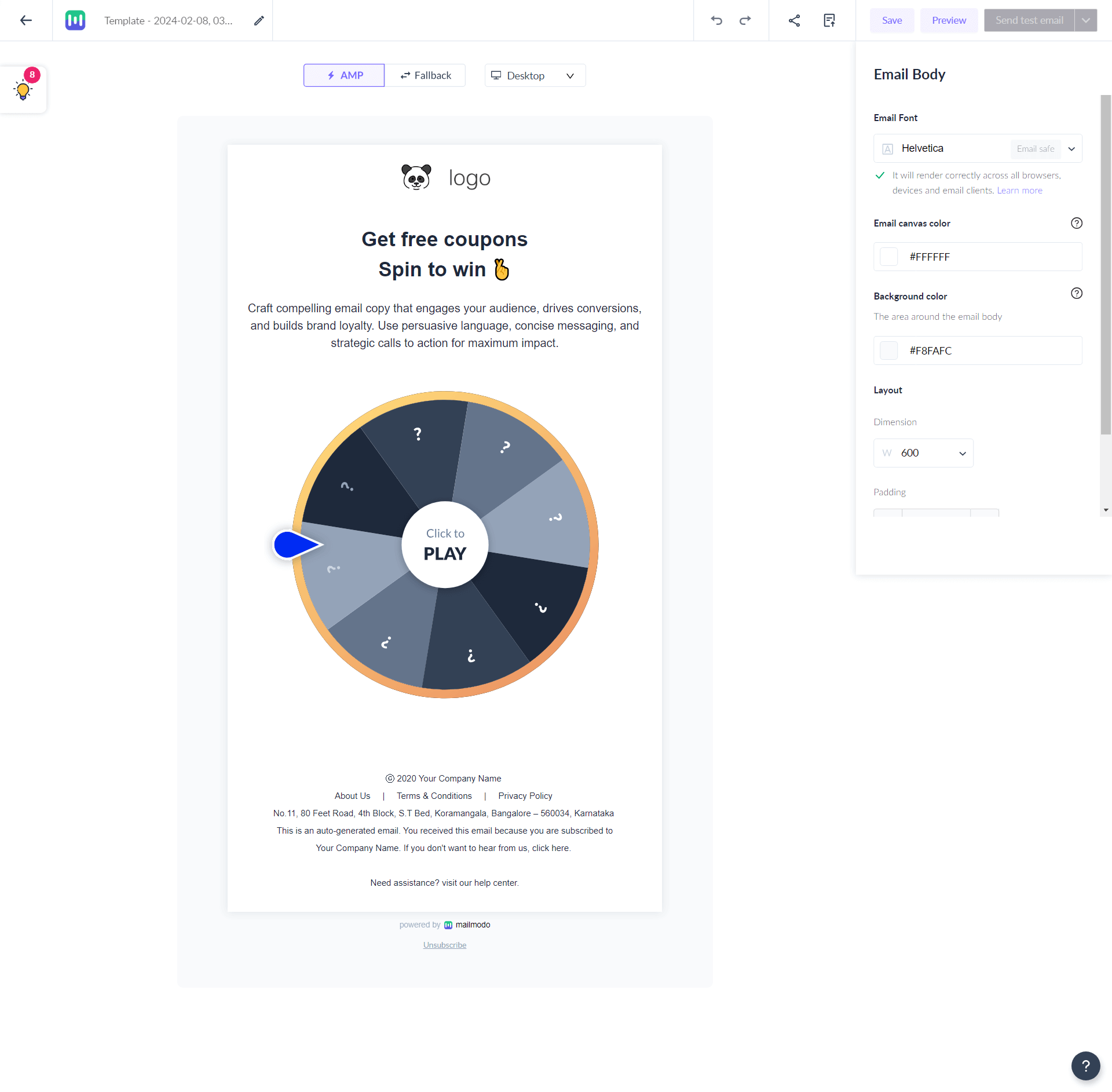
This one might be for you if you have no marketing experience at all. Not only Mailmodo has a huge collection of professional templates, the software also guides you through the whole process and notifies you of mistakes and possible improvements. Never send an email with a broken link again!
The big feature is the support of AMP blocks for better user experience and memorable product integrations. Mailmodo also offers AI for easier design and content creation that includes subject line, copy, and template generator. The latter allows you to build your own templates without lifting a finger — just write a prompt or choose the email type, tone, and length.
Features: 430+ templates, AMP elements, AI template creator, error checking tool
Free plan: 21-day free trial only
Pricing: Starts at $39/month (billed annually)
Rating: 4.6 out of 5⭐
Mailjet
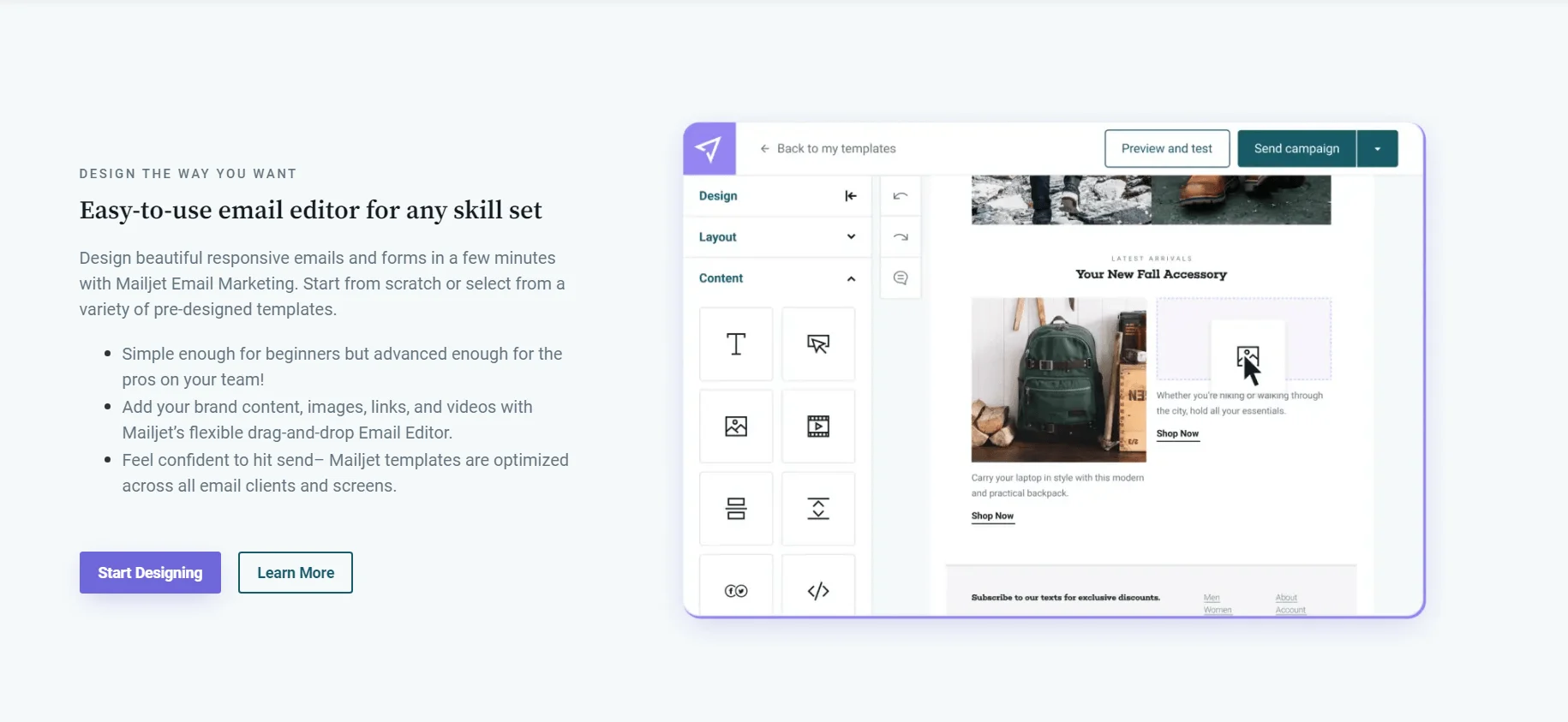
A flexible tool for composing, customizing and sending your newsletter. Functionality includes an AI copy generator for faster email writing and real-time collaboration much resembling the Google Docs workflow. On top of the builder, there is a fully featured marketing software with a focus on mailing automation and deliverability improvement. Keep in mind that the Mailjet support reviews registrations by hand and may ask for additional information on your business and the quality of your subscriber base.
Features: Templates library, AI copy generator, real-time collaboration
Free plan: Limited to 1,500 contacts and 6,000 emails/month. Only basic functionality
Pricing: Starts at $13.50/month (billed annually)
Rating: 4 out of 5⭐
Link: Mailjet Email Editor
Stripo
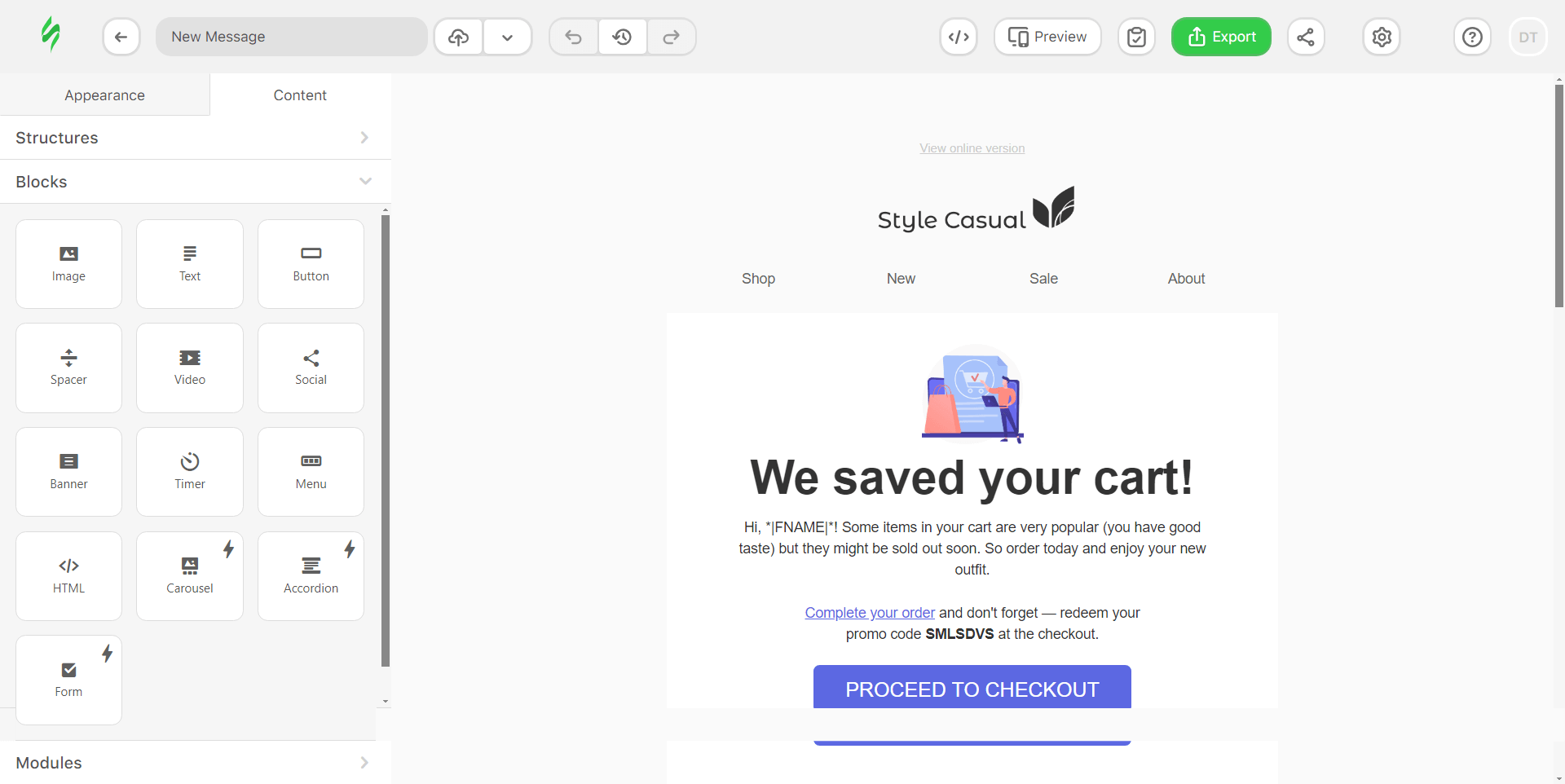
Stripo is a standalone email design platform, so its main strength is template production rather than campaign sending. It works well when you already have an ESP but need more control over design, mobile views, reusable modules, AMP elements, and export workflows.
You can build from scratch, start with a template, add dynamic content, fine-tune the mobile version, and then export the email to another provider or as HTML. This makes Stripo especially relevant for teams that create email templates for several clients or sending platforms.
Unlayer
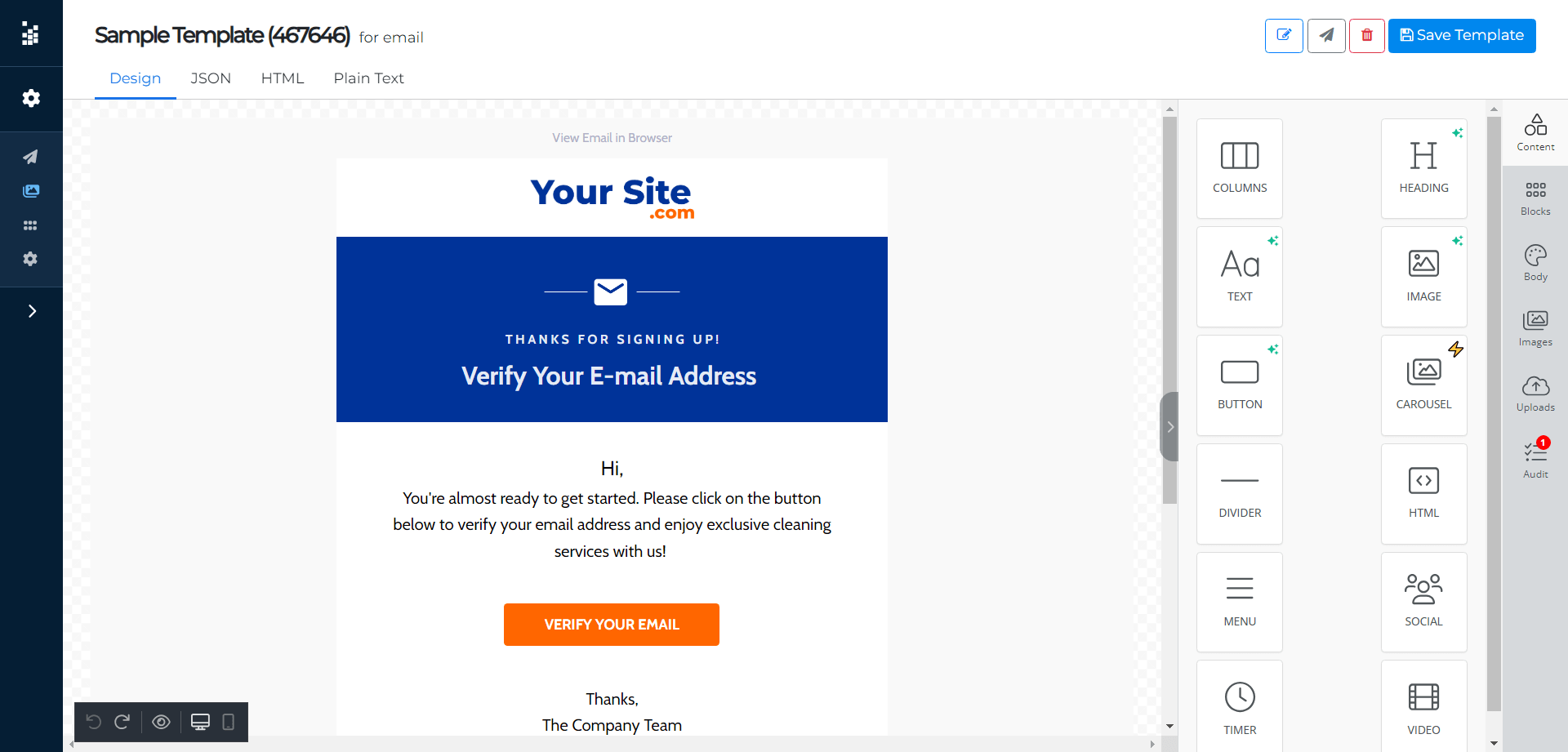
Unlayer is built around fast drag-and-drop template editing. Marketers can use it as a standalone builder to create emails and export HTML, while product teams and SaaS companies can also use Unlayer as an embeddable email editor inside their own apps.
The template library, AI writing help, HTML download, premium assets, and team collaboration options make it a good fit for agencies and teams that need a clean production workflow without tying every email to one ESP.
Features: Library of community-reviewed templates, AI generation and improvement, embeddable editor, collaborative editing (Team pricing tier)
Free plan: No premium templates, HTML export only
Pricing: Starts at $15/month (billed annually)
Rating: 4.1 out of 5⭐
Link: Unlayer Studio
Designmodo
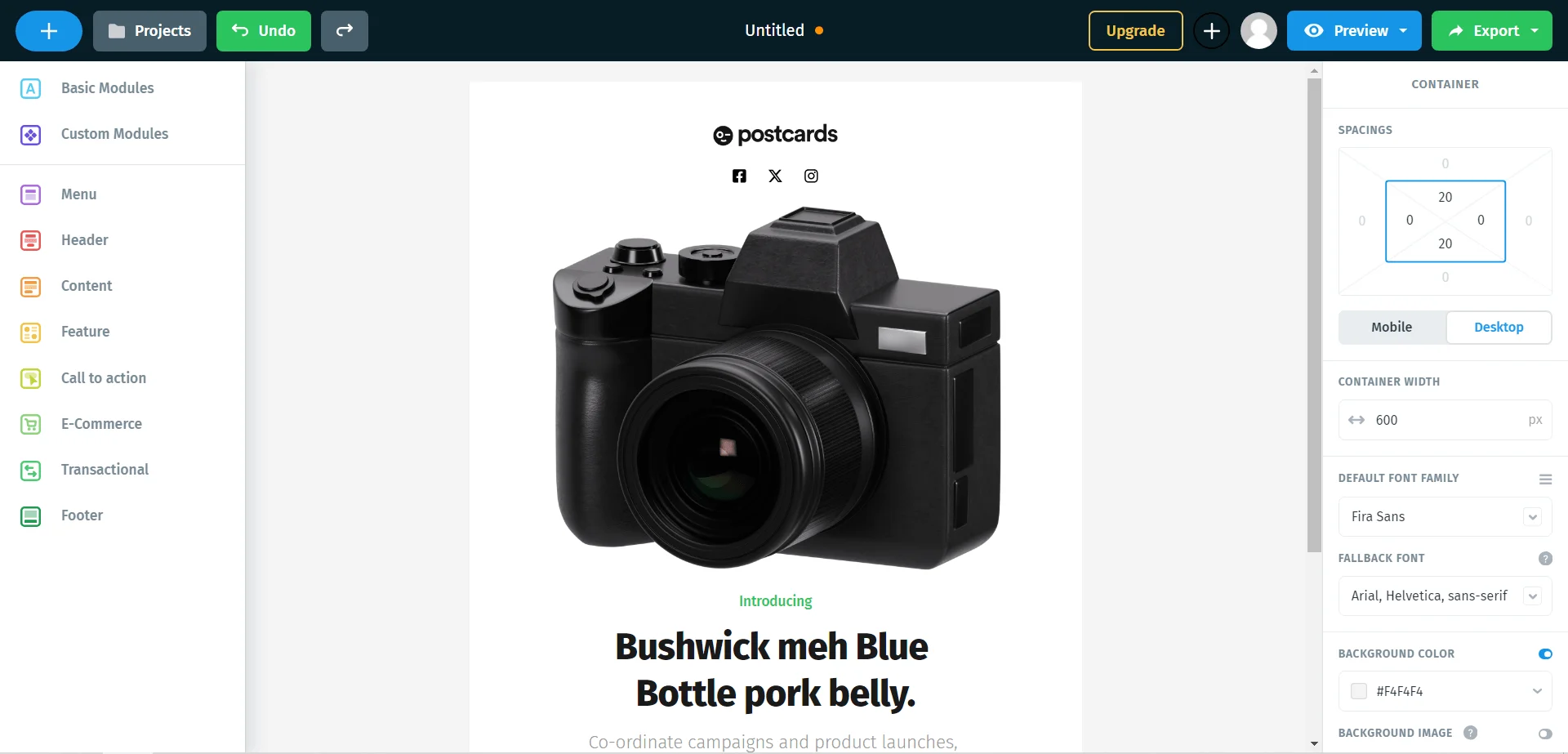
Designmodo Postcards is a modular no-code email builder with a workflow that may feel familiar to designers. Instead of relying only on full templates, you assemble emails from pre-made modules such as headers, product blocks, CTA sections, and footers.
The layer-style editing, reusable custom blocks, integrations, export options, team collaboration, and AI writing help make Postcards a strong option when design consistency matters and several people review the same template before launch.
Features: Customizable design blocks, inspirational layouts, 28 integrations with mailing services, team collaboration, AI assistant for writing emails
Free plan: Limited to 10 templates, 5 monthly exports and 10 email tests per day
Pricing: Starts at $16/month (billed annually)
Rating: 4.7 out of 5⭐
Link: Designmodo Postcards
Topol
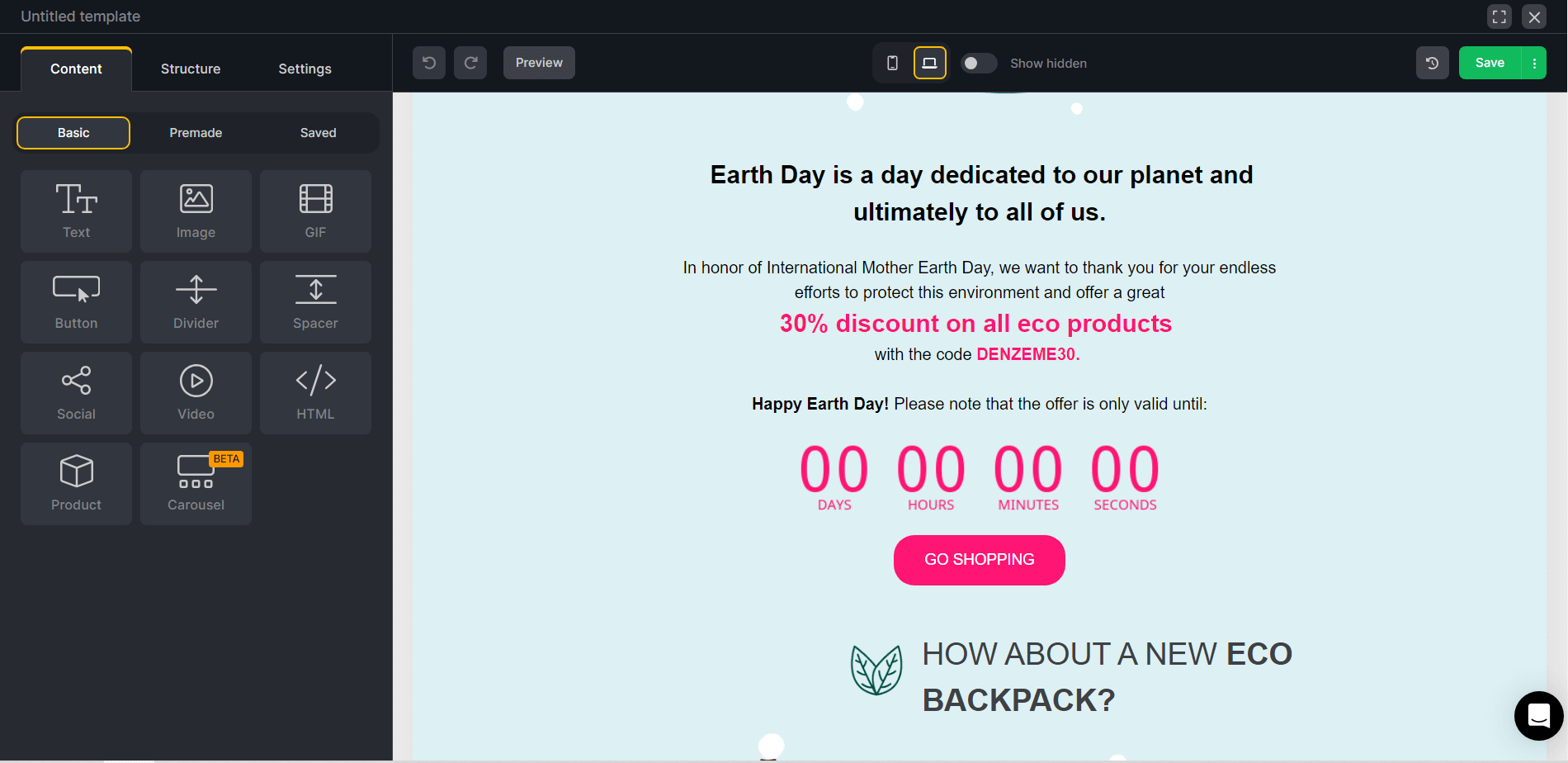
Topol is a simpler standalone builder for creating and downloading responsive email templates. It is not as deep as some larger template-production platforms, but the interface is approachable and the basic block system is easy to understand.
The free workflow is useful for trying the editor and producing simple templates. Paid features add more storage, exporting, collaboration, and AI assistance, so Topol makes the most sense for users who want a lightweight builder instead of a full marketing platform.
Beefree
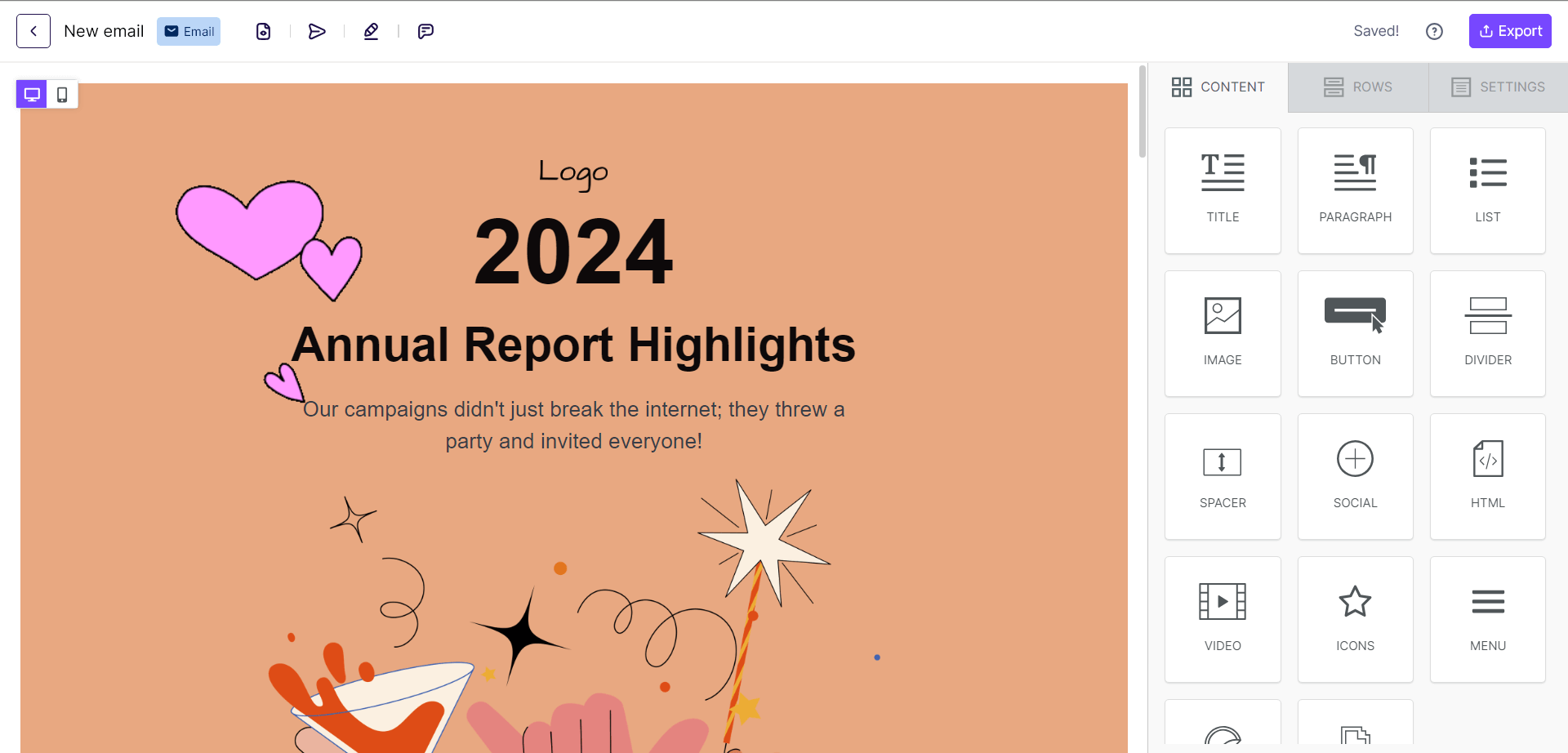
Beefree is one of the most visible standalone no-code email builders, and the SERP data for this update shows strong search demand around the Beefree topic. It is built for template creation, visual editing, exports, comments, approvals, and team workflows.
The platform offers a large template gallery, reusable assets, collaboration features, and export options for teams that create emails before sending them elsewhere. It is a strong fit for agencies, ecommerce teams, and marketing teams that care about design production as a workflow of its own.
How to choose the best no code email platform
Start with the workflow, not the longest feature list. Some teams need an all-in-one ESP with sending, automation, segmentation, and analytics. Others only need a flexible builder that exports clean templates to an existing platform. Use free plans or trials to test the editor, mobile preview, export process, and collaboration before choosing.
- Decide where sending happens. If you want one tool for design and campaigns, choose an ESP-bundled builder. If you already have a sending platform, a standalone builder may be better.
- Check export and integration limits. Standalone builders can limit monthly exports, direct integrations, or HTML downloads on free plans.
- Test mobile controls. A good builder should let you preview and adjust responsive versions without breaking the desktop layout.
- Look at collaboration needs. Comments, roles, approvals, saved modules, and brand controls matter when more than one person touches a template.
- Compare AI features by output quality. Subject line, copy, and image tools are useful only if they fit your brand voice and review workflow.
User-friendly interface
Even the most brilliant services sometimes suffer from UI flaws. Imagine buying a product only to find that it’s unusable without a three-hour-long video tutorial — not good, right? Your everyday working tool is not something you should struggle with. It should have a clean layout and intuitive workflow to make things easy for you. That’s why we use email builders in the first place!
Responsive design
Responsiveness is a vital feature. Whenever you design a marketing email, it must be easy to read and click through on any device. Most builders have a button to switch between desktop and mobile view. This way you can create the best experience for any user.
Ideally, the software itself should also adapt to your screen, if you’re ever in need to work on your mobile device.
Template variety
When you are just starting out, you may have no idea on what an email should look like. And it’s not limited to the visuals and layouts! Templates can help you in the beginning or break you through a creative block if you’re feeling stuck. Best services have loads of useful pre-made designs for any occasion and you can use them any time if you can’t or do not want to come up with something on your own.
Customization options
You can’t just take an existing template and send it to your clients like that. You need to make it your own, and the more options there are, the better. Replace visuals with your own designs or generate new ones if the service has integrated AI. Integrate your socials or engage with the clients through interactive AMP blocks. Pick the builder with the most options, so you can compose the dream newsletter each time you use the service.
Real estate is one of the industries where presentation matters the most. Your clients need to see the detailed photos and get hooked on what you offer them. Learn more about the best real estate marketing services and close more deals on the houses!
Integration with other tools
If you use a standalone builder, it is more convenient to integrate it with other apps that you have. If your no code software is not integrated with your email marketing or mailing app, you’ll have to copy and paste HTML. Although it’s not that inconvenient, HTML export is not as easy if you send emails using common email clients. For example, Gmail requires the code to be prerendered.
So, seamless integrations with mailing apps save you time and effort, so you’re just one click away from launching the campaign when you’re done. Other integrations may include options for embedding content or gathering clients’ information using the external CRM functionality.
Automation capabilities
It’s just easier to finish the template and click “Send” instead of juggling around on several different platforms. What’s even better is setting automation parameters and creating a whole user journey, for example, a welcome series.
If you have several alternatives to choose from, pick the one with automation. Even if you don’t know what it does yet, it will help you a lot further down the line. However, it still depends on your needs. If you already use a marketing automation platform and all you need is a builder with cool templates, standalone solutions like Stripo or Beefree can be a way to go as well.
Analytics and reporting
When your service gathers analytics and gives you a full report, you can use this knowledge to improve your emails or even the business itself. Getting insights on open and click rates will let you know which parts of your emails work and which don’t. It’s not necessary for a builder to have these extras if you only intend to use it for creating emails. But if you’re looking for a full-scale marketing solution that is suitable for more, analytics is a must-have.
Pricing structure
When choosing a paid plan, be sure to compare packages and see which ones have the most of what you need. For example, complex SaaS solutions like HubSpot have confusing pricing systems and a lot of extra features that come along with a no code email builder. So, choose the software and its pricing plans according to your needs if you don’t want to overpay for the functionality you won’t use.
For example, if you need a full CRM to run and analyze marketing campaigns, there’s no point in settling for apps that don’t have such functionality. And maybe you already have a nice mailing and tracking service but need a flexible builder? Then pick a quality one that lets your creativity run free but maybe doesn’t have a lot of fancy marketing features.
Collaborative editing
Some no code email builders offer real-time collaborative editing, which is convenient for teams. This feature allows you to stop wasting time on endless approvals and export-send test-rework hell. Instead, you can invite your coworkers (or clients, if you’re a freelancer) in the builder, look through their comments, and make changes right away. It’s like Google Docs for emails!
However, keep in mind that this feature is often paywalled. So, if you don’t work in a large company and use the builder sporadically for personal or small work-related tasks, you might not need to overpay for it.
AI-generated everything
These days, so many no code email builders offer native generative AI it’s becoming an industry standard. Many email building tools offer:
- Subject line and preheader generators
- Email copy generators
- AI image generators
Some email builders offer more exotic AI features. For example, Selzy’s updated builder has an in-built AI chatbot that performs several roles. It can translate your copy in any language or analyze your email from the psychological point of view and suggest improvements.
FAQ
What is a no-code email builder?
A no-code email builder is a drag-and-drop tool for creating emails without needing programming or web design knowledge. It still uses HTML under the hood, but the blocks are presented visually so you can focus on content and design. You can also tweak the source code by hand if needed.
What’s the difference between an ESP-bundled builder and a standalone email builder?
An ESP-bundled builder includes sending and automation inside the same platform, so it handles more of the campaign workflow in one place. A standalone builder is mainly for creating templates that you export to another email service provider. The best choice depends on whether you want an all-in-one tool or just template creation.
Do no-code email builders create responsive emails?
Yes, the designs are responsive by default, so they’re meant to look good on both desktop and mobile devices. You can also check the layout on smartphone screens as you build. This is one of the main advantages over coding everything manually.
What should I check before choosing a no-code email builder?
Look at templates, AI help, collaboration features, export options, built-in email marketing tools, and free-plan limits. Also consider whether you need sending and automation in the same platform or only a standalone template builder. These factors will help you match the tool to your workflow.
Are there good free no-code email builders?
The guide compares tools by their free-plan limits, so free options can be useful, especially if you are on a tight budget. However, free plans may come with restrictions, so it’s important to check what you actually get before committing. This matters even more for teams or nonprofits that want to avoid hiring a designer.
Final thoughts
Building beautiful and effective email campaigns may seem like a complex task at first. But there are plenty of tools that make it much easier. Design is what makes a good first impression, so don’t hold back on it and always pick the best software among the alternatives. There is an abundance of no code email builders that will help you send attractive content while not demanding you to learn anything new. Just find a service with the most fitting features and explore the new world!
 New and noteworthy on our blog