


Key takeaways
- Luxury brands rely heavily on strong customer relationships for success.
- Effective luxury email marketing involves personalized, visually appealing, and relationship-focused campaigns.
- Email marketing offers wide reach and direct, personalized communication for luxury brands.
- Retention emails are crucial for retaining loyal customers and winning back inactive ones in the luxury market.
Luxury brands depend on strong customer relationships more than any other niche. Selling high-ticket items while growing brand loyalty demands a unique approach, and luxury email marketing is a perfect solution.
Read this guide to learn effective strategies that will help you retain affluent customers and persuade them to purchase your products. Plus, see effective examples of email marketing for luxury brands.
Quick answer
Luxury email marketing is the use of personalized, visually polished, and relationship-focused email campaigns to sell high-value products or experiences without making the brand feel mass-market. The strongest campaigns combine customer data, elegant design, storytelling, exclusivity, subtle CTAs, and omnichannel follow-up. For luxury brands, email should feel less like a discount channel and more like a private client communication.
Benefits of email marketing for luxury brands
One fact to convince you that email marketing is the right choice for your luxury brand: for every dollar you spend on email marketing, you get $36 back.
Need more arguments? Below, we’ve outlined some of the key benefits email marketing can offer to your business.
Wide reach
is a very popular channel. In 2025, the number of email users globally reached 4.55 billion. Your Millennial and Gen X customers alike probably have at least one email address.
However, a big audience doesn’t always equal big reach. Many social media marketers have to constantly account for platform changes and other factors. Unlike social media, email marketing is an owned channel. There are no algorithms influencing your reach, no major platform rule changes, or restrictions like the ones looming over social media platforms globally. You can be sure that when you send your luxury email campaign, it will land in your customers’ inboxes. In general, your reach with email marketing is unlimited.
Direct and personalized communication
Luxury product advertising is all about building a deep connection with your audience, and offering a personalized experience is one of the best ways to do that. With email marketing, this process starts from the very first touch point.
You collect customer information like names or birthdays right on your website using an email signup form and then send personalized emails that include the facts your clients shared. Over time, you can integrate product preferences, purchase history, etc., to make personalization even more detailed.
Brands on social media broadcast a message that is the same for everyone. With email marketing, you can make your mass campaign feel unique to each customer. For luxury brands, that uniqueness should feel like recognition, not surveillance: use declared preferences, purchase history, appointment history, loyalty or VIP tier, location, size and style preferences, and lifecycle stage without overexplaining how much data you have.
Customer retention tool
According to McKinsey, the luxury market is emerging from slower growth, but the recovery is uneven. The United States remains the largest luxury market by sales, China is expected to be among the fastest-growing markets through 2030, and the global luxury market is projected to approach $700 billion by the end of the decade. In these circumstances, it is even more important to focus on existing customers, retention, clienteling, and owned audience relationships.
Retention emails allow you to prevent your loyal customers from leaving and give you a chance to win over those who have been ignoring you. Thanks to segmentation, you can group together subscribers based on their engagement levels and create dedicated campaigns for each segment.
Like B2B products, luxury often has long sales cycles. After all, expensive purchases need to be considered over time and discussed with family members, particularly when it comes to travel, real estate, and cars. Email marketing provides just the right tools for your brand to stay top of mind and keep your customers interested.

10 best email marketing strategies for luxury brands
Luxury brands have been using digital marketing for decades, so there are plenty of effective approaches out there. Let’s explore what you can do to make the most out of emails.
Use this quick matrix to decide which strategy deserves priority in your next campaign:
| Strategy | Best for | What to avoid |
| Personalization | VIP clients, repeat buyers, and shoppers with clear preferences | Copy that makes customers feel watched instead of recognized |
| Visual excellence | Fashion, beauty, jewelry, hospitality, travel, and design-led products | Generic layouts, cramped modules, or low-quality product images |
| Storytelling | Heritage brands, founder-led brands, and products with craft or provenance | Overexplaining features without building desirability |
| Exclusivity | Limited editions, waitlists, private previews, and member-only moments | Cheap urgency, aggressive countdowns, or discount-led scarcity |
| Customer-value segmentation | Brands with clear VIP, high-LTV, or high-intent segments | Treating top clients like a generic promo list |
| Experiences | Events, appointments, openings, launches, travel, and hospitality | Only sending product pushes after a high-touch interaction |
| Mobile optimization | Any luxury brand with image-heavy emails or appointment flows | Beautiful desktop designs that are hard to read or tap on mobile |
| Subtle CTAs | Premium products where discovery matters more than a fast checkout | Salesy language that breaks the luxury tone |
| Omnichannel integration | Brands connecting store visits, CRM, ecommerce, events, and service | Disconnected messaging across email, website, social, and clienteling |
| Valuable content | Brands with strong creative direction, expertise, or behind-the-scenes access | Content that feels like ordinary educational marketing instead of brand world-building |
Personalize extensively
As we’ve already established, personalization should be at the foundation of your luxury email marketing strategy.
You probably know about adding subscribers’ names to email subject lines, but there are a lot more ideas:
- Use demographics to target customers based on their gender, age, marital and family status, or profession. For example, send fashion newsletters dedicated to womenswear trends to your female customers and recommend products for kids to the parents in your audience.
- Insert relevant product recommendations based on past purchases. You can not only advertise similar items, but also send upsell or cross-sell emails.
- Send birthday emails and celebrate anniversaries.
- Create customer-specific recaps or yearly reviews. Although not universal, this strategy can be great for luxury travel brands or car brands.
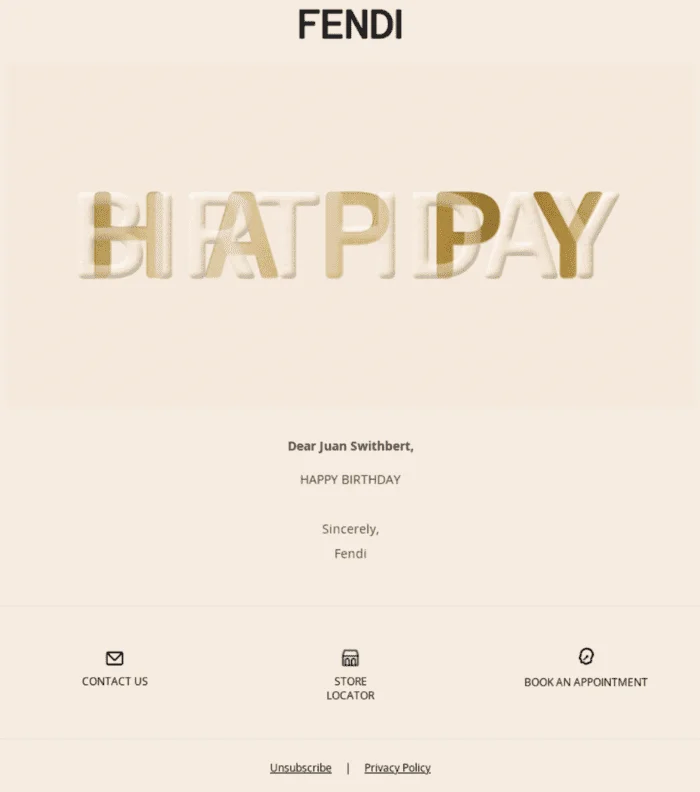
As an example, Fendi sent this minimalistic email to celebrate an email subscriber’s birthday.
Note how the brand refers to the customer by their full name as a sign of respect. Brands of a wide appeal would also probably include a personalized discount code. Conversely, luxury companies should avoid that, as it can both literally and metaphorically cheapen the experience.
Prioritize visual excellence
More than anything else, luxury buyers are driven by aesthetics and the image of owning an item.
Instead of explaining why your product is what they need, show them why they should want it. Make the visual aspect of your emails a priority — this is especially important, as more and more purchases happen online.
Here are some ideas you can use:
- Show close-ups of physical items to impress with every detail.
- Focus on craftsmanship by highlighting seams, texture, etc.
- Make out-of-the-ordinary photoshoots to complement your brand’s unique vision. Besides, 24% of luxury buyers want brands to feel bold.
- Use photographs of celebrities wearing your brand’s items.
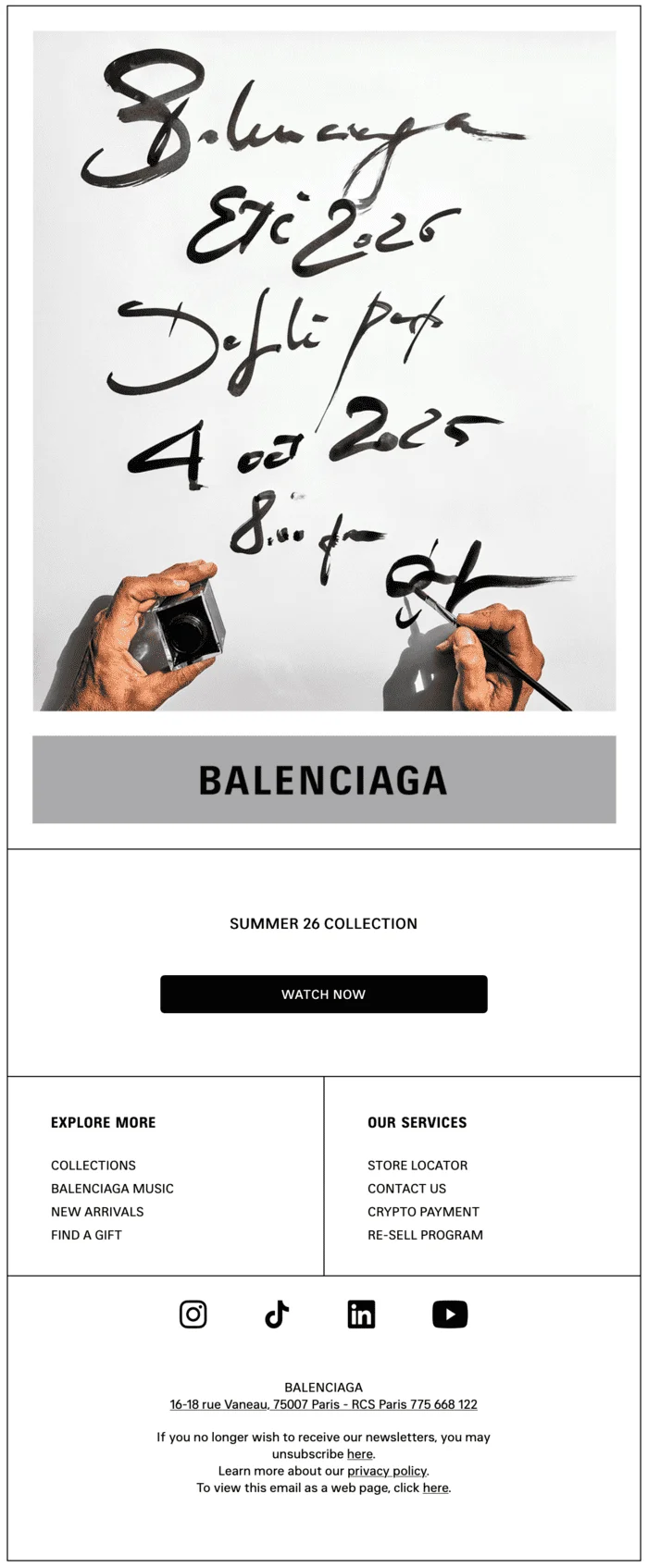
To announce the launch of the summer collection, Balenciaga used a photo of a poster, handwritten in ink. When everything is digital and mass-produced, this banner image feels bespoke and also ignites interest.
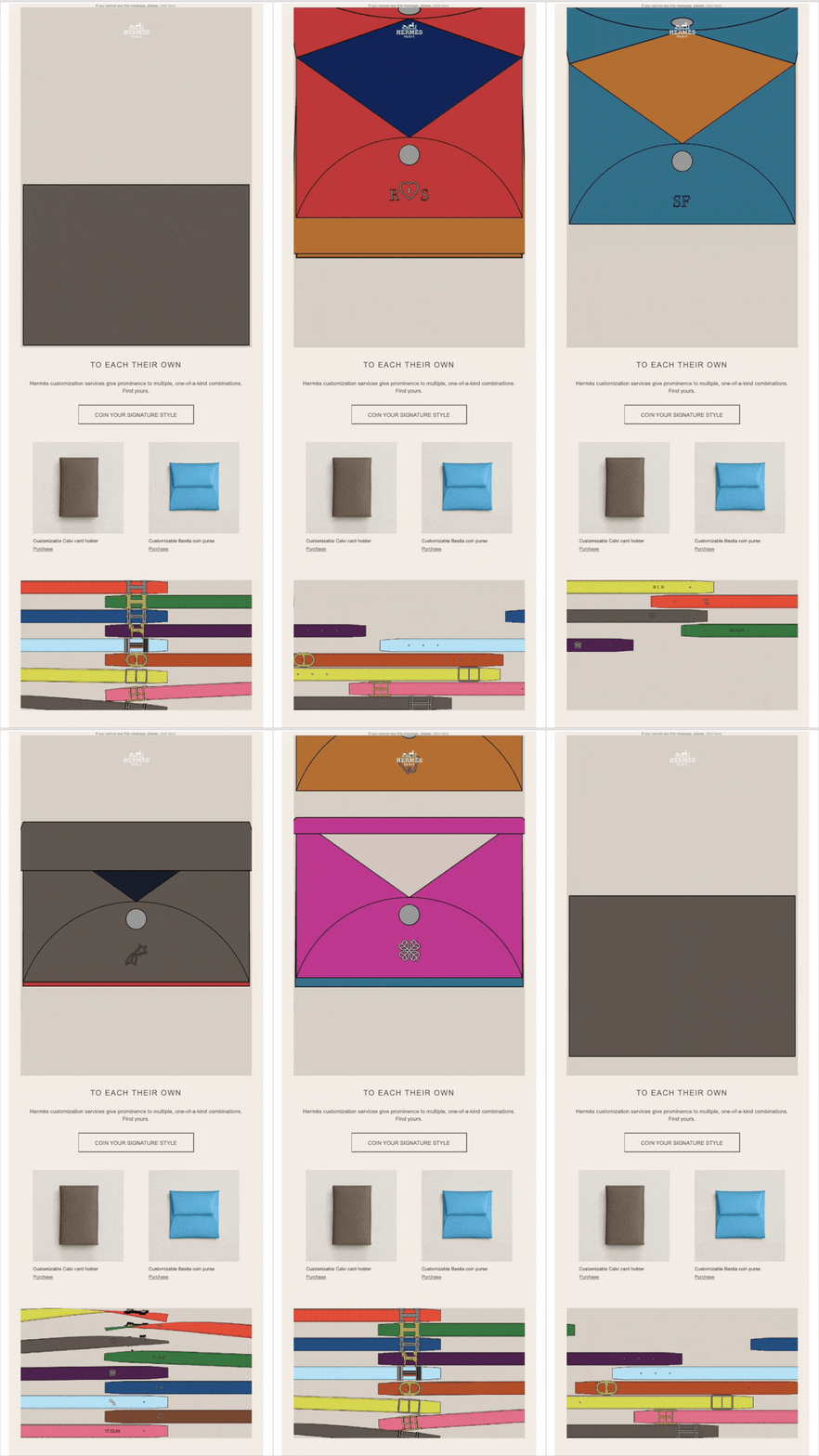
Hermès uses another approach to make the email marketing campaign visually interesting and inspiring. With two colorful GIFs, it looks playful and effectively conveys the message about customization.
Tell your brand’s story
Luxury items are not just products — they are status symbols. 24% of buyers want brands to help them improve their image or reputation, which means your brand needs to have a strong narrative supporting it.
Using storytelling in your emails, you can establish the prestige and value of your luxury business. Each company has its own specific positioning and suitable brand marketing strategies, but here are some general ideas you can explore:
- Tap into your brand’s history. Luxury fashion houses like Dior or Chanel have been around for decades. Celebrate your brand’s anniversary, talk about iconic pieces from years prior, or mention historical figures who were your ambassadors — make your company’s legacy front and center.
- Put the spotlight on founders. Show that there’s a visionary whose ideas are translated into products. This is especially important for designer brands and name brands.
- Highlight the innovation and expertise. This is a great strategy for newer brands. Convince your customers that your product has unique features or qualities, uses patented technology, or industry professionals’ knowledge and skills.
Another effective storytelling strategy is creating your brand’s own language. More than just brand voice, this means employing designated terms to talk about your products. In the content marketing email below, Ferrari calls the cars “Prancing Horses” and mentions their “breeds.” This plays nicely into the brand image and its logo.

Create urgency with exclusivity
Urgency is one of the popular tactics that broadly fit into FOMO marketing. For luxury brands, though, it’s not that easy. Even for your Black Friday emails, you ideally shouldn’t just use typical CTAs like “Act now” or big countdown timers.
Luxury marketing requires more sophistication. Instead of time-sensitive messaging, focus on exclusivity like limited editions or members-only access. You can also create email sequences that start from joining the wait list, continue to teasers, and lead to launch, which builds loyalty over time. The goal is to make subscribers feel recognized and invited, not pressured by artificial scarcity.
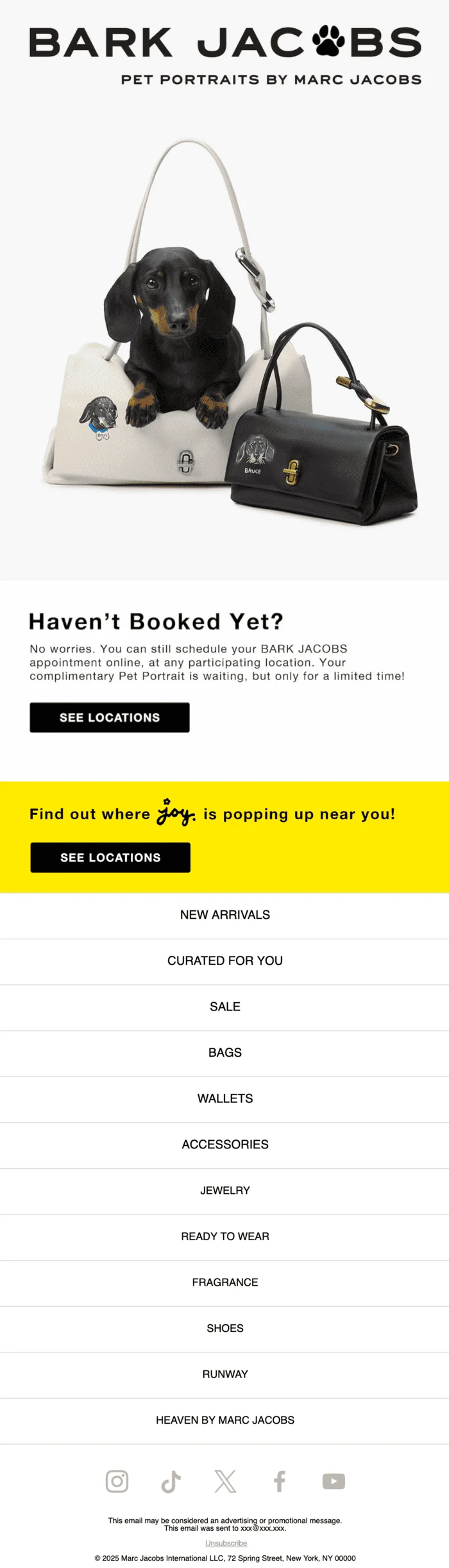
Marc Jacobs is a brand that excels at this strategy. Take a look at the email below. It reassures the customer that they can still make the appointment, but reinforces the idea that time is running out.
Segment based on customer value
Segmentation is the backbone of effective email marketing. It helps you send relevant content and advertising, which results in higher conversions.
Just like in your VIP email marketing, you can group customers based on lifetime value (LTV), average order value, overall spending, etc.
Treat your most significant customers with early access, exclusive offers, private service, and virtual or offline events. This makes them feel cared for and strengthens their loyalty. For US-focused campaigns, membership-like benefits and community moments can work well; for high-touch luxury categories, private appointments and trusted adviser-style follow-up may matter more.
18% of customers want brands to create communities or forums. So when you want to go to the next level, create a community for your regular luxury buyers.
Focus on experiences
Having a website and a robust digital presence is all well and good, but luxury marketing should go further. Nothing beats the exclusivity of an offline event or a special place.
Turn your store openings into grand occasions, hype up new collection launches on the runways, or come up with in-store experiences similar to the pet portraits from Marc Jacobs. After the fact, you can send content marketing emails with recaps and highlights from the events, like Loeffler Randall. These follow-ups help transform a one-time visit into an emotional memory and a reason to stay close to the brand.
This luxury brand made the boutique opening into a joyful evening with the community. Note how this language implies closeness and bonding. By becoming a valuable customer and a guest at the event, a person becomes the brand’s “friend.”

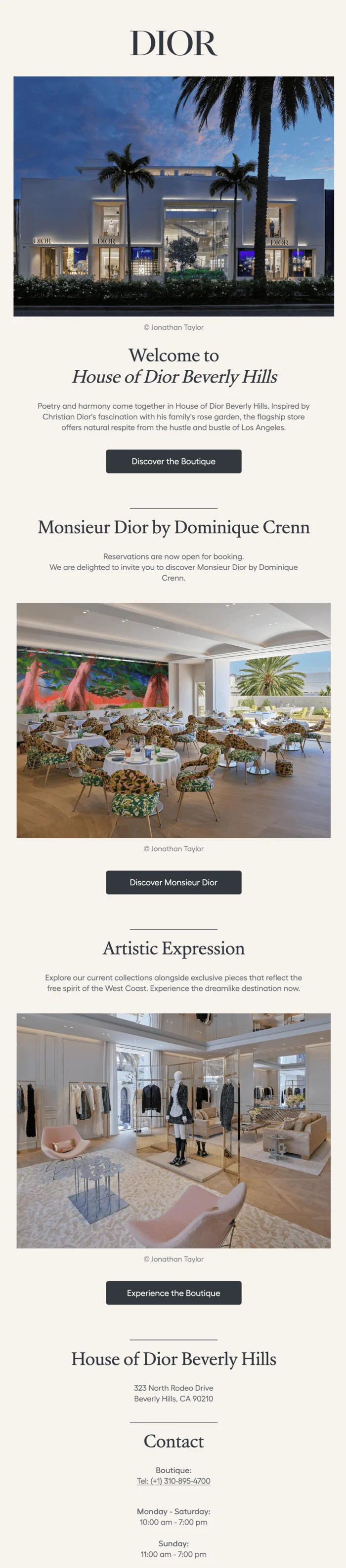
And here’s another example from Dior. The brand promotes visiting its flagship store and booking a table at the restaurant there.
Optimize for mobile
According to GWI, luxury buyers are tech-savvy and comfortable using new technology. Coupled with the global trend of using mobile devices to read emails, this makes optimization even more important.
Make sure you use responsive templates that adapt to readers’ devices and look good no matter where they are viewed. Use appropriate font sizes, big enough buttons and images, and follow other mobile email marketing best practices.
Craft subtle call-to-actions
Calls-to-action, or CTAs, are the main conversion drivers in your emails. You are surely familiar with using direct language and action verbs like “shop” or “add to cart”. However, for luxury brands, your copy should be more subtle.
Pushing your buyers won’t work here, and salesy expressions also go against the feeling you are trying to create. Instead of typical words, use something evocative, like:
- Discover or uncover
- Unveil
- Access
- Get a look
- Explore
- Admire
- Tap into
- Experience
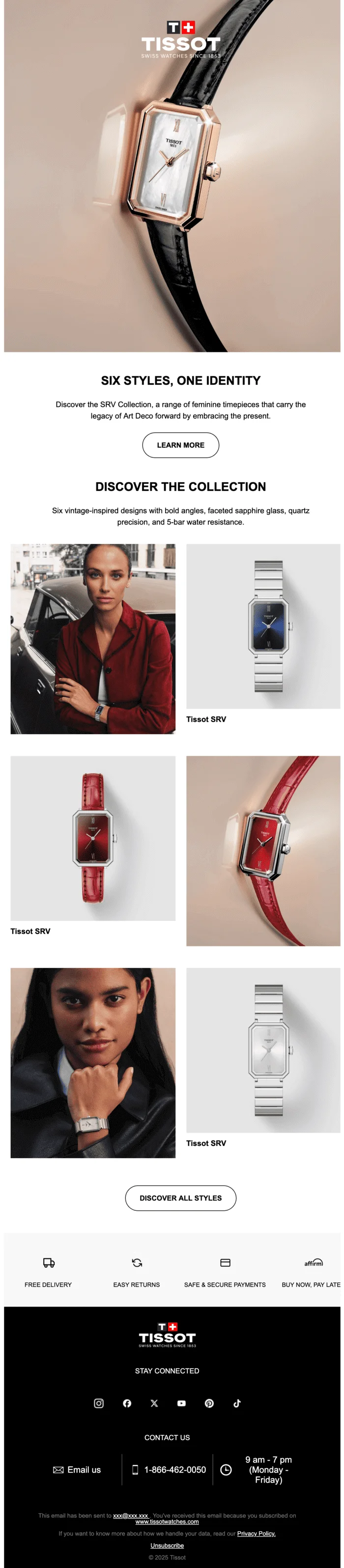
This email from Tissot promotes a product, but the CTAs are all about the experience rather than the purchase. They emphasize getting to know about the watch rather than blindly buying it right away.
Integrate across channels
Luxury buyers want a seamless customer experience, no matter the channel. From your website to social media and other digital channels, your messaging and offers need to be consistent and on brand.
Customer journeys can be complex, include multiple touch points, and span over time. The best approach is to develop an omnichannel marketing strategy that integrates channels, transfers customer data between them, and allows you to provide a personalized customer experience.
You first research your target audience, then map the customer journey, and integrate your CRM system with your marketing tools, like email marketing software, chatbots, social media tools, etc.

Provide valuable content
Gated or exclusive content is another staple in luxury brands’ email marketing. Your emphasis here should be on your brand’s legend, unique business practices, creative approach, and other parts of your brand DNA. It’s about bringing your customers behind the scenes, making them feel like they are part of the select few privy to this information.
You can also offer advice or expert opinion, but don’t get too practical with it. Remember that you’re selling a status and a vision, not so much the use cases.
Other ideas you can use for your email content:
- Founder or designer interviews
- Drafts and other design process information
- Runway photographs or videos
- Factory tours
Measure relationship value, not just clicks
For luxury email marketing, do not judge success only by opens or immediate purchases. Track repeat purchase rate, revenue per client, appointment bookings, event RSVPs, private consultation requests, product waitlist joins, browse or cart recovery revenue, unsubscribes, and VIP segment engagement. These metrics better reflect long luxury sales cycles and relationship value.
Best examples of luxury email marketing campaigns from known brands
Let’s now examine some great campaign examples in more detail. These brands use the strategies we’ve outlined in the article and excel at blending advertising with promoting a luxury lifestyle.
Le Silla

For a regular brand, even a single celebrity endorsement would’ve warranted a celebratory email.
Le Silla showcased seven in one campaign. There are no CTA buttons, no overexplaining, just photographs along with the shoe model names. This campaign subtly yet effectively implies that by buying from the brand, its subscribers can be among the famous actresses, musicians, and models.
Tiffany & Co.
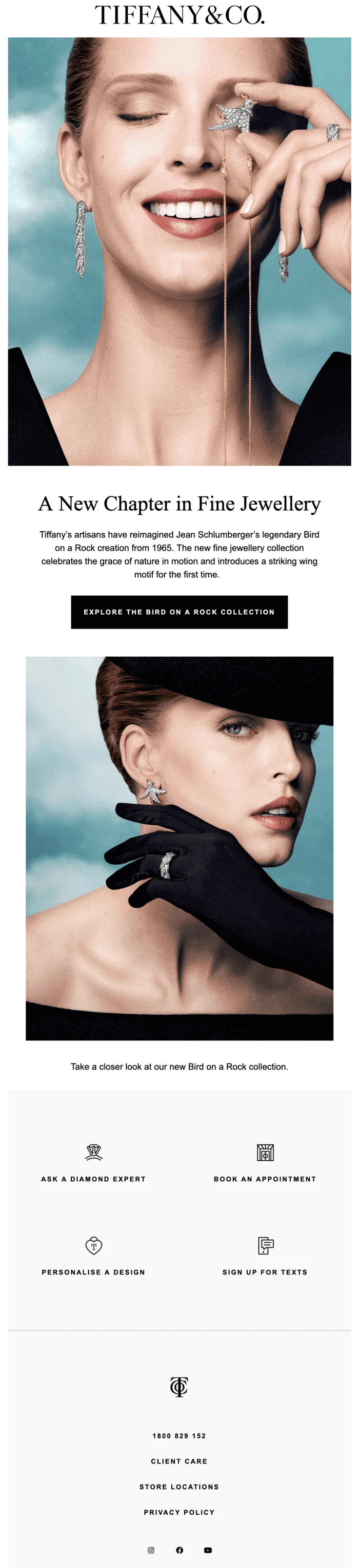
This email from Tiffany not only has gorgeous, evocative photographs, but it also calls back to the brand’s famous past collection to reinforce the brand image. The CTA button is subtle, as the focus is on the story and visuals more than anything else.
This campaign speaks to everything a luxury buyer would appreciate: a connection to cultural and artistic heritage and a unique modern reimagining.
Gucci
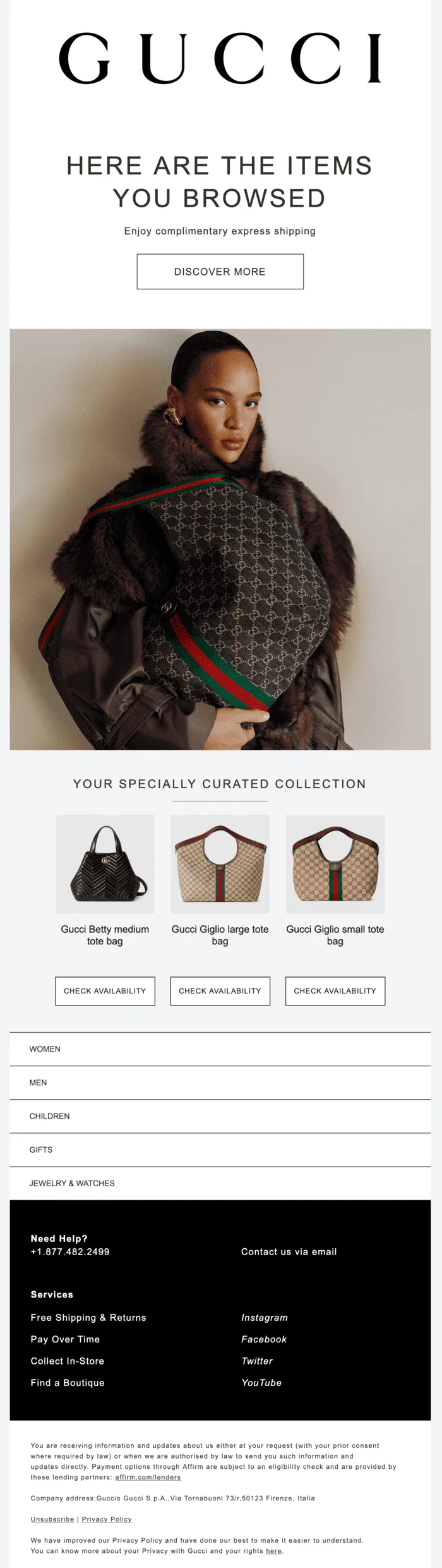
Like abandoned cart emails, browse abandonment emails are an effective e-commerce email automation. But how do you approach it as a luxury brand?
Usually, these emails emphasise scarcity and urgency, but Gucci chose an indirect approach. The CTAs “Check availability” imply that the bags might be out of stock without sounding pushy or salesy. Plus, the heading “Your specially curated collection” complements the luxury brand messaging. To sweeten the deal, Gucci also offered free express shipping.
FAQ
What is luxury email marketing?
Luxury email marketing is the use of personalized, visually polished, and relationship-focused email campaigns to sell high-value products or experiences without making the brand feel mass-market. It should feel like a private client communication, not a generic promotional blast.
Why is email marketing important for luxury brands?
Email gives luxury brands a direct, owned channel to reach customers without relying on social platform algorithms or rule changes. It also supports retention, clienteling, and long sales cycles by helping brands stay connected with existing customers and win back quieter ones.
What kind of emails should luxury brands send?
Luxury brands should send emails that emphasize storytelling, exclusivity, elegant design, and subtle calls to action. Campaigns should also be supported by omnichannel follow-up so the experience feels coordinated and high-touch.
How can luxury brands personalize emails without feeling intrusive?
Use declared preferences, purchase history, appointment history, loyalty or VIP tier, location, size and style preferences, and lifecycle stage to tailor messages. The goal is to make customers feel recognized, not watched, so avoid overexplaining how much data you have.
Should luxury brands use discounts in email marketing?
Luxury email marketing should not feel like a discount channel. It works best when the focus is on exclusivity, relationship-building, and premium brand value rather than mass-market promotions.
How do you measure luxury email marketing success?
Track both relationship and business metrics, such as repeat purchase rate, revenue per client, appointment bookings, event RSVPs, private consultation requests, product waitlist joins, browse or cart recovery revenue, unsubscribes, and VIP segment engagement. Together, these show whether email is strengthening loyalty while driving high-value action.
 New and noteworthy on our blog