


Key takeaways
- SMS marketing is a direct and owned communication channel that allows businesses to reach engaged customers and drive conversions.
- SMS campaigns can be promotional, transactional, triggered, two-way, or conversational, each serving different purposes.
- Benefits of SMS marketing include high open rates, immediate engagement, direct and personalized communication, and measurable results.
- SMS marketing works best when integrated into an omnichannel marketing strategy.
- Building a compliant subscriber list and defining campaign goals are crucial for successful SMS marketing.
In the world of oversized lattes and complex drinks, why do people still drink espressos? It’s quick and easy and gets right to the point — just like SMS.
It’s a great communication channel to reach engaged customers and drive conversions. What is SMS marketing? In this guide, we’ll break down how SMS marketing works, why businesses invest in it, and how to build a compliant, high-performing SMS strategy.
What is SMS marketing?
SMS stands for “short message service,” and it refers to the text messages you receive on your phone.
SMS marketing, or text marketing, is a strategy of sending text messages to customers who explicitly opted in to receive them. These can be time-sensitive offers, general promotions, reminders, announcements, etc.
SMS is an owned marketing channel, meaning that, unlike social media, you don’t rely on platforms and algorithms to determine your reach. To send text messages, you only need an explicit, documented customer consent in accordance with local regulations.
Besides SMS, there’s also MMS — messages that include pictures and GIFs.
Types of SMS marketing campaigns (with examples)
Just like any other marketing communication channel, SMS campaigns vary depending on their purpose, content, and features. Let’s explore the most common types of SMS businesses can use in their strategy.
Promotional SMS marketing
Promotional SMS marketing campaigns aim to increase sales and put the spotlight on specific products or launches. They can be sent once or be part of an email sequence, like a drip campaign.
Some examples include:
- Product launch SMS
- Seasonal and other offers
- Flash sales
- Announcements
- Contests and giveaways
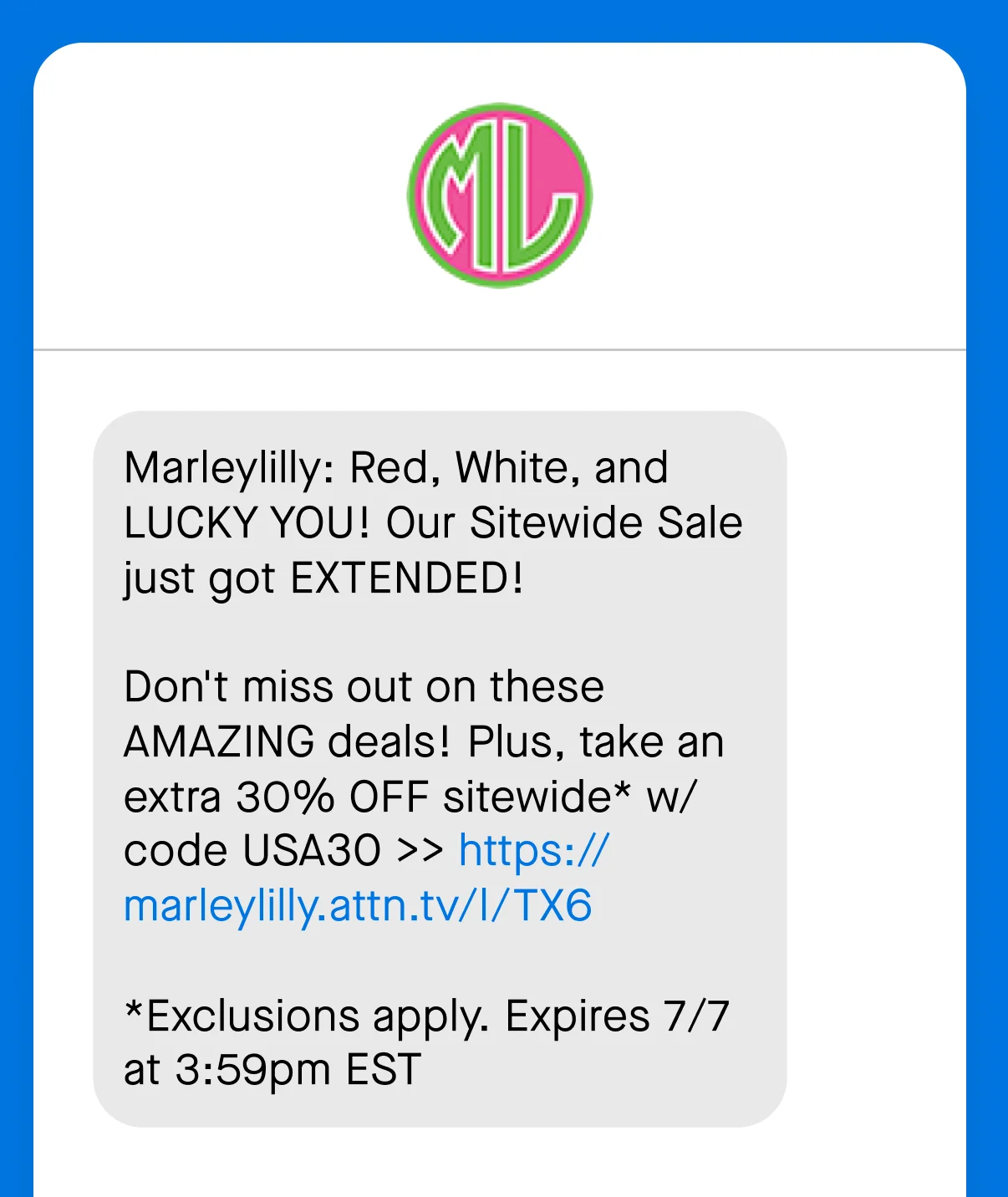
For the 4th of July, Marleylilly sent a promotional SMS to inform the customers about the sale extension:
Transactional and triggered SMS marketing
Both transactional and triggered SMS messages are sent automatically.
Transactional SMS is integral to the customer’s purchasing journey. These notifications inform about the order status and ensure a smooth customer experience. Although they are non-promotional, they help build a good rapport and strengthen loyalty.
Transactional SMS can be:
- Receipts and order confirmations
- Shipping updates
- Delivery confirmations
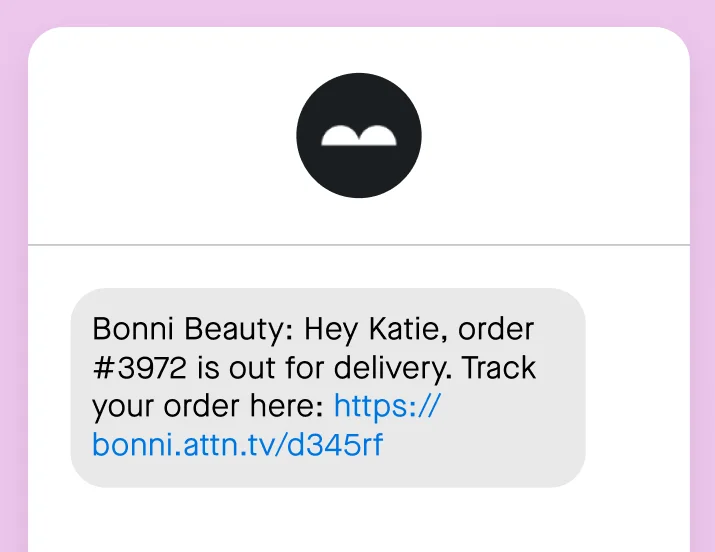
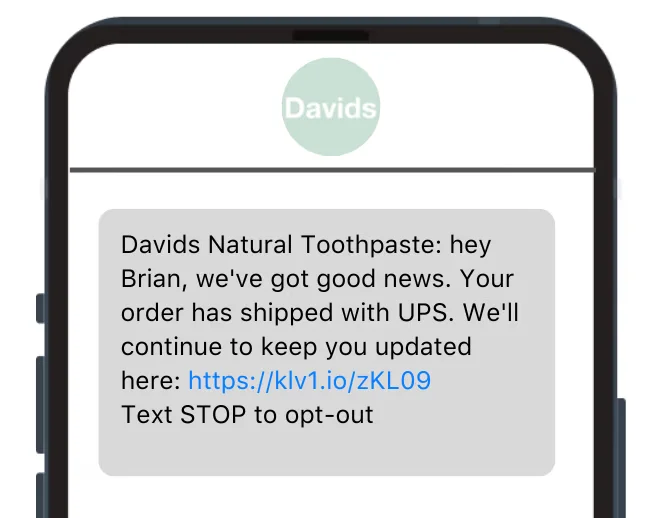
As an example, here’s a personalized delivery status update SMS:
Similar to a triggered email campaign, a triggered SMS is a message sent when a predefined condition is met. Triggers can be tied to customers’ actions, time, stock updates, and more. Triggered SMS campaigns rely on integration between your SMS marketing platform, website, e-commerce store, and other services, so they can exchange data.
Common triggered SMS messages are:
- Cart and browse abandonment notifications
- Restock alerts
- Birthdays and anniversaries
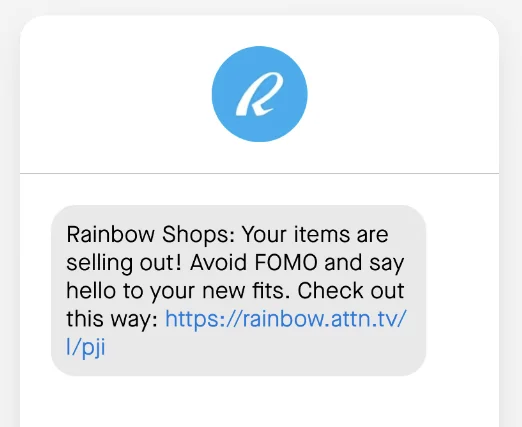
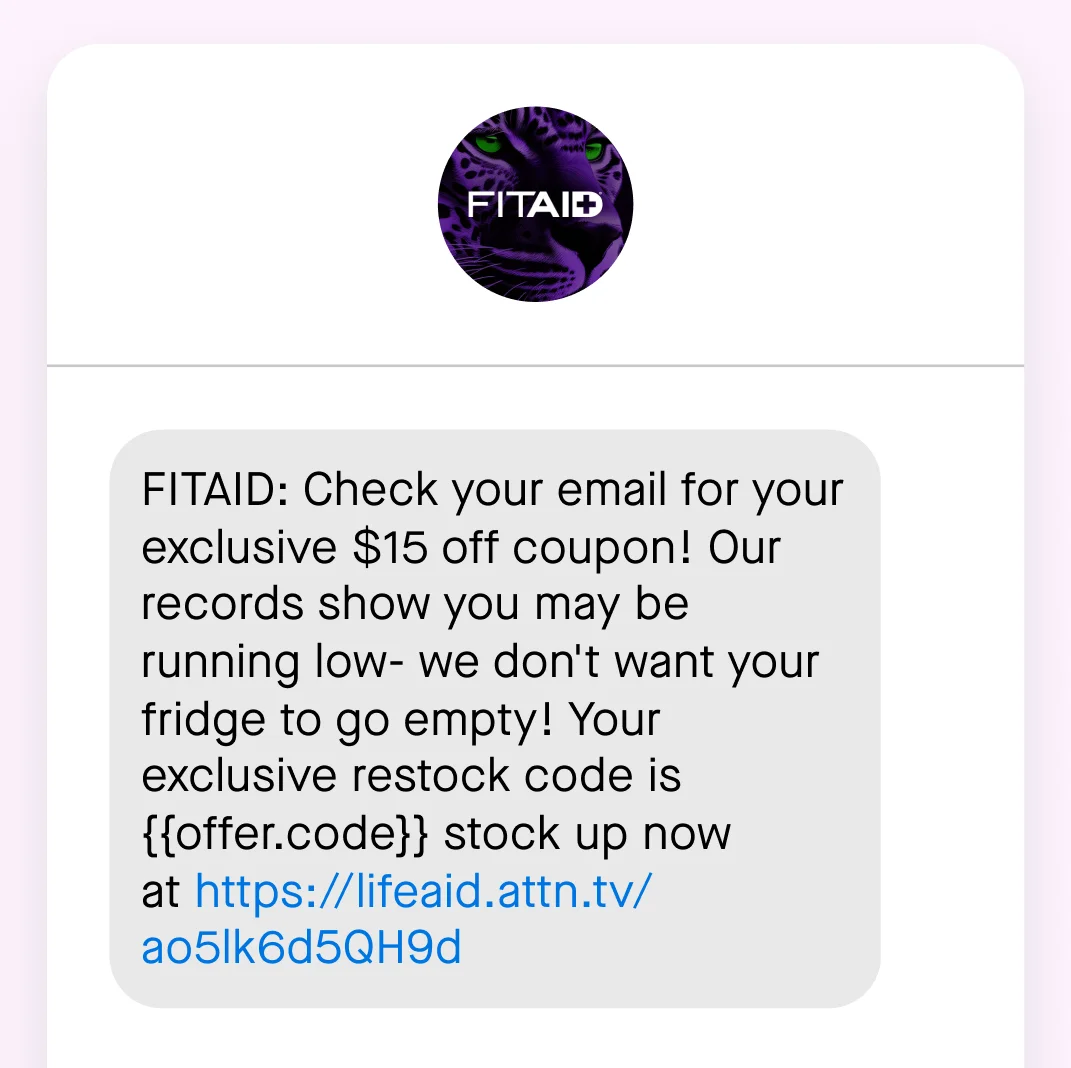
In this SMS, the company uses FOMO marketing to encourage sales:
Two-way and conversational SMS marketing
Previous SMS marketing messages we’ve discussed work like no-reply emails — businesses send them to customers, but they have no way of responding.
Two-way SMS marketing, on the other hand, allows companies to not only send text marketing messages to their audiences but also receive them. This approach relies on pre-set, automated scenarios and specific prompts, like “reply YES to confirm”.
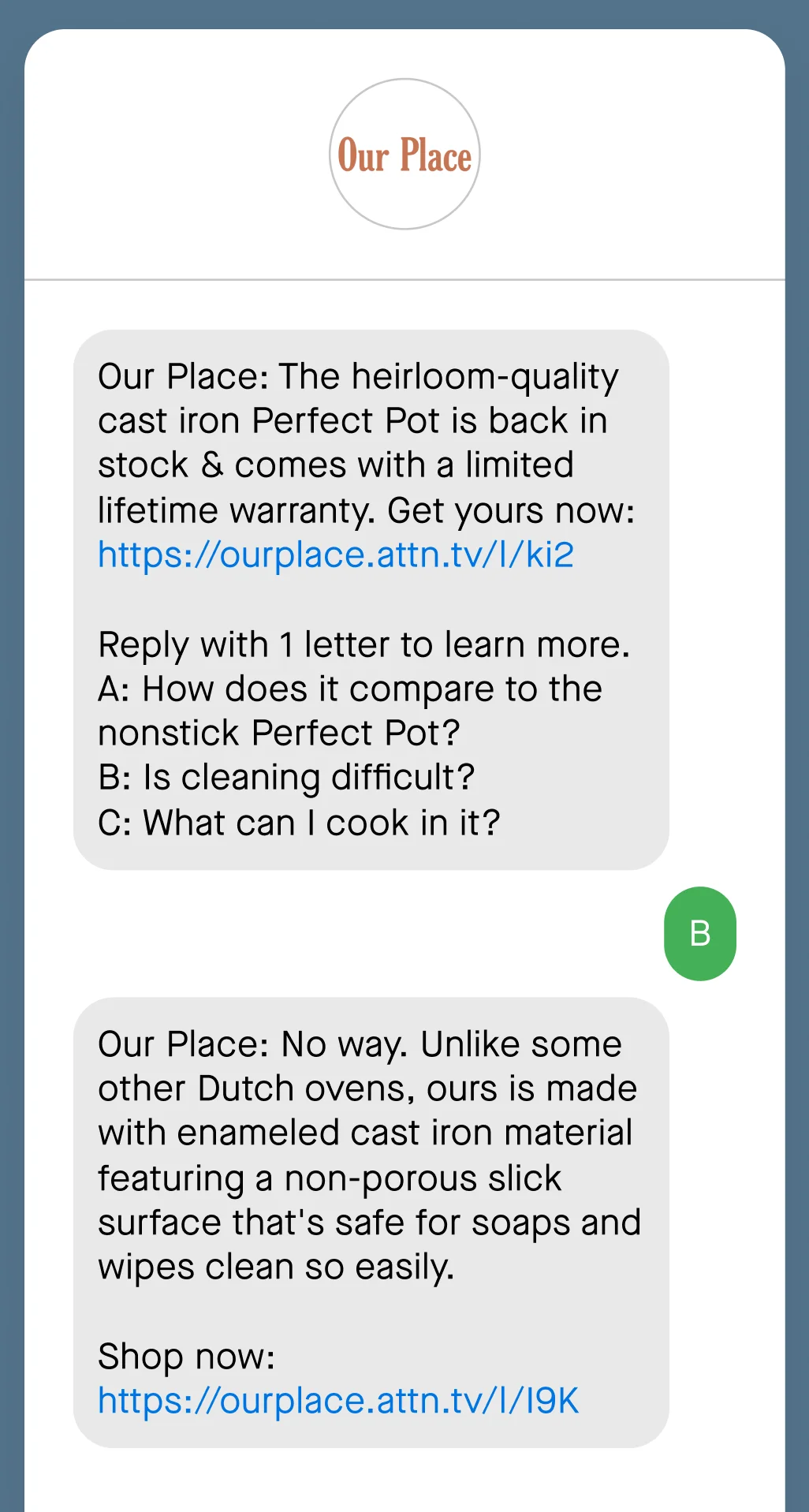
Two-way SMS marketing treats each exchange with the customer as separate. It’s not a continuous dialogue, unlike conversational SMS.
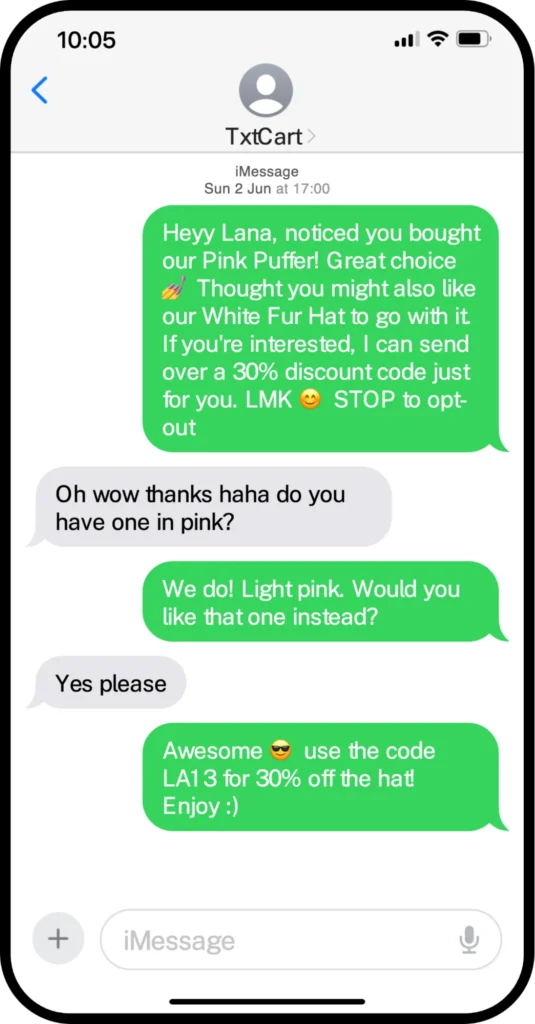
Conversational SMS is a more enhanced strategy. It uses natural language processing with AI and/or human agents to create a seamless dialogue between the brand and its customers. The history of the exchange across platforms is retained, so the conversation can start right where it was.
This approach is typically used for personalized messaging and SMS customer support.
Why businesses use SMS marketing: Key benefits
Unlike social media marketing or SEO, sending SMS to your customers requires spending money. Prices depend on location, specific platforms, and volume, but if you want to use SMS marketing, you will have to pay. Even if this makes you skeptical about the channel’s cost, it has a lot to offer.
We’ve listed the main benefits of SMS below, so you can understand the potential of this strategy.
High open rates and immediate engagement
According to Statista’s US survey, 31% of business owners and marketers use SMS because of high open rates and CTR.
On top of that, SMS offers quick access to your audience. SimpleTexting’s 2025 survey states that 82% of people check their texts within 5 minutes after receiving them. This makes SMS particularly effective for flash sales, limited-time offers, and time-sensitive updates where speed directly impacts conversions.
The same goes for situations when you need your customers to respond. EZ Texting’s 2025 Consumer Texting Behavior Report found that 71% of people reply to messages either right away or within 5 minutes.
Direct and personalized communication
As we’ve touched on above, SMS is an owned communication channel. Unlike social media, SMS delivery isn’t affected by changing algorithms or declining organic reach. It creates a direct line of communication with your customers.
Plus, with triggered and transactional SMS campaigns, you can react to customers’ actions and send relevant and timely texts. This makes SMS marketing personalized and effective.
Measurable results
You can track the effectiveness of your SMS campaigns using different metrics: open rates, delivery rates, opt-out rates, conversion rates, and more.
Thanks to that, you can create a data-driven strategy, test various methods, and shift your approach if something is off.
SMS marketing vs email marketing: How they work together
SMS works well on its own, but is especially great when used as part of an omnichannel or multichannel marketing strategy.
Customer journeys become more and more complex, and the number of touchpoints before sale increases. This challenging environment requires businesses to put extra attention on customer experience, and combining different channels is one of the best approaches here.
According to Attentive’s report, 85% of subscribers to a brand’s texts are also subscribed to its emails. Customers are not only unbothered by repeated communication, but more than half would be more likely to purchase if they receive the same promotion across channels.
Feel free to communicate with your customers using more than one platform — it’s now marketing best practice and something your audience wants. You can even explore sending text messages via email!
SMS marketing strategy and best practices: How to build an effective approach
Ready to jump into action? Follow our guide below to learn how to approach SMS marketing if you’re just starting with this strategy.
-
Choosing an SMS marketing platform
First things first, you need a reliable SMS marketing platform. Besides pricing, consider these features:
- Deliverability — this metric should be close to 100%, so that all your subscribers get their messages.
- Compliance — the platform needs to have the necessary tools for opt-in and opt-out and ensure the relevant regulations are respected.
- MMS and RCS (Rich Communication Services) capabilities — you might start with just SMS, but for future-proofing, your platform of choice should offer these advanced messaging protocols.
- Segmentation and personalization — as with any marketing channel, pinpointing the right customers to target is at the foundation of successful SMS marketing.
- Automation — some of the most effective SMS campaigns are automated, so pick a platform that offers this feature.
- Analytics and reporting — a data-driven strategy requires precise information about campaign results.
- AI tools — AI can make your work easier and fill the gaps in your strategy.
- International messaging — depending on your needs, look for a service that covers all the countries you plan to target.
If SMS is not your only channel, choose a platform that allows you to send both emails and SMS.
Best practice
Choose a platform that supports automation, segmentation, and compliance from the start.
Migrating SMS providers at a later point can disrupt deliverability, subscriber data, and accuracy of reporting.
-
Building a compliant subscriber list
When it comes to regulating SMS outreach, each country has its own set of regulations that control the opt-in process, quiet hours, etc. In the US, the TCPA (Telephone Consumer Protection Act) and the CTIA (Cellular Telecommunications and Internet Association) require explicit customer consent to receive text messages.
Among other rules, every message should include your business’s name, it must be easy to opt out, and you can’t send any SMS content covering the SHAFT topics (Sex, Hate, Alcohol, Firearms, and Tobacco) to a mass audience. That said, exceptions are made for alcohol and tobacco advertisements — you can send SMS messages covering these topics to customers of appropriate age.
To create a subscriber list that abides by the rules, use pop-up or embedded subscription forms on your website or a text-to-join mechanic, where customers need to message a specific keyword to a short number.
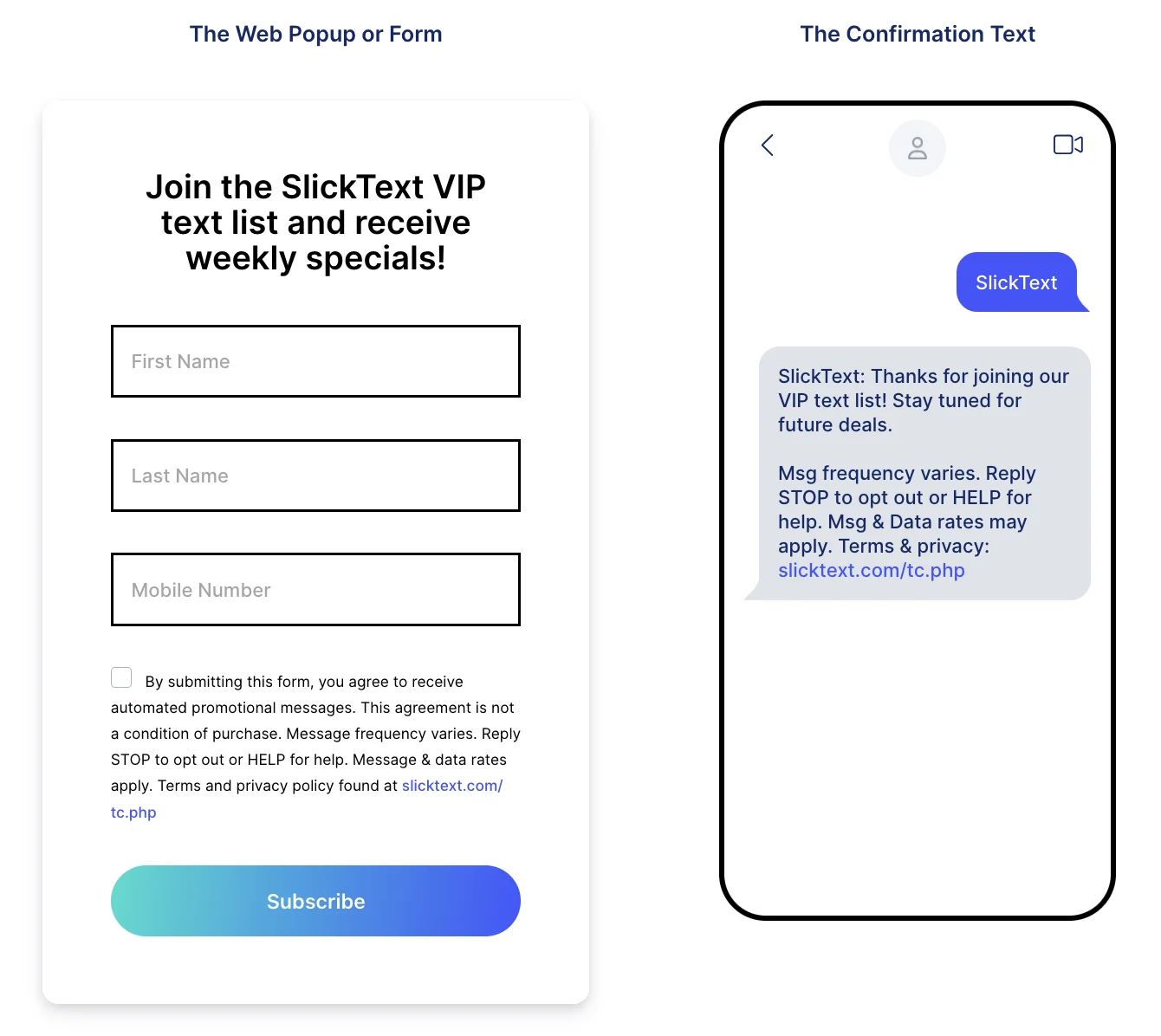
No matter which route you choose, make sure you use clear language, explaining what the customer is signing up for: messaging frequency, types, etc. Include a link to the full terms & conditions document and provide opt-out instructions.
Best practice
Never rely on implied consent.
Instead, use clear opt-in language, double opt-in where possible, and always state how frequently you are going to send messages and provide opt-out instructions upfront to reduce legal risk and spam complaints.
-
Defining campaign goals and use cases
Next, think through your first campaign. You need to decide on the type of SMS to send and your KPIs to measure the success.
You can first use one SMS type for one use case and gradually add more. Start with promotional campaigns about sales and limited-time offers, then complement them with transactional, triggered, and conversational types.
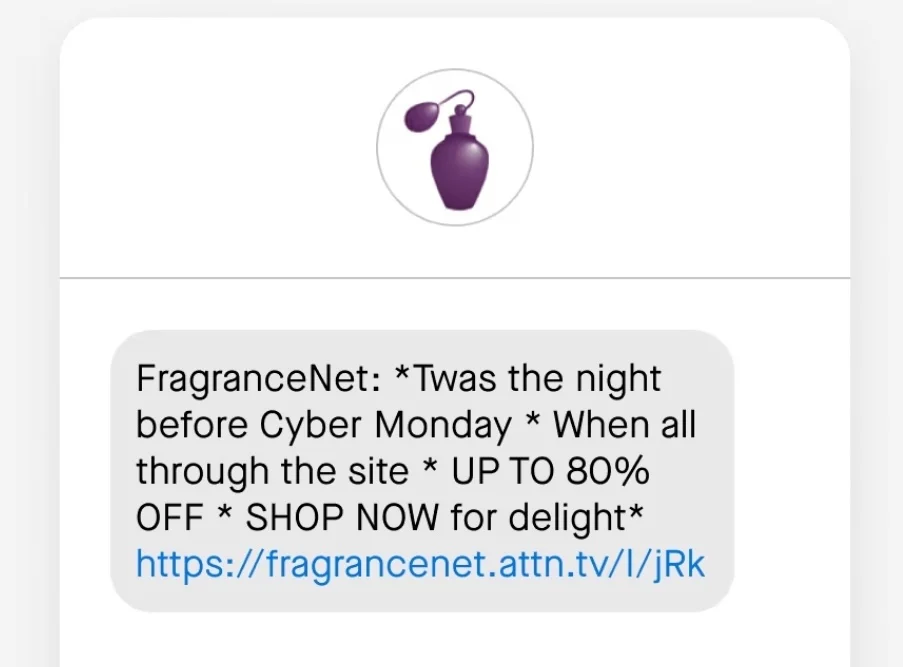
As an example, let’s take a seasonal offer campaign. As you plan to send a promotional, sales-focused SMS blast, your target metric can be CTR or conversion rate. If you create a promo code, you can also track how many customers used it during checkout.
Best practice
Decide on one primary KPI per campaign.
SMS performs best when each message has a single objective, whether it’s clicks, purchases, confirmations, or replies.
-
Audience segmentation and timing
You may start with an audience-wide SMS outreach, but the most effective campaigns aim at particular customer segments. Create customer groups based on demographics, like age and gender, location, product preferences, and other parameters, as relevant for your business.
For example, you can create separate messages for customers interested in men’s or women’s clothing.
Segmentation is the basis for relevant outreach, but to push this even further, use personalization. Even small tweaks, like addressing customers by name, can make your message feel more relevant.
As for the timing, consider sending marketing messages before the sale starts, follow up with a message when the deals are on, and finish up with a message 24 hours before the promotional period ends.
According to Attentive’s report we’ve cited above, 61% of customers check their texts in the evening. However, 54% also do so during the day, and 41% in the morning. This can vary by generation, with younger people preferring the daytime over evenings.
Experiment with your sending time to reveal your customers’ preferences.
Best practice
Start broad, then narrow down quickly.
Monitor engagement by segment and sending time, and adjust frequency before opt-out rates begin to rise.
-
Message length, tone, and CTA optimization
Now that you’ve done the preparations, create the SMS content.
Keep your standard messages under 160 characters for Unicode encoding and 70 when using emojis and non-Latin scripts to avoid additional segmentation costs. Use online SMS length calculators to make sure you’re staying within the limits. For example, Textmagic’s calculator or Messente’s calculator.
End your messages with a clear and compelling call to action (CTA). Use active verbs, like “shop” or “try”. Remember that your customers should clearly understand what their next step should be. Test out different CTAs to see which one works best for your audience.
As for the tone, follow your brand voice guidelines. Every message you send to your customers should be recognizable and strengthen your image, no matter the length or channel.
Your tone should also reflect the SMS type. You can be experimental with promotional messages, but the transactional ones should be direct and to-the-point. For conversational SMS marketing, that’s meant to feel like a personal interaction, keep it casual and friendly.
Best practice
Focus on one clear call to action per message. If your SMS includes multiple offers or competing CTAs, conversions typically drop.
-
Analyzing the results and adjusting the strategy
Last but not least, analyze the results of your campaign. Compare them to your plans, previous campaigns, and industry averages.
If your results fall below benchmarks or internal targets, adjust segmentation, timing, or messaging before increasing send volume: try out different CTAs, discount formats, timing, etc.
Continuous improvement is essential to get the most out of money you pay for your SMS marketing.
Best practice
Track trends and not only single-campaign results.
Sustainable SMS performance comes from ongoing testing and incremental optimization.
SMS marketing examples that drive engagement
Whether you’re figuring out SMS marketing for restaurants or other types of businesses, examples can help you figure out the best approach. Let’s take a look at SMS campaigns across different industries and analyze what makes them effective.
E-commerce and retail
FITAID’s omnichannel promotion is a great example of connecting your SMS and email marketing programs.
The fitness drink brand mentions a coupon the customer got via email and also reminds them to restock on their favorite products. The link is right there in the message, reducing friction.
Shipment update SMS from Davids Natural Toothpaste shows how even a transactional notification can showcase brand voice and create excitement for the delivery. The message is straightforward, yet the customer’s name and small additions, like “good news” and “we’ll continue to keep you updated,” make it warmer and more personal.
In text message marketing, balancing practicality with a customer-friendly brand image can be tricky — but it’s highly effective when done right.
Online services
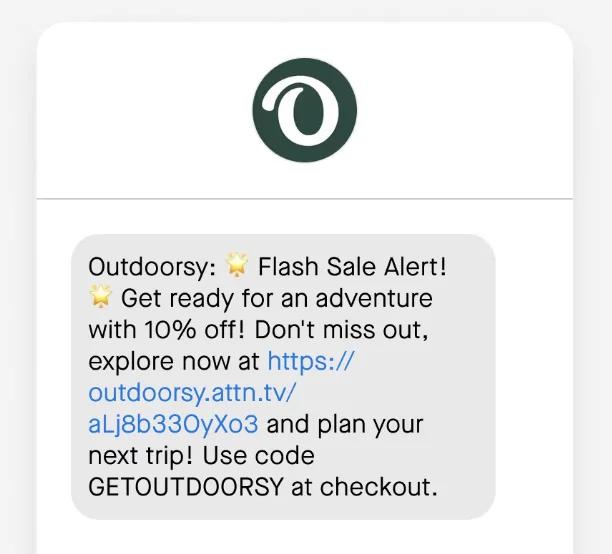
Outdoorsy is a marketplace for renting recreational vehicles. This flash sale SMS uses FOMO marketing to motivate its customers to shop the sale. Note how the code is easy to remember, so that customers don’t need to reference the text several times.
Customer support and events announcements
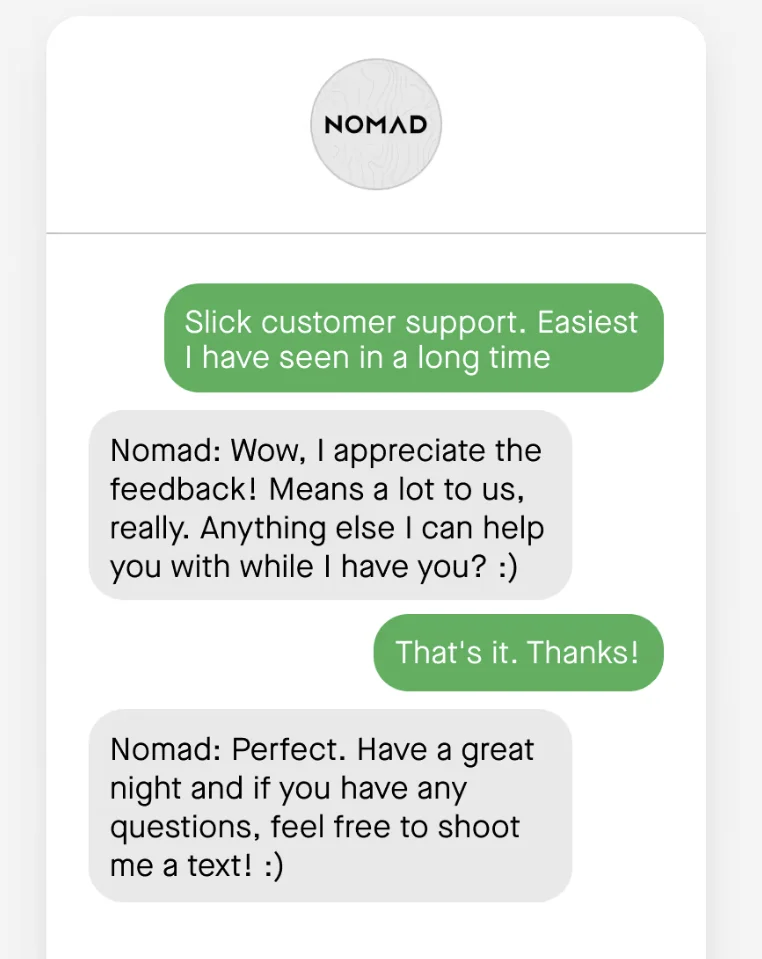
Nomad Goods is an electronics accessories brand from the US.
In this conversational customer support SMS exchange, the company maintains a friendly rapport with the customer. The agent’s texts are positive, helpful, and to-the-point — ideal for this type of interaction.
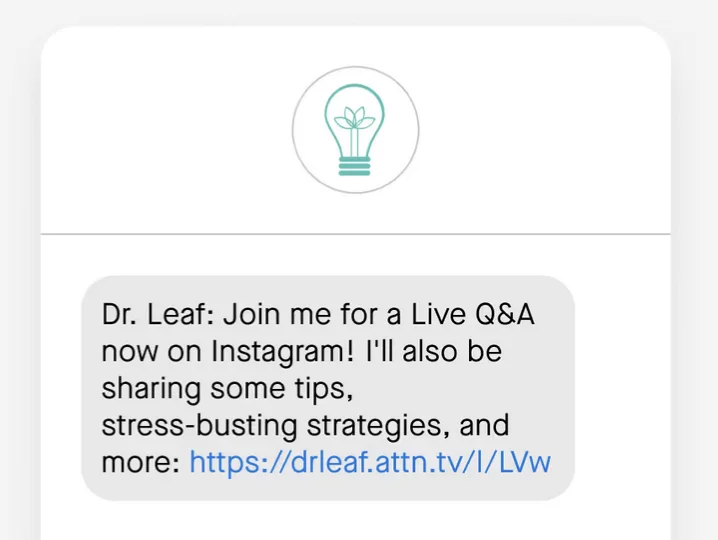
This Instagram live announcement SMS from a neuroscientist, Dr. Caroline Leaf, is another example of uniting different marketing channels.
The message states the value upfront — the author will answer questions and share practical tips and strategies. Ending with a link to the Instagram page, this SMS helps to inform subscribers and engage them on social media.
FAQ about SMS marketing
Is SMS marketing free?
No, SMS marketing is not free. To send SMS messages to your customers, you need to pay the marketing platform fees and sometimes the carrier fees as well.
Is SMS marketing effective?
SMS marketing is an effective marketing strategy. According to the Vibes Mobile Consumer Insights report, 65% of customers made a direct purchase from an SMS or MMS in 2025. Moreover, SimpleTexting found that most businesses have an average SMS CTR between 21 and 35%.
What are the legal requirements for SMS marketing?
Every country has its own SMS compliance laws. In the US, you need to comply with TCPA and the CTIA regulations. Most importantly, obtain explicit written consent from customers before sending them messages.
 New and noteworthy on our blog