


Key takeaways
- Multichannel marketing involves promoting a business through various channels, both online and offline.
- Chappell Roan's creative multichannel marketing approach included outdoor billboards and a hotline for her single promotion.
- Multichannel, cross-channel, and omnichannel marketing strategies differ in focus, message types, and customer journey mapping.
- Benefits of multichannel marketing include increased customer reach, enhanced data collection, improved customer experience, more conversions, and better ROI.
Imagine that you were cursed by an evil witch, and now the only place where you spend time is the nearest coffee shop — other places are unavailable to you. You may lose some friends over the situation. Some just hate coffee, others get tired of meeting at the same place all the time. It’s also not a popular coffee shop, so it’s almost impossible to meet new people — you already know each and every regular.
Sounds lonely, right? This is what businesses feel like to customers when they only use one channel for marketing. Let’s get rid of this curse and learn to grow revenue and clientele with multichannel marketing. Wondering, “What is multichannel marketing?” In this article, we’ll describe what it is, the key challenges, and how to implement it wisely.
What is multichannel marketing?
Multichannel marketing is promoting your business and engaging with customers via multiple channels. These can include all sorts of online and offline channels, such as social media, emails, website, direct mail, outdoor and digital ads, and even your brick-and-mortar store. Getting back to our “evil witch curse” analogy, it’s like going to all sorts of places like coffee shops, bars, offline workshops, parks — and meeting all sorts of people there.
Here’s a less metaphorical example. When Chappell Roan promoted one of her singles, she followed a creative approach to multichannel marketing. Aside from regular social media posts and that photoshoot you’ve probably seen everywhere by now, she made several outdoor billboards and a “hotline” where you could listen to the song’s snippet after dialing the number.



Multichannel marketing vs. Cross-channel marketing vs. Omnichannel marketing
Multichannel marketing is not the only approach that implies working with several marketing channels — there are also cross-channel and omnichannel marketing strategies. While these are siblings (sort of), they’re not triplets. Let’s learn to read them apart!
| Multichannel marketing | Cross-channel marketing | Omnichannel marketing | |
| The focus of marketing efforts | Promoting products/services | Promotion and creating a customer experience | Creating a customer experience |
| The relationships between channels | Messages are isolated from each other — each channel is managed separately | Some messages are isolated, others are connected (i. e. emails based on mobile app engagement data) | Messages across channels are synchronized, creating the feeling of an uninterrupted conversation |
| Types of messages | Mostly static — the same for all viewers | Both static and dynamic, depending on the channel | Dynamic, both the content and the display of the messages depend on past interactions |
| The approach to customer journey mapping | A simple and straightforward funnel like paid ads → website → newsletter → purchase | More complex than the multichannel customer journey map because it implies data exchange between certain channel clusters | An even more complex customer journey that involves moving between multiple channels before completing a purchase |
| Data storage | Can be stored and used separately or together | Stored together for “intertwined” channels | Always stored in the common data center — CDP |
If you’re still figuring it out, we have a separate article going in-depth into the omnichannel marketing vs multichannel marketing differences.
Benefits of multichannel marketing
Managing several channels from a bunch of social media accounts to emails, your website, Google Ads, and whatever else sounds like a lot. Especially for small businesses — you’ll need to make so much content. What if you can’t afford hiring a marketing department?! Is it even worth it?
It actually does, so let’s explore the benefits of multichannel marketing.
Increased customer reach
Despite buyer personas being a popular framework for portraying the target audience, your customers are, in fact, not the same person copied and pasted. Not everyone who might purchase from you “lives” on the same platform. So, adopting the multichannel approach gives you more opportunities for customer acquisition.
Let’s say you’re promoting a cosmetics company that mostly targets Gen Z and younger Millennial women. Since you’re targeting Gen Z folks, you might think, “We need a TikTok account,” and you probably do. But not all your potential clientele is on TikTok. Some of them, particularly the older part of your target audience, might stay on Instagram instead. So you also need an Instagram account, at least for cross-posting short videos. Also, you still need a website so customers can easily buy stuff from you online. That’s multichannel marketing!
Enhanced data collection
These days, data is the most valuable thing a marketer can have — and here’s how multichannel marketing can help you with that:
- More data from more platforms. If you only have an online store, for example, you only have the customer data that describes how people interact with this store specifically. But if you add a promotional newsletter, you can notice that in emails, people react better to certain CTAs. You implement these CTAs on the website, and boom, more conversions to purchases! You wouldn’t have a chance to know it if you didn’t add another channel to the picture.
- More nuanced data. If you have only an Instagram account, your testing and experimenting opportunities are limited by the platform itself and its specifics. You can’t really run A/B tests on social media (unless it’s paid ads, but it’s different), and Instagram doesn’t allow you to check if your audience responds well to longreads or game mechanics. Meanwhile, more channels mean more available types of content, mechanics, and testing opportunities. That way, you have a larger content toolbox to test on your audience and make more informed decisions in the future.
- Cleaner data. Social media algorithms work against you — for example, the average engagement rate of a Reels video is 0.5% so far. This and other factors mess up with your engagement metrics, so you might not even know that something actually works. Meanwhile, if you have several channels, some of which are less affected by these external factors, you’ll get a much clearer picture of how people interact with your content and what they actually like.
Improved customer experience
Unlike omnichannel marketing, the multichannel approach is not that focused on creating a seamless experience for customers — however, several channels instead of one still can make it better.
As we mentioned earlier, not everyone from your target segment spends their time on the same platforms. Your audience wouldn’t want to leave their preferred channel just to follow your “business” account.
The same goes for purchasing behavior. If people have to break their habits just to buy from you, it might alienate customers at the consideration stage. But if you provide several options, it will improve customer experience — and get you more revenue.
More conversions
We already mentioned that not all channels are equal — take the incredibly low engagement rates on algorithmic social media platforms like Instagram. So, putting all your resources into this platform when email marketing with an average click rate of 2% exists is, to put it lightly, not smart.
Some channels work more on acquisition, while others work on retention and repeat purchases. With multichannel marketing, you can build an effective media funnel that will help you recruit new customers and retain old ones. So, you’ll get more conversions into purchases. Once you’ve attracted new people with one channel, you push them further down the funnel and make them stay and continue the interaction via other channels. Compare that to the situation when you’re really good at hacking Instagram algorithms and have made a couple of viral videos, but the audience has no reason to stay, so your sales don’t really go up.
Better ROI
Last but not least, if you don’t put all your eggs in one basket, you’ll get a better return on investment. Here’s why diversification works when it comes to multichannel marketing:
- Risk management. One of your channels failed to take off? If it’s your only channel, you’re doomed. If it’s not, you can relocate your resources to the channels that give more revenue. In the end, you’re decreasing the risk of going into the negatives.
- More conversions. As we mentioned, multichannel marketing increases your sales, which means a higher marketing payoff.
- A higher resilience. Most available marketing channels, if not all of them, are vulnerable to tons of factors simply because the platform itself doesn’t belong to you. SEO algorithms change, social media algorithms (and owners) change, banner blindness is real, and so on. So, it’s natural that your marketing ROI may fluctuate — but it’s not going to fluctuate too much if your investments are distributed across several platforms.
How to create a successful multichannel marketing campaign
We’ve talked a lot about how good multichannel marketing is, but how to actually implement it? Let’s break it down step by step.
Plan your strategy
You can’t skip it — every marketing activity, big or small, starts with strategic planning. In the case of multichannel marketing, your strategy also includes the choice of channels — “multi” doesn’t mean “every channel possible”. Here’s what you should consider during the strategic planning stage:
- Audience. Your channel choice largely depends on who you’re marketing to. For example, there’s no need for outdoor ads if you’re not promoting for locals. Or, if you’re promoting a B2B business, your prospects are more likely to end up on LinkedIn than Facebook. You get the gist.
- Objectives. The end goal for marketing is always money, but it’s not always “money right now.” Sometimes the goal might be along the lines of “increasing brand awareness,” “expanding to other markets,” and so on. This defines exactly what you’ll do with the channels you have and plan to implement.
- Success criteria. It’s crucial to set up clear, measurable, and realistic KPIs for each channel you’re using. To set those KPIs, check industry-based benchmark reports for the channels of interest. By the way, we did our own email marketing benchmark research based on Selzy’s data.
Develop content wisely
Your strategy should provide you with a clear understanding of what content you need, so it’s time to create content. Since you’re dealing with multiple channels, you’ll need tons of content. So, if you don’t want to lose precious time on content creation, a wise thing to do is to reuse as much as possible.
Think of it this way: if you keep making completely unique content for every platform, you’ll lose brand consistency. So, content repurposing doesn’t mean you’re repeating yourself — if anything, it’s the only possible way to deal with so many channels. You can reuse:
- Whole posts. For example, crosspost identical short videos on Instagram, TikTok, and YouTube Shorts — all these social media platforms have different audiences, so you won’t come off as annoying.
- Resizes. Transform the long reads you post on your website into short posts for Instagram and Twitter, then make scripts for short videos. You can also rewrite the same longread for an external resource — for example, the piece about spam emails we published on Hackernoon is actually a shorter version of this blog article.
- Visuals. Did a stunning product photoshoot for a landing page? Post it on social media with minor changes and format adjustments, use the same source images to create a header image on X or YouTube, outdoor ads, and so on.
- Copy. Came up with a good catchphrase for your brand? Don’t use it on a landing page alone — mention it in short-form texts for other resources, add it to your welcome email, use it for social media, and so on.
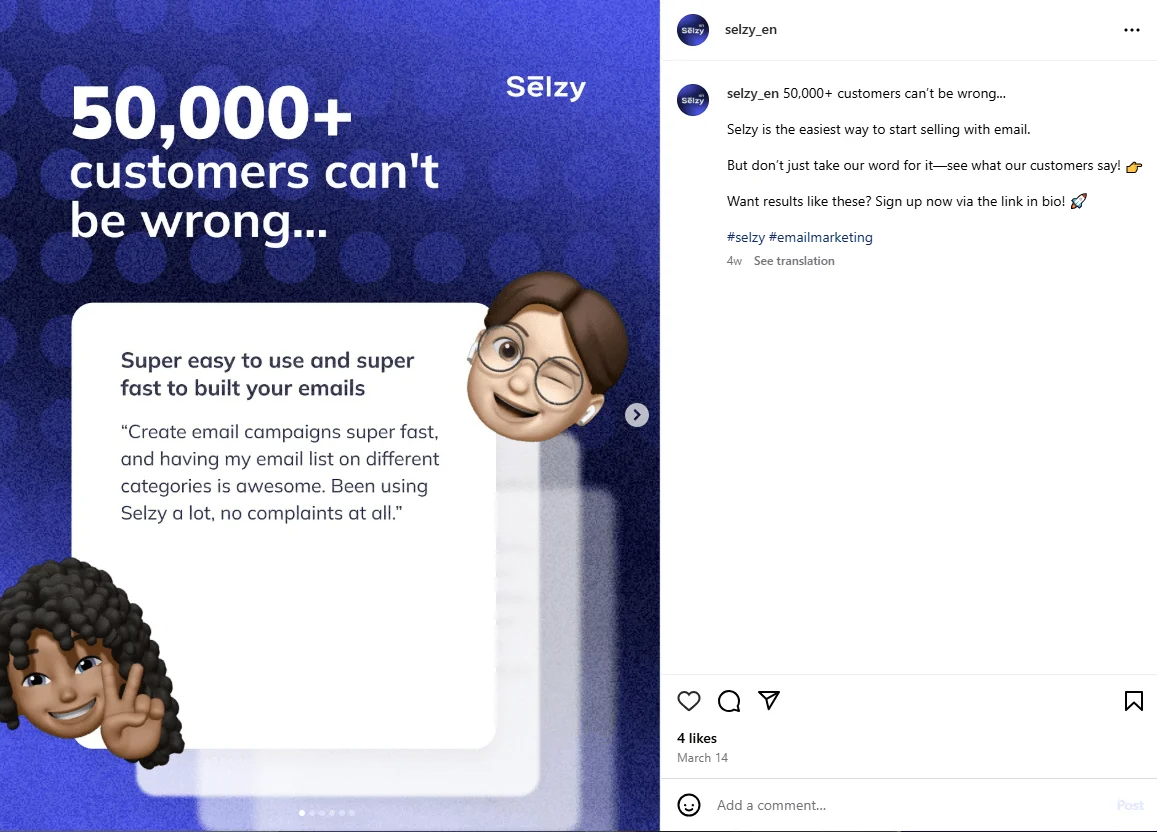
Here’s another example we like. Compare Selzy’s social proof marketing section on the website…
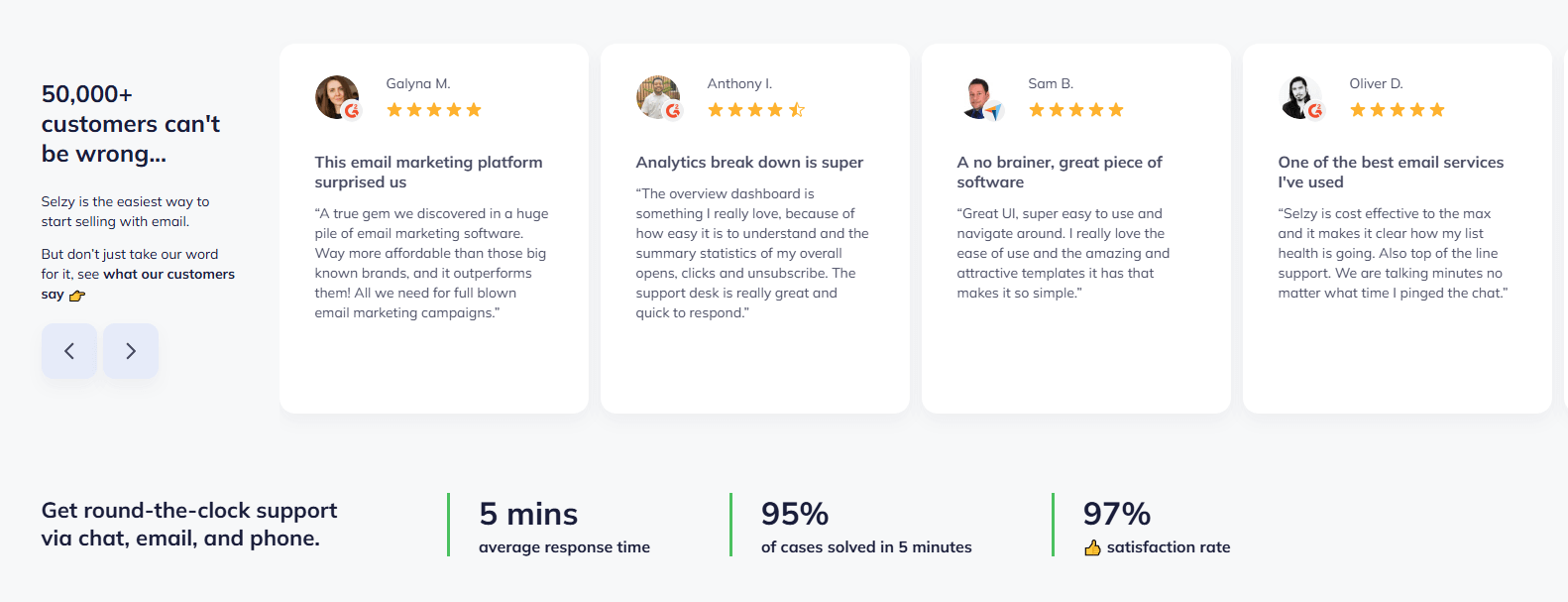
…and this post on Instagram. Same tagline, less writing work!
Connect your martech stack
Before executing your multichannel marketing campaign, make sure your marketing tech stack is set up and ready. Here’s what to pay attention to:
- Marketing automation. Automation is an amazing way to save time and money on marketing — you set it up once, and it keeps working forever. When you’re working with several channels, such shortcuts are a question of survival!
- Integrations. Compared to omnichannel marketing, the multichannel approach doesn’t require personalizing every single interaction. However, it’s not an excuse to not connect at least some of your marketing tools for better consistency in communications. For example, if you want to send abandoned cart emails, you need to integrate your ESP with your online store and ensure everything works correctly.
- Marketing attribution. You also need to lace every channel with tools for analytics so you can check out the numbers and make sure you’re reaching desired KPIs. Setting up Google Analytics alone won’t work. Since you’re dealing with many channels, your analytics should clearly represent which channel brought you these sales or subscriptions, or whatever other metrics you’re monitoring. The easiest thing to do in that direction is to add UTM tags to every link and set up the “channel” parameter in each one. For mobile app campaigns, dedicated attribution platforms provide more advanced marketing attribution and a clearer view of the full customer journey across both web and mobile touchpoints.
Monitor and adjust
Your job doesn’t end with launching one multichannel marketing campaign. After executing, you’ll need to monitor and make minor adjustments to meet your goals. The way you’ll monitor your multichannel campaign depends on the channel. For example, you’ll look into the built-in ESP analytics for your emails, you’ll scroll through Google Analytics to assess the website performance, check out likes and comments on your social media posts, and so on.
What about adjustments, though? Here are some forms it can take:
- A/B testing. For example, at FWD: by Selzy, we test subject lines on each issue to optimize open rates a little. You can go further and test more complex elements of emails like the design and placement of CTAs, certain images, copy, and more. You can also run tests on landing pages, paid social posts, and a lot of things.
- Self-corrections and crisis management. We are all people, and we make mistakes sometimes, from typos to incorrect discount codes, broken links, or even insensitive jokes. It’s especially vital for public channels — if you’ve noticed yourself making a mistake or saw backlash, you might need to respond to it quickly.
- Minor content adjustments. It’s not always possible, but sometimes you might need to adjust the already published marketing content. You can’t unsend an email, but many people, for example, delete or archive non-viral short videos on their TikTok or Instagram pages. It works because when your videos have an equally large number of views, it acts like social proof.
Key challenges of multichannel marketing
Although the benefits of multichannel marketing look pretty sweet, the implementation is not going to be easy. Here are the key challenges you might face.
Consistency management
This one is pretty obvious. You have several channels that require regular content creation and publishing, analyzing and adjusting, community management (responding to comments and such), and so on. It’s like having several children and making sure everyone is fed, clothed, educated, and loved!
Now, imagine yourself as a single mom… sorry, marketer working for a small business and managing all this stuff alone. Even with a strict content plan for social media and omnichannel marketing automation, it’s still quite challenging.
Resource allocation
This one is especially relevant for all sorts of companies, marketers, and solopreneurs who do marketing on a strict budget. When it comes to several children, you can’t really have “favorites” and “scapegoats” — it’s not good parenting. But in multichannel marketing, you can’t blow a fortune on something that won’t work.
It’s particularly hard when you start marketing from scratch. Sure, you can choose a list of channels based on the preferences and habits of your target audience — for example, you wouldn’t market on TikTok for the Gen X audience, you’d go on Facebook instead. However, you can’t 100% predict that a certain channel will resonate and bring you revenue. Meanwhile, you’ll have to spend money, time, and effort promoting yourself on each platform. So, financial and planning decisions are much harder when you’re going multichannel.
Data integration
Most challenges of multichannel marketing, including this one, come from, well, many channels. Data is essential for further campaign optimization and making data-driven marketing decisions.
The problem with multichannel marketing, though, is that you have several sources of data. It’s also stored in different places. For example, you can get social media stats via an internal analytics platform, your email engagement data in your ESP, paid ads data in Meta Ads and Google Ads… That creates chaos and issues in analyzing the effectiveness of your campaigns and attributing good (and bad) results to one channel or another.
Technology complexity
When we talk about multichannel marketing today, we don’t mean “print, TV, and radio” anymore — we imply various digital channels like emails, social media, website blogs, and such. Starting up and maintaining this media machine, especially if you’re a solopreneur, requires learning tons of digital tools like:
- Email marketing platforms
- CRM systems
- Photo and video editing tools
- CMS tools of all sorts, from simple landing page builders to e-commerce powerhouses
- Analytics tools like Google Analytics
- A/B testing tools
- AI tools
- …and so, so much more!
And, despite so many no-code products on the market, sometimes you might need to code — for example, if you’re crafting interactive email campaigns.
Content adaptation
The last challenge of multichannel marketing we’d like to cover is content adaptation. You can’t make unique content for each platform you’re present on for two reasons: lack of resources and possible inconsistency in brand messaging. So, you need to take some of the core messages you want to convey and adapt them for several platforms.
Content adaptation is relatively easy when it’s just text. For example, you have a long-form article published on a blog, and you can make it into several bite-sized posts for social media platforms. But what if it’s not just one long content piece for resizing but promoting a particular product? What if it’s the general tone of voice? The design consistency? Now it doesn’t sound like a 5-minute task at all!
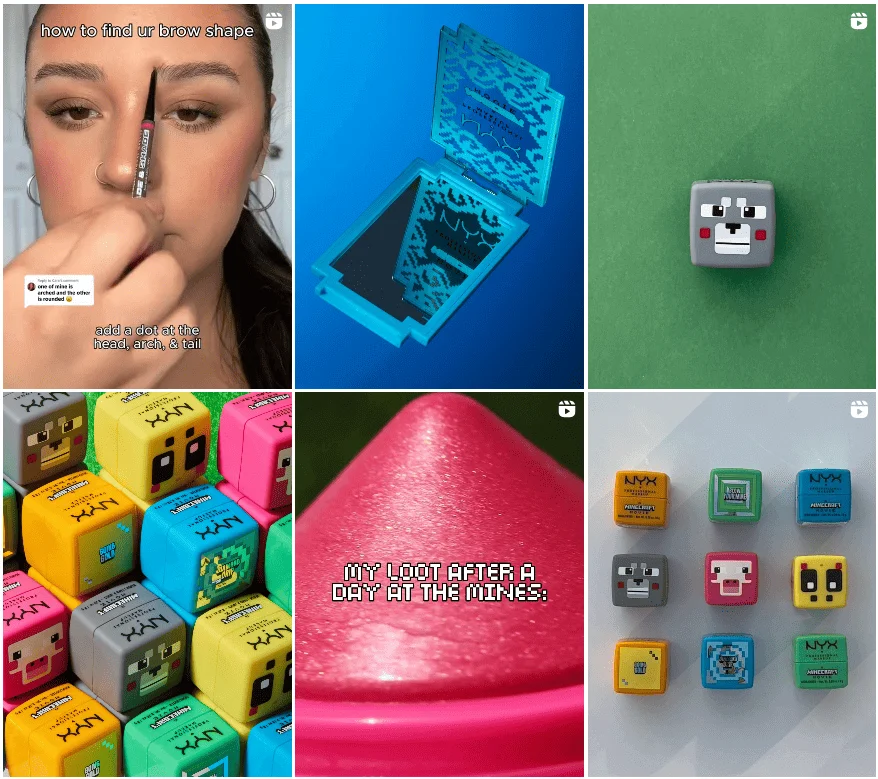
Here’s an example of what it can look like. Compare how NYX Cosmetics’ marketers promoted the Minecraft-themed collection in their newsletter…

…and on Instagram. As you can see, it’s not one but several Reels and static posts.
Wrapping up
That’s it — now you know a thing or two about multichannel marketing! Although it’s complex and requires a lot of resources for management, content creation, and maintenance, here are some benefits it can offer your business:
- Increased customer reach — more channels, more different people.
- Enhanced data collection — more data, better data, clearer data.
- Improved customer experience — people will connect with you and buy from you where they got used to, not where you force them to.
- More conversions — you’ll have a whole media funnel.
- Better ROI — and, as a nice addition, a higher resilience of your marketing machine.
 New and noteworthy on our blog
