



Key takeaways
- Email marketing remains a cost-effective way for travel agencies to attract new customers and stay top of mind.
- The travel industry has rebounded post-pandemic, with a significant increase in international tourist arrivals.
- Email marketing helps agencies stay visible, build relationships, personalize offers, promote seasonal deals, and achieve high ROI.
- Key aspects of successful travel agent emails include personalization, catchy subject lines, strong visual content, sense of urgency, and shared opportunities.
As we are well past the pandemic and global travel rebounded and competition intensified, travel agencies have to get answers to the same old questions: how to attract new customers and how to stay top of mind between trips? Email marketing for travel agencies remains as one of the most cost-effective channels for doing exactly that.
In this article, you’ll learn key tips and best practices to create effective travel agency emails. Whether you’re promoting seasonal offers, re-engaging past travelers, or helping clients plan their dream vacation, email lets you build relationships at scale — we got you covered.
Why email marketing for travel agencies is so important
The travel industry looks very different today than it did a few years ago when it was affected by the COVID-19 pandemic. Just a few years after 2020 was declared the worst year in the history of tourism, according to Statista, it got fully back in 2024 and is set for a new arrival record in 2025.
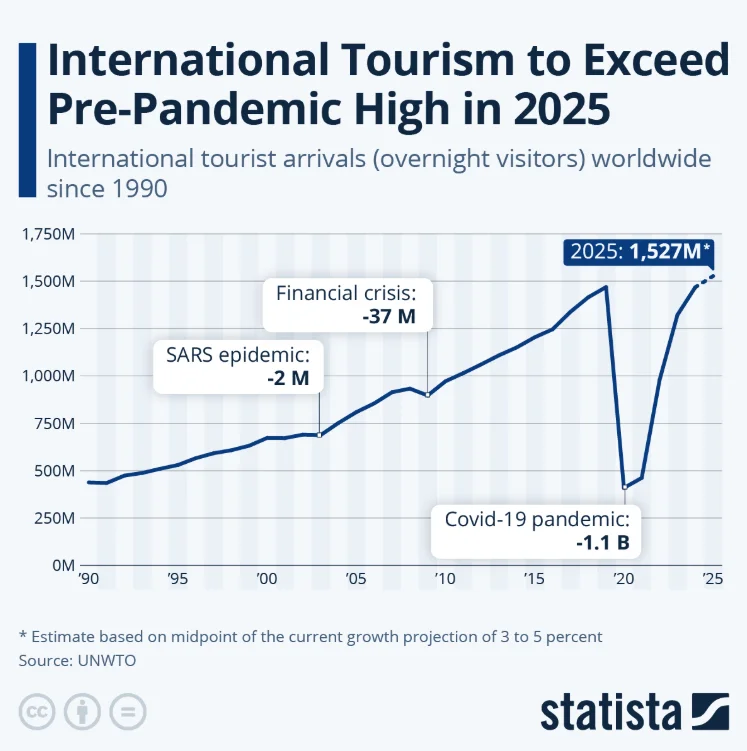
And according to UN Tourism, international tourist arrivals are up 5% in the first nine months of 2025 with over 1.1 billion tourists having travelled internationally between January and September this year, compared to the same period of 2024.
In other words, we are back to normal and even better than before 🎉🏝️
So, with travelers researching more than ever before making decisions, agencies need a direct and reliable way to reach potential clients.
Email marketing offers exactly that. It helps you:
- Stay visible. Email keeps your agency top-of-mind when travelers are ready to move from browsing to planning.
- Build long-term relationships. You know how much more a returning traveler is valuable than a one-time booking. Email allows you to stay connected year-round.
- Personalize your offers. People expect relevant suggestions. With segmentation and personalization, email lets you tailor recommendations.
- Promote seasonal offers. Email is perfect for promoting timely deals, last-minute tours, and holiday packages.
- Get a high ROI with minimal cost. Email delivers exceptional ROI while giving you full control over your audience.
The key aspects of a successful travel agent email to a client
Now that you know the importance of email marketing for travel agencies, let’s take a look at the recipe for a good email campaign in this industry.
Personalization
McKinsey says that 71% of customers expect personalized communication from brands. When it comes to personalization in email marketing, it’s more than including your customer’s name in the greeting or the subject. One of the ways to make your marketing emails more personal is giving relevant recommendations.
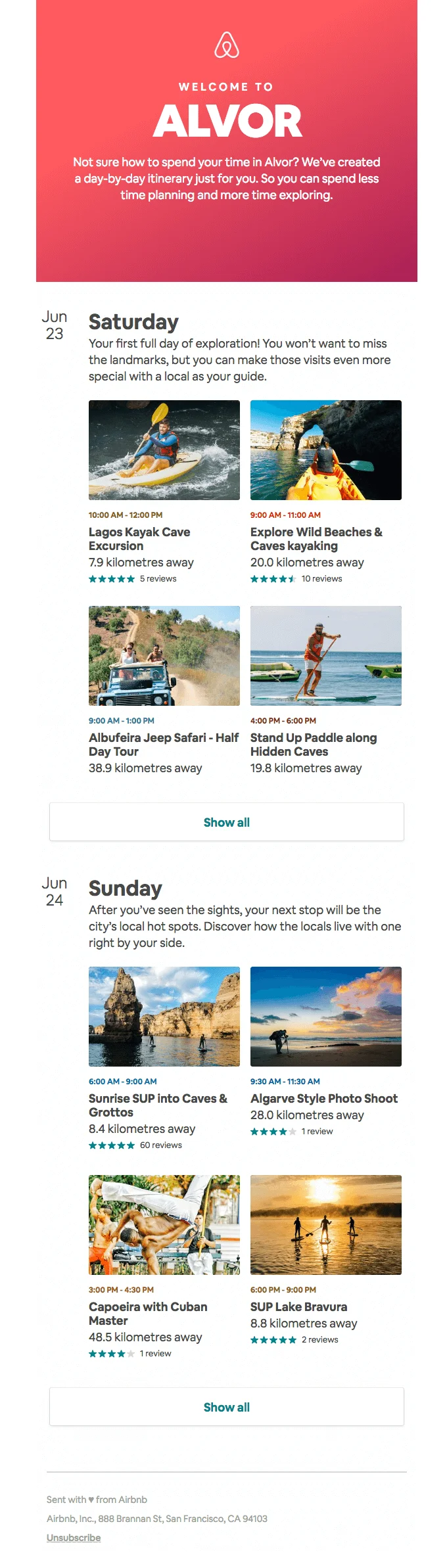
For example, Airbnb implemented location-based personalization. Right after the customer arrives somewhere, they suggest what to do and where to go.
Subject lines
A good email subject line can vastly improve your open rates. Here’s how you can create catchy subject lines specifically for travel agency emails:
Appeal to the value of traveling
People travel for different reasons — depending on the niche of your agency, you can use different buzzwords in your subject lines. Possible options include:
- Discovery, Enlightenment, Experience.
- Relaxation, Vacation, Getaway, Weekend.
- Adventure, Bucket list, Road trip.
These word groups appeal to different audiences — know your customers and use what triggers them.
Use urgency markers
Word combinations like “Last chance”, “Starts now”, “Don’t miss it”, and other similar subject lines will trigger FOMO. But don’t overdo this — some words might get you a one-way ticket to the spam folder.
Use jokes and puns
A funny email subject is a great way to stand out in your customer’s inbox. Examples include “Czech this out: 10 places to see in Prague” or “Been to South America? I don’t Bolivia”. Opportunities are endless — use your sense of humor to increase sales.
Get down to business
For sales emails, the best tactic is to describe your offer in the subject line. Examples include “Get 30% off our July package holidays” or “Save money on your next dream vacation”.
The use of strong visual content
There are many ways to use visual aids. You can use photos, GIFs, videos, and illustrations — or come up with a minimalist email design that only highlights the important elements. Typefaces and layouts also count — they make customers pay attention to important parts of email content like CTAs.
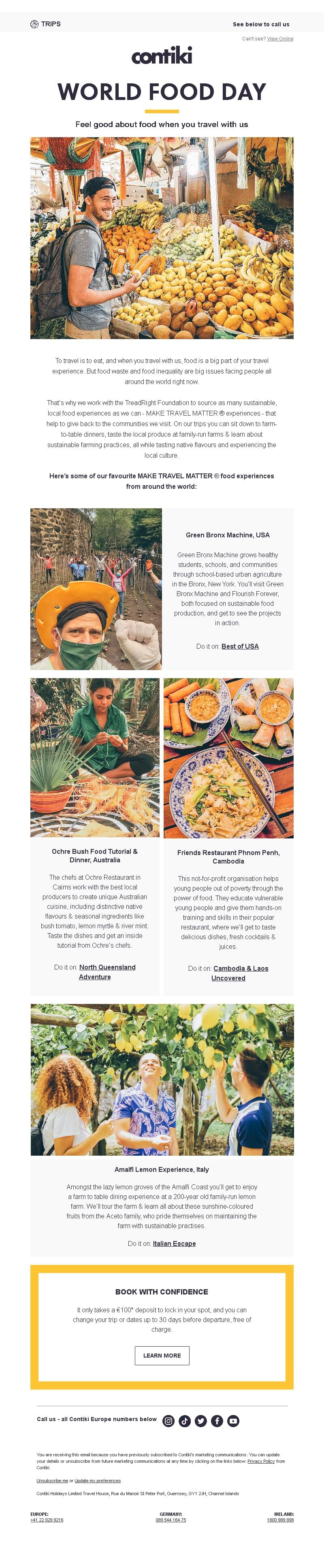
This World Food Day email from Contiki Travel Tours uses vibrant pictures and warm colors to create a certain mood. But aside from photos, they accentuated the part with CTA with an all-caps header and a bold yellow frame. These simple tricks instantly draw attention to the button.
Sense of urgency
Using FOMO in email marketing is not limited to travel agencies. For example, it’s often used in retail during Black Friday or holiday-related promotion campaigns.
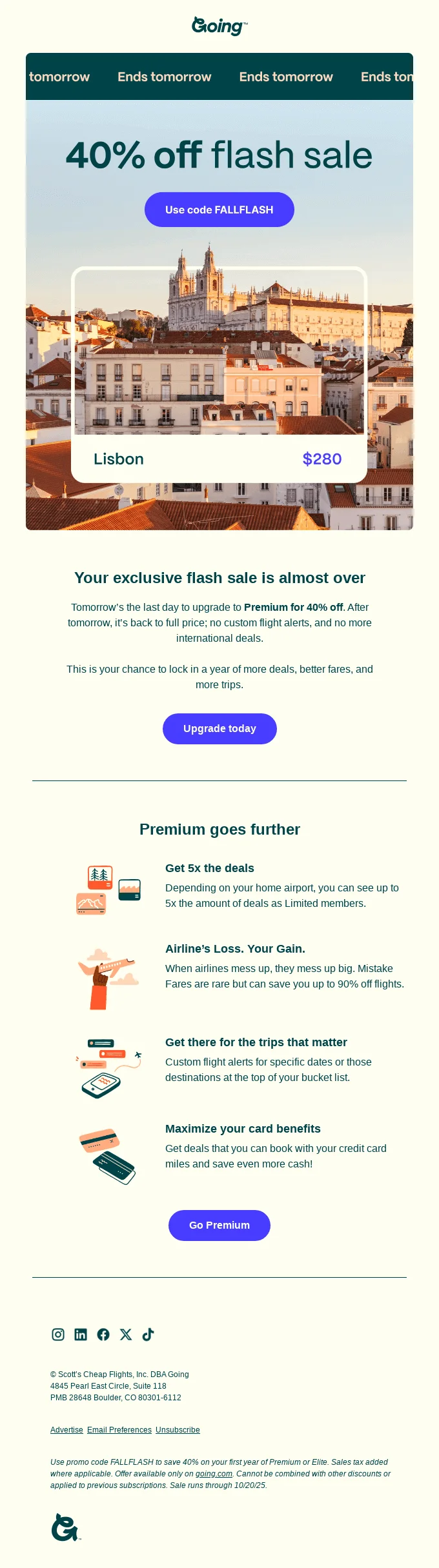
This email from Going is a well-executed example of how urgency works in campaigns for travel agents. Its subject line is “One day left!” and we see a big “40% off flash sale” header in the email body. Urgency is created via verbal cues — use them in email subjects and content copies.
Shared opportunities
Even the most aesthetically pleasing email with the funniest subject line wouldn’t work without a valuable offer. Here are some ideas for what you can suggest to your customers via email:
- Promo codes and discounts
- Last-minute tours that are cheaper than regular tours
- Convenience — for example, a fully-planned vacation plan
- Helpful content related to traveling — for example, guides on packaging or what to see in a certain city
- Unique experiences — these offers work best for niche travel agencies
Most popular travel agency email types
Another promo code is not the only reason to send emails. Let’s take a look at the most popular travel agency email types. Most of these email types are not specific to the industry — but they work well for travel agencies too.
Welcome emails
Sending a welcome email to a new customer is like giving a house tour to a first-time guest. If you show your guest where the bathroom is and offer them tea, they will be more comfortable staying at your place and might come over again.
It works the same with email marketing. According to GetResponse, welcome emails have a 83.6% open rate, which is twice as better compared to newsletters.
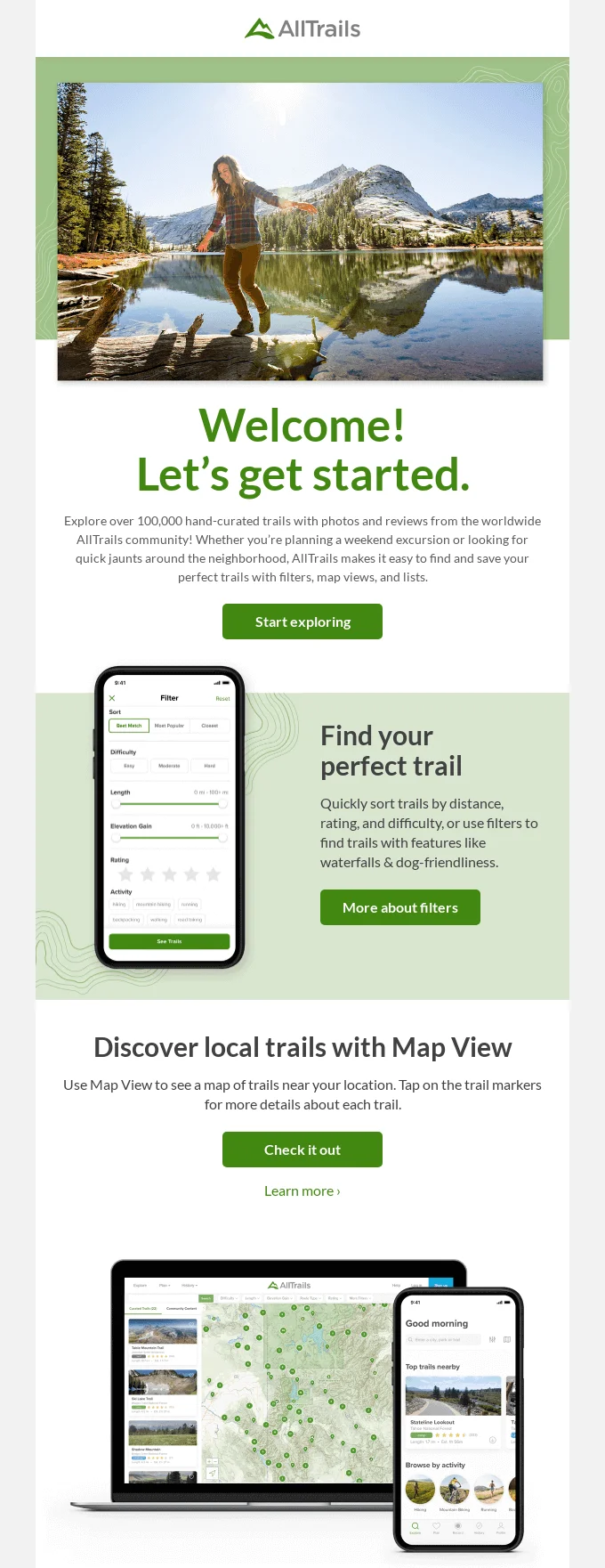
This email from AllTrails is a strong example of onboarding — they give the guide on using the service right away.

Newsletters
A newsletter is an email you send regularly to share updates. They can be used for introducing new offers, giving them something fun or useful to read, or inviting them to take part in a contest. Newsletters are great because:
- It’s a good source of traffic for your website.
- It increases brand recognition — the tone of voice and the choice of content add more details to your brand personality and make it more charismatic.
- It increases customer loyalty — by regular communication, you build stronger relationships between customers and your business.
- It gives room for personalization — by tailoring suggested website content, you can increase customer satisfaction.
And speaking of personalization, here’s a great example from Airbnb.
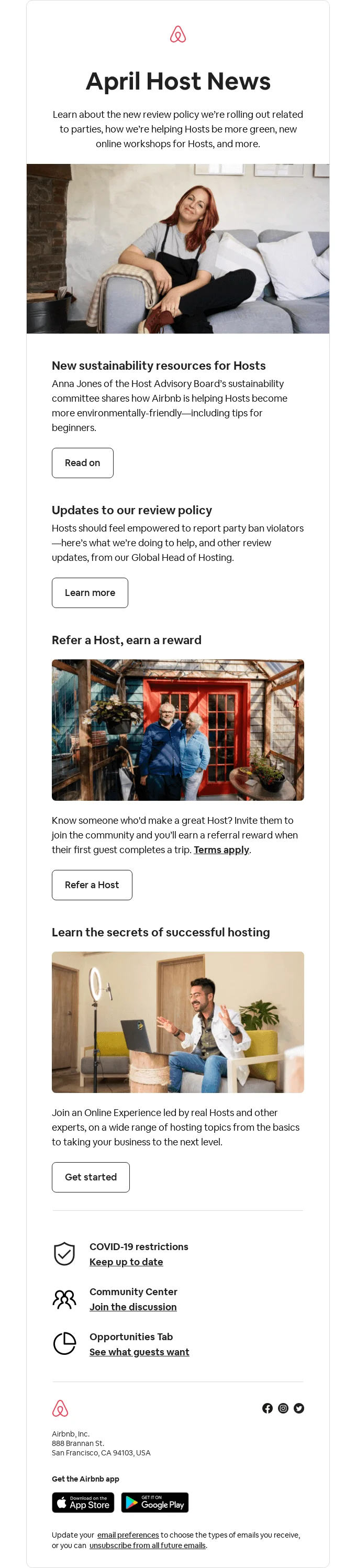
They came up with a newsletter specifically for hosts — and included lifehacks and policy updates.
Confirmation emails
Customers need confirmation emails so they know that the transaction was successful. They also need these emails to get important information like delivery details or the hotel’s address. Confirmation emails also give further directions for the next step in the customer flow — that’s why they are so important.
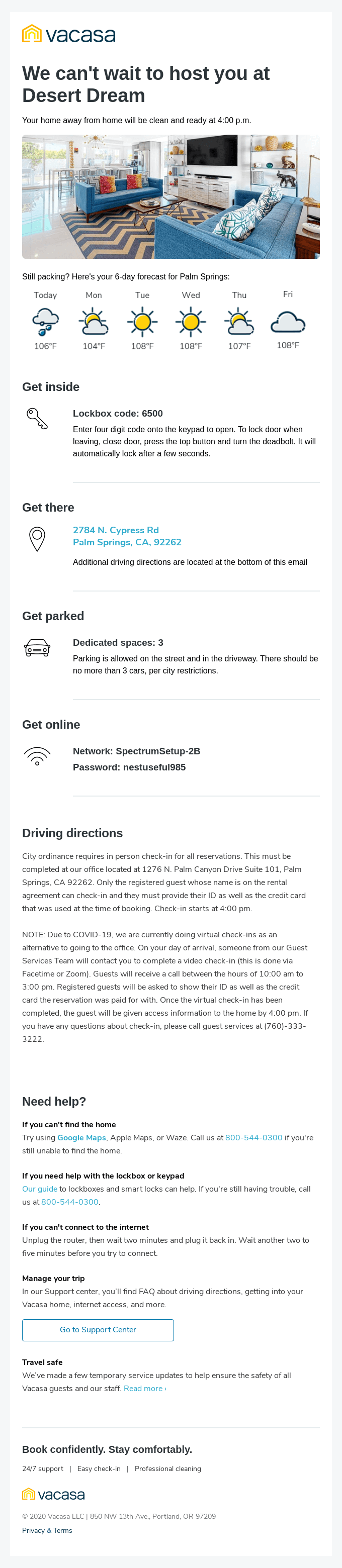
A good example of a confirmation email is this one from Vacasa. It contains all the necessary information for checking in — the lockbox code, the address and driving directions, and even the weather forecast for easier packing.
Thank you messages
Thank you messages are sent after a customer completes the target action — like buying something or subscribing to an email list. They might not be as important for the customer journey as confirmation emails. But thank you notes express appreciation and help you build warmer relationships with your customers.
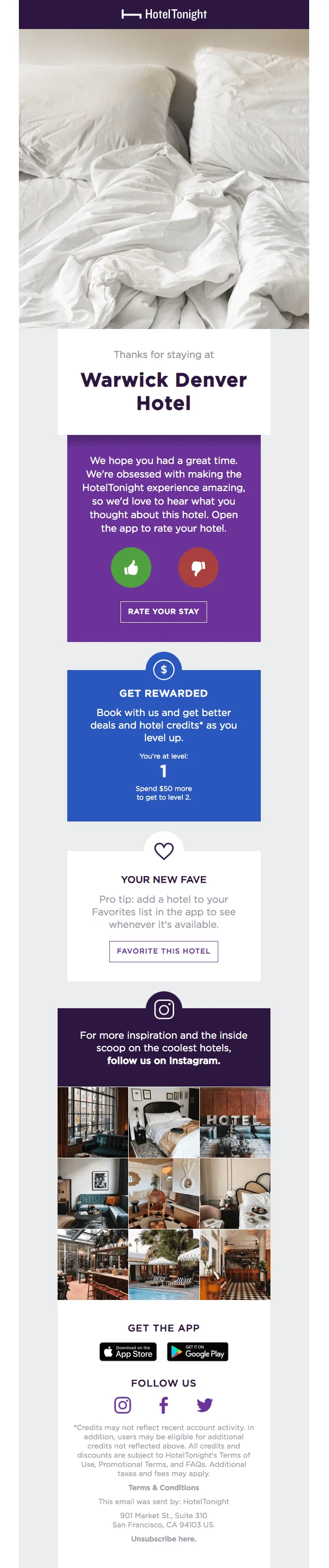
This email from HotelTonight is an effective example of a thank you note for a traveling business. They don’t just show appreciation with words — they suggest what to do next, including taking part in a loyalty program.
Informational emails
There is a difference between newsletters and informational emails.
Newsletters are sent weekly or monthly and they give an overview of the latest updates.
And informational emails are sent in case of emergency.
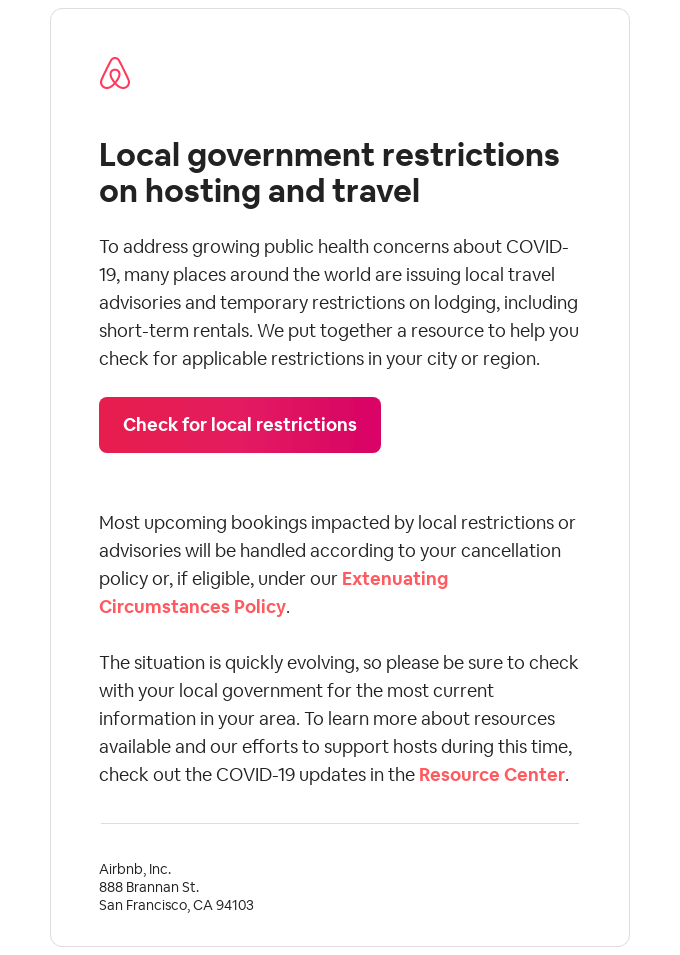
For example, this Airbnb informational email is about current policies and how the company handles the situation.
Re-engagement emails
Imagine that your best friend hasn’t reached you in three months and has been ignoring your text messages where you suggested hanging out or watching a movie they liked. If you forget them and move on, you will lose a friend. But a wellness check message will increase the chance to win your friend back.
Email marketing works the same. You will lose customers — just like you will grow apart from friends. But you can decrease these losses if you send re-engagement emails.
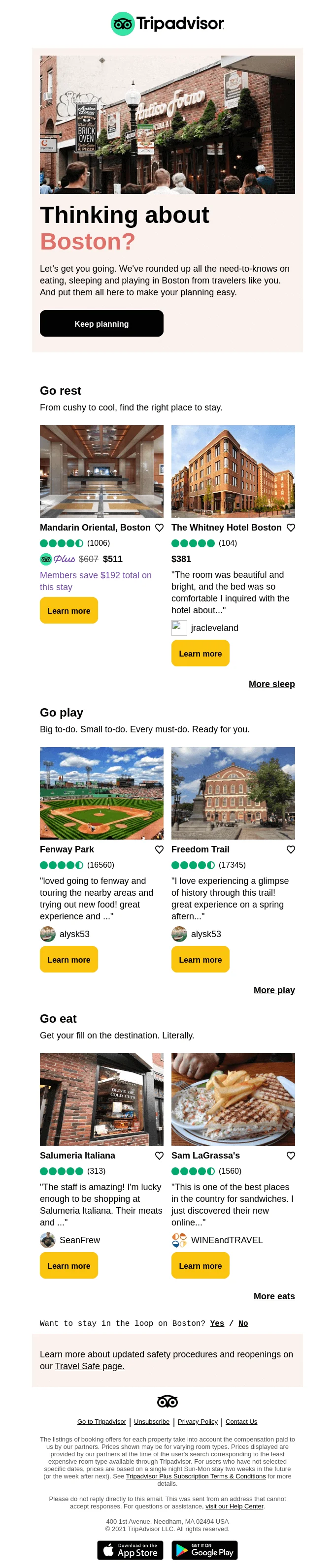
This is a great example of a personalized re-engagement email from TripAdvisor. They saw that a customer was browsing Boston-related pages — and based on the hypothesis that this customer was too confused to make a decision, they provided extra information on this region.
Seasonal offers
Many industries have seasonal offers to give. But traveling is probably the most season-driven industry.
According to Eurostat, one-third of the nights Europeans spent in tourist facilities were in July and August. And it’s reasonable — people plan long trips for summer and short trips for holidays. That’s why travel agencies should send emails with seasonal offers.
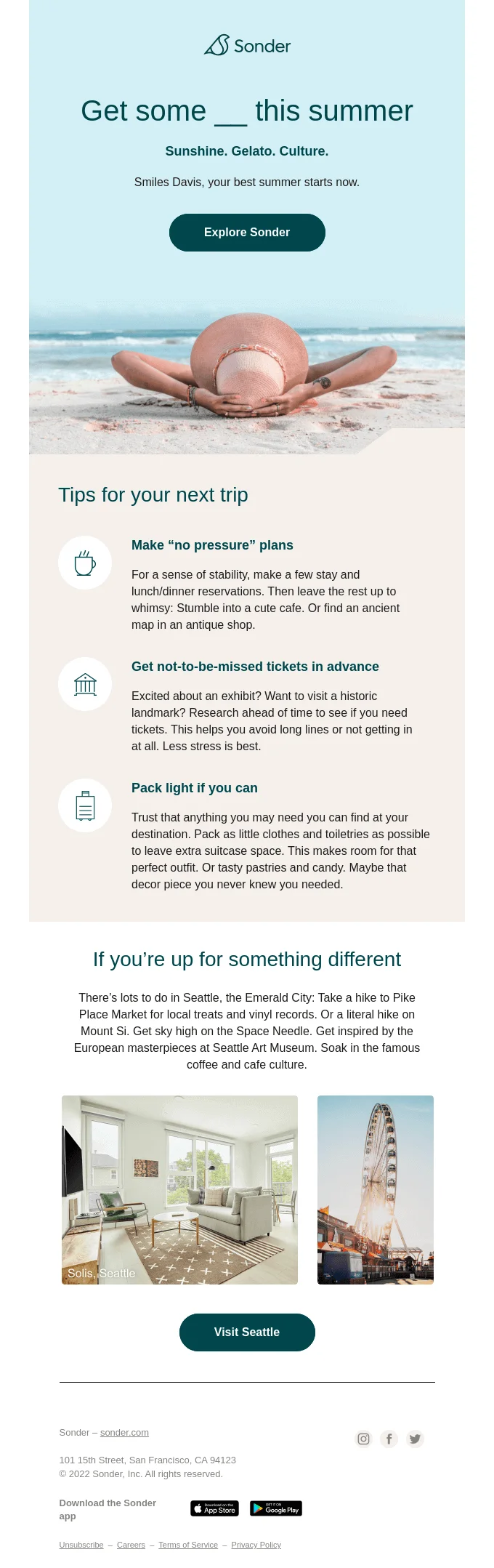
This email by Sonder is a great example of how to do a seasonal offer message right. They don’t just give an offer — they also give useful information on planning a summer trip, which adds more value to the email.
Upsell emails
Upsell emails suggest a more expensive version of the same product or service after your customer completed the transaction. Not only does this type of email increase sales — it also raises brand awareness and increases your customers’ lifetime value.
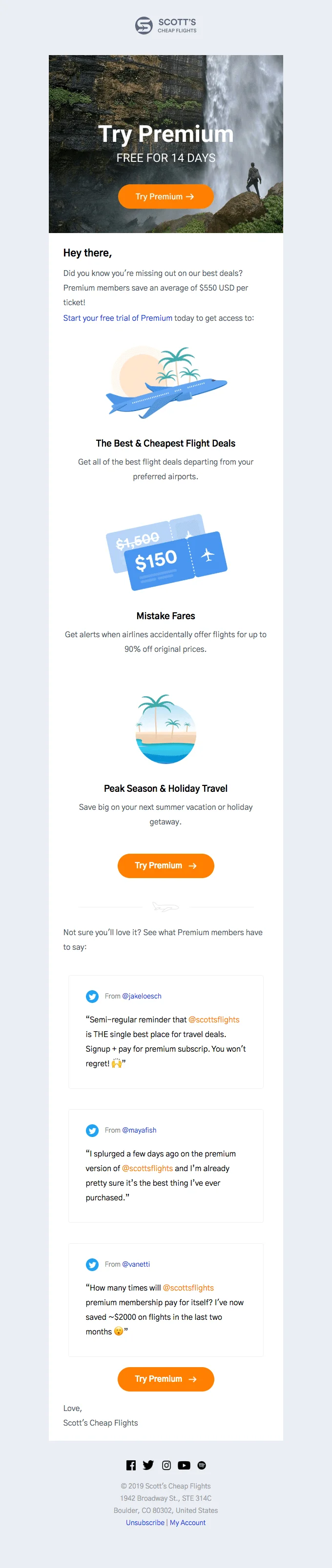
This email from Scott’s Cheap Flights is a perfect example of upselling. After a new customer used their app, they suggested a premium membership and explained its value. They also offered a free trial period so customers won’t feel pressured to spend money right now and try it out instead.
Keep in mind that these are not all the possible types of emails that can be used for promoting travel-related businesses — we’ve listed the most popular types. And these types can be mixed together. For example, you can include a thank you note in a confirmation email or add a seasonal offer to a monthly newsletter — it depends on the goal of your campaign.
Travel email marketing strategy: a step-by-step framework for agencies
Setting up a campaign for a travel agency is not different from other industries. Here’s a short recap of the whole process.
| Setting up a travel agency email campaign | ||
| Preparation | Content | Testing |
| Define the goals 📈 | Choose the type 🖊️ | QA testing 🧪 |
| Build your list 🗒️ | Design your email 🎨 | Split testing 💡 |
| Segment the list 🥧 | ||
-
Define the goals
Every campaign starts with an email marketing strategy. You need to understand why you’re running a campaign in the first place — for example, to increase sales.
The next step is defining success criteria using the SMART framework:
- Specific
- Measurable
- Achievable
- Relevant
- Time-bound
For example, if your goal was to increase your website blog’s readership, your success criteria would look like “Increase the number of daily unique visitors by 30% by the end of this month”.
-
Build your mailing list
A mailing list is a list of users who will receive your marketing emails. Keep in mind that buying readymade email lists online and using them for marketing campaigns is illegal. Build your list using opt-in forms and pop-ups. To learn more, read our article about building an email list.
-
Segment the list
Segmenting your email list is important for sending relevant emails. There are many segmentation criteria — age, location, website activity, and so on. The choice of criteria depends on your campaign and your market niche.
Try travel-specific segmentation:
- Past destinations visited
- Regions of interest (Europe, Southeast Asia, Latin America)
- Travel style (luxury, family, adventure, budget, wellness, corporate)
- Trip duration (weekend getaway vs. 2-week trips)
- Travelers with children vs. without
- Off-season / on-season booking behavior
- Last booking date or engagement level
-
Decide on the type of content
The type of content you chose will affect the subject line, the copy, the CTA, and the email layout. Choose the content type depending on your marketing campaign goal and the stage of the customer journey.
| Journey stage | Email types that work best | What they achieve |
| Dreaming | Inspiration newsletters, destination guides, blog roundups | Build desire & increase site visits |
| Planning | Comparison emails, FAQs, early-bird promotions | Help customers choose your offer |
| Booking | Sales campaigns, last-chance offers, abandoned-search emails | Reduce friction & boost conversions |
| Pre-trip | Packing lists, reminders, weather updates, upsell alerts | Prepare customers & increase order value |
| In-trip | Local tips, excursion offers, partner discounts | Improve experience & generate extra revenue |
| Post-trip | Thank-you emails, feedback requests, referral offers, loyalty perks | Drive repeat bookings & advocacy |
One of the types of emails often used for travel agencies is last chance emails. Use these emails for promoting seasonal offers — and use our guide on last chance emails with writing tips and best practices.
-
Design your email
Good email design draws attention to CTAs, improves email readability and helps you express the charisma of your brand. And a trendy look will keep your subscribers engaged.
To learn more, read our guide on email design with tips and best practices.
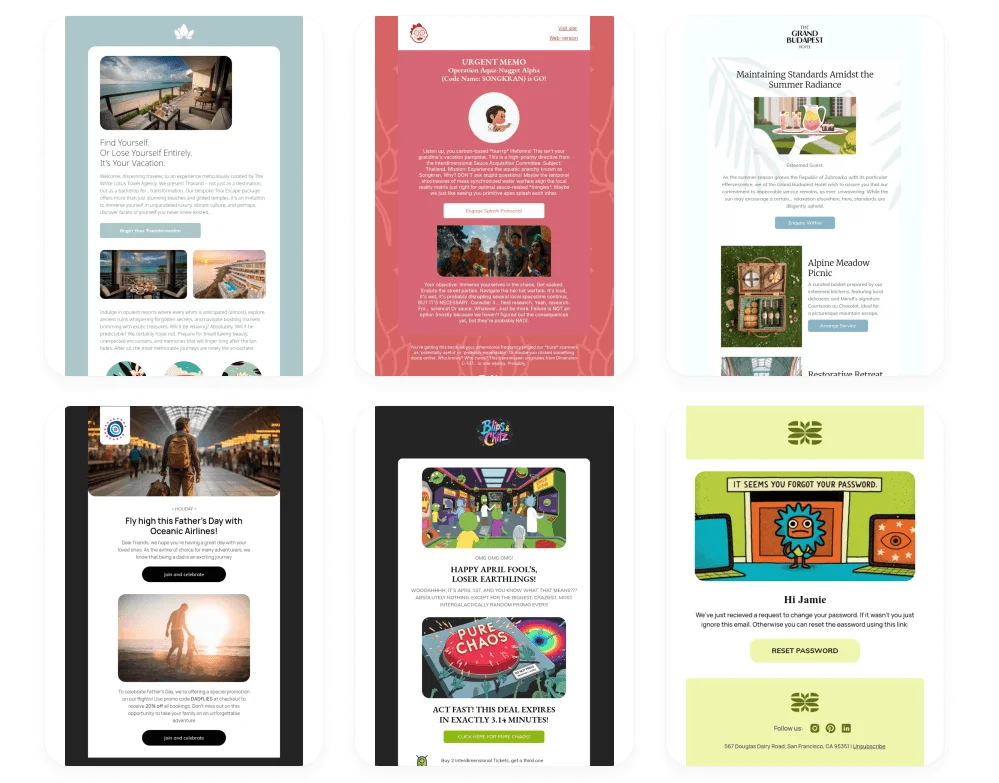
You don’t have to do everything from scratch — we have an AI-powered email builder for you that you use to create campaigns with ease and in no time.
Ready-made templates specifically designed for the travel industry are also there for you, but you can actually choose any of our 1,000+ email templates, they are fully customizable.
-
Automate the high-impact flows
Set up simple automated sequences that run without manual effort:
- Welcome series → introduce your agency + offer planning resources.
- Browse follow-ups → send destination info after page views.
- Abandoned booking → remind customers who didn’t finalize.
- Seasonal prompts → summer deals, holiday trips, weekend escapes.
- Pre-trip sequence → check-in info, packing tips, weather, upsells.
- Post-trip sequence → feedback + loyalty offer.
-
Test and analyze the results
Once you’re done with your email content and design, test your emails before sending:
- QA testing — to make sure that your email campaign is set correctly, all the hyperlinks work as intended and customers won’t receive an email with a “Hello <undefined>” greeting.
- Split testing — to validate your ideas and hypotheses and make smarter marketing decisions.
That’s the basic process for setting up a travel agency campaign. If you’re worried about missing a step, use our email marketing checklist.
Best travel agency email examples
Now that you know how to set up an email campaign for a travel agency, let’s take a look at some examples of great campaigns in the industry. We’ve picked 4 good travel agency emails for your inspiration.
Vacasa: Wanderlust-worthy road trips
Vacasa is a rental management company that operates in North and Central America. And although their business is focused on destinations, they ran a campaign that’s all about the journey.

Vacasa caught up on the trend for domestic and rural tourism and made a guide on interesting road trip destinations within the US. We love how visually appealing this campaign is — and the lovely “Life is a Highway” CTA button. Another good thing about this email is that you can look through rentals right away if you like a certain destination — it’s convenient for customers.
Intrepid: Celebrating BIPOC culture
Intrepid is a US-based company that specializes in small group tours and adventure trips. Since the questions of oppression and justice in the postcolonial world have been around for a long time, they rolled out a series of educational tours and ran an email campaign.

It’s hard to run a campaign like this without being offensive. Educational tours are great but they shouldn’t look like a trip to a zoo where the privileged group looks down on the culture of those who survived genocide and occupation.
Intrepid handled the subject matter gracefully — they give the word to local experts and aim at educating, not just entertaining. And the campaign itself is great — it’s well-written, and beautiful pictures and minimalist email design create a stylish look.
Oliver’s Travels: God Save The Queen!
Oliver’s Travels is an agency that specializes in luxury vacations and high-end real estate rental in Europe. And they’ve prepared something special for The Queen’s Jubilee.
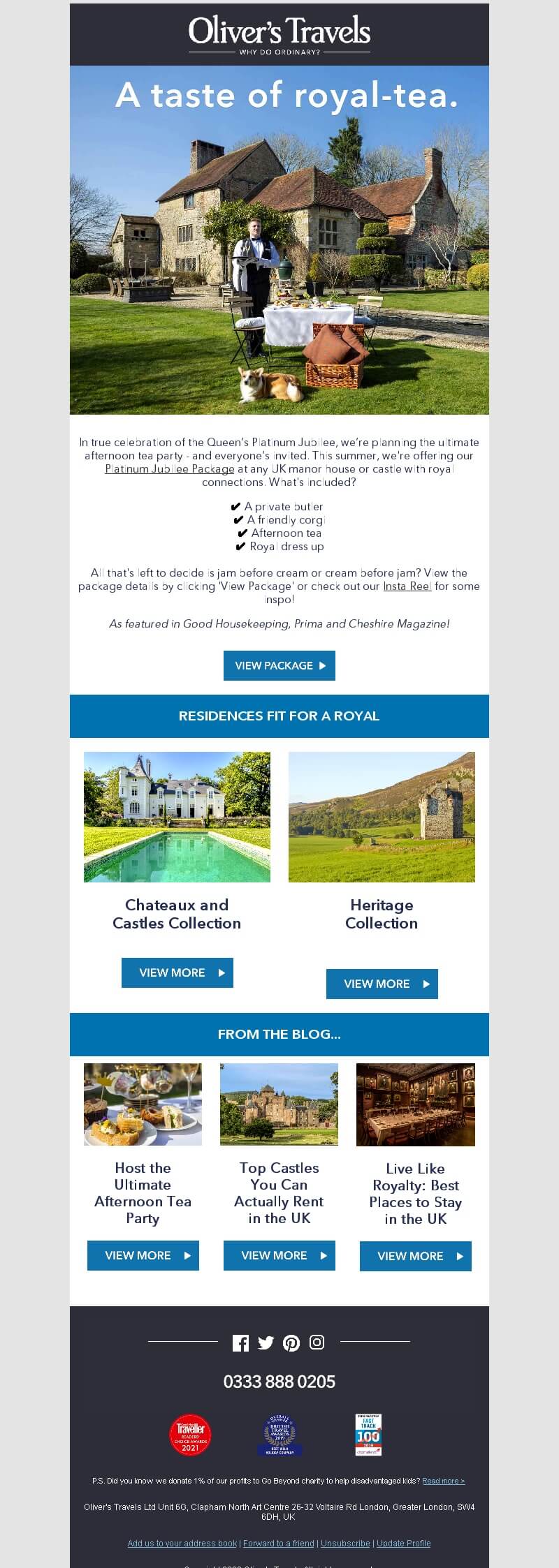
First of all, just because you’re a luxury brand doesn’t mean you can’t throw a pun in an email. And they didn’t stop here. Apart from the invitation, they added topic-related blog articles and links to luxury castles in the UK. Maybe they overdid it with CTAs. But overall, this email makes you feel like a queen. Or a king.
Tripaneer: Yoga in the USA
Tripaneer is a travel agency that specializes in wellness holidays like retreats for mindfulness, weight loss, spiritual growth, and so on.
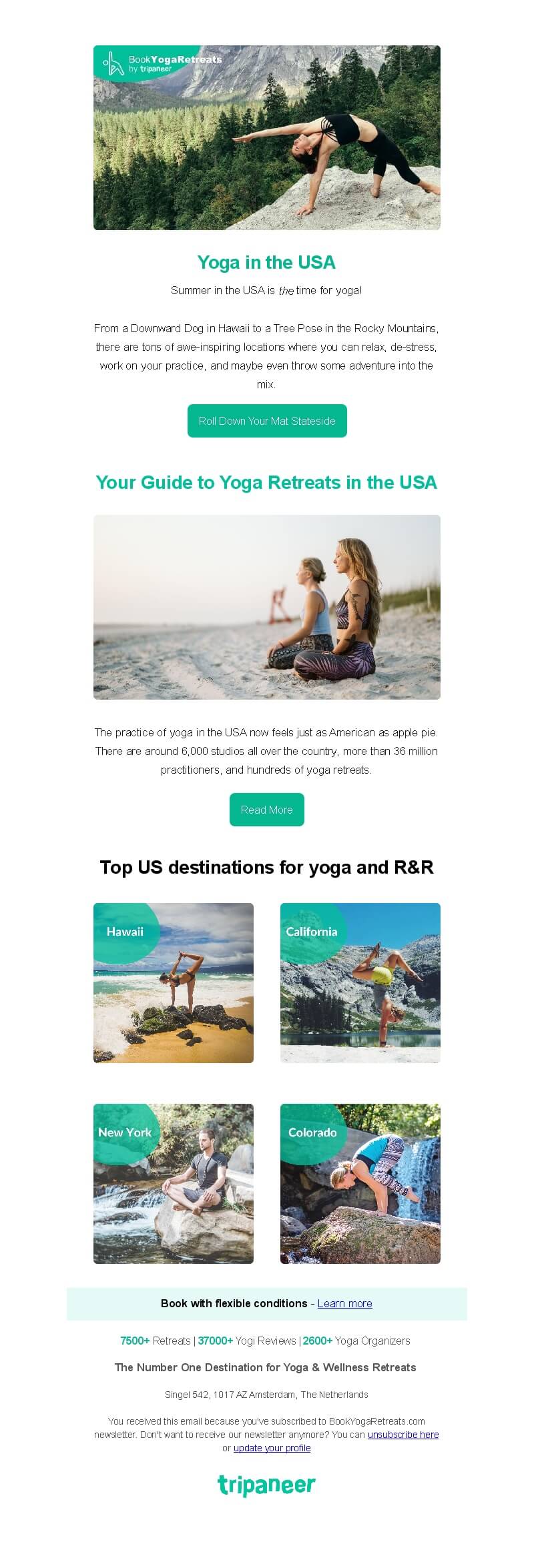
This email about US-based yoga retreats doesn’t have a lot of text — but it’s incredibly well-written. And we appreciate creative CTAs — like the one about rolling down mats. We also like that Tripaneer added a link to a guide on their website instead of writing the whole article for the email.
Final thoughts
Running an email campaign for a travel agency is a good way to re-engage your customers who stopped traveling due to lockdowns and increase sales. Some common types of emails for campaigns in this industry include:
- Welcome emails — use them to introduce customers to your service and explain how it works.
- Newsletters — it’s a great way to draw more traffic to your website and stay in touch with your customers.
- Confirmation emails — use them to share valuable information and notify that the transaction was successful.
- Thank you messages — this type of email increases customer loyalty and helps you build stronger relationships.
- Informational emails — unlike newsletters, these emails are not sent regularly and are used to share important information, for example, about emergencies.
- Seasonal offers — since tourism is a season-driven industry, emails with summer vacation or holiday offers will help both you and your customers.
- Upsell emails — suggesting a more expensive version of what your customers already bought will increase your revenue.
To run a successful campaign for a travel agency, don’t forget about:
- Personalizing your campaign to give more relevant offers
- Catchy subject lines — use humor, add a personal greeting, or appeal to the value of traveling depending on your niche
- Visual aids — they will gently coax your customer into clicking on the CTA button
- Sense of urgency — verbal urgency cues will trigger FOMO
- Shared opportunities — offer your customers something valuable.
 New and noteworthy on our blog
