Subscribe to the FWD: by Selzy email marketing digest and get actionable tips, trends, and 21 growth ideas to try today.
Key takeaways
Last chance emails are crucial to remind customers of expiring offers and trigger FOMO to drive action.
Common types of last chance emails include time-limited deals, social proof emails, and out-of-stock notifications.
Practices for effective last chance emails include using banners with discounts, countdown timers, emphasizing limited edition products, and highlighting scarcity.
Subject line best practices for last chance emails include keeping it short, using urgency, emojis if appropriate, and complementing it with a clear preheader.
No matter how desirable your product is, your customers might forget about it, making you lose out on potential profits. Last chance emails help you avoid such situations by reminding, offering sweet deals and discounts, and emphasizing that the offer is short-lived and will be gone soon. It’s a win-win deal for all parties — your customers get a discount, while you get more sales.
In this article, we’ll talk about the most popular types of last chance emails, their place in the email marketing strategy, and how you can craft your own FOMO messages that will help you get more profit from your existing customer base.
What is the last chance email?
Last chance emails are sent directly to customers as a last-ditch effort to get them to buy the product. They aim to get people to act on expiring offers, and they do it by triggering “fear of missing out”, or FOMO for short.
It taps into FOMO — the anxiety of missing out on what others are getting — to nudge action.
Most common types of last chance emails
Usually, companies send last chance emails close to the end of the deal. Depending on your business and audience, you may want to send it on the last day, 24 or 48 hours before the end, and in some cases, an hour or a few before.
Also, different situations need different messages. Here are the most common types of last chance emails and email marketing tips.
This offer expires
One of the reasons time-limited deals work is because anxiety fuels impulse. Like countdown timers on landing pages and in reminder emails, it reminds customers that time is running out and they have to act now.
“This offer expires…” message is versatile and can also be used as a win-back email — sent to inactive customers to bring them back on board.
For example, here’s a last chance email by Navan — a corporate travel management platform.
It’s quite simple, but it’s also super clear: it tells you exactly how much you can get as your reward, when the offer expires and a step-by-step guide on how to make it in time and redeem your reward.
The “Other customers are interested in…” type of last chance email works on two fronts. First, it suggests to the reader that products in the email are popular with other people, thus they might get out of stock soon. Second, it provides social proof that the products are worth their cost.
The “Other customers are interested in…” works better when your email list is segmented — you’d be able to customize and send more personalized emails then.
You don’t even have to outright say that other customers are interested in the product and it’s in short supply. You can let your subscribers know with the help of customer testimonials, like Athletic Brewing did in their email below.
Source: Really Good Emails
“It is now out of stock” followed by “It is back in stock”
This is a “…This product is now out of stock. It’s a pity, but no worries, you may still get it at the next opportunity”… type of message. It reminds people about products they might have wanted to purchase but postponed and ended up missing out.
A “you missed it” message triggers FOMO and works well for travel and e-commerce. But it can and should carry value for the customers — give them an idea whether that product is going to be back and when; offer an alternative; or even simply a promise to let them know once it is back.
You could also offer to pre-order the product so that they get it as soon as it’s back in stock. This would book you some sales in advance.
“Out of stock” reminder is only half the trick — the second and most important half is the “Back in stock” message. This is the email that will actually get you sales — since people can only buy it if it’s available.
This approach works for both potential customers and promotes customer loyalty and retention of existing clients.
OFFHOUSE’s “Back in stock” features multiple products with images and “Buy” buttons. Source: Really Good Emails
Proven last chance email practices you can’t go wrong with
Using a banner with a discount
Banner sends a clear message that the reader can see immediately after they open the email. The downside is that some email clients may not show the image by default — in which case your potential customers won’t see the banner. This is why it’s best to repeat the same information in text after the banner and make sure the email still looks good even if the banner is not there.
Source: Really Good Emails
Adding a countdown timer
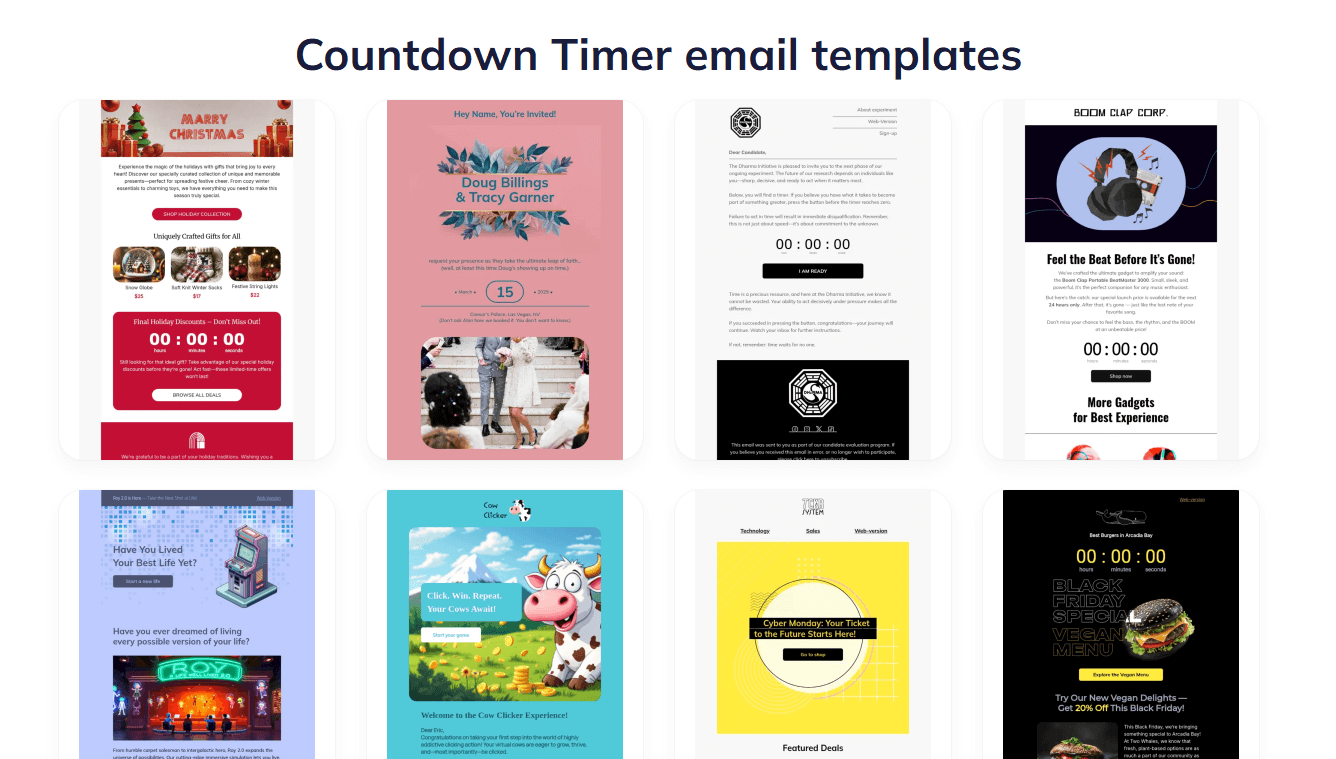
Countdown timers help visualize the time that is ticking away. You can use an actual ticking clock.
You could also design a countdown email campaign — a series of three or more emails counting down to the deadline. Each email shows less time remaining, increasing the sense of urgency. You could also increase the discount with each next email — or do the opposite, decrease it if you sell popular limited edition products and want to maximize profit.
An animated countdown timer in a last chance email
It’s not just about timers, we have hundreds of unique ready-made templates for different industries, seasons, of various types and seasons.
Explore, take your pick, mix and combine and save your time! All for free.
Limited edition suggests the product is exclusive so that the person who has it can differentiate themselves from everyone else. The thought of owning something that only a few can get is the idea attractive to many. It can drive sales by itself and works even better in combination with other tactics.
Happy Human’s last chance email combines a “limited stock available” tactic with a discount. Source: Really Good Emails
Putting emphasis on scarcity
A limited number of tickets for an event, remaining spots in a valuable course, or items in stock create pressure and motivation to get them before others take everything away. It works even better in combination with limited time availability.
Neil Patel used these tactics for his Sales Funnel Playbook offer. He does not forget to add social proof by stressing how in demand this product is, telling readers it was all sold out in just a day.
Neil Patel’s last chance email about his Sales Funnel Playbook offer puts emphasis on scarcity. Source: Neil Patel
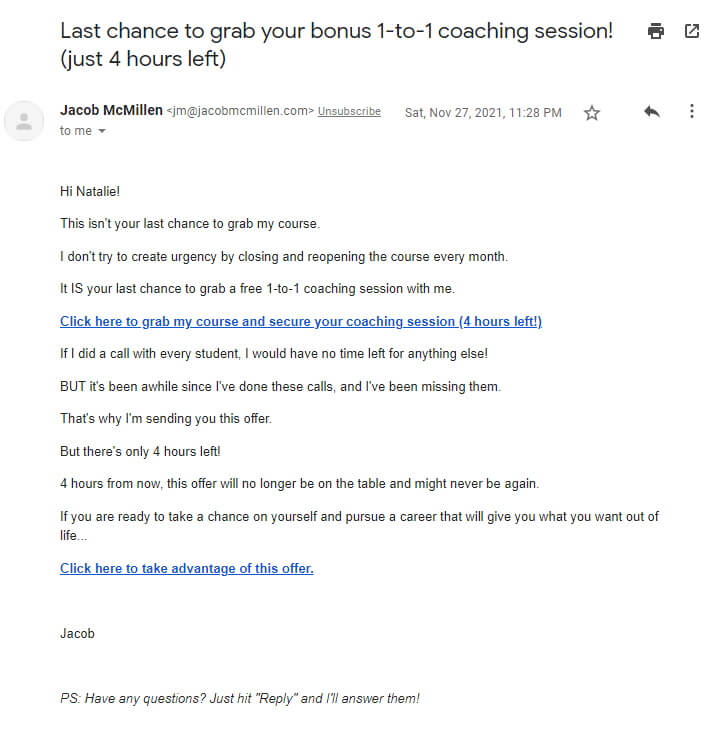
Jacob McMillen, a six-figure copywriter and an author of The Internet’s Best Copywriting Course, uses a combination of scarcity and limited time to sell his 1-to-1 coaching session. Hinting that it might never be available again adds even more pressure and desire to grab it while it’s still there.
Jacob McMillen uses a combination of scarcity and limited time to sell his 1-to-1 coaching session. Source: Jacob McMillen
Best last chance email subject lines to try out in your campaign
Subject lines often determine if people open your emails or send them to the trash folder. Luckily, there are a number of templates you could use (that work great for others).
Last chance…
Only [X] hours left
Price jumps by [X] tonight
Last day
Your [X]% OFF deal ends soon
Get [X] with [Y]% OFF (next 36 hours only)
Up until [X]: Try a [Y] for FREE for 30 days
Almost gone!
You are missing out
These items are going to run out soon
When crafting a subject line for your message, remember these few things.
The shorter the better. Your readers may be using smartphones and the long title won’t show on it fully. Keep it under 9 words and 60 characters.
Use emojis to stand out and convey meaning (but only if they fit with your brand’s style). It will save you space (one emoji instead of multiple words or characters) and attract your readers’ attention.
Make sure your preheader compliments and explains the subject line. Preheader is a text that comes after the subject line when an email is viewed in your inbox.
Top last chance email examples that actually worked
SAXX Underwear
SAXX Underwear makes comfortable men’s underwear and loungewear with proprietary designs and cool patterns. Their products have a number of unique features, and the trademark is what they call a “ballpark pouch” — a 3D hammock of sorts, that is meant to hold men’s manhood in place while limiting chafing and perspiration.
Source: Really Good Emails
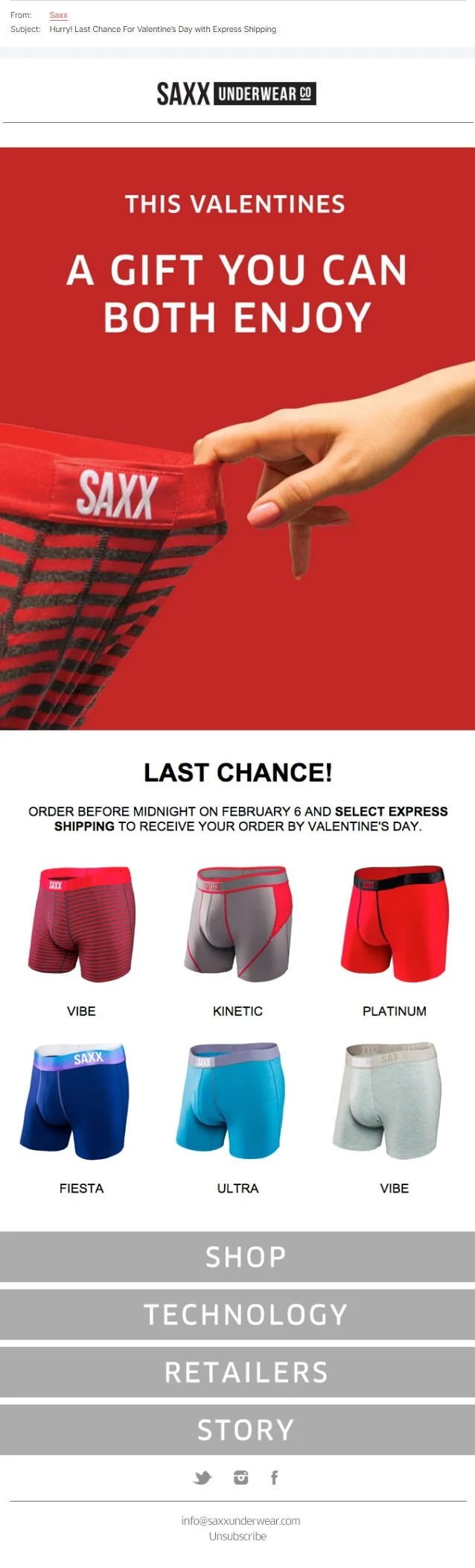
The last chance email from SAXX Underwear immediately captures attention with a big red banner. It then goes on to explain why this is the last chance — since any later and the purchase won’t arrive in time for Valentine’s. The email also cuts out extra steps — it shows the products right there so that the reader can choose and go on to buy.
Valley Cruise Press
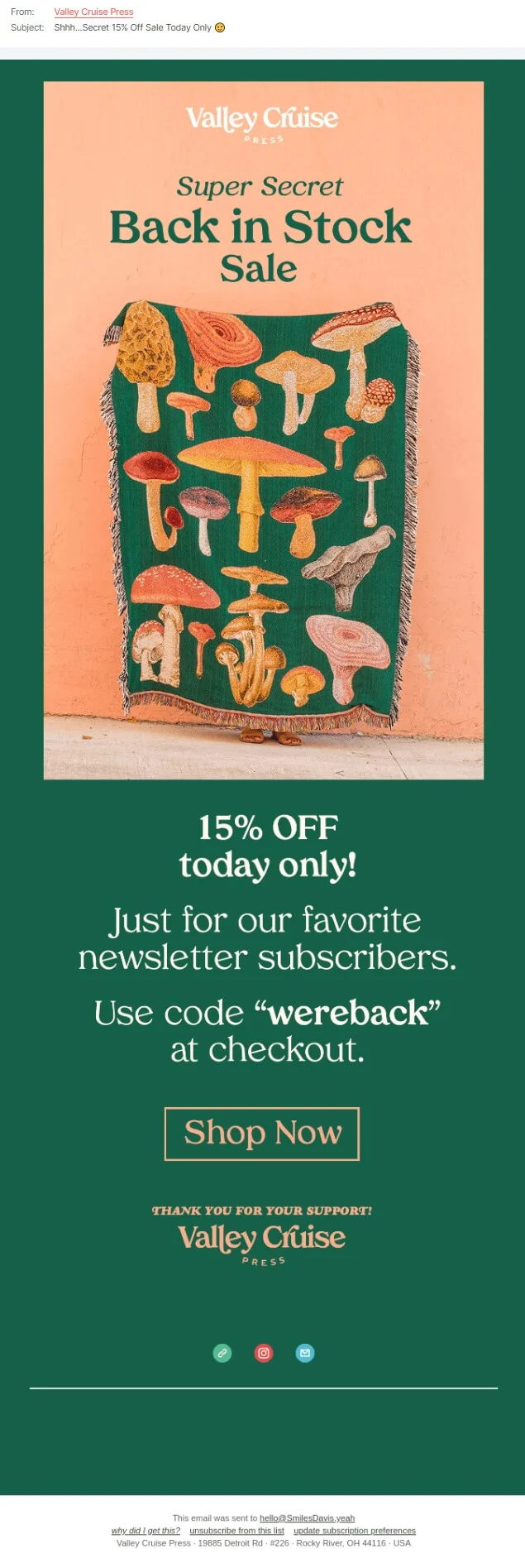
Valley Cruise Press is an art and design-focused press label specializing in limited edition pins, patches, books, and other accessories. They “have been making cool stuff and sharing good designs since 2014”.
Source: Really Good Emails
Valley Cruise created a beautiful artistic design, consistent with their website. They use exclusivity tactics by offering a discount to newsletter subscribers only and added a limited-time availability tactic by selling for only one day.
Grammarly
Grammarly is an AI-based writing assistant that reviews spelling, grammar, punctuation, clarity, engagement, and delivery mistakes while also offering specific suggestions to help you improve your writing.
Source: Really Good Emails
Grammarly gets straight to the point with a big bold 50% offer on the premium plan and makes it immediately clear that readers need to act quick — the offer ends today. The email goes on to compare the free and premium plan and make it clear to the reader what they would lose if they don’t act.
Goodreads
Goodreads is one of the world’s largest sites for readers and book recommendations. It also has a community, and in its database, there are both paid and free-to-read books.
Source: Really Good Emails
Goodreads’ “last chance to vote” email uses a clear subject line, explains the details with a beautiful banner, and then shows the books with their covers.
Bob Bly
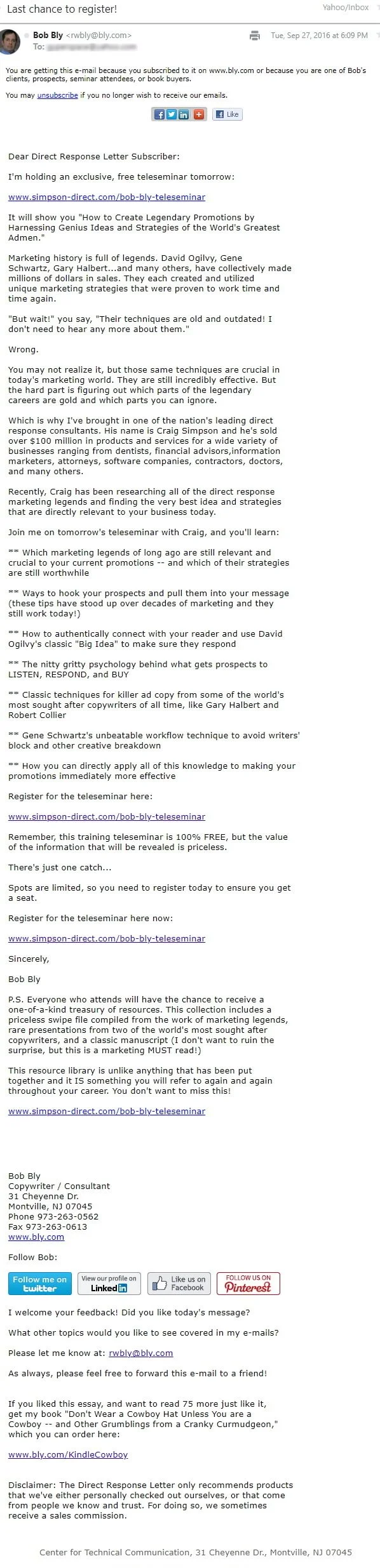
Bob Bly is a top-level copywriter and author of 100 published books on copywriting and marketing. Here is the last chance email he sent to his subscribers promoting a free webinar. It goes without saying that Bob Bly should have marketing resources to create any type of impressive email with banners and whatnot — however, he opted for plain text to persuade his subscribers. And in his case, plain text is enough.
Source: Bob Bly
Bob Bly uses plain text only for his last chance email yet the message is still clear and persuasive. He combines tactics: training is exclusive, and available spots are limited. Plus, he adds a big fat bonus for attendees: a free library of swipe files useful for his audience — marketing professionals.
FAQ about last chance emails
What is a “last chance” email?
It’s a time-sensitive message sent near the end of a deal or availability window to trigger FOMO and drive action (e.g., sale ending, low stock, shipping cutoff, “back in stock”). It’s a direct nudge to buy now.
When should I send last chance emails?
Close to the end of the offer: the last day, 24-48 hours before, or even in the final hours. Many brands also send a short “final hour” reminder.
Which tactics work best in last chance emails?
Clear banners with the offer, countdown timers, limited-edition/limited-stock framing, and social proof (“other customers are interested…”). Keep the message brief and urgent.
Do countdown timers really help?
Yes. Timers visualize that time is running out and can be used in a single email or in a short countdown series (e.g., 3 emails with decreasing time left).
How do I handle “out of stock” scenarios?
Send a polite “out of stock” notice (with alternatives or a promise to notify) and follow with a “back in stock” message — that second email is the one that typically converts.
Any subject line best practices for last-chance emails?
Keep it short (aim under ~60 characters/9 words), front-load urgency (“Last chance…”, “Only X hours left”), use emojis sparingly if they fit your brand, and support the subject with a clear preheader.
Can last chance emails work beyond e-commerce?
Yes, they also work for courses, events, SaaS promos, restocks, and win-back campaigns, not just online stores.
Natalie is a content writer and blog writer that specializes in SEO and on-page optimization. Her specialty is marketing and sustainability niches, with years of actual hands-on experience in the roles like digital marketer generalist, webmaster and Facebook advertiser.
Outside and in the course of work, Natalie remains an animal lover and a human-nature coexistence enthusiast.
Others just make a list of ways. We actually explain how to make the most of each way.
Subscribe to the FWD: by Selzy email marketing digest and get 21 ways to grow your email list with explanations and examples.
Based on research and 10+ years experience.
Thank you!
Check your email — the guide is on it’s way to your inbox.








 New and noteworthy on our blog
