


Key takeaways
- Customers do not follow a linear path from discovery to purchase; they interact with various channels.
- Omnichannel customer engagement ensures a connected experience across channels.
- B2B consumers switch between 10 touchpoints before purchase in 2024, up from 5 in 2016.
- Benefits of omnichannel strategy include better understanding of the target audience, increased revenue, more brand ambassadors, and efficiency.
- Challenges include complexity, existing data silos, syncing teams, privacy concerns, and understanding the business necessity.
Customers rarely move in a straight line from discovery to purchase. They may see your product on Instagram, compare options on your website, open an email offer, contact support, visit a store, and only then check out.
If those interactions feel disconnected, customers have to repeat themselves, receive irrelevant messages, or drop off before buying. Omnichannel customer engagement helps prevent that by connecting your channels into one consistent customer experience.
In this article, we’ll explain what omnichannel customer engagement is, when it makes sense for your business, what challenges to expect, and how to build a strategy in 8 steps.
What is omnichannel customer engagement?
Omnichannel customer engagement is when your customers — or potential customers — jump between several of your marketing channels (e.g., website, Instagram page, and an email newsletter) with all their information carrying over from one channel to another.
Omnichannel customer engagement is the customer-facing result: a connected experience across channels. An omnichannel customer engagement strategy is the internal plan that makes it happen. It defines which channels you connect, what customer data you use, how teams coordinate, and how you measure success.
McKinsey tells us this is the new norm: in 2024, B2B consumers switched between 10 different touchpoints before making a purchase — up from just five in 2016.
Their experience is seamless, they pick up where they left off on the previous channel — that includes offline channels as well. Connecting different experiences, whether online or offline, is what an effective omnichannel strategy is about.
Building an omnichannel strategy requires meticulous planning, keeping all your marketing channels in sync, and mapping out convoluted customer journeys in advance. However, when pulled off correctly, an omnichannel customer engagement strategy brings multiple benefits to the table.
Why omnichannel customer engagement matters
Disclaimer: Adopting an omnichannel strategy is not a must for every business. It’s not easy to create, harder still to implement, and costly to maintain and iterate. You should first consider how implementing an omnichannel strategy will help your business. We’ll cover that in more detail below, but for now, let’s assume you intend to go ahead with such a strategy. How will it help you?
Benefits for your business
- You’ll get a better understanding of your target audience. It’s a necessary early step when creating an omnichannel strategy. You’ll analyze which channels your customers prefer, how their journey eventually leads them to checkout, and how you can segment your customers to better help them.
- You’ll boost your revenue and lower acquisition costs. 25% of companies with an omnichannel engagement strategy in place reported higher revenue and lower costs. Other benefits included increased sales of premium items, higher order values, and more frequent purchases.
- You’ll increase the number of your brand ambassadors. In simple terms, customer loyalty will grow — 35% of brands with an omnichannel customer engagement approach benefited from better retention and customer loyalty. People will make repeat purchases and recommend your brand to others.
- You’ll become more efficient. With omnichannel marketing automation, you can schedule campaigns across channels and make the strategy run smoothly even when you’re away from your computer.
Benefits for your customers
- It’s how they shop. A significant number of customers are omnichannel customers: they switch between offline and online. With an omnichannel engagement strategy, you’ll be meeting your customers where they are.
- It’s an experience they’ll enjoy. With an omnichannel approach, people will feel like they are on a continuous, uninterrupted journey — because they are. You’ll know more about them, will be able to better help them, and, most importantly, will spare them the repetition as they switch between channels. As a result, customer satisfaction can improve.
Here’s how Solsten’s CEO and co-founder, Joe Schaeppi, thought their customer journey through after the purchase has happened — giving the customers a seamless experience and reducing unsubscribe rates in the process:
After a customer made a purchase, we didn’t just send a thank-you email — we invited them to choose their own post-purchase path. They could pick from “Learn the story,” “See the hacks,” or “Join the community,” and their selection shaped everything from follow-up emails to ad creatives and even inserts in their next package. It made the experience feel personal and allowed us to speak to what actually interested them.
Because of this, unsubscribe rates dipped noticeably, and people who returned to our site spent 44% more time exploring. Giving them a sense of control made the brand feel more like a two-way conversation than a broadcast.
Potential challenges of an omnichannel customer engagement strategy
As mentioned earlier, omnichannel engagement is difficult to implement well — and it is not a universal solution. Here’s what to consider before building an omnichannel customer engagement strategy:
- Sheer complexity. Your customer journeys may become complex, especially when several teams, tools, and channels are involved — you may need to rethink your tech stack, workflows, and team responsibilities. It requires time, budget, effort, and careful change management to avoid internal friction.
- Existing data silos. Your customer data may already be scattered across disconnected systems. Other teams may not have access to a shared source of customer data.
- Syncing up teams and processes. You’ll need to bring all teams that are involved in the omnichannel strategy up to speed with how others operate. You’ll also need to review their internal processes to work towards a common goal, because existing workflows may serve individual departments rather than the full customer journey.
- Privacy concerns. Customers are increasingly concerned about how companies collect, store, and share their data. You’ll need to both collect data with your customers’ consent and share it between teams in a secure way — as well as be ready to wipe this data upon their request.
- Business necessity. Last but not least: you need to understand why you are going omnichannel, what benefits you expect, and how soon. Your existing approach (be it multichannel or something else) might be better-suited for your company and target audience. Simply because the idea of an omnichannel approach is enticing and other companies are pulling it off successfully doesn’t mean you should follow suit.
8 steps to create an omnichannel customer engagement strategy
An omnichannel customer engagement strategy answers the question of how you are going to make your consumers happy — and how you are going to measure results. Such a strategy, however, requires careful planning and precise execution.
So, below we will break down what you need to do to create a successful omnichannel engagement strategy.
-
Analyze how customers move across your marketing channels
This step helps you identify two things: where customers drop off on each channel and how those channels connect.
Where do your customers go after looking at your newest Instagram offer? Is it your website where they can ask questions about the product? Do they search through their emails to see if they are eligible for a discount on that offer?
You will get insight into how your users behave, how you can segment them based on that, and which channels naturally work together.
-
Outline buyer personas
The data you’ve gathered allows you to understand how different customers behave, which, in turn, allows you to create buyer personas — or complement existing ones. Once you have a fuller picture of customer behavior and preferences, you’ll know how to best adapt your offer, which channels to include in their customer journey, and what your customers will generally respond to best.
-
Pick the channels to use as part of your strategy
At first glance, it might be tempting to use every available channel, but there are three issues with such an approach:
- A more complex customer journey. More moving parts to keep in sync, more places for your customers to drop off before converting.
- Vast resources required. You will need many professionals to maintain or even develop new outreach channels. It’s not just a budget problem, it’s also a communication problem: All these people will need to be on the same page for an omnichannel approach to work.
- Channel overload. You simply might not need all the available channels. That’s why the first step is important: you need to identify where your customers hang out — and target these channels only. Otherwise, you might end up wasting resources on channels that don’t play into your customers’ journey.
In short, use the data you’ve gathered about your consumers to know which channels you need to focus on. The omnichannel approach is hard enough as is: no need to complicate it further.
-
Map out your customer journeys
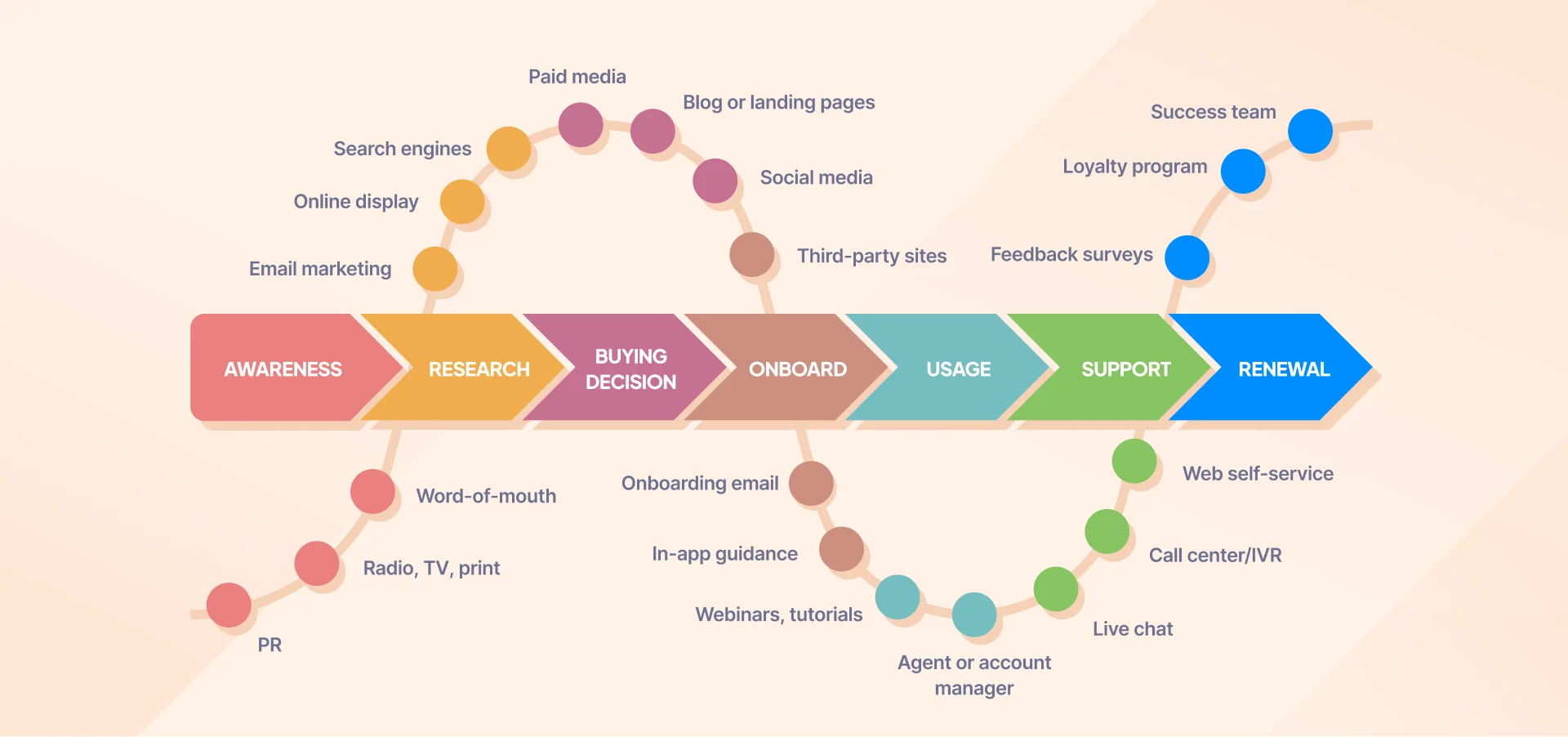
Yep, there will be more than one. The omnichannel approach not only makes the journey more convoluted because several touchpoints are involved — it also segments users based on how they switch between these channels. Customers from different generations, income levels, and locations may behave differently, even when they use similar channels.
So, identify how it all works with different audience segments and tailor your customer journeys accordingly. Here’s an example of how a customer journey with many marketing channels involved might look like:
-
Create or adapt a tech stack to consolidate behavioral data
An omnichannel approach depends on centralized customer data. All channels are interlinked, so marketers need to know how their work ties into the bigger picture. That means marketers need access to data from other channels and must stay aligned with other teams.
All of this calls for a customer relationship management or customer data platform (CRM and CDP). And it should play well with channel-specific software, such as search engine optimization tools, email builders, and customer service solutions.

You might need to rethink your tech stack from scratch if you can’t sync your current tools the way you need to. One important caveat: a single solution for an omnichannel approach might not be the best. It might lack the flexibility you need for specific channels, as well as come with a steep learning curve for your team.
-
Sync up all your departments
The most important ones are those that create content and map out customer journeys (most likely marketing) and those which are in close contact with your customers as part of your omnichannel strategy (sales and customer support). Don’t forget about offline sales reps too — brick-and-mortar stores are part of the journey as well.
Members of different teams need to be in contact with one another, as well as have access to their shared pool of knowledge. This is where a CRM or CDP comes in. Or perhaps a database such as Notion. Everyone involved should understand that an omnichannel approach is the ultimate customer-centric way of doing things — and ponder how they contribute to making your clients’ experience better.
-
Come up with content for your marketing channels
With your target audience’s preferences sorted, journeys mapped out, and teams on the same page, it’s time to start implementing the strategy by creating channel-specific content. While doing so, focus on two principles: personalization and consistency.
The journey your customer undertakes across channels needs to feel personal to work. Customers do not move between channels randomly; they expect one continuous conversation with your company. They expect each next stage to pick up where they left off, without repetition.
Consistency is about your tone of voice. While messaging should be adapted to each channel, as they can be very different, your unique voice should shine through. Brands like Nike or McDonald’s are instantly recognizable from their ads, tweets, the way they pop into comments, etc. Your tone of voice should stand out too, so that your customers are in no doubt who they are talking to.
For example, an e-commerce brand could use website behavior to trigger an email reminder, send an SMS only if the cart remains abandoned, and stop promotional messages once the purchase is complete. That kind of sequence is simple, but it already creates a more connected experience than treating email, SMS, and website activity separately.
-
Define what a successful omnichannel strategy looks like, measure, and iterate
Omnichannel should support a clear business goal. In most cases, it boils down to increased revenue, whether through acquisition, retention, higher order value, or repeat purchases.
So you should clearly define what a successful omnichannel strategy looks like (e.g., average order value increased by 10% by the end of the quarter), measure how you are doing, and suggest improvements. It’s a continuous process, during which you monitor metrics and iterate to become better. Much like with A/B testing, you learn as you go along — even unsuccessful tests can reveal useful patterns in customer behavior.
Omnichannel customer engagement examples
Many brands use omnichannel marketing to improve customer experience and retention. So we went ahead and picked out a couple of companies which integrated successful omnichannel customer engagement strategies — to give you an idea of how it works.
Warby Parker
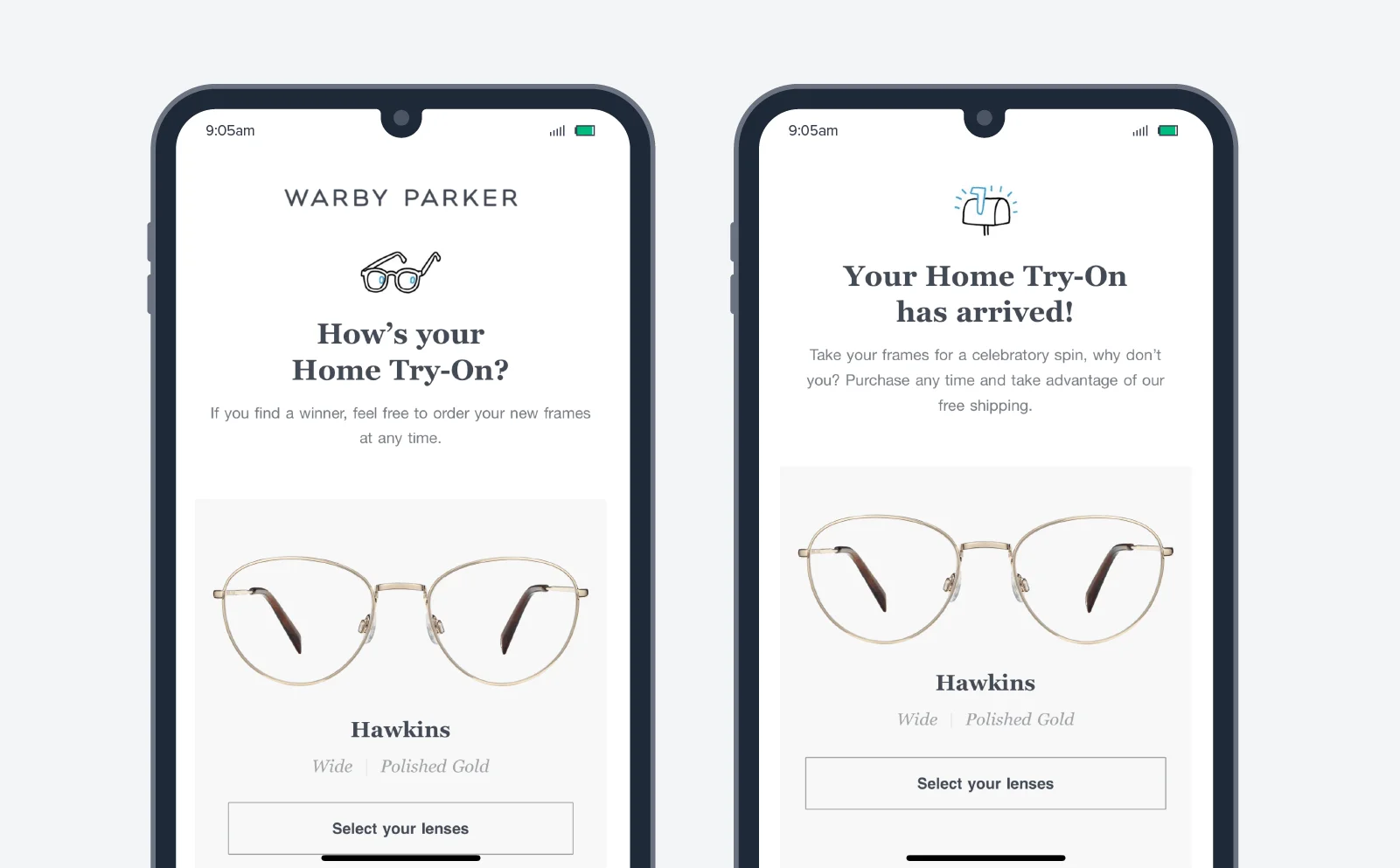
Warby Parker helped reshape the eyewear market by making glasses more affordable and easier to buy online. The company continues to connect online and offline shopping experiences. Here’s roughly how customers move along the journey:
- Look at frames through the app, try them on virtually, schedule eye exams at physical stores.
- Pick out frames to try on at home.
- Visit physical stores for said eye exams and frame-fitting in person.
All the customer data obtained offline is synced to the online profile — and vice versa, where shop assistants look at their profiles when customers come in.
That’s how the brand blends their website, app, and offline to deliver a personalized omnichannel customer experience. Warby Parker is active on social media as well — you can ask them questions there, on top of the standard chat through the app.
Home Depot
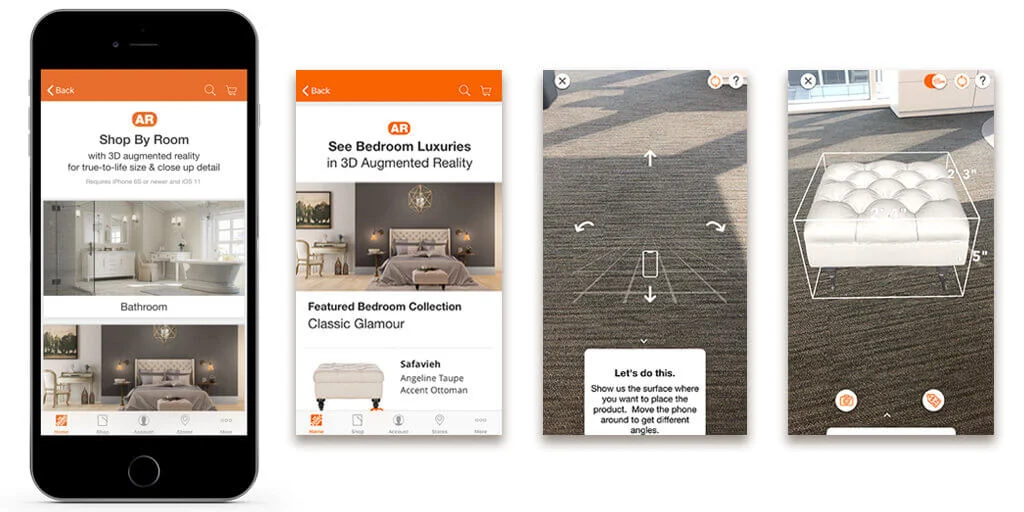
Home Depot is one of the largest home improvement retailers in the US. They sell tools, appliances, etc., to help you make your house a better place to live. They have an omnichannel customer engagement strategy that combines offline and online in several ways:
- The website is for browsing the inventory, checking whether it’s available at your local store, and reading DIY tips.
- The app gives you the ability to visualize how something would look in your home (using augmented reality), find nearest stores, and locate what you want within them.
- The stores themselves are staffed by trained employees who can help customers choose the right products.
Wrapping up
Omnichannel customer engagement is based on the concept that customers in this day and age prefer to shop in a certain way. It’s a sound concept too, as big players in the market of designing customer journeys prove with hard data. However, before going for it, ensure your company really does need an omnichannel customer engagement strategy: It’s a massive undertaking with several big questions to ponder before committing significant time and resources.
Integrating an omnichannel customer engagement strategy can be good for your business because it’ll help you bring in more revenue. It’s also great for your customers: They will love the personalized experience and continuity when going from one channel to the next one.
You can create your own omnichannel strategy by analyzing how your target audience shops, creating content to help them make purchases this way, syncing up teams across your organization, and measuring results for subsequent strategy improvement.
Omnichannel customer engagement FAQs
What is omnichannel customer engagement?
Omnichannel customer engagement is the process of connecting customer interactions across different channels — such as your website, email, social media, app, customer support, and offline locations — so the experience feels consistent and personalized.
For example, if a customer browses a product on your website, receives a relevant email later, asks a question in chat, and then completes the purchase in store, an omnichannel approach helps make those interactions feel like one continuous journey.
What is the difference between omnichannel and multichannel customer engagement?
Multichannel customer engagement means using several channels to communicate with customers. For example, a company might use email, social media, SMS, and live chat.
Omnichannel customer engagement goes further: those channels are connected. Customer data, context, and messaging carry across touchpoints, so customers do not have to start over or repeat themselves every time they switch channels.
In short, multichannel is about being present on multiple channels. Omnichannel is about making those channels work together.
What are examples of omnichannel customer engagement?
Common examples include abandoned cart reminders that reflect a customer’s website behavior, email campaigns based on past purchases, SMS updates after an online order, personalized product recommendations, loyalty program messages, and customer support handoffs where the next agent can see the full conversation history.
A simple example is an e-commerce store that sends a cart reminder by email, follows up with an SMS only if the customer has opted in and still has not purchased, and then stops the sequence once the order is complete.
What channels should an omnichannel strategy include?
An omnichannel strategy should include the channels your customers actually use. These may include email, SMS, social media, website chat, mobile app notifications, customer support, paid ads, and offline locations.
The goal is not to use every possible channel. The goal is to connect the channels that matter most to your customer journey and make each interaction relevant.
How do you measure omnichannel customer engagement?
You can measure omnichannel customer engagement by tracking metrics such as customer retention, repeat purchase rate, customer lifetime value, average order value, conversion rate, churn rate, customer satisfaction, and engagement across channels.
It is also useful to look at how channels work together. For example, you can analyze whether customers who interact with both email and SMS convert more often than customers who only interact with one channel.
Is omnichannel customer engagement necessary for every business?
No. Omnichannel customer engagement is useful when your customers already interact with your company across several channels and expect those interactions to feel connected.
If your business relies on one or two simple touchpoints, a full omnichannel strategy may be unnecessary or too expensive to maintain. In that case, it is better to improve your existing channels first and add more complexity only when your customer journey calls for it.
 New and noteworthy on our blog
