


Key takeaways
- Small Business Saturday is an annual event in the U.S. on the Saturday after Thanksgiving.
- Campaigns should focus on community connection, brand story, inbox angle, and commercial results.
- Email timeline: announce 10-14 days before, reveal offer 3-5 days before, send primary campaign on Friday/Saturday, send one reminder, and thank customers after.
- Subject lines and preheaders should be specific and avoid false urgency.
- Campaign ideas include shop-local, offer and urgency, founder or team story, and gratitude and impact.
Small Business Saturday is the Saturday after Thanksgiving in the United States. In 2026, it falls on November 28. For small brands, the event is an opportunity to combine a timely offer with a founder, team, or community story — without trying to outspend the largest Black Friday advertisers.
A useful campaign normally includes an early announcement, a clear reason to shop, and one final reminder when the deadline is real. This guide covers the timing, subject lines, promotion ideas, and real email examples you can adapt for your own campaign.
What is Small Business Saturday?
Small Business Saturday is an annual observance that encourages people to support independent and local businesses. American Express introduced it in 2010, and the U.S. Small Business Administration has supported the initiative since 2011.
The event takes place on the Saturday after Thanksgiving — November 28 in 2026. A business does not need to offer a discount to participate. A campaign can highlight a local event, a collaboration, the people behind the brand, customer impact, or a limited product bundle.
If you are building a broader seasonal calendar, see Selzy’s November newsletter ideas and email marketing calendar.
The benefits of Small Business Saturday emails
Small Business Saturday gives independent brands a distinct reason to contact customers during a crowded shopping period. It can support several goals:
- Strengthen community connection. Show how purchases support a local team, neighborhood, supplier network, or cause.
- Tell a recognizable brand story. Founder notes, team introductions, and customer thank-yous make the business easier to remember.
- Create a different inbox angle. A community or impact story can stand apart from a purely discount-led Black Friday email.
- Generate commercial results. American Express estimated $18 billion in consumer-reported spending at small businesses on Small Business Saturday 2025. The figure comes from a consumer insights survey and is an estimate rather than audited sales receipts.
The strongest campaigns connect the commercial goal to a credible story. A discount alone may drive urgency; a clear explanation of who or what the purchase supports gives the event meaning.
Small Business Saturday email timeline
You do not need to send every message below. Choose the stages that fit your normal cadence and subscriber engagement.
- 10–14 days before: announce the event or tell the brand, founder, or local story.
- 3–5 days before: reveal the offer, bundle, event, or collaboration and explain the terms.
- Friday evening or Saturday morning: send the primary campaign with the clearest value and CTA.
- Final hours: send one reminder only when the deadline or inventory limit is real.
- After the event: thank customers, report the impact, or welcome new buyers.
Small Business Saturday sits between Black Friday and Cyber Monday, so keep each message focused. One useful angle is helping customers complete holiday shopping with products from independent brands.
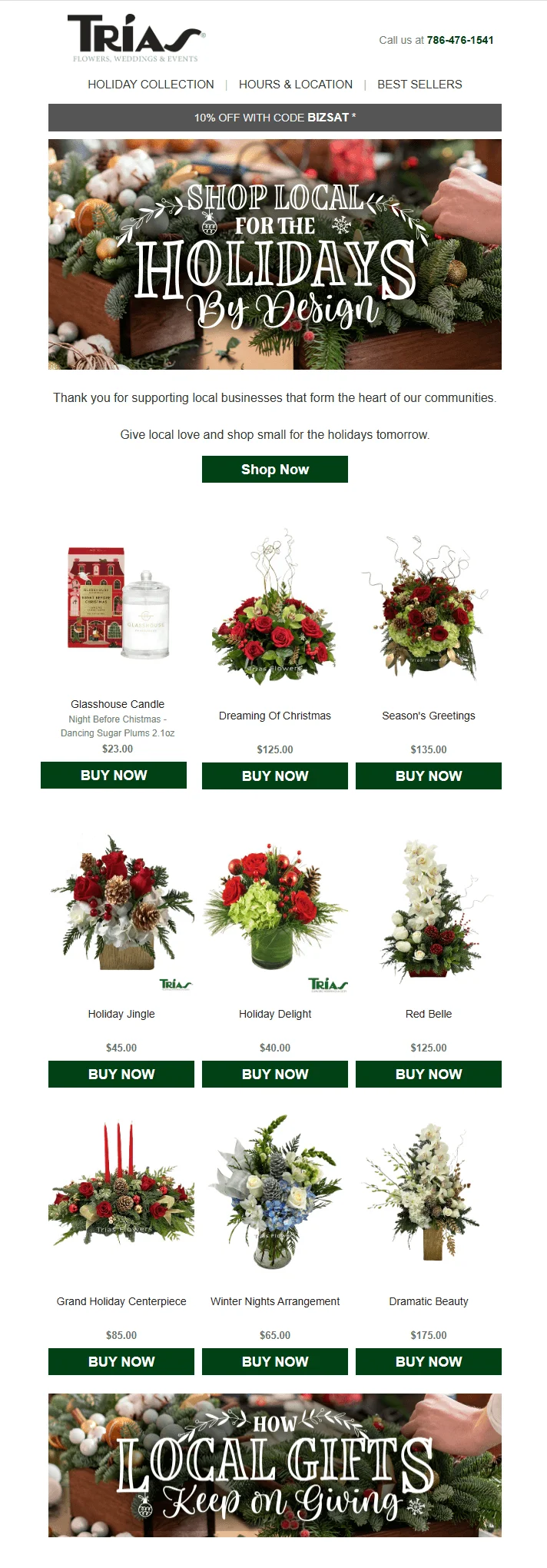
What to borrow: Trias connects shopping locally with holiday gift-buying, giving the message a practical seasonal purpose.
Tips and best practices for a successful campaign
Use the following ideas as a menu rather than a fixed recipe. The best combination depends on what the audience already knows about the business and what action you want them to take.
Write a specific subject line and preheader
The subject line should identify the value of opening the email. Mention the event, offer, story, or impact, and use the preheader to add information rather than repeat the same phrase. Check both fields on a mobile preview and avoid false urgency.
Shop-local and community
- Small Business Saturday starts here
- Shop small, discover something special
- Made locally, chosen for you
- Meet the people behind your order
Offer and urgency
- Your Small Business Saturday offer is here
- Saturday only: a thank-you for shopping small
- A limited bundle for Small Business Saturday
- Last call to shop our Saturday offer
Founder or team story
- A note from the founder this Small Business Saturday
- Small team, big thank-you
- How your order supports our team
- Why this Saturday matters to us
Gratitude and impact
- Thank you for choosing a small business
- Here’s what your support made possible
- You helped our small business grow
Preheader ideas:
- Meet the team and see what we planned for Saturday.
- Shop the limited bundle before it is gone.
- Your purchase supports local work and independent makers.
- See the event details, store hours, and Saturday offer.
- A personal thank-you — plus a little something for you.
Real campaigns can also provide useful inspiration. Examples include “Shop Local on Small Business Saturday and Save 10%” from Trias, “A note of gratitude” from Q for Quinn, and “Support independent artists with every purchase” from Spoonflower.
Choose a promotion that fits the business
A discount is only one option. You can build the campaign around:
- a limited bundle or gift with purchase;
- a loyalty or early-access benefit;
- an in-store event, workshop, or demonstration;
- a collaboration with another local business;
- a donation or community-impact mechanic;
- a founder or team story;
- a customer thank-you or post-event impact message.
Whatever you choose, specify the deadline, time zone, eligibility, inventory limits, pickup or shipping conditions, and how the customer receives the benefit. If urgency is part of the message, it should reflect a real constraint. For more examples, see Selzy’s guide to FOMO email marketing.
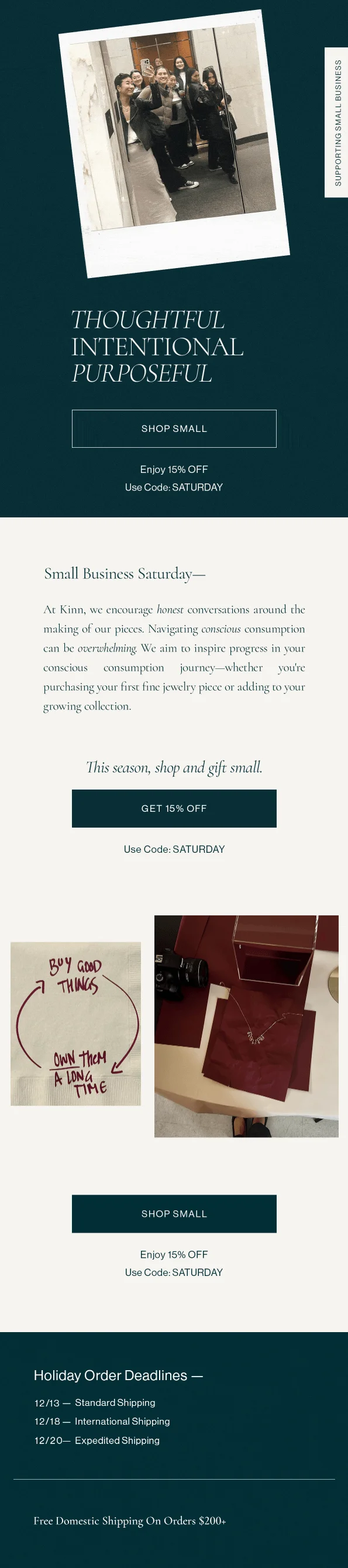
What to borrow: Kinn makes the offer easy to understand by pairing one code with a clear sitewide discount and a defined occasion.
Express gratitude
A thank-you email can work without a dramatic promotion. Explain what customer support enables, keep the tone specific, and give readers one clear next step. If you want a fuller writing framework, use Selzy’s guide to the thank-you email.
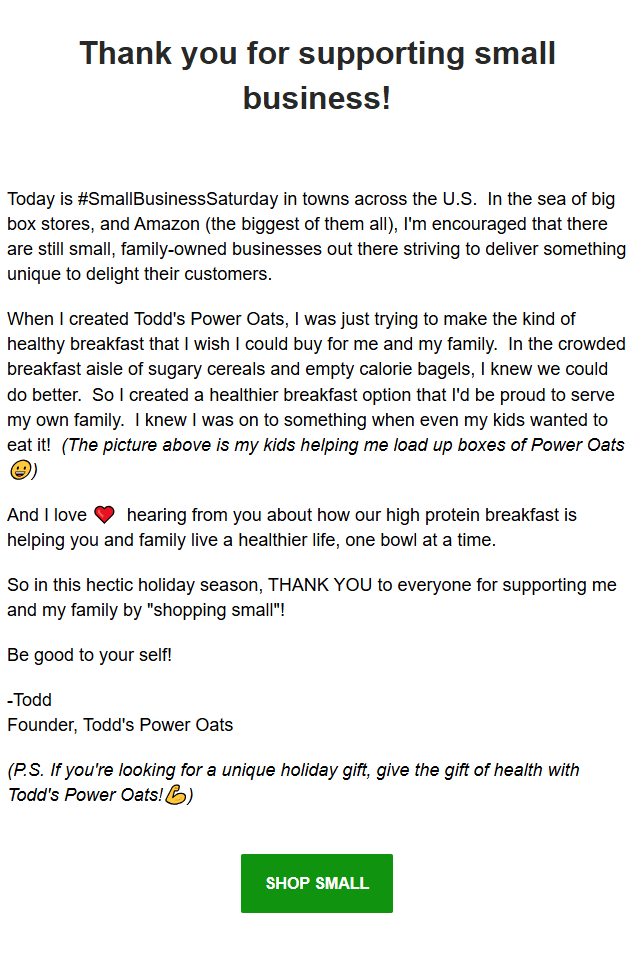
What to borrow: Todd’s Power Oats puts appreciation first and lets a single understated CTA support the note.

What to borrow: Bebonia keeps the founder’s message short enough to fit naturally into a promotional email.
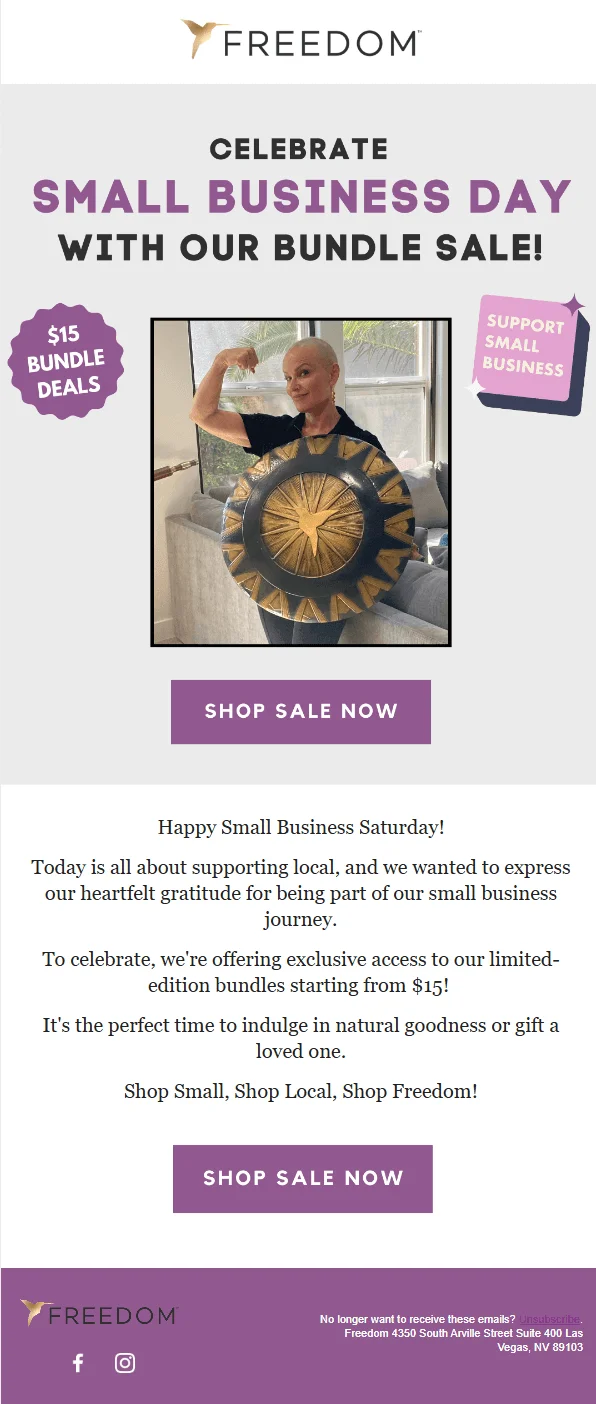
What to borrow: Freedom turns gratitude into a concrete benefit by giving customers access to exclusive bundles.
Add a personal touch
A founder or team story helps readers understand who benefits when they choose the business. Share a relevant detail — how the company started, a challenge the team solved, or what customers helped make possible — without guilt-tripping the audience.
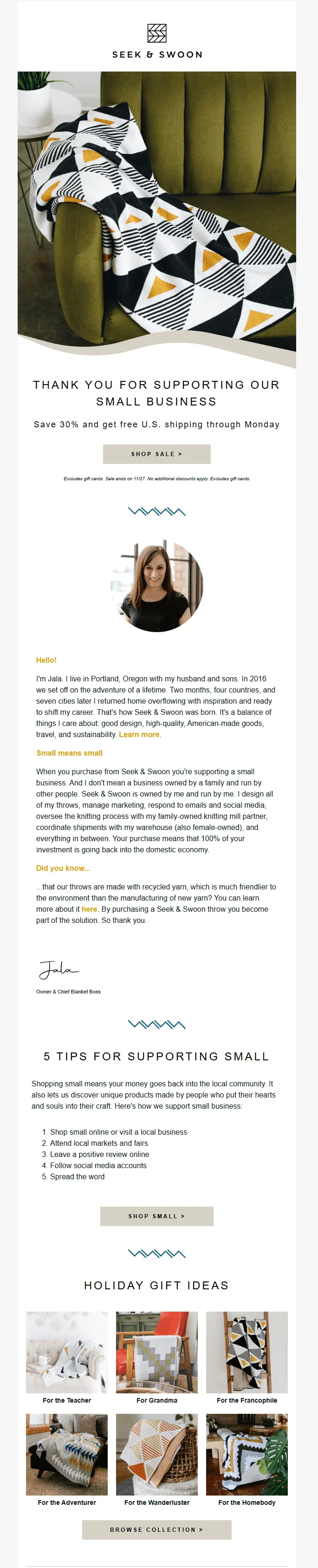
What to borrow: Seek & Swoon combines the founder’s background, product recommendations, and tips for supporting small businesses in one coherent story.
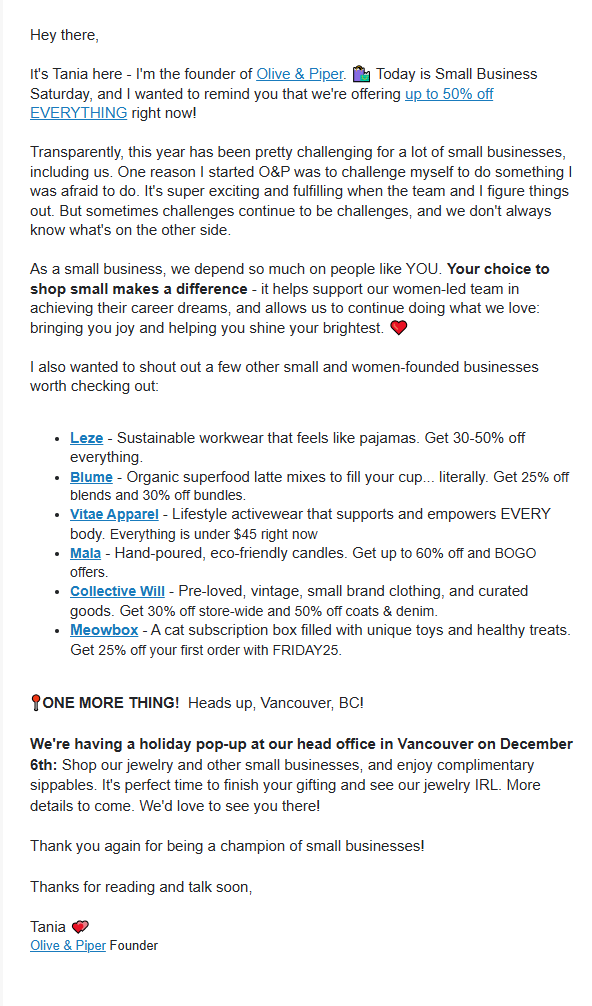
What to borrow: Olive & Piper acknowledges the realities of running a small business while also promoting an event and highlighting other women-led brands.

What to borrow: Kris Nations creates a personal message with a childhood photo, a current photo, a handwritten sign-off, and concise copy.

What to borrow: Woobles shifts the spotlight from one founder to the whole team, making the people behind the products visible.
Tell a local or collaborative story
Small Business Saturday can spotlight the neighborhood, another independent brand, or a shared event. Cross-promotion works best when the connection is clear and useful to the audience.

What to borrow: Tattly uses an interview with a local bookstore to make the campaign about a wider business community. View the original example on Really Good Emails.
Before you send: operational checklist
- Confirm the offer deadline, time zone, eligibility, inventory, and fulfillment terms.
- Test every link, coupon code, store-hours listing, address, and event detail.
- Check the mobile layout, images-off behavior, alt text, dark mode, and button visibility.
- Verify the sender name, reply-to address, preference controls, and unsubscribe link.
- Send a test to the inboxes that matter for the audience.
For more help beyond the holiday, review Selzy’s guide to email marketing for a small business.

Final thoughts
Choose a genuine reason to participate, plan the message sequence and offer, and test the delivered campaign before it reaches subscribers. The best Small Business Saturday emails make the value clear while showing the people, place, or community behind the business.
Once the campaign is complete, save the strongest subject line, layout, and content blocks so next year’s preparation starts with a tested foundation.
Small Business Saturday email FAQ
When is Small Business Saturday in 2026?
Small Business Saturday is the Saturday after Thanksgiving in the United States. In 2026, it falls on November 28.
What should a Small Business Saturday email include?
A strong campaign usually includes an early announcement, a clear reason to shop, and one final reminder when the deadline is real. You can also highlight a founder, team, community, collaboration, customer impact, or a limited product bundle.
When should I send a Small Business Saturday email?
A useful timeline starts 10–14 days before the event with an announcement or brand story, followed by a reveal 3–5 days before. Send the primary campaign on Friday evening or Saturday morning, and only send a final reminder if the deadline or inventory limit is real.
What are good Small Business Saturday email subject lines?
Good options include “Small Business Saturday starts here,” “Small team, big thank-you,” “Your Small Business Saturday offer is here,” and “Thank you for choosing a small business.” These angles fit the event’s community and seasonal shopping focus.
Do I need to offer a discount for Small Business Saturday?
No, a business does not need to offer a discount to participate. You can instead highlight a local event, collaboration, the people behind the brand, customer impact, or a limited product bundle.
How many Small Business Saturday emails should I send?
You do not need to send every message in the timeline. Choose the stages that fit your normal cadence and subscriber engagement, and keep each message focused because the event sits between Black Friday and Cyber Monday.
 New and noteworthy on our blog
