


Key takeaways
- E-commerce inboxes are crowded, making subject lines crucial for grabbing attention.
- Clear e-commerce email subject lines can boost opens, clicks, and sales.
- Subject lines impact open rates and sales significantly.
- Buyer psychology can be leveraged to maximize results.
- Mobile devices show limited characters for subject lines, so keep them concise.
- Preview text can complement subject lines effectively.
- Best practices for writing e-commerce subject lines include clarity, urgency, personalization, power words, emojis, and A/B testing.
In 2026, e-commerce inboxes are crowded, and buying online is still one of the fastest, most practical ways to shop. That makes the subject line one of the first chances to earn attention before a customer scrolls past your message. A clear e-commerce email subject line can support opens, clicks, and sales when it matches the offer inside.
In this blog post, we will cover the importance of writing attractive e-commerce subject lines, the best practices when doing so, and over 150 examples you can adapt for different campaigns, customers, and stages of the buying journey.
Catchy e-commerce email subject lines that drive clicks and sales
Writing truly attractive email subject lines that don’t fall into the bait and spam category is an art. That being said, you don’t have to reinvent the wheel, as there are tried and tested examples. We’ll categorize them and explore each in detail below, but here are some top picks:
- Welcome to our family, here’s a welcome gift
- Gear up for our ______ SALE, [client name]
- Enjoy ___% off your first purchase, [client name]
- Welcome to [brand name]! Get inside for a special offer
- Still thinking it over? Your cart is waiting
- New arrivals picked for you, [client name]
- Thanks for your order – here’s what happens next
- We miss you, [client name] – here’s a reason to come back
As you can see, the idea is to give your clients a good reason to click, and then deliver the goods. Treat these examples as starting points: the best version should match the offer, the customer segment, and the urgency level of the campaign.
Why subject lines matter in e-commerce email marketing
Impact on open rates and sales
Great content might be hidden behind a subject line that fails to attract clicks. If you want to increase the chances of your email being read, it starts with the subject line.
According to ZeroBounce’s email statistics report, 43% of email recipients open the message based exclusively on the subject line. As you can see, getting the subject line right goes a long way in driving open rates and sales up.
Buyer psychology behind subject lines
Subject lines can be used in tandem with buyer psychology to maximize results.
To illustrate the point, e-commerce messages that advertise one-time offers or exclusive gifts tap into a concept that has been explored by buyer psychology: the fear of missing out (also known as FOMO). A subject line that reads “A special one-time offer for you” might compel clients to click on a message because they could regret not taking advantage of an easy opportunity.
Mobile, preview text and character limits
Most users are probably going to see your messages on their smartphones, simply because it’s more practical than powering up a laptop or sitting in front of a desktop.
However, mobile devices usually show the first 30 to 50 characters of a subject line and the rest is cut. For example, I can read up to 39 characters on my Gmail (by the way, I’m on Android). The number also changes between email clients, meaning that Gmail displays things differently than, let’s say, Yahoo. You can find more data in our study of email subject lines.
That being said, a good rule of thumb is to put the most essential part of the message in the first 33 characters. There’s a benefit, though: it teaches you to write shorter, straight-to-the-point lines that are likely to be more attractive.
Preview text matters here too. Use it as a second headline: expand the offer, clarify the benefit, or add a detail that did not fit in the subject line instead of repeating the same words.
Best practices for writing e-commerce email subject lines
Be clear, not clever
Give your readers a reason to click – a clear, specific reason.
What we mean here by not being “clever” is simple: don’t write something cryptic or clickbait, thinking people will be compelled to open your message out of curiosity. Actually, you might just annoy them. For example, “we have a surprise for you” might be too vague, so go with “open for a special one-time …% off promo code” instead.
Add a sense of urgency or scarcity
Without urgency, people might put things off, your emails included.
What you should do is fight that procrastination by adding a sense of urgency, letting clients gently know your offer is not on the table forever.
If it’s their birthday, let them know the exclusive gift you sent them is redeemable only for that specific day, for instance. That generates the FOMO we mentioned before, making it more likely for the message to be opened.
Personalize with names or preferences
Use clients’ names and other data to make content more relevant to them – it will make them feel catered to, and well, everybody likes feeling important.
You could use past purchases and previous interactions, for example. Generic subject lines might be even more likely to be considered as spam, whereas something with a client’s name has a higher chance of avoiding that.
Go beyond the first name when you can. Cart abandoners, browse abandoners, repeat buyers, VIP customers, and inactive subscribers respond to different triggers, so their subject lines should not all sound the same.
Use power words and emojis wisely
Power words are a double-edged sword – don’t overdo it, don’t oversell and don’t use capital letters. Poor use of that aspect will trigger spam filters, make you sound unprofessional and cause a bad impression.
Avoid things like “FREE”, “BUY NOW!” and capital letters, for example. If you need help with this, check our blog post on common spam words, and remember, it is impossible to avoid them – you just have to use them sparingly, with purpose, add some form of personalization, and make sure you have a good sender reputation, among other things.
Likewise, emojis can add a more personal, informal touch that certain people might enjoy, but make sure you understand the context and use the right emojis.
A/B testing subject lines
Email subject lines aren’t one-size-fits-all — testing helps you discover what works best. You can test subject lines within the same segment and see what works better, make modifications, adapt and profit from it.
Skipping testing is one of the biggest mistakes you could make. After all, if you have multiple chances to get it right, why use only one and call it day?
Do this instead: develop a few variants, send them to a limited number of contacts within the same demographic or segment, check the results, adapt and then commit. Open rate can still be useful, but also look at clicks, conversions, revenue per email, unsubscribes, and spam complaints so the winning subject line is not judged by opens alone.
150+ best e-commerce email subject line examples
Welcome emails
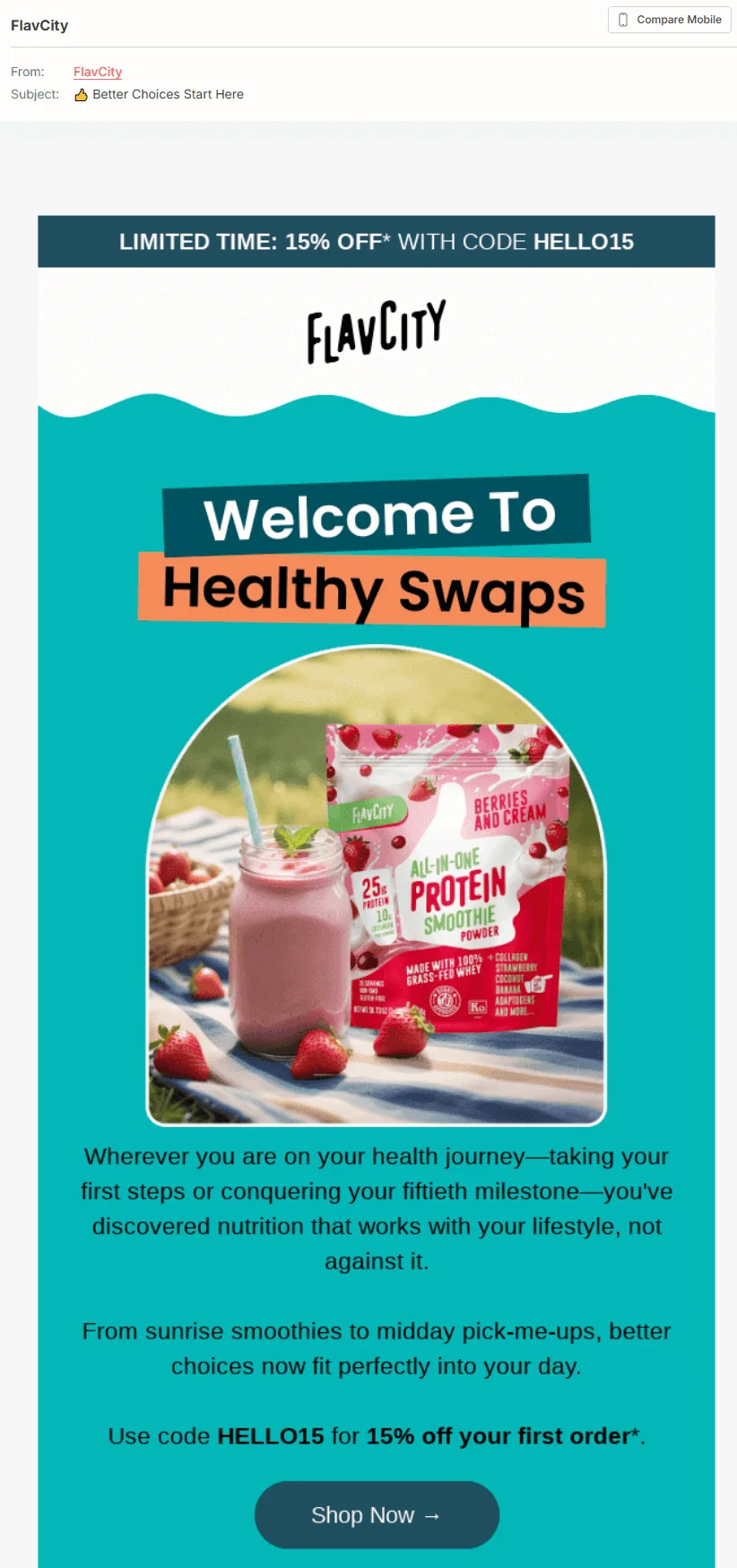
FlavCity’s welcome email is a nice example of how to blend brand identity to effective email marketing – “Better choices start here” is a catchy line. It is also complimentary and likely to make clients feel better about themselves. Finally, it provides a 15% off promo code for a first order, to improve conversion rates.
This is to say that you can tailor the subject line to your business, but here are some other nice, more universal examples:
- Welcome to [brand]
- Claim your free welcome gift
- Welcome to the [brand] community!
- Welcome! Here’s a special gift from us
- We are so happy to have you!
- Thank you for joining [brand]
- Welcome! Your journey starts now
- Thanks for joining! Here’s a freebie
- Your welcome gift is inside
- Welcome! Enjoy […]% off your first purchase
- Hello [name], welcome to the club!
- Hi [name], welcome on board!
- A special welcome gift for [name]
- Start with [brand]: your first offer is inside
- Your [product/category] picks are ready

Promotional/sale emails
- Your exclusive deal awaits!
- A special one-time offer for you
- Limited-time offer: up to […]% off!
- Last chance to save on [brand/product]
- […]% off your [product] ends today
- Last day to save […]%
- Our biggest sale of the year!
- [Client], your […]% off code expires today/tomorrow!
- All our newest products for up to […]% off!
- Your […]% off is waiting!
- Private sale starts now for [client]
- Save on the [category] you viewed
Cart abandonment emails
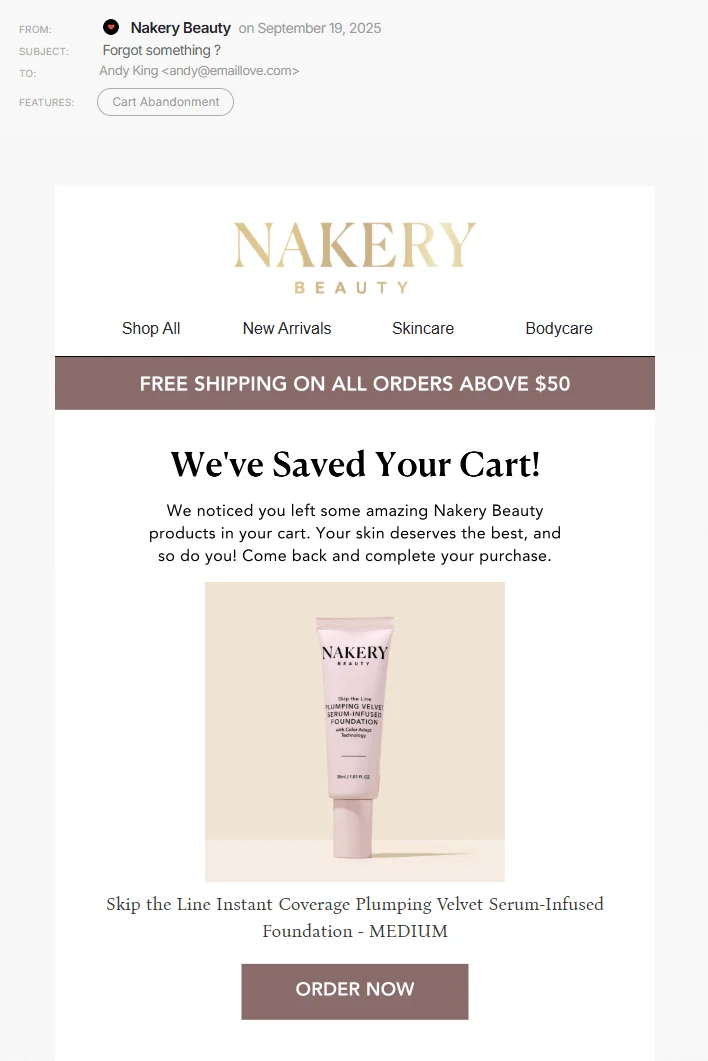
Sometimes, people forget to finish a purchase, and that’s what abandoned cart emails are for.
We like Nakery Beauty’s casual approach to the subject line: “Forgot something?” is a nice way to break the ice. The email then proceeds to show a picture and description of the product, plus a visible CTA button to encourage the client to buy it.
Take a look at more subject line possibilities:
- [Client], you forgot something…
- Did you see something you liked?
- Is this yours, [client]?
- Thinking about [brand]?
- Still deciding?
- Hey [client], you left something behind!
- Thanks for exploring! We saved your cart
- We saved your bag!
- Your [product] is waiting for you
- Empty your cart with free shipping
- Get [product] for […]% off!
- Good choice! We set it aside for you
- The price dropped for something in your cart
- Heading out without checking out?
- Your cart is saved – complete it today
- [Product] is almost yours
Product launches and new arrivals
- Introducing [product], [quick description]
- Now live: [product]
- Exclusive: the all-new [product]
- [Product] has arrived!
- The all-new [product]
- Tailored to you: [product]
- The day has arrived: [product] now available!
- New season, new arrivals
- Pre-order the new [product]
- Experience the new [product]
- First look: [product] is here
- Your early access to [product] starts now
Birthday & anniversary emails
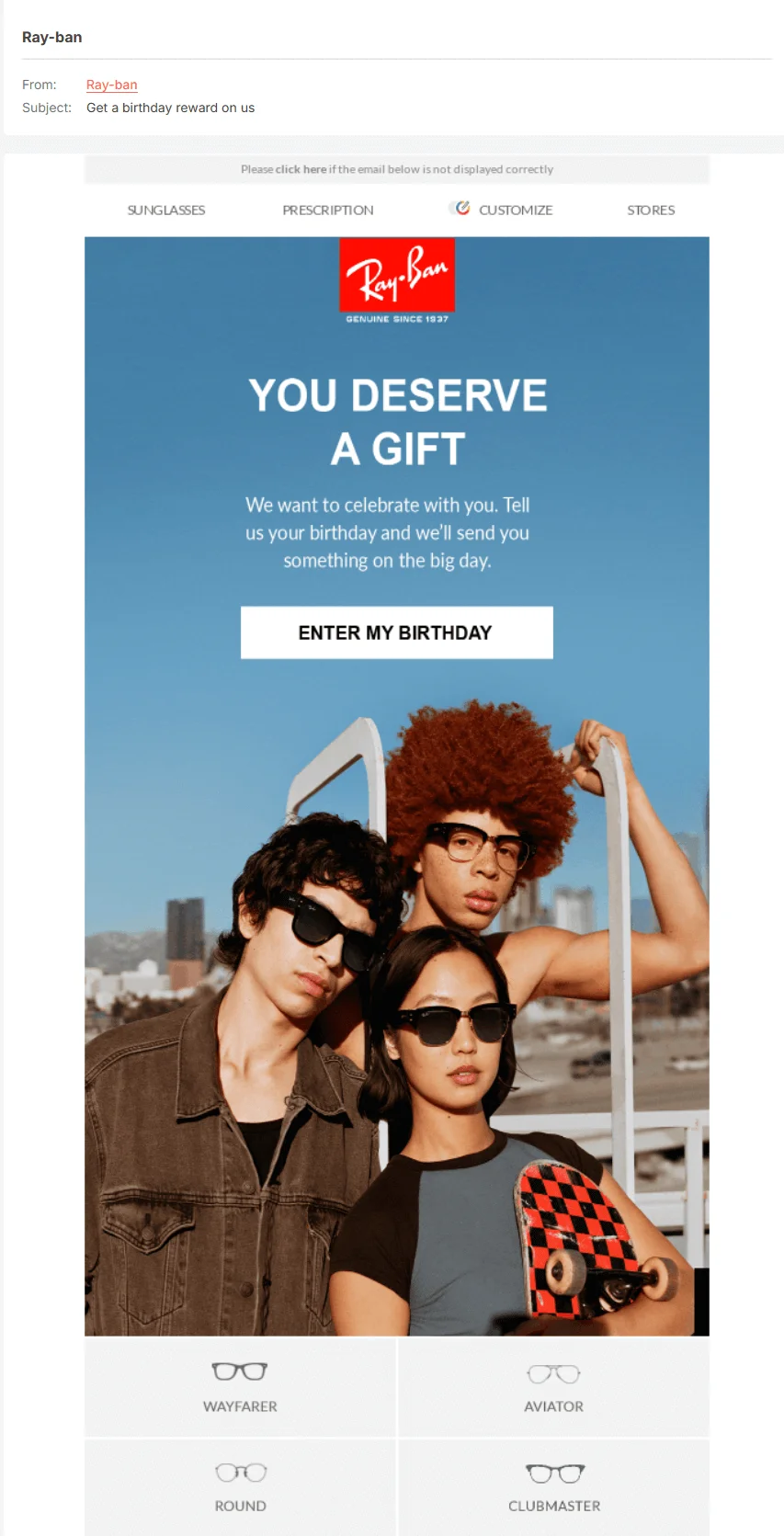
In the above example, automation is the name of the game – clients enter their birth date and then get a gift on the day. The subject line, “Get a birthday reward on us”, is simple, effective and very, very clickable. Check more ideas:
- Happy birthday, [client]!
- A birthday deal like no other
- A special gift on your special day
- Celebrate with us!
- Celebrate our anniversary with a gift
- It’s our anniversary! Open for a treat
- Happy birthday! We got you a gift
- Today is our birthday! Here’s a gift
- Our birthday sale is almost over
- Today’s your special day!
- Happy birthday from [company name]
Holiday & seasonal campaigns
- Up to […]% off our spring finds
- Celebrate Women’s Day with us!
- Here’s your sneak peek at Black Friday
- Your Thanksgiving toast is ready!
- Our 12 days of giveaways start today!
- Are you ready for the holidays?
- Last chance to shop our holiday sale
- No time? Give a gift card this Christmas
- Get all your gifts yet?
- Our top Valentine’s gifts: spread the love!
- A V-Day treat for you
Re-engagement/win-back emails
- Fancy a free gift card?
- An exciting new offer for you!
- Allow us to reintroduce ourselves!
- A special offer for you
- Have you seen our latest features?
- Hey [client], check what’s new at [brand]!
- Something special is waiting for you
- [Client], here’s your year-in-review
- Products you don’t want to miss
- Your account is still waiting
- [Client], we saved something new for you
- Come back for a fresh offer
Post-purchase and thank-you emails
- Thank you for your purchase!
- Got two minutes?
- Tell us what you think
- Your order is complete
- How does it feel to be part of the [brand] family?
- You have completed a purchase!
- Thank you for buying from [brand]
- You’re what makes us great!
- A message of gratitude from [brand]
- A token of our appreciation
- We appreciate you, [client]!
- Thanks again – your care tips are inside
- Your order is complete. Here’s what to try next
Order and shipping confirmations
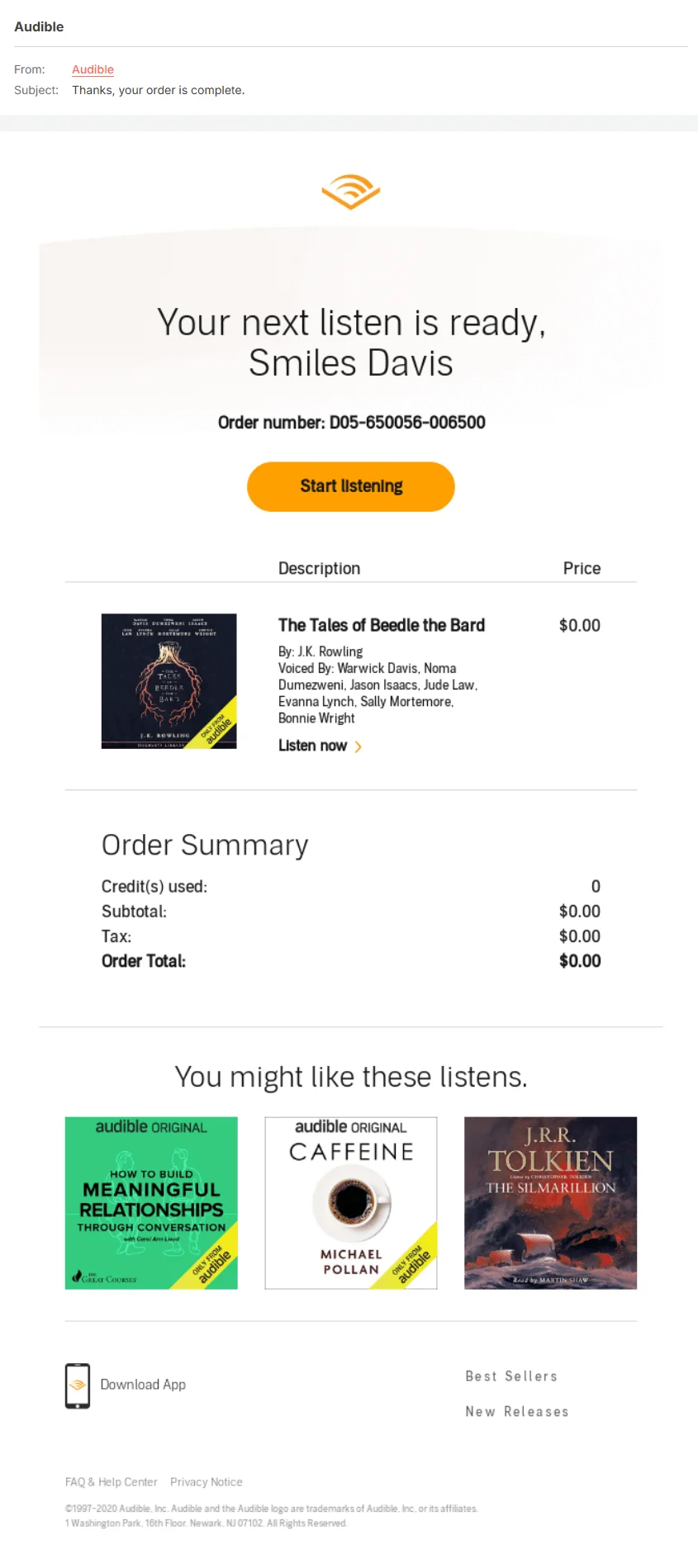
Audible’s approach is textbook: a simple thank you message, an order summary, a link to the purchased audiobook and more listening suggestions. Not only does it work as a receipt, but it also tries to draw the client’s attention to more products.
Subject lines in this category are pretty straightforward:
- Your order #[…] is complete
- Order confirmation: thank you for your purchase!
- Your order #[…] is on its way!
- Your shipment #[…] will arrive soon
- Track your order #[…]
- Good news, (client)! Your order #[…] is confirmed
Feedback and review request emails
- Can we ask you one question?
- Share your thoughts with us!
- Your voice matters
- Tell us all about it
- Your feedback is important to us
- How was your experience buying from [brand]?
- We want to hear from you!
- Take our survey to win […]% off your next purchase
- A couple of questions for you…
- Help us improve your experience!
- How satisfied are you with [brand/product]?
- We’d love your feedback, [client]!
VIP/exclusive offers
- You’re invited: VIP-only giveaway
- A special invitation for our VIP clients
- Your exclusive offer is waiting for you
- Exclusive gifts and savings worth $[…]
- Your VIP invite is inside
- Your VIP pass runs out today
- VIPs first: exclusive access to our sale
- Black Friday VIP offers are live!
- Get exclusive VIP access to our best offers!
- VIP early access starts now
- [Client], your members-only reward is inside
Refill and repeat purchase reminders
- Time to restock your favorites!
- Running low on [product]? Time to reorder!
- It’s time to buy [product] again!
- Need more [product]? We’ve got you covered
- Keep your essentials stocked!
- Quick reminder: [event/offer] ending soon!
- Last chance to save […]%.
- A friendly reminder: our [occasion] sale ends today!
- [Opportunity/deadline/sale] ending soon!
- Reminder: special offers on [product]
- Log in to keep your account from being deleted
- Friendly reminder: your subscription expires in […] days.
- Running low? Reorder your [product] in one click
- Time for your next [product] refill
Browse abandonment emails
- Your browsed items are order-ready
- Did you see something you liked?
- Find something interesting?
- [Client], we found these options you might like!
- We noticed you checking [product], but they’re going out fast!
- Your [product] is waiting, but not for long
- We saved these products just for you
- Recommendations just for you
- […]% off for the next 24 hours!
- Take a second look!
- Thanks for stopping by!
- We want you back. Take […]% off!
- Still comparing? Here are our top picks
- Your recently viewed [category] is still here
Event-based emails

- Coming soon: get ready for the [event name]!
- You’re invited: [event name/date]
- Get your ticket for the [event name/date]
- Are you ready for the [event name/date]?
- Quick reminder: the [event name] webinar is tomorrow!
- We missed you at the [event name]. Here’s a recap
- Thank you for registering for our webinar [event name]
- Save the date: [event name]
- Your upcoming webinars are inside
While we’re here, we also invite you to check our comprehensive guide on writing great subject lines for event emails.
FAQ about e-commerce subject lines
What makes a good e-commerce email subject line?
A good e-commerce subject line is clear, attractive, and closely matched to the offer inside the email. It should give the reader a real reason to click without feeling like bait or spam. The best lines also fit the customer segment and the urgency of the campaign.
Why are subject lines so important in e-commerce email marketing?
Subject lines are often the first—and sometimes only—chance to earn attention in a crowded inbox. The content notes that 43% of recipients open emails based exclusively on the subject line, so a strong one can directly affect open rates, clicks, and sales. If the subject line fails, even good content may go unread.
How long should an e-commerce subject line be?
A useful rule of thumb is to put the most important part of the message in the first 33 characters. That matters because mobile devices often show only the first 30 to 50 characters before cutting off the rest. Shorter, direct subject lines are usually easier to read and more effective.
How can preview text help improve email opens?
Preview text should act like a second headline, not a repeat of the subject line. Use it to expand the offer, clarify the benefit, or add an important detail that did not fit in the subject line. This gives you more room to persuade the reader to open the email.
Should e-commerce subject lines use urgency or scarcity?
Yes, when it fits the campaign, urgency can help motivate clicks. The content explains that one-time offers and exclusive gifts can tap into FOMO, or fear of missing out. A subject line that signals a limited opportunity may encourage recipients to act sooner.
Can personalization make e-commerce subject lines more effective?
Yes, personalization is used in the examples and can make a subject line feel more relevant to the recipient. Adding a client name or tailoring the message to a specific stage of the buying journey can help the subject line stand out. The key is to keep it aligned with the actual offer.
Should I use emojis, power words, caps, or spammy wording in e-commerce subject lines?
Use these elements carefully, because the goal is to attract attention without drifting into bait or spam territory. The content emphasizes that strong subject lines should give customers a clear reason to click and match the offer inside, so anything exaggerated or misleading can work against you. Keep the message clear, relevant, and aligned with the campaign.
How do I choose the best e-commerce subject line through A/B testing?
The best subject line is the one that matches the offer, customer segment, and urgency level of the campaign. Since different audiences and stages of the buying journey respond differently, test variations to see which version earns the strongest response. Use the winning result as your starting point, then refine it for future emails.
Conclusion: Turning subject lines into sales
Subject lines are a great ally when it comes to open rates, conversion and customer retention for your e-commerce business. If it’s clear and engaging, chances are that your recipients will open the email, and then your carefully crafted content will do the rest for you.
Don’t forget:
- Keep it short, simple, clean and clear.
- Don’t resort to clickbaiting.
- Be careful about spam words.
- Test your versions and see what works best.
- Optimize for mobile.
- Personalize whenever possible.
- Be creative, but sound professional.
We hope all the tips and examples provided in this article help you write great subject lines and achieve even better results. Good luck and good sales!

 New and noteworthy on our blog
