


Key takeaways
- Unsubscribe emails can help in retaining subscribers by acknowledging their decision and providing a way to reactivate subscriptions.
- Common reasons for unsubscribing include overwhelming frequency, irrelevant content, lack of perceived value, and poor mobile optimization.
- Tailoring content, analyzing customer data, and optimizing for mobile are key practices to reduce unsubscribes.
- Examples of effective unsubscribe emails from brands like BetaList, Showtime, Netflix, and others showcase best practices like offering discounts, seeking feedback, and making re-subscription easy.
While there may be many reasons why you lose your subscribers in the first place (some of them totally natural), unsubscribe emails can be a great way of turning the situation around.
In this blog post, we will discuss common reasons people unsubscribe, provide the best unsubscribe email examples from well-known brands to inspire you, and talk about the best practices when sending these messages.
What is an unsubscribe email (opt-out email)?
At any given point in the relationship between your brand and your customers, they might decide it is time to stop receiving your emails.
The unsubscribe email is the message you send to your clients, acknowledging their unsubscription, thanking them for their partnership with your business, and ideally, providing them with a simple way to reactivate their subscription.
To put it briefly, it is your graceful goodbye – a temporary one, hopefully.
Most common reasons why customers unsubscribe
Overwhelming frequency
Too much of a good thing is actually a bad thing: email fatigue is real. The frequency is important: not so much that your contacts feel overwhelmed or annoyed, not so little that your brand ends up being forgotten.
A study conducted by DataBox on email marketing frequency reveals that approximately 45% of respondents send weekly emails, and most of them (72%) reduce the frequency when engagement rates are low.
The best practice here is to gain a deeper understanding of your customers (their behavior, demographics, and segments, as well as previous interactions), analyze key data (such as open rates and click rates), and then determine the best course of action. For example, if customers are not interacting with your content, it might be better to reduce the frequency and work on content better-suited for their demographic or segment.
Depending on your field or the season, you might even bump it up a little bit – e-commerce businesses tend to send way more messages during the holiday season, for example.
Irrelevant content
You wrote a nice subject line, and you got the customer to open your email. You are only halfway through converting, though. The content needs to be relevant and up-to-date for each segment. Avoid wasting subscribers’ time with off-target content.
A quick tip: tailor the content for your customers. Data from Marigold’s Global Consumer Trend Index pointed out that 78% of consumers said they would be more likely to engage with a personalized offer tailored for their interests.
If you need more help, we’ve got you covered, too: check our email marketing course on content and avoid ending up in the spam folder because your content is misleading or irrelevant.
Lack of perceived value
Relationships work better (or actually, work) when every part involved is getting something good out of them. Once customers realize there is no advantage to being in your contact list, chances are they will unsubscribe. Here are a few things to keep in mind:
- What do you offer to the customer?
- How valuable is it? A 5% discount voucher to celebrate a two-year subscription might be rather underwhelming, for instance.
- The ratio between the frequency of your messages and how worthy of attention they actually are – pay attention to click rates and open rates to gauge that interest.
Poor mobile optimization
According to data from Litmus’ email market share research, 43% of email marketing campaigns are read on mobile devices, as opposed to 19.4% on desktops.
To put it simply, your emails have to be optimized for mobile, and customers are supposed to have a smooth experience when viewing your messages. Some pointers:
- Focus on one-column layouts.
- Keep subject lines short.
- Use a font size big enough that users can read it without trouble.
- Design for both portrait and landscape modes.
- Make sure your CTAs and other links are easy to click on a touchscreen.
In case users don’t have a pleasant experience on mobile, or even have to open your emails on their desktop for proper visualization, they will likely unsubscribe – imagine having to leave the comfort of your sofa, just to go to your computer to open an email that you could be seeing at the palm of your hand.
10 examples of effective unsubscribe email messages from well-known brands
BetaList
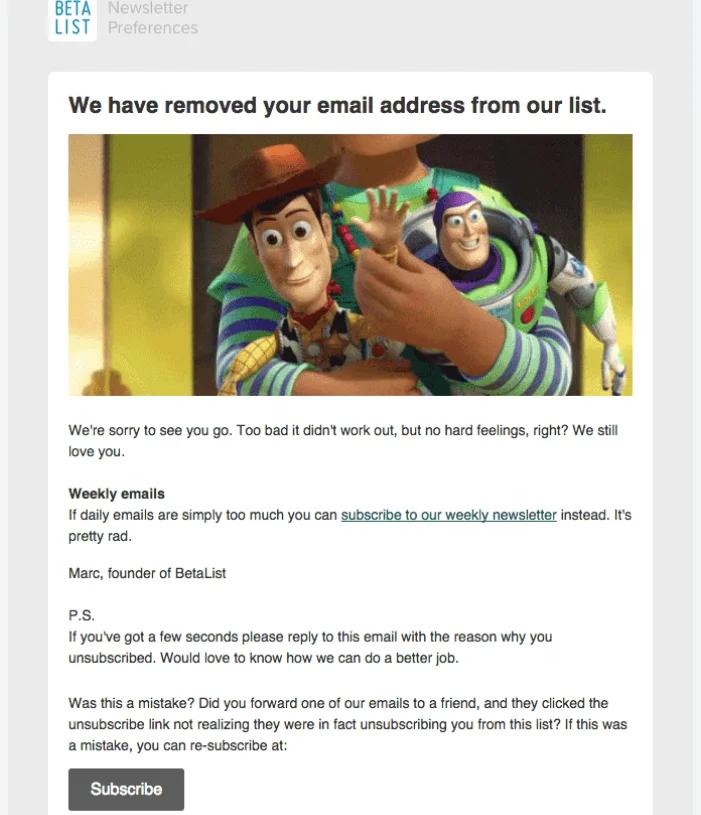
There’s a lot to like in BetaList’s email.
The understanding and informal tone are a nice way to start. Things get better when they offer an opportunity to subscribe to a weekly newsletter – an attempt to customize and improve the user experience. Finally, they ask for feedback and provide a quick way of resubscribing.
It’s concise, effective, professional, and likely to leave a very good impression.
Showtime
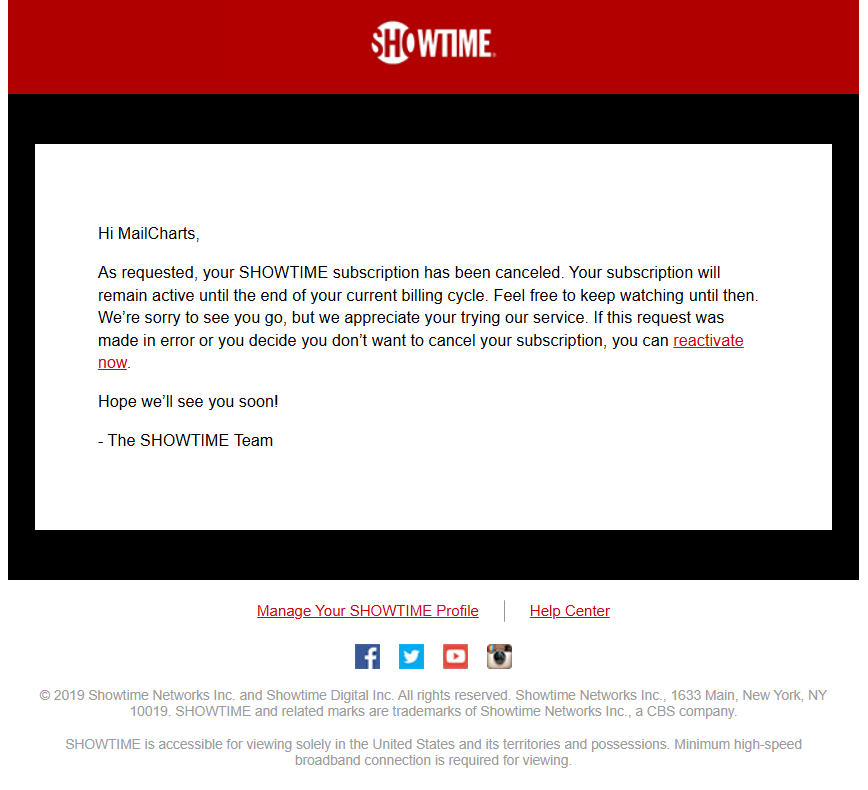
Brands can go a number of ways about subscription cancellation messages. Showtime is more straightforward, but we like this email for a few reasons:
- It provides important information about the billing cycle and how long the customer can keep using the service.
- The graceful tone and the show of appreciation for the customer who tried using the service.
Netflix
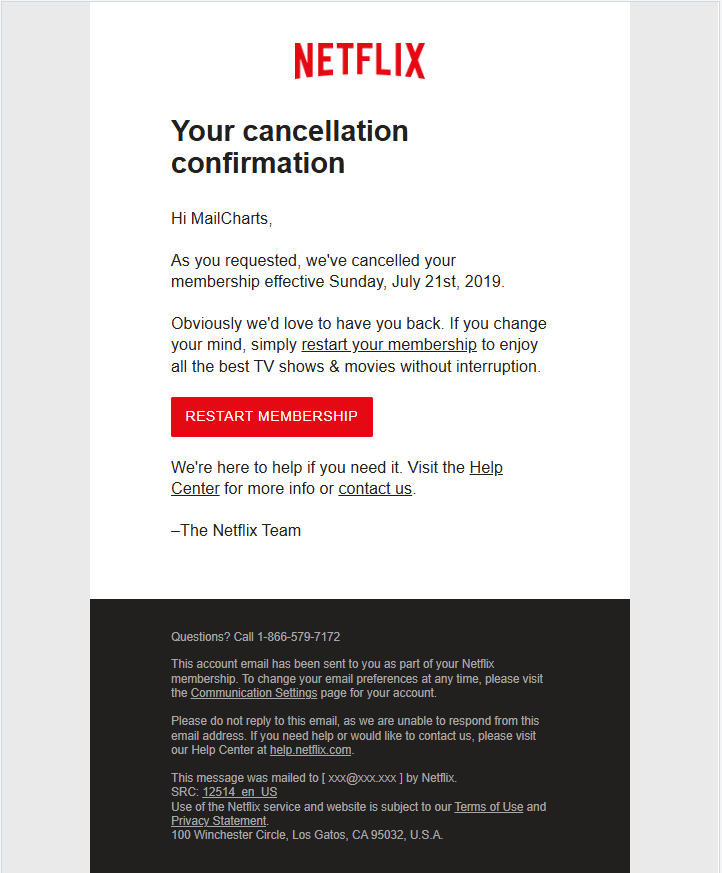
Netflix takes a very concise and professional approach.
There is info about the end-of-subscription date, and a message letting clients know they will be so missed that re-subscription can be done through a single click.
Imagine having to go through the registration process again. Not here, and that’s what makes this message so effective.
Ritual
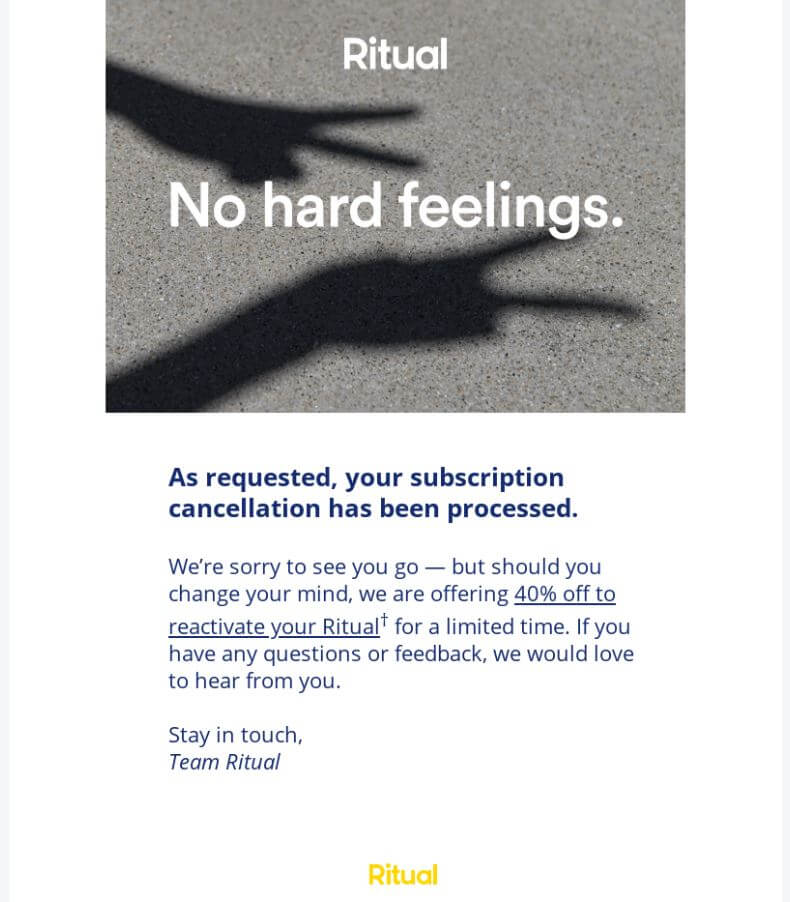
A great way of winning your followers back is by offering them something valuable in return. Ritual’s email starts with a banner, “no hard feelings”, keeping things a bit more informal and nailing the tone. The catch here is the 40% discount for users to reactivate their subscription.
The company then asks for feedback, and the “Stay in touch” sign-off is a nice way to finish things. This is a great example because it encompasses all the best practices: nice tone, easy reactivation, feedback opportunity and a parting gift.
Curology
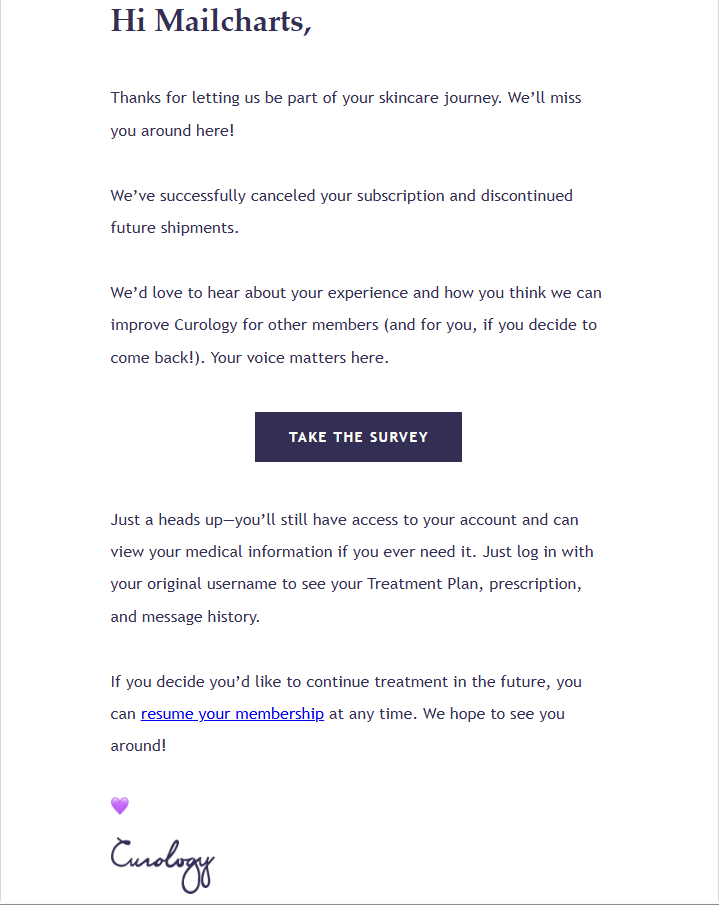
Curology offers an opportunity to answer a survey and even lets users retain access to their medical data on the platform.
The brand completes the full combo with a “resume your membership”, a little heart emoji, and a nicely designed signature. This email is the full package.
Dinnerly
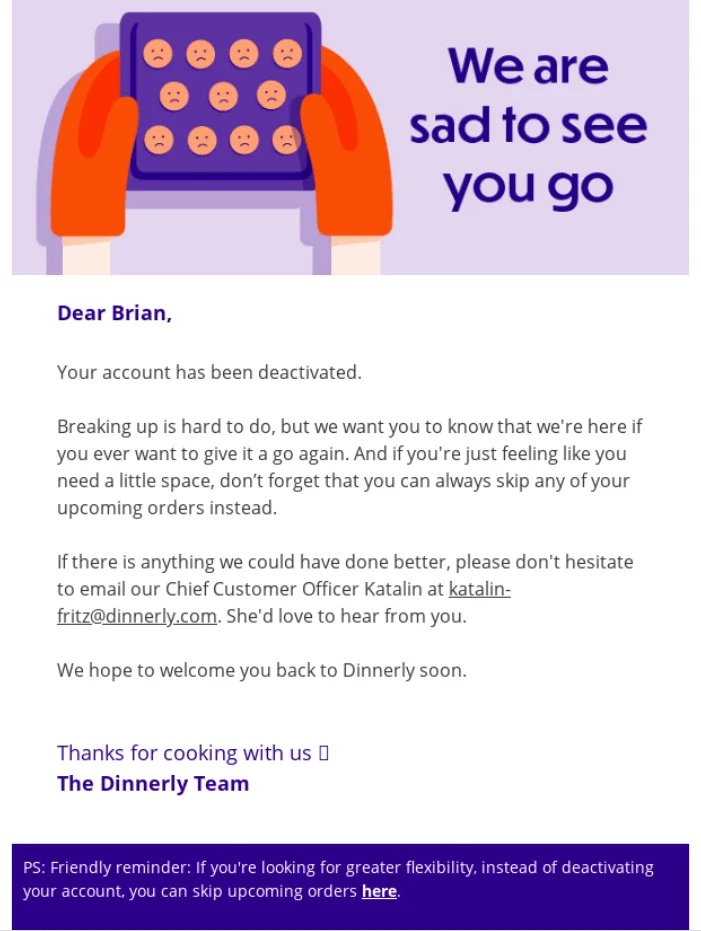
Dinnerly went for a very personal, nurturing tone. It is very much on-brand with the field they operate in, and any customer is likely to feel understood or even compelled to give it another go.
The company also offers an alternative: “You can skip any of your upcoming orders instead”. They even encourage the user to offer feedback – to a person, nonetheless, making everything feel cozier.
Finally, there’s a link for users to customize their experience.
Dollar Shave Club
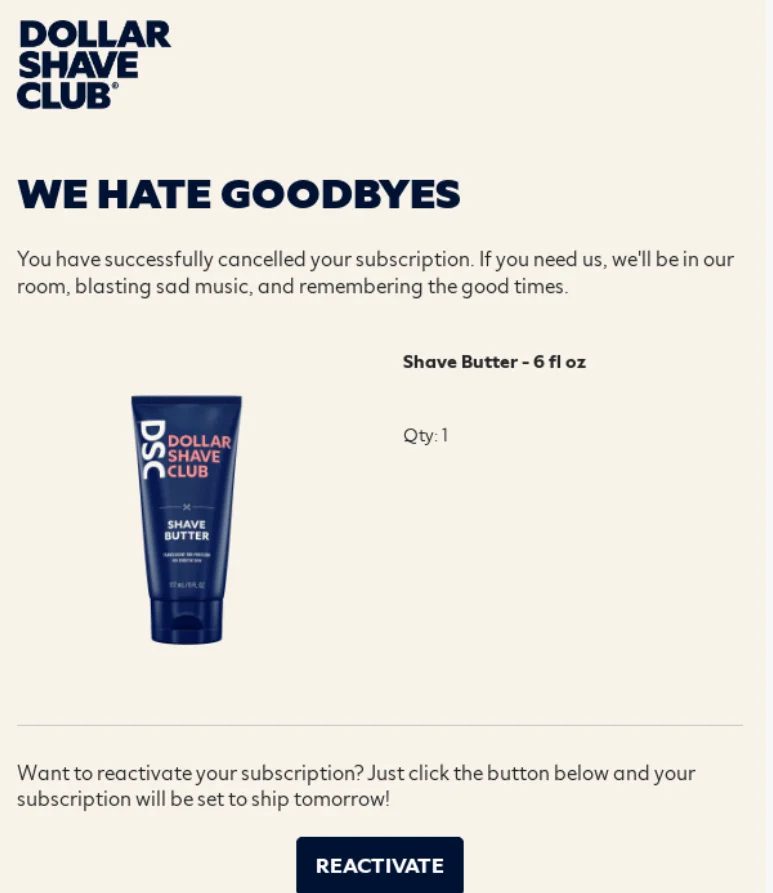
“We’ll be in our room, blasting sad music and remembering the good times” is just downright funny and cool.
There are other nice things about this one too: they show some of your favorite products (that you won’t be receiving anymore), there’s a nice, big “Reactivate” CTA button and the promise that the product will be “set to ship tomorrow”.
Talk about efficiency.
Stance
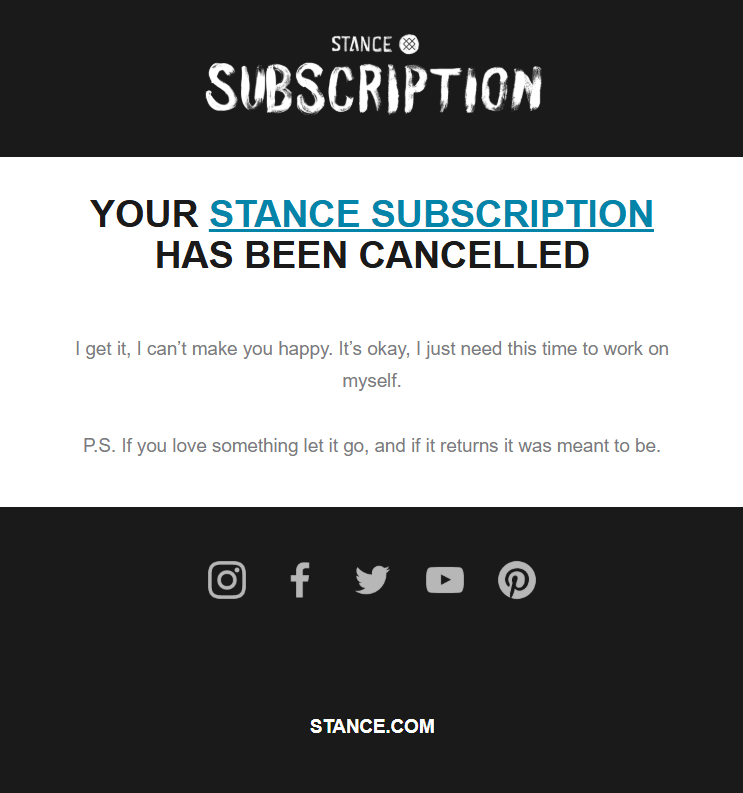
What we liked about Stance’s message is the love affair tone – the “I just need time to work on myself” is an all-timer when it comes to break-up excuses, and it lightens the mood.
At the same time, the greatest trick here is “Stance Subscription” as a clickable link. It doesn’t tell you exactly what it does, and if you are like me, curiosity will get the best of you. You just feel like you need to check it out, and that’s a win for the brand.
Hulu
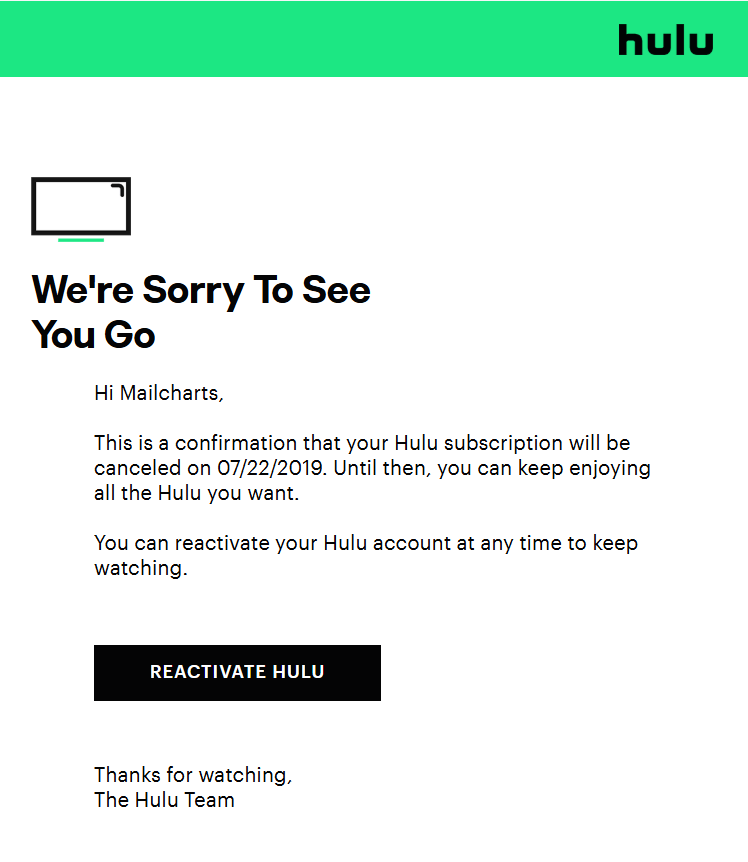
The above example might sound too simple, but you don’t have to reinvent the wheel.
“We’re sorry to see you go” stands out immediately due to its text size. The brand then proceeds to add relevant information about subscription periods, and just like its contender, Netflix, it offers a quick way of just reactivating the account without going through the registration process all over again.
Bean Box
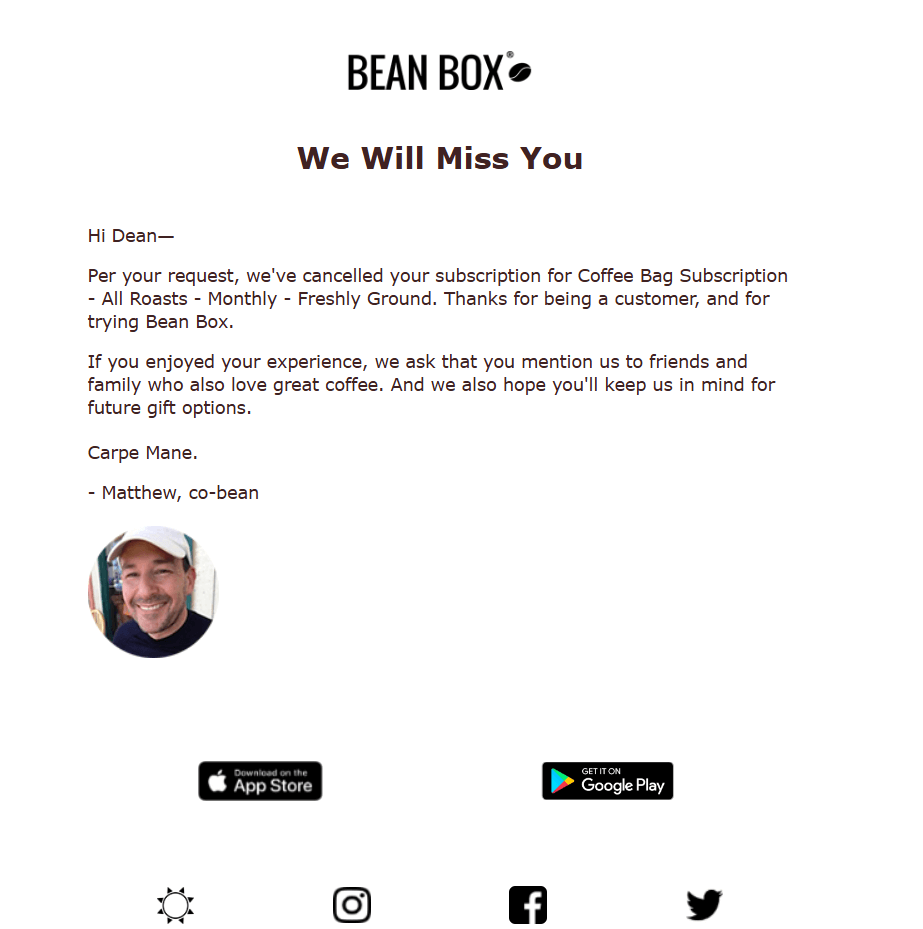
BeanBox is very graceful and understanding, with an extra nice touch: there’s a picture of the owner, and a very personal tone. The message sounds like it was written by Matthew himself.
The thank you message sounds heartfelt, and finally, they (or Matthew) remind you that even if you don’t buy their coffee for yourself, you can buy it for other people as a gift.

Unsubscribe email best practices to make your subscribers come back
Offer subscription management options
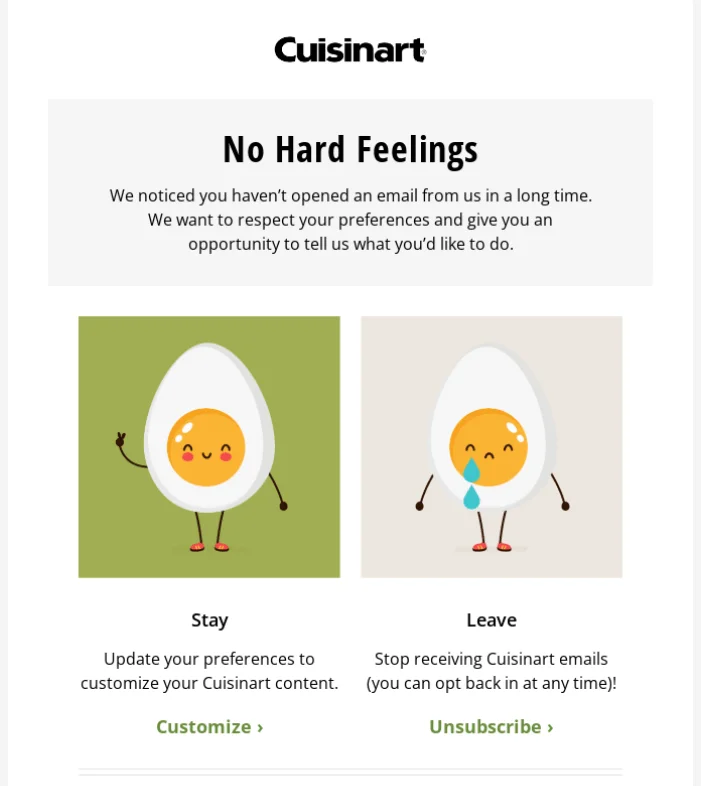
Cuisinart devised an elegant solution to the subscription cancellation problem – offering customers the option to customize their experience. The email above shows that the brand is paying attention to customer behavior, and instead of letting them go, is willing to listen and adapt.
The bonus: in case the customer decides to stay, the company will obtain valuable information about their preferences as well.
Use a friendly, understanding tone
Losing customers, as much as we dread it and hate it, is part of the game. You cannot simply burn bridges in a business relationship, as leaving the door open is a much wiser way of dealing with the situation.
As you can see in all the emails above, messages such as “We’re sorry to see you go” or “No hard feelings” are pretty common for a reason – they show your contacts that your brand respects their decision. At the same time, it lets them know, in a smooth and non-intrusive manner, that you care about them and would like them to come back.
Highlight what they’ll miss
Some of the above examples (BeanBox and Dollar Shave Club) do this very nicely: they cite the product you won’t be getting anymore. Others, like Curology, let you know you will have access to some of their features, but not the whole thing.
The point is to remind customers why they subscribed in the first place, and by doing that, you might as well turn a loss into a win.
Provide a “pause” option
You don’t need to give up right away when a customer clicks “unsubscribe”. Offer a pause button or other options for them to customize the frequency of your messages or product shipments. There are many advantages to doing so:
- Your contacts might change their mind.
- You keep a window of opportunity to impress or pique their interest again once the pause period is over.
- You don’t lose them without giving it one last shot, which is the goal.
Include a quick feedback form
If knowledge is power, learning what led you to lose that contact will go a long way to prevent it from happening again.
Use that subscription cancellation as a learning opportunity for your brand, and then improve upon what was criticized. You can do it through a quick survey link, by requesting their written feedback, or any other creative way you like.
Make re-subscription easy
The examples from this article all have something in common: a re-subscription button or link. Streaming services such as Netflix and Hulu facilitate that process to a 100%: you click the link and your account is reactivated.
We are living in a world where people want things fast, and if re-subscribing takes as much effort as registering for the first time, chances are people will give up.
Make sure you add a nice CTA button after your text, and be mindful of the text as well: pick something that stands out and can be easily findable later.
Offer a parting gift
Sometimes all you have to do is extend your hand. Even if the contact decides to leave anyway, you might convert one final sale.
We suggest adding a nice subject line, something like “We’ll miss you, here’s a gift for you to remember us” and a discount voucher, free content, or any other things worthy of value. If that doesn’t compel the customer to stay, it will at least leave a good impression.
Unsubscribe emails FAQ
How do I get clients to subscribe in the first place?
Through the opt-in process. For example, someone interacts with your brand and adds their email to your website during a purchase. That’s a great moment to give them the option to subscribe to your mailing list. You should also let them opt-out later when they see fit. Check our guide on opt-in and opt-out emails to learn more.
Why am I losing subscribers?
Here are some possible reasons:
- Content might not be relevant for their segment or demographic.
- No perception or low perception of value.
- You’re sending too many emails.
- Your emails are not mobile-friendly.
What makes a good unsubscribe email?
Among tried and tested methods, here’s what we recommend:
- Mindful and understanding tone, with a personal touch.
- Easily findable link for re-subscription, or a well-placed CTA button for subscription reactivation.
- A feedback survey.
- A reminder of what the client will miss out on.
- A graceful sign-off, in the form of a heartfelt message or a parting gift, such as a discount coupon.
Is there an alternative, or do I take the loss and let the customer unsubscribe?
Actually, there is, although we recommend not insisting too much. Instead of writing the usual unsubscribe message, you can give it one last shot: offer your contacts the opportunity to customize the email frequency or the products they want to see, and let them pause the subscription as well. If that doesn’t work, be graceful, follow our tips, and leave the doors open.
Should I make unsubscription less easy?
No, not at all. That’s actually malpractice – every email from a mailing list should have an “unsubscribe” link, as per the CAN-SPAM Act rules. While some companies try to hide it, we advise you not to, unless you want to frustrate your customers or end up in the spam folder. Customers have the right to unsubscribe.
If you need more help, we’ve got you covered, too: check our unsubscribe link guide and learn why every email you send should have one.
My contact unsubscribed. Can I try again at a later time and send them another email?
You should respect your customer’s wishes. Moreover, sending emails to an unsubscribed address violates anti-spam laws and goes against the policies of most email marketing platforms. Even if you ignore this advice and do it anyway, you will end up in the spam box and with a worse sender reputation than before.
Final thoughts
To wrap it up, sometimes we win, sometimes we lose. Pay attention to the most common reasons people unsubscribe, do the opposite, and try to prevent the loss of customers. In case you do lose them, we hope the guide we provided here helps you reverse the situation, or at worst, end things on a positive note and pave the way to earn their trust again.
 New and noteworthy on our blog
