

Key takeaways
- Email conversion rate is crucial for measuring campaign effectiveness.
- Calculate conversion rate by dividing desired actions by total emails delivered.
- Good conversion rates vary by industry, with averages around 2-3%.
- Benchmark your conversion rate against industry averages.
- Optimize conversion rates by segmenting audiences, personalizing emails, and designing attractive subject lines.
- Mobile optimization is essential, with over 70% of emails opened on mobile devices.
- Clear and prominent CTAs are crucial for driving conversions.
Email marketing is one of the best channels to both promote products and make your sales surge. If you want campaigns to be as effective as possible, pay extra attention to conversions.
Read this article to learn how to increase the email conversion rate. We’ve got 10 simple strategies to use and a brief refresher on marketing theory.
What is an email conversion rate?
An email conversion rate is an important marketing metric that measures the percentage of recipients who completed a desired action and contributed to achieving the campaign goal.
The goal corresponds to the call-to-action and can be anything from increasing the number of e-books downloaded to increasing landing page traffic and gaining sign-ups for an event or a webinar.
According to Statista, conversion rate is the second most used marketing metric for measuring a campaign’s effectiveness.
There are a lot of techniques to improve the rate, including less obvious ones like optimizing a campaign to make it accessible, especially for those using text to speech software.
How do you calculate the email conversion rate?
To calculate the email conversion rate, divide the total number of recipients who performed/completed the desired CTA by the total number of emails delivered. Then, multiply the result by 100 to get the percentage.
Look at the calculation formula:

Let’s use an example. Say you had 230 conversions and delivered 2,000 emails. Dividing 230 by 2,000, we get 0.115. Next, multiply it by 100 and get a conversion rate of 11.5%.
What is considered a good conversion rate?
A good conversion rate depends on your industry type, type of company (B2B or B2C), customer base, and content of the email campaign itself.
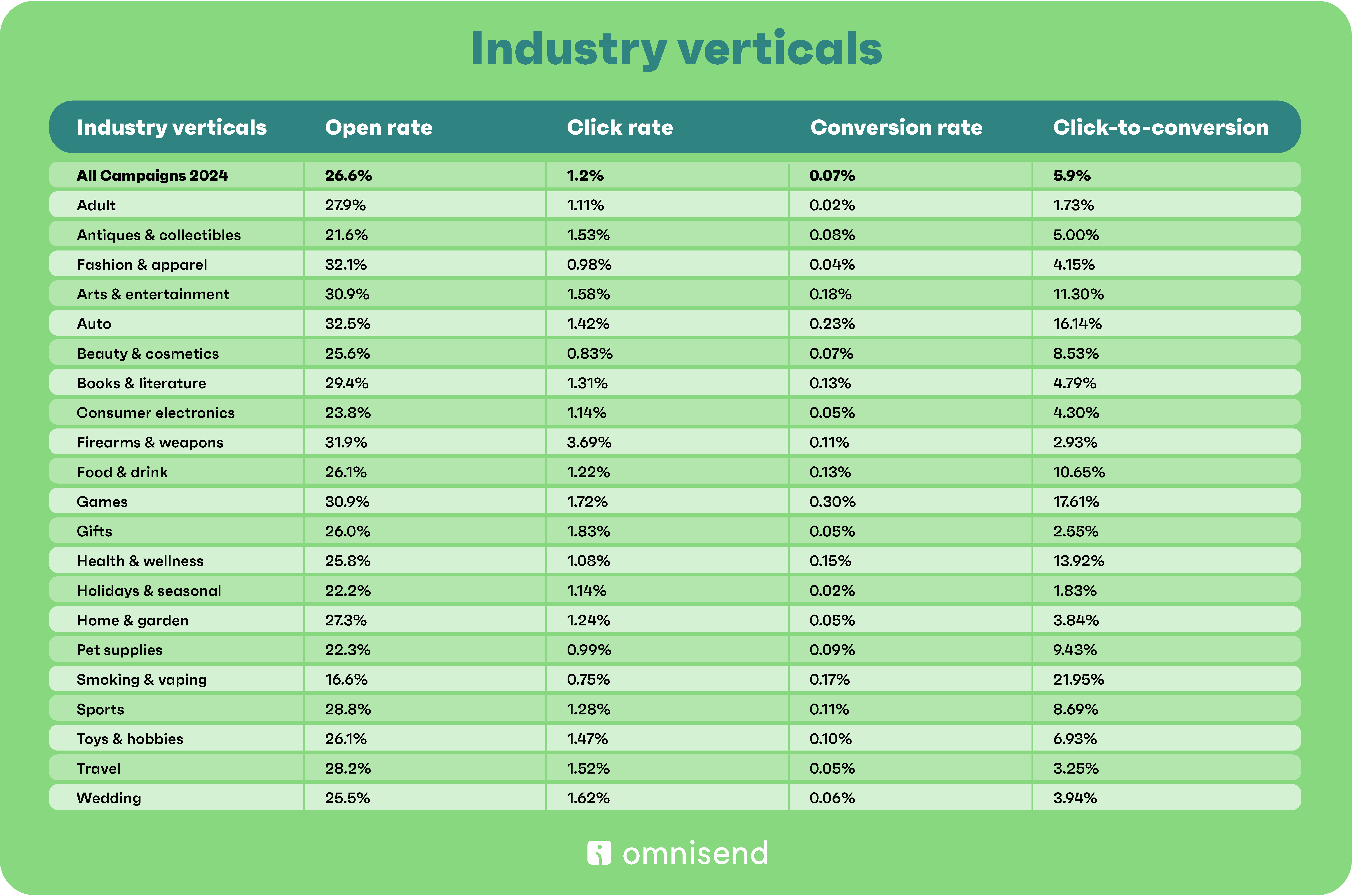
A FirstPageSage research says the average conversion rate is 2.4% for B2B companies and 2.8% for B2C companies.
In addition, the average conversion rate across all industries is 0.07%. To compare your conversion rate results to the averages in your industry, take a look at the table below:
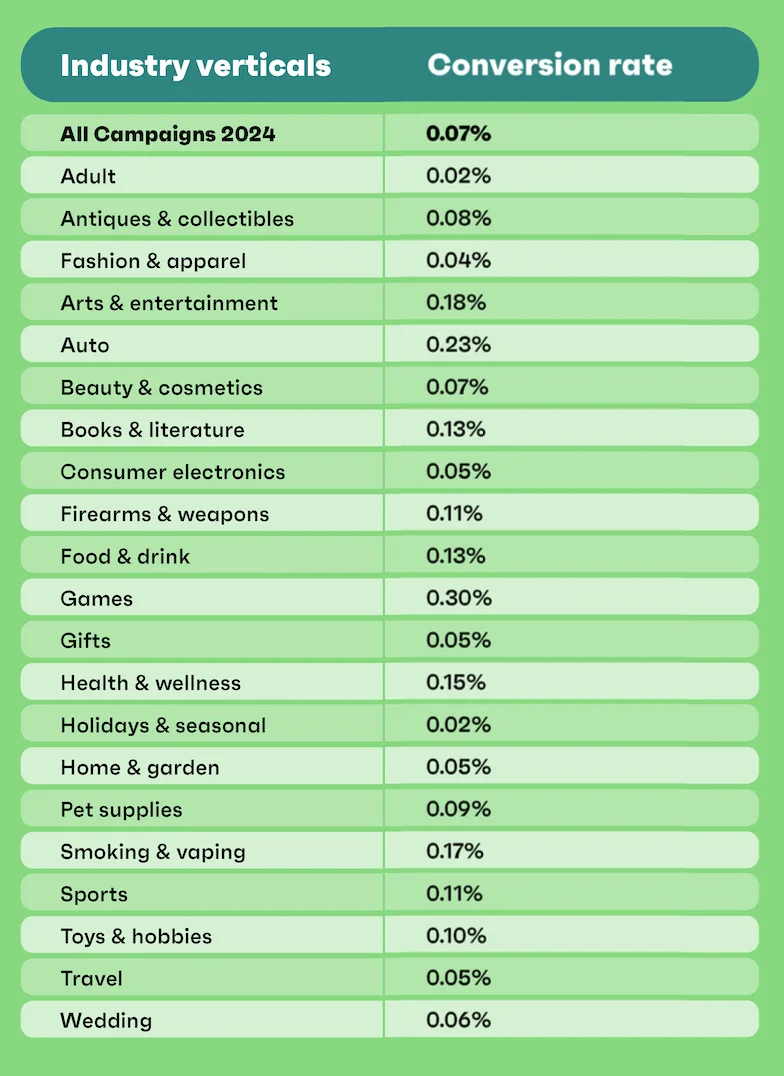
So, how do we know that the emails are getting good conversion rates?
Simply benchmark your conversion rate against the industry averages for your vertical. If it matches or exceeds the average conversion rate for your industry type, the marketing campaigns are delivering effective conversion rates.
However, conversions also vary between different email types. For example, transactional emails (like invoices or shipment information) have a higher conversion rate compared to promotional emails and newsletters.
Why optimize the email conversion rate?
Conversion rate is the indicator of your campaigns’ success. Not trying to improve it is akin to wasting marketing budgets. Before trying anything else, use these strategies and see if the problem can be easily fixed.
10 best strategies to improve email conversion rate
By now, you’ve probably calculated the conversion rate for your latest marketing campaign. If the results didn’t meet your expectations, don’t worry. Below, you’ll find 10 top strategies that can increase the conversion rate.
-
Segment your email list
Email blasting a fashion product ad to a SaaS-interested audience might not be relevant, and in the worst-case scenario, they might mark your emails as spam. That’s why it is critical to segment the audience based on demographics, past purchases, and engagement.
Segmented campaigns target particular groups in your audience and are more relevant to each individual subscriber, so they tend to get higher open rates and conversions.
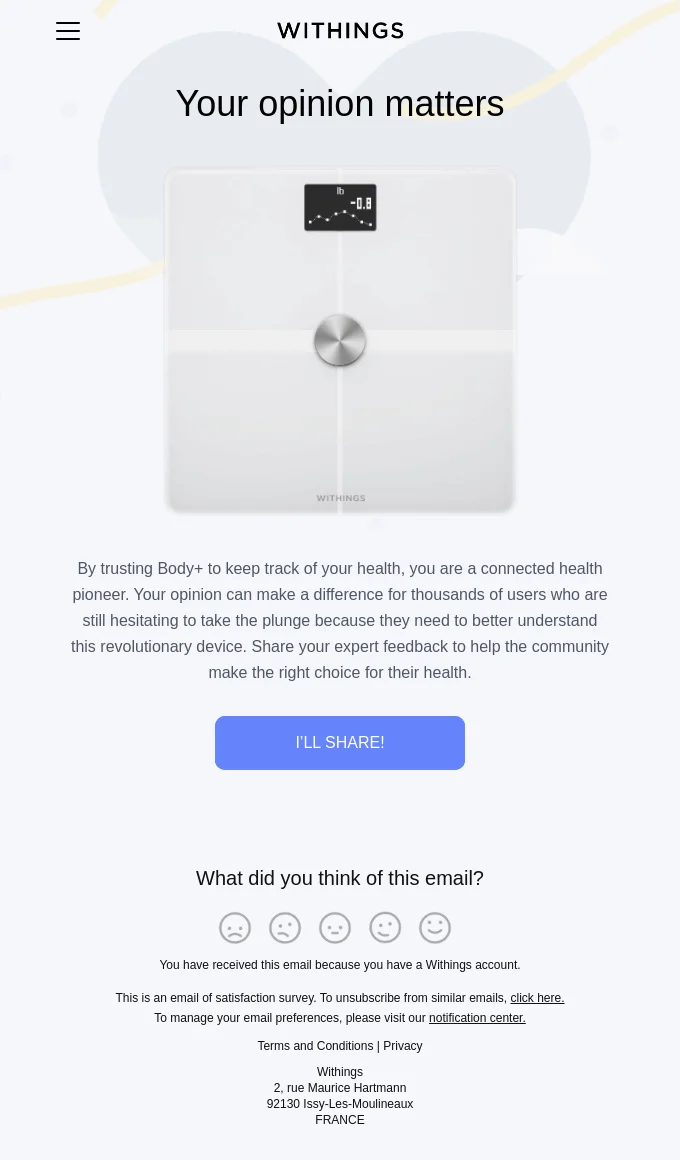
For instance, one of the segmentation ideas would be to email customers who have already purchased your product or service to get feedback from them and make improvements.
Here’s an email corresponding to the described scenario. It calls back to the customer’s previous purchase and has an active and enthusiastic CTA: “I’ll share!” It also shows a photo of the item, so that the subscriber immediately understands what product the company wants to learn more about.
-
Personalize your emails
Promotional emails overwhelm customers’ inboxes, but a personalized one can cut through the clutter. Personalized content like the customer’s name, location, or relevant pictures and statistics based on their choices can enhance user engagement and conversions. It’s no surprise that companies that excel at personalization get 40% more revenue than average.
Here is a good example of a personalized email. The added name of the customer may trigger active involvement from someone who loves to travel, which increases the conversion rate.


-
Design attractive subject lines
Email subject lines are one of the most important factors that contribute to a good conversion rate. Some recipients may mark your emails as spam based on subject lines alone, so they’re paramount for both deliverability and conversions.
Check out these tips for writing compelling subject lines that drive conversion:
- Add personalization, like a name or location.
- Add an exciting detail about the email content.
- Keep the subject line concise (not more than 60 characters) but also meaningful.
- Avoid excessive punctuation and writing in all caps, so as not to appear spammy. Stick to no more than three punctuation marks.
- Use emojis depending on the subject line and content. Skip emojis, however, when sending targeted official business emails.
For example, using a catchy subject line referencing a concrete discount percentage is a smart way to improve conversion rate. This particular example also has a good preheader that further explains the offer requirements, so the customer already starts thinking about future purchases.

-
Optimize for mobile devices
More than 70% of all emails are opened on mobile devices, so email mobile optimization for smartphones or tablets is a must in order to increase conversion rates.
Ensure that the email template design is scalable and responsive across both the desktop and mobile versions. This means the layout, images, and CTAs should adapt automatically to the screen size. Also, try to keep the email code light to optimize the email load time.
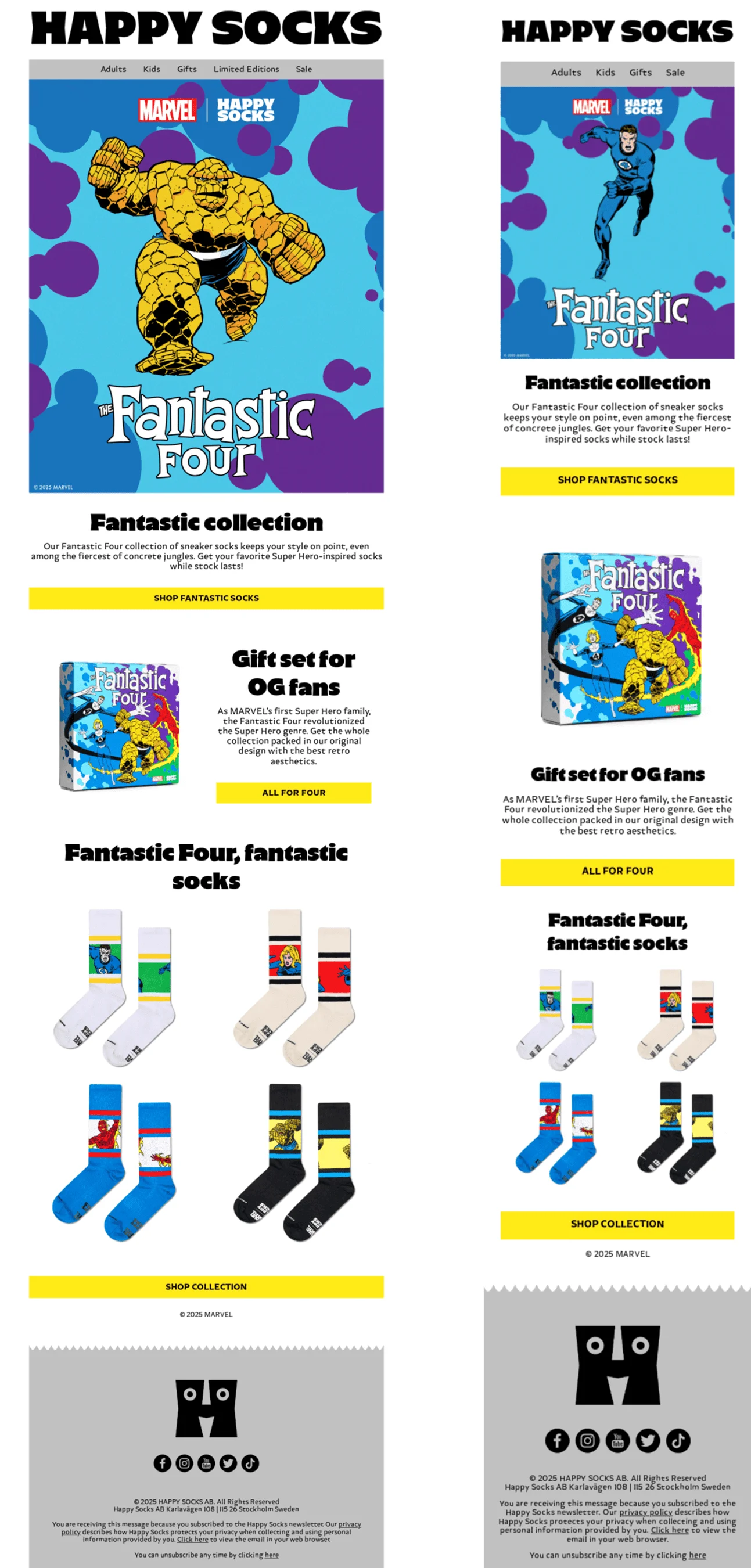
Here is a desktop and a mobile version of the same email, side-by-side, as an example of good mobile optimization. The button text is larger, all buttons are big and easy to tap.
-
Create a clear and prominent call-to-action
Presuming your audience knows what to do after they’ve read your email is a big mistake that most marketing teams still make.
Craft CTAs that are clear, specific, and push toward the target, like downloading a brochure, paying for something, or visiting a landing page.
On top of that, place CTAs in prominent places where they are most likely to get clicks. To use an example, if you put a CTA “Buy the e-book now” at the beginning of an email, the readers might ignore it because they haven’t yet learned what the e-book is about and whether they need it or not.
Here’s an email with a perfectly placed CTA. The CTA is easy to understand and in context with the content — there’s a video and then a button asking the customer to watch the video.

-
A/B test your emails
Marketers use email marketing A/B testing, or split testing, to determine which variation of an email performs best with customers. Experiment with different elements of your email, such as images, headings, CTA, and body copy.
This helps to get which email aspects resonate well with the audience and which need improvement to enhance conversion rates.
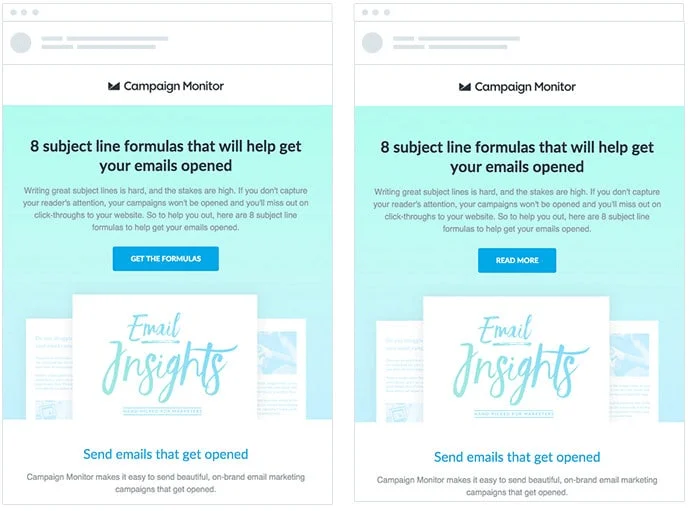
Here are two variations showcasing how a company performs A/B testing to check which variation of a CTA gets more clicks. The CTA on the left mentions what the subscriber gets by clicking, and the CTA on the right is shorter and more abstract.
-
Provide value in every email
Provide your target audience with regular, relevant, and useful content in the form of tips, news digests, or educational resources. This encourages customers to engage with your emails with the expectation of fresh, unique content, ultimately improving your open rates and conversions
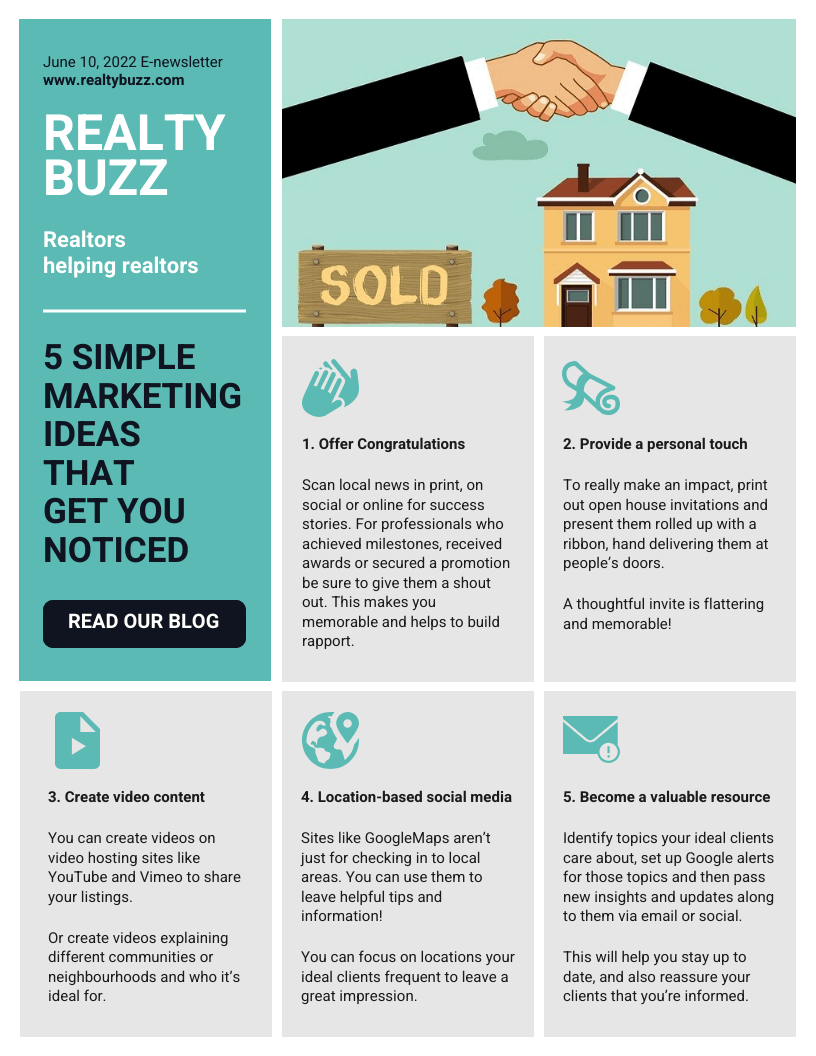
Using infographics in your email campaigns is another effective way to provide easy-to-understand and valuable content to your audience. See this example:
-
Use social proof
Adding social proof, such as customer testimonials and reviews, to your email builds trust and enhances credibility. You can also add star ratings, genuine feedback from users, and case studies that may prove that your brand has relevant experience, and the emails are authentic.
Many businesses also invest in media and endorsements from top industry experts. You can add their recommendation quotes and suggestions to your content to significantly improve conversion rates.
See this example in which a brand uses customer reviews in the email content as social proof. Note how the company showcases different products, so that the campaign is appealing no matter which option the subscriber prefers.

-
Optimize your send times
The time when you send your emails to the audience also affects the conversion rate. You may use email analytics to find the time at which most of your targeted audience opens the emails.
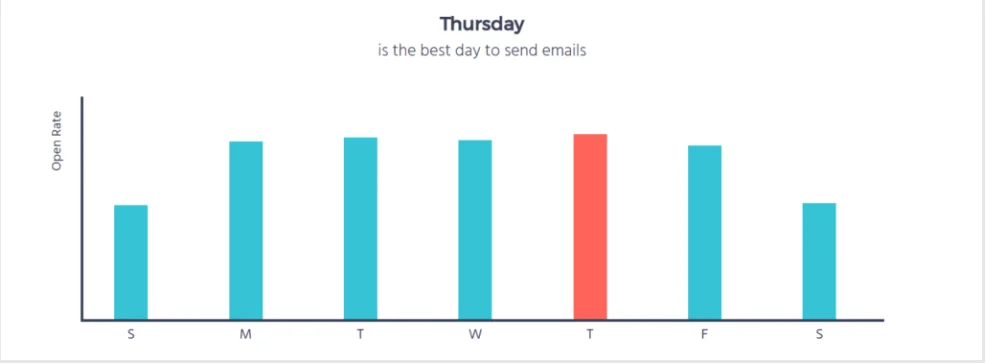
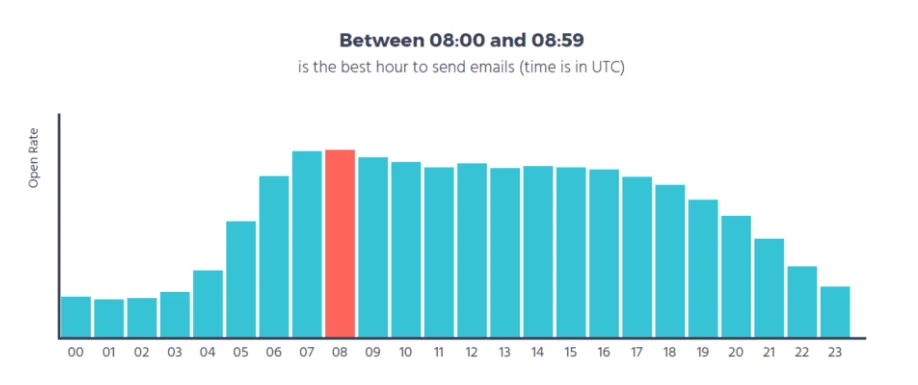
According to Moosend research, Thursday is the best day to achieve high open rates, and 8-9 am is the best time to send emails.
However, these numbers may differ between B2B and B2C customers.
-
Clean your email list regularly
Update your email lists occasionally to filter out unresponsive and invalid contacts. This helps to minimize the bounce rate and improve deliverability.
Verify new customers’ email IDs to check their authenticity and keep cleaning your mailing list for better engagement
Final thoughts
Email conversion rate plays a significant role in determining a campaign’s success. It is important to nail the optimization strategies to see measurable results.
Incorporating strategies, such as audience segmentation, personalization, and crafting engaging and valuable content, can improve the email conversion rate and boost the overall performance of your campaign.
 New and noteworthy on our blog