



Key takeaways
- Lead nurturing through email marketing helps in maintaining client engagement and providing personalized messages.
- Email marketing is cost-effective for promoting services and new listings, with segmentation and automation enhancing targeting.
- Building a carefully curated and segmented email list is more effective than large, messy lists.
- Use a personalized and trustworthy email address for credibility and deliverability.
- Engaging subject lines are crucial for increasing open rates in email marketing.
- Maintain a friendly and natural tone in emails while balancing professionalism.
As a real estate agent, you probably have a lot on your plate. Property hunting, seeing places, and meeting people leave little resources for other essential activities such as email marketing. Naturally, this makes coming up with quality emails on a regular basis especially daunting.
The good news is, we’re here to help. In this article, you’ll find tried and tested real estate email ideas to help you put together a real estate email campaign every agent can be proud of.
But first, let’s talk about what exactly makes a good real estate email.
Why do you need a strategic real estate email campaign
Here is why you need your own real estate email marketing strategy:
- Lead nurturing. With email marketing, you always keep the conversation going with your clients, make sure they are up with the latest news and best deals. Personalization email techniques will make your messages more compelling and engaging.
- Cost-effective promotion. Email marketing is a convenient and budget-friendly way to promote your services and new listings. Email segmentation and email automation help you deliver the right messages to the right audience at the right time. Easy-to-use free platforms, like Selzy, help you save time and money on promotion.
- Customer retention and loyalty. Helpful tips, insights, trends — all of it allows you to stay in the spotlight and on your clients’ minds. Thus, you make sure that next time they need a real estate agent, they know precisely where to go.
Key elements of a high-converting real estate email campaign
From picking the right audience to consistently providing valuable content, here’s what you need to stay on top of your game.
Smart targeting and segmentation
Finding the right audience for your emails is the first and most vital step to success. You don’t want to be a spammer, so make sure you send emails to people interested in your services. These might include your present and past clients, their referrals, and contacts collected via lead-generation efforts on your website and social media channels.
As you build up your mailing list, you can segment it to make your real estate marketing email campaigns more focused and personalized. For example, you can send different campaigns to buyers and sellers, segment your list by location, marital status, stage of the sales funnel, and other characteristics.
By the way, while it’s lucrative to buy a “ready-made” email database online, we strongly recommend building up your email list from scratch — this way, you’ll avoid invalid addresses and contacts.
Here is a real example from a marketer, CEO, and founder of SeoProfy, Victor Karpenko.
I’ve seen that a carefully curated, precisely segmented list, even with fewer than 1,000 contacts, beats big, messy lists in every way that counts.
We only use signups from people who’ve genuinely given permission; we never use scraped contacts or buy lists. Then, we break everything down: people actively looking to buy, general prospects, people who visited open houses, other real estate agents (especially those in nearby markets), and social media contacts who’ve opted in. Every campaign gets tailored from there. Off-market property alerts go only to serious, pre-qualified buyers. Stories about sellers getting above the asking price never get sent to other agents. This approach may seem very detailed, but it keeps you from spamming people and makes every email feel like a tip meant just for them.
This method usually delivers open rates around 60%, compared to the real estate average of just 30%.
Personalised and trustworthy email address
Next, take care of your email address and sender name as these two are essential to building trust and credibility with potential clients, as well as to your deliverability rates.
A good address should be short, clear, and easy to remember. In the real estate business, the most common option is to use your name and your brand name in an email address.
For example, if your name is Jane Smith and your company name is Perfect Housing, your email address can be janesmith@perfecthousing.com.
Other real estate email address ideas include:
- Using initials (for example, jsmith@perfecthousing.com)
- Using punctuation symbols (jane_smith@perfecthousing.com or jane.smith@perfecthousing.com)
- Combining your name with your profession or location (janesmith.ny@perfecthousing.com)
Whichever option you choose, the best practice is to use a custom domain name for your real estate email address. We recommend avoiding free providers such as Gmail, Yahoo, etc., because they are only designed for personal use. Therefore, some recipients may perceive marketing emails sent via these services as amateurish or suspicious. More importantly, the recipients’ mail servers typically regard mass emails sent with free email providers as spammy or unprofessional.
That’s why you should use professional email service providers for business communication. With professional software such as Selzy, you can send bulk emails safely from your business email address, automate and test your campaigns, and more. Alternatively, you can send your campaigns using professional tools such as Google Workspace, Office 365 Outlook, or via your website host.
That said, it is sometimes acceptable to send mass emails to potential customers via free email providers such as Gmail or Outlook. However, this method has certain limitations — for example, you can’t send promotional emails with these tools.
As for the sender’s name, the safest option is to use your name or your company name, or a combination of both. For example, “Jane Smith”, “Perfect Housing”, or “Jane, Perfect Housing”.
Important
When coming up with your professional email address, be careful with the word “realtor” as there are certain limitations to its usage, both by The National Association of Realtors® (NAR) and by certain states’ authorities. For example, NAR states that the term “REALTOR” is a trademark and is not interchangeable with “real estate agent”. Therefore, you can only use the term “realtor” if you are a member of NAR.
Also, make sure you have all the necessary links in place. For example, Texas requires real estate license holders to display the Consumer Protection Notice in a “readily noticeable location”. Typically, this includes your company’s office and official website, but may also include your business’ social media accounts, and an email signature for your marketing emails.
Attention-grabbing subject lines
Once you’ve made it into your potential customers’ inboxes, it’s vital not to get lost among the dozens of other emails they receive daily. And that’s where email subject lines come in.
According to research, engaging email subject lines increase open rates by 33 to 47%, making them one of the key factors affecting the performance of your email marketing campaigns. So, it’s crucial to get them right.
The easiest way to do it is to learn from examples. Take a look at these subject lines from actual campaigns to get an idea of what you should aim for.
- Search tips for house hunters (Zillow)
- Your home’s Redfin Estimate (Redfin)
- 🔓 Unlock your property bonus (Willow Real Estate)
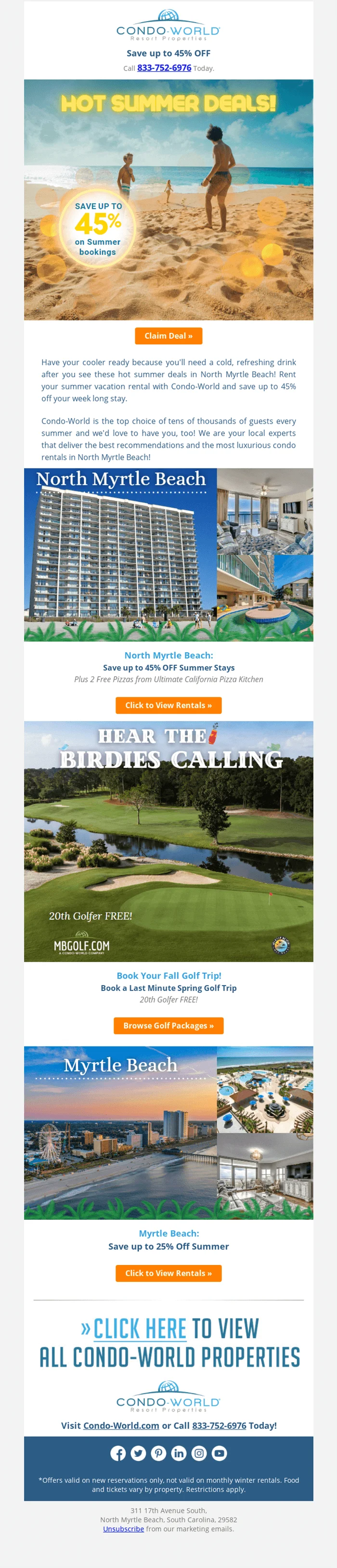
- You Belong at the Beach! Save Up To 45% (Condo-World Resort Properties)
- Your perfect home is out there (Zillow)
These subject lines are short and concise, which makes them easy to grasp and ensures they are displayed properly on mobiles. The first four also highlight value (tips, a helpful tool, a bonus, and a discount), while the fifth one offers a promise and evokes emotion.
To see more examples like these, read real estate email subject lines. There, we provide 50+ professional subject lines and give tips and best practices to help you come up with impressive ideas of your own.
Friendly and natural tone
After your leads click open, it’s vital to hold their attention until they get to your CTA. A friendly, warm tone will help you establish rapport and make it easy for people to keep reading. However, professional emails should still remain professional, so it’s important to strike the right balance between sounding casual and businesslike.
If you’re unsure about how your tone reads, try to recall how you speak to your clients in person and stick to more or less the same manner when writing your emails. Writing tools such as Grammarly or other software with similar functionality can also help you nail the right tone.
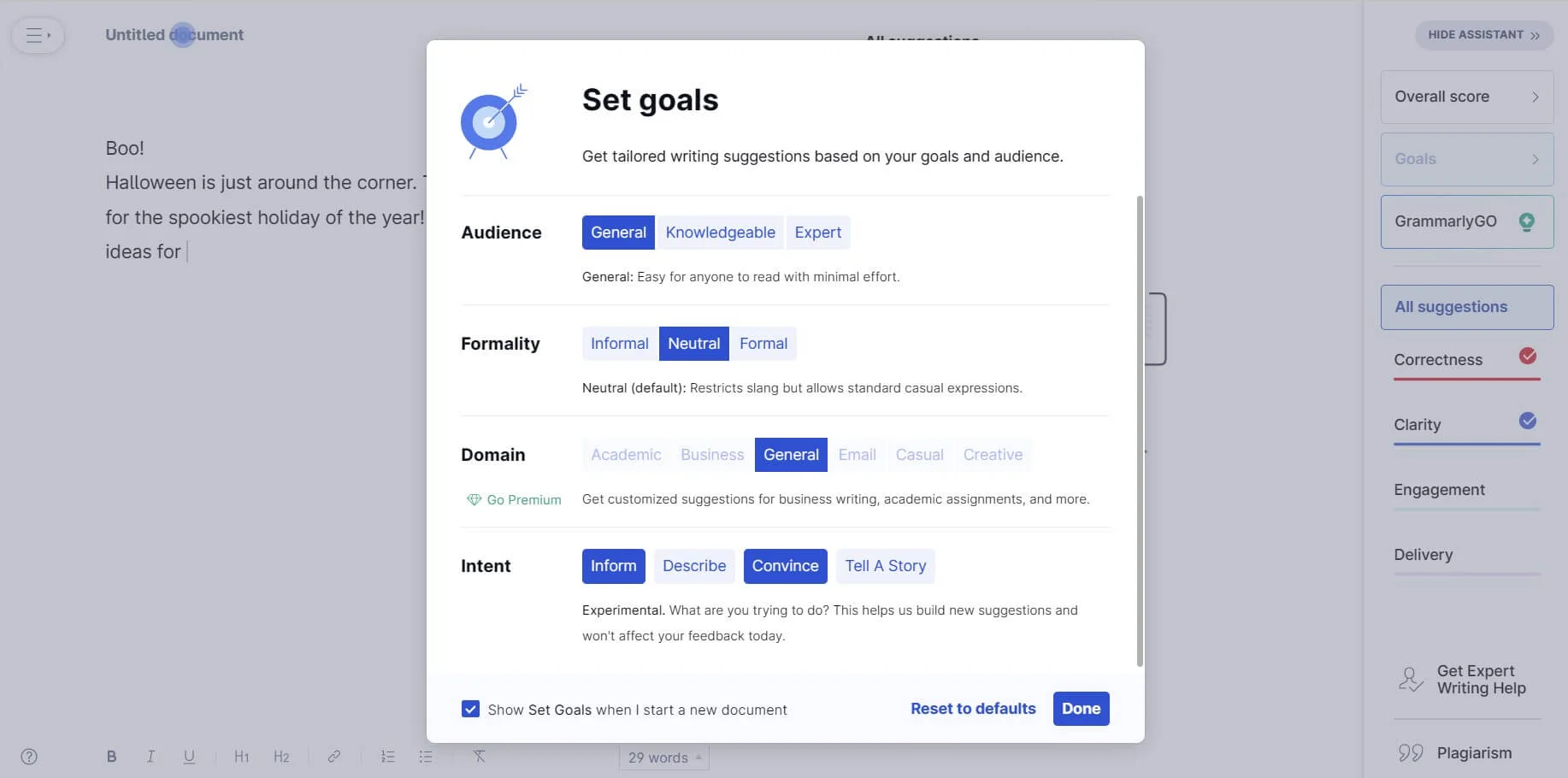
It can also help to keep in mind who your target audience is for a particular campaign, and what the email content is about. For example, a newsletter with home decoration tips calls for a more casual tone than one containing market updates and industry news.
However, you need to keep your tone consistent across all of your emails, so make sure variations are subtle.
Valuable content
While all of the above matters, valuable content is the key thing that can make your email marketing campaign (and all your content marketing, for that matter) a success in the long run.
Avoid generic “salesey” and/or “watery” copy as much as possible, and always remember that your subscribers are not with you because of what you are, but mainly because of what you can do for them. In short, your emails should be valuable to them.
To make sure your real estate email ideas hit the mark, always review your emails from the reader’s perspective before launching your campaigns. Here is a quick checklist for your real estate email content:
- Can your clients learn something new from this email?
- Can they put this knowledge into practice?
- Does this email solve any of their problems or alleviate their pain?
If the answers are “yes”, then you’re on the right track. If there are more “no-s”, rework your emails to make them more client-oriented. For more tips on creating valuable content for your subscribers, check out more of our articles on real estate.
Here is the experience of the founder and CEO of Hennessey Digital, Jason Hennessey, that proves: value is everything in email marketing.
Instead of sending out the standard “please relist with me” emails to homeowners whose homes didn’t sell, we use a more personal, empathetic campaign for recently expired listings. This method points out specific problems in the listing and offers concrete solutions. For example, our subject lines don’t push urgency. We show empathy: “Frustrated your home didn’t sell? Let’s talk about what went wrong.”
Clear CTA
To make your content more focused and your CTAs more effective, add just one CTA per email. This will make it easier to assess how your content performs and make the necessary improvements. If you want your subscribers to perform several target actions, it’s recommended to use different emails for each CTA. To learn more about email CTA best practices, read our article entirely dedicated to this topic.

Consistent schedule
Last but not least, valuable content works best when delivered consistently over time. Given that real estate email marketing campaigns often run longer than in many other industries, devising an email marketing strategy for your real estate business early on is the best way to stay on track and ultimately achieve your marketing goals.
To make sure you always stay in touch with your prospects and clients, come up with a manageable campaign schedule early on. Take into account how much content you or your team can produce, and then test the audience’s preferences — A/B tests can help you with that.
To add variety, leverage different types of emails: newsletters, announcements, special offers, and others. This way, you’ll ensure you keep your subscribers engaged in the long run and get tangible results from your email marketing efforts.
Speaking of which, here are some best real estate email ideas to help you optimize these efforts and maximize positive results.
15 best real estate email ideas for your campaigns
Real estate emails don’t have to be “salesey”, “watery”, or boring. Here are the best email marketing ideas to diversify your real estate campaigns and provide value to your subscribers without spending hours on content production.
Share local market updates and industry trends
Most people who consider selling, buying, or renting property want to stay updated on the current market trends and industry news because these can seriously affect their decisions. Make sure to focus on a local real estate market — this will help you establish your reputation as an expert and an agent to turn to for professional advice.
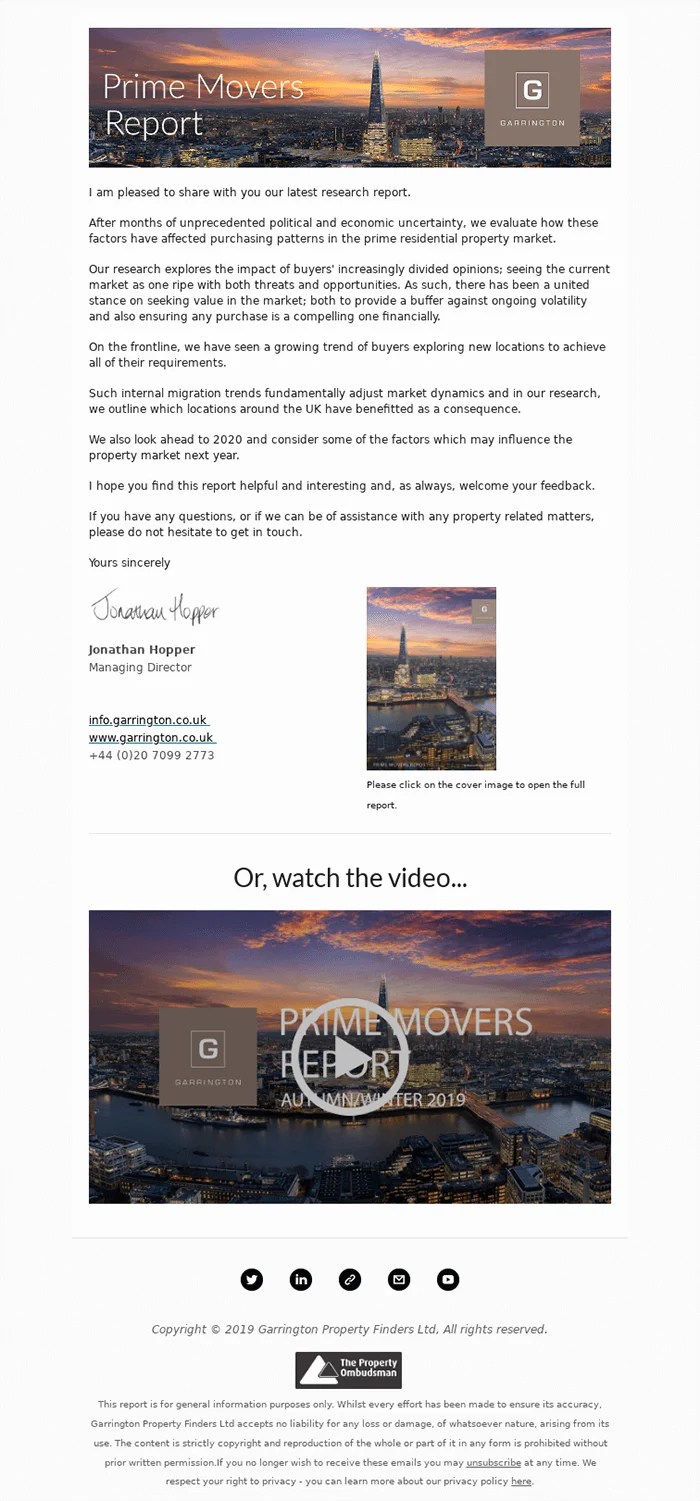
In the example below, Garrington Property Finders handles this format marvelously. This email is clear, concise, informative, well-designed, and contains all the elements a professional email should: a polite signoff, an email signature with contacts, links to the company website and social media accounts, and an unsubscribe link.
Promote exclusive local deals or new listings
Keeping in touch with past clients is essential for real estate agents. A lot of people buy homes in a new area, and you can leverage this. Let your clients know about local deals. A weekly newsletter with a selection of deals offered by businesses in the area — a sale in a local store, a discount offer at a nearby cafe, and the like — will save your clients time and money and establish you as a go-to expert in the neighborhood.
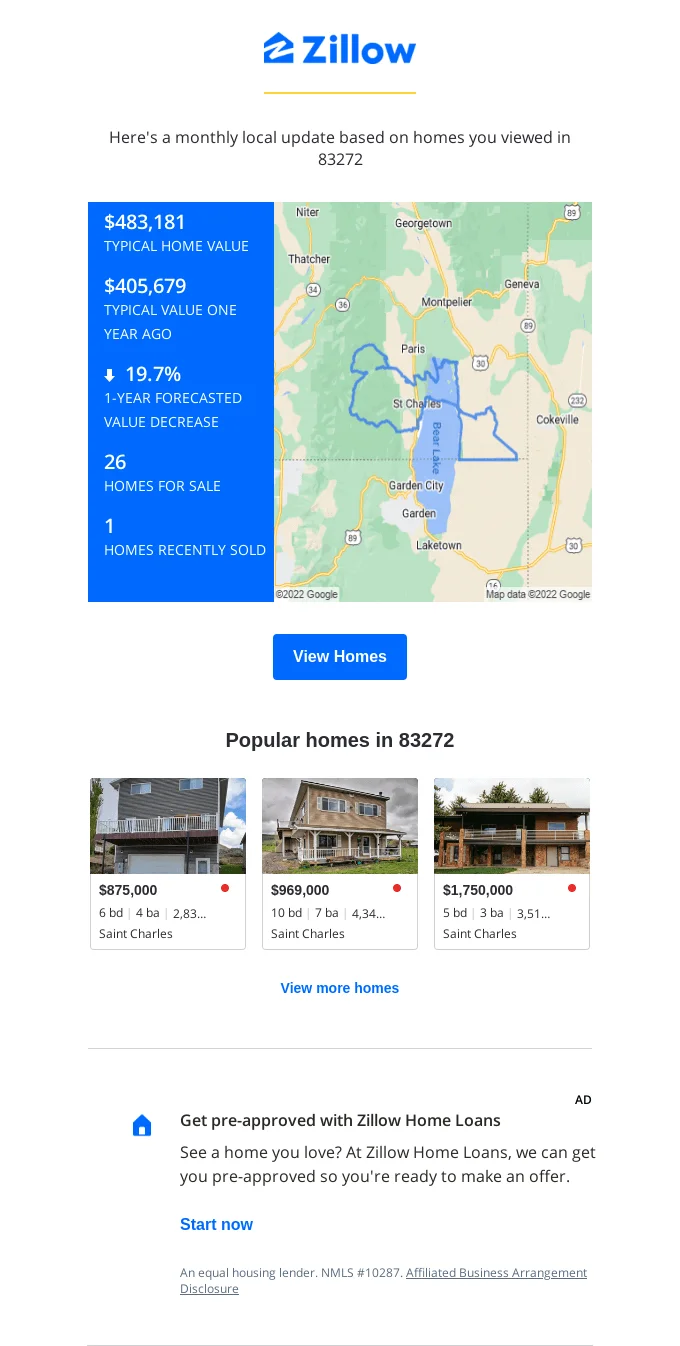
Another way to leverage the format of the local deals is by sending emails targeted at leads who recently viewed the property in a certain area. That’s exactly what Zillow does in this monthly newsletter, with an overview of popular homes similar to the ones a lead browsed. Everyone enjoys some occasional house-hunting, so new real estate listings will bring more joy than you can expect.
Invite subscribers to local community events
Informing past clients about events in an area they’ve just moved to is a great way to stay in touch. Similar to the local deals newsletter, you can put together a selection of events people typically find interesting, such as concerts, festivals, parties, lectures, etc.
Active clients looking to buy a home will likely be interested in open house events, as these usually present great opportunities to get a better feel of the property.
To make the most of your open house announcement, remember to include a large, eye-catching image of the house and put it front and center, just like in this email from Sotheby’s International Realty:

Tip
If you are planning to attend a local event yourself, remember to mention it in your email. Your potential customers might want to catch up with you there, and you’ll get a unique opportunity to forge personal connections on-site. Perhaps, they will even introduce you to their friends, and some extra referrals have never hurt anyone.
Share how-to guides for buyers and sellers
How-to guides can serve several purposes at a time, driving traffic to your website and building trust with your audience. After all, why search for information all over the internet when you have a guide put together by industry professionals in your inbox?
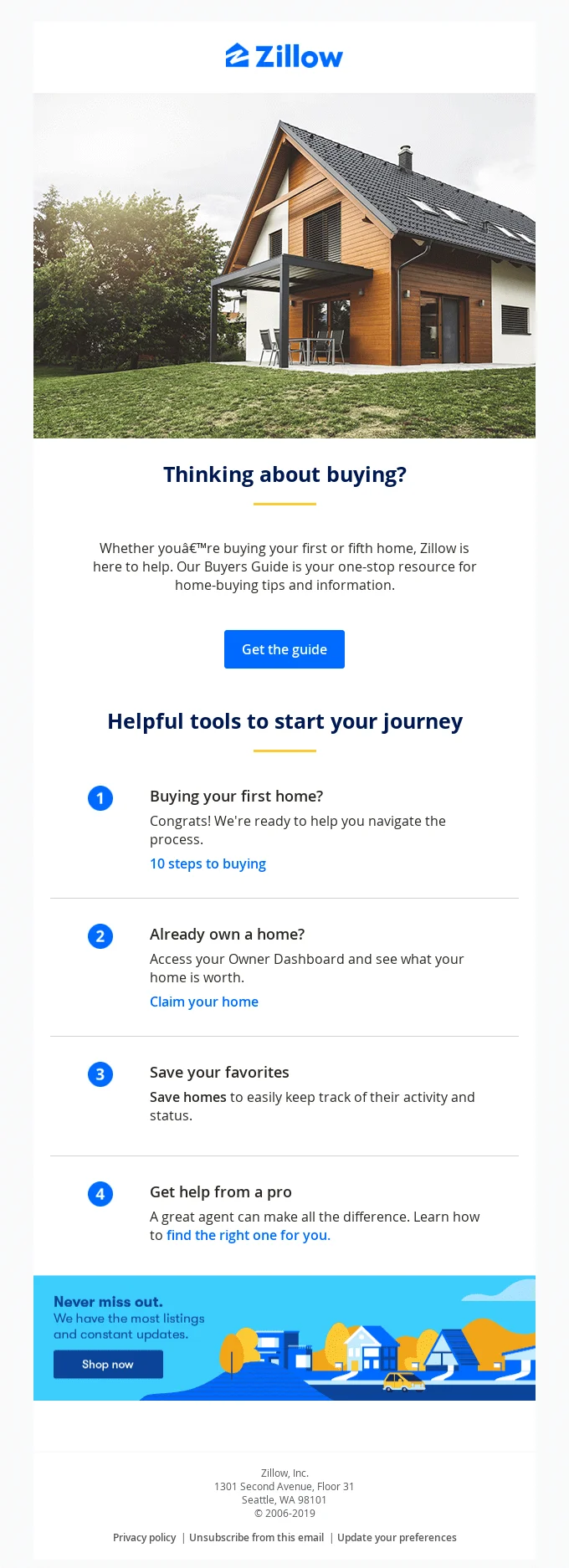
One more advantage of this format is the number of topics to cover in a how-to guide. You can offer a home buying guide like Zillow does in the example below, or a guide to home sellers; give home renovation and decoration tips, offer home cleaning best practices, or even provide a guide to properly mowing a lawn — the possibilities are endless.
Send seasonal home maintenance tips
To help your subscribers embrace seasonal changes, send them an email newsletter with useful content: tips on keeping the house cool during the summer or making it warm and cozy in the winter.
If you have any seasonal special offers, you can also announce them via a promotional seasonal email, as Condo-World does in this “summer deals” email below.
Other real estate email ideas for seasonal content include:
- Seasonal holiday decoration tips (Christmas, Halloween, etc.).
- Seasonal home maintenance tips.
- Seasonal local events guides.
- Travel deals and ideas.
Provide business updates and celebrate milestones
Sharing updates about your business, such as opening offices, hiring people, or offering new services, is a great way to let your subscribers know you are not stagnating. If your business is growing, it is successful; therefore, it is likely reliable. Besides, keeping your clients, leads, and prospects in the loop will help them develop a certain connection to your business because the more they know about it, the more emotionally involved they become.
Another good option here is to celebrate significant events or milestones — for example, an outstanding deal or the end-of-year results. This will help you to position yourself as a leader in the industry.
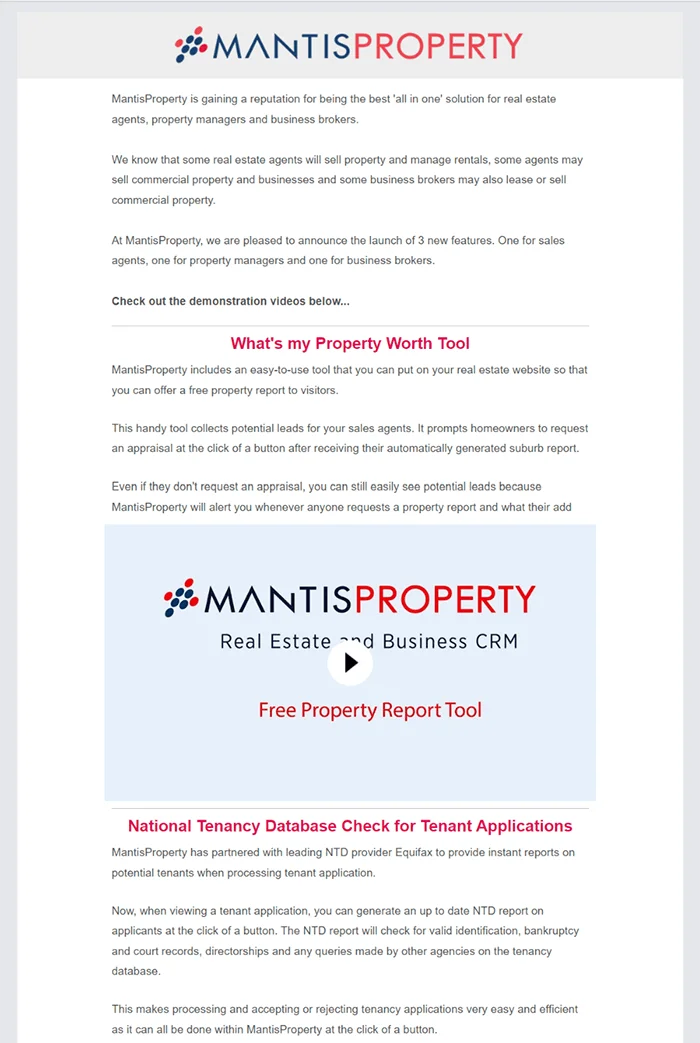
In this example from Mantis Property, the company announces new useful features for its clients while establishing itself as one of the industry leaders at the same time.
Reuse and repurpose evergreen content
Even with experience, generative AI, and professional tips and tricks at hand, content creation is a lot of work. One way to reduce the workload is to have evergreen content — articles or posts that are always relevant. You just need to put it together once, and then you can recycle it almost indefinitely.
Typical examples of such content include how-to guides and seasonal content we mentioned earlier. Here are some more real estate email ideas featuring evergreen content:
- Welcome messages
- FAQ articles and videos, and
- Personal branding content (more on that later)
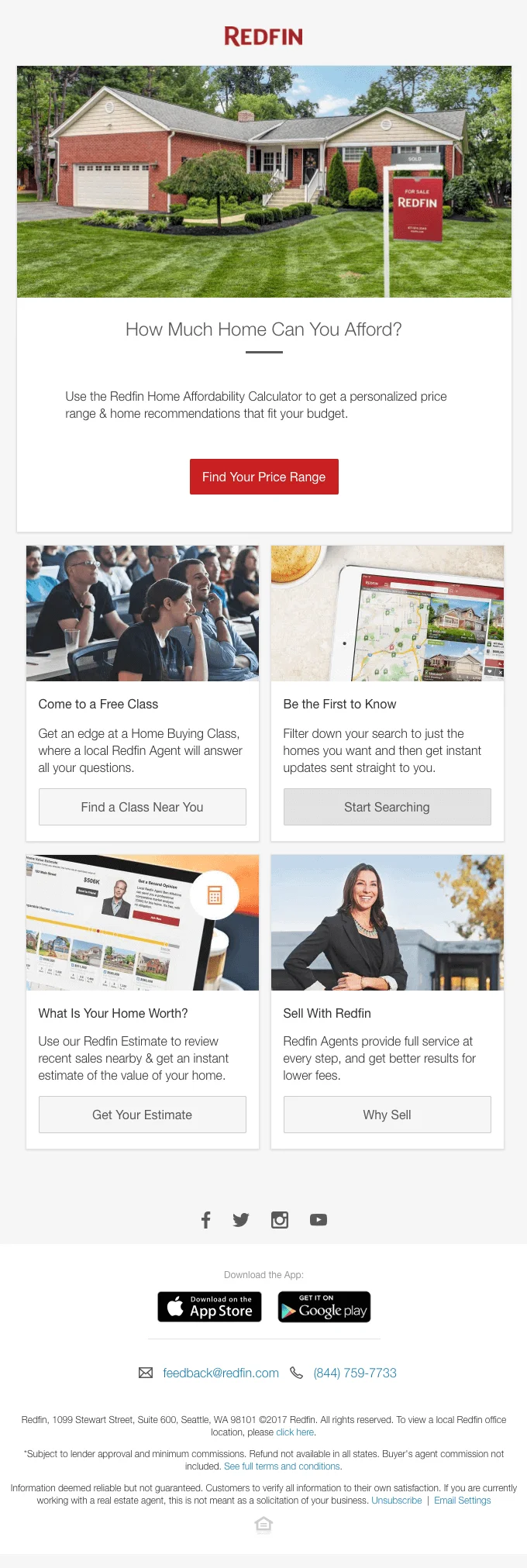
In this email from Redfin, the company answers one of the most frequently asked questions home buyers face while also promoting its online tool and driving traffic to its website:
Highlight blog posts
Having a blog on your website makes content creation for email marketing and social media so much easier.
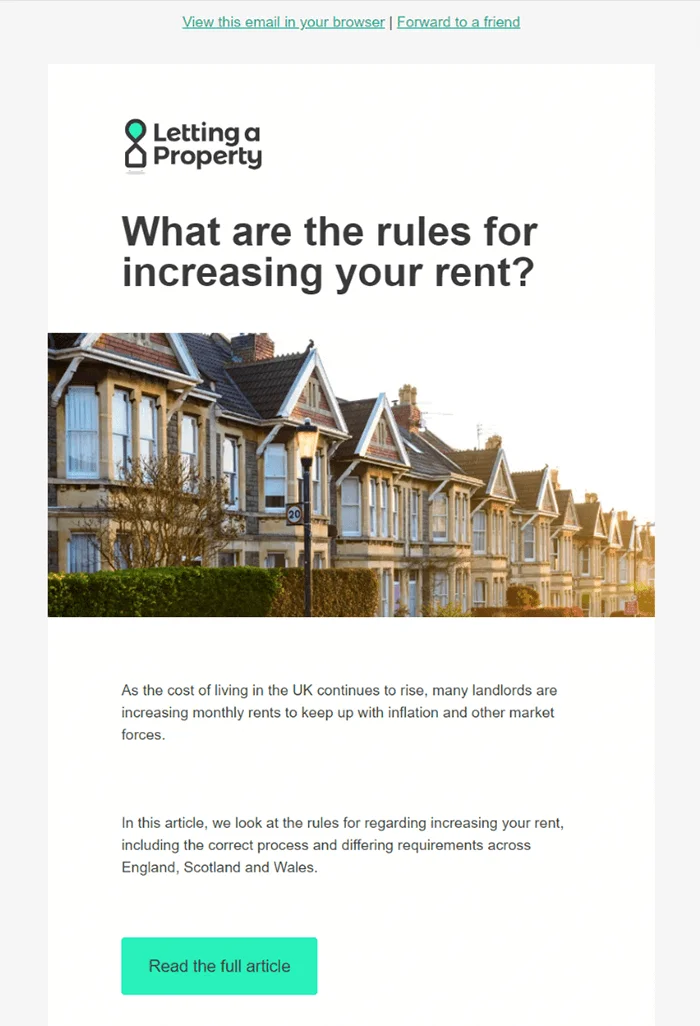
Typically, email newsletters help promote blog posts by showcasing the most intriguing excerpts from the articles and inviting readers to learn more by clicking on the CTAs. Alternatively, you can rewrite a blog post for an email campaign, turning it into a series of engaging emails — just remember to add a relevant CTA.
Below is an example of the most traditional way to promote a blog post in an email.
Build a personal brand with behind-the-scenes content
Providing value for subscribers is important, but you should always keep in mind the goals you are pursuing as a business. That’s why you need to occasionally alternate valuable content with personal branding content — i.e., content that puts you and your services in the spotlight.
The best way to build a personal brand through email is to give your clients glimpse behind the scenes. For example, you can show how you inspect property before listing or give reasons why you love your job. Real estate email ideas for personal branding include case studies, success stories, and even some rare stories of a failed deal — everything human will attract interest from your subscribers. This way you keep them engaged, entertained — and show yourself as a great professional.
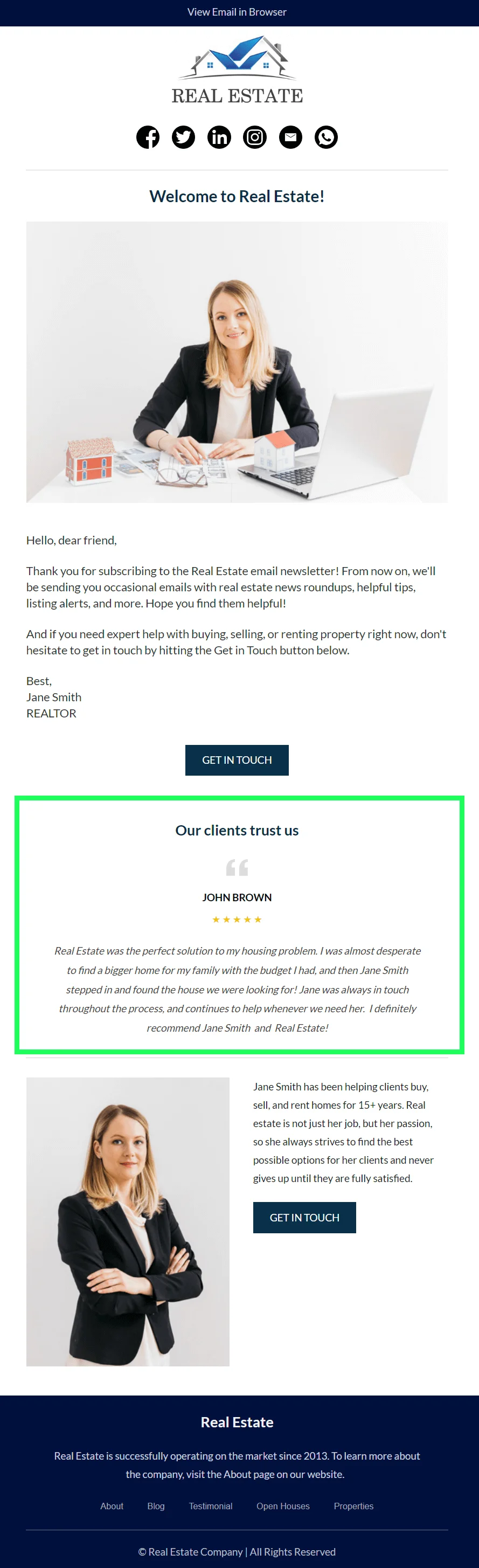
Keep in mind that you can also incorporate personal branding into emails of any type — for example, into a welcome email, as shown in the template below.
Tip
There’s also another great way to incorporate elements of personal branding in any of your emails, including newsletters, announcements, season’s greetings, and whatnot. Add a professional email signature featuring your photo, credentials, and contact information to each of these emails.
Offer lead magnets
Lead magnets help you to build your contact list with active subscribers, but they also serve as tools to check interest in certain services or to engage your existing contacts. What can be a lead magnet in real estate email marketing? For example, a checklist for new homeowners or a list of necessary documents for those interested in buying a condo. Whether subscribers are new or existing, they have to share some personal information or provide something in return — like giving a review.
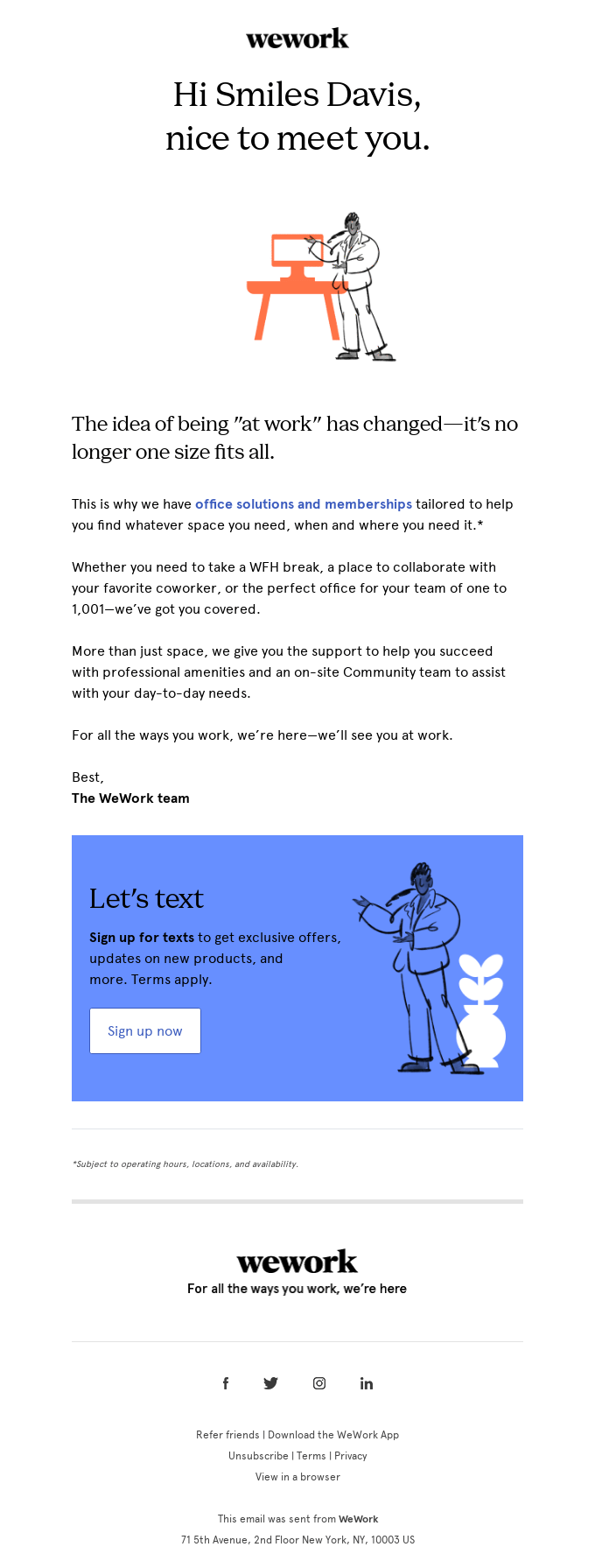
Take this banner from WeWork email as an easy example — while the company doesn’t offer a specific tool, it highlights all the benefits new subscribers will get.
Share testimonials and success stories
User-generated content is a must in your email marketing strategy. Take advantage of the reviews, feedback, and testimonials your clients leave, and don’t hesitate to share them with your subscribers. People tend to trust fellow customers more than promises from the business, even the most successful one. Have a huge story with twists and turns about finding a forever home for your clients? Even better — this will make you look like a super-realtor, and a relatable one at that.
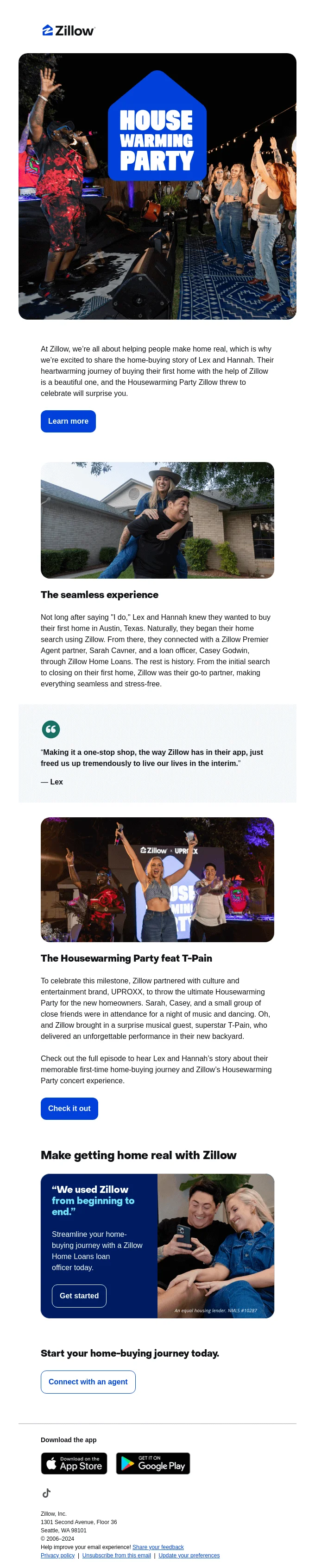
In the email below, Zillow shows a success story of a first home purchase. It’s personal, warm, and a little whimsical (if you count a music star showing up at a housewarming party). It also highlights how the process was easy for the couple.
Run polls or surveys to engage your audience
Polls and surveys will give you great insight into your clients and subscribers — their thoughts, interests, and preferences. Plus, that makes your real estate email content more interactive and engaging. If you are not sure how to use this type of content, we have a helpful guide on how to embed a survey in a newsletter.
Here are a few ideas for your survey or poll:
- Topics your customers are most interested in. You can use it to adjust your content strategy.
- The best locations to live or to rent a home in your area. Incorporate insights from your clients into your next newsletter issue.
- The hardest part of homebuying. Again, you can use it in both your content (for example, create an FAQ for the most triggering topics) and in your business.
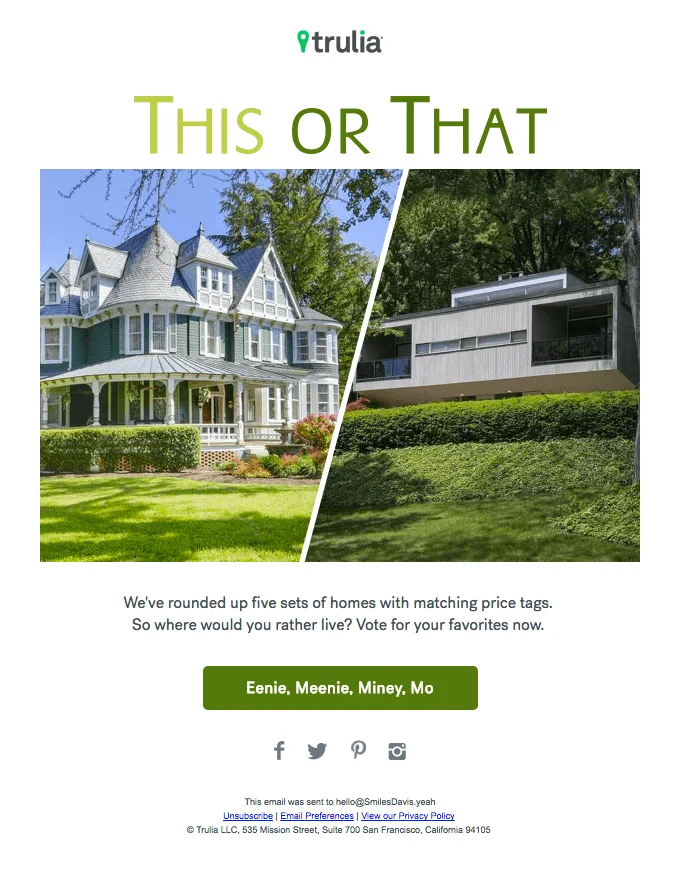
Here is a great example from Trulia that offers customers to vote on their favorite type of property.
Promote referral programs with email blasts
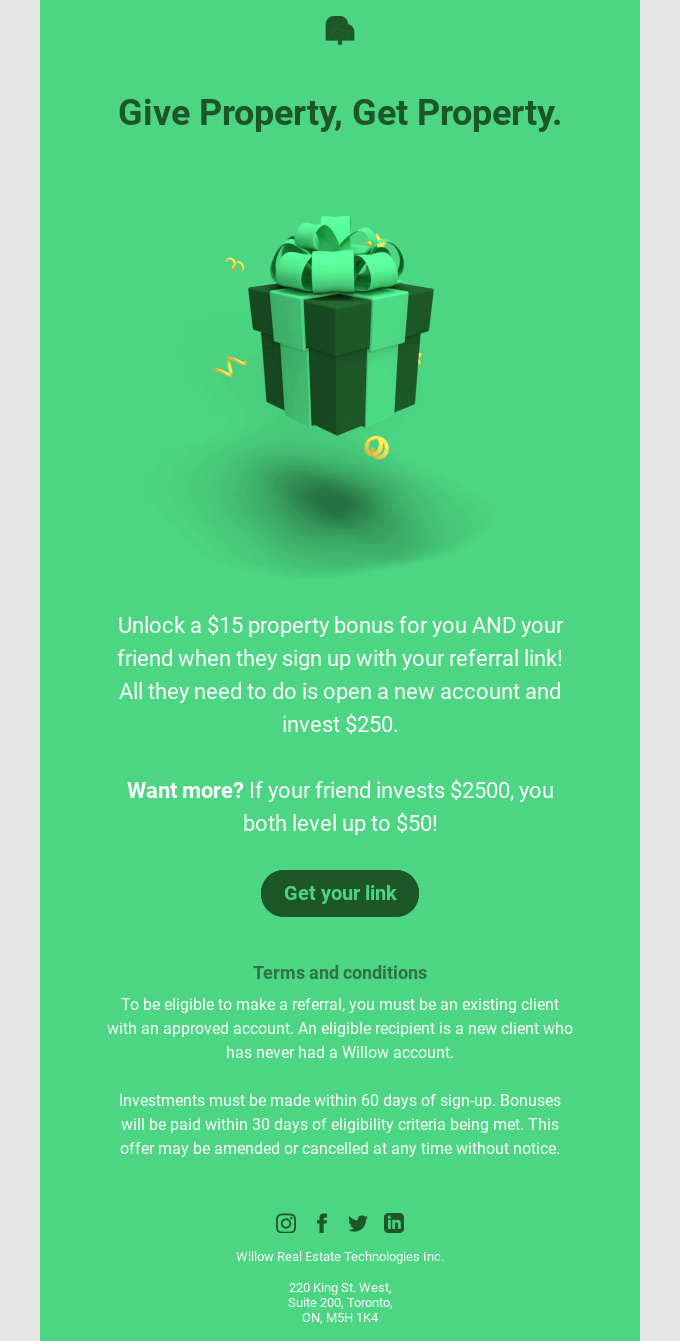
An email blast is a one-time mass email sent to your contact list. You can use it to spotlight your referral program: invite clients to refer friends or family in exchange for a bonus. It can be a future discount, a special offer in collaboration with other local businesses, or any kind of reward. Keep the message short, friendly, and easy to share, with a direct link or referral code.
Take the email from fractional real estate platform Willow as an example — they offer bonuses to existing clients for referrals, plus rewards for their friends.
Celebrate anniversaries or holidays
Real estate business is extremely personal, and any customer will appreciate thoughtfulness. There are plenty of ideas you can use. For example, congratulate your clients on the anniversary of a home purchase, or simply send greetings for a major holiday. A warm, personal message helps keep your brand top-of-mind and builds loyalty. Add value with tips for the season, a home maintenance checklist, or a free check-in offer.
Don’t worry about marking all of those dates in your calendar, email automation and specialised platforms can take care of that for you and send pre-made emails at the right time. Yes, Selzy can do it, too.
Below is a classic example of a seasonal greeting email.

Educate leads with short drip campaigns
A drip campaign is a sequence of pre-written emails sent over time. For example, you can pre-make a series of short emails to guide your leads through the buying process, or create a sequence with an explanation of the next steps for those who have already purchased a new home.
Use a short 3–5 message series to guide leads through the buying or selling process, and share. This builds trust while moving potential clients closer to conversion.
Of course, your regular email client, like Google, won’t be able to help you with this, but Selzy can — you can easily create both the emails with the drop-and-drag builder and the sequins you need to nurture leads.
Tips for creating effective real estate email templates
Let’s review what makes real estate email content effective and engaging, so your open rates and conversions will make you happy.
Use dynamic content to personalize at scale
Dynamic email content is a piece of content that changes depending on a segment of your audience. For example, your clients in Seattle and New York will receive similar emails, but the “New exciting offer” section will be different and based on the location they live in. This helps you to personalize your emails and make sure that your clients always have valuable information instead of a generic email.
Add relevant visuals
Relevant visuals include property photos, agent photos, and even behind-the-scenes video tours. Real estate business is all about what you see — simple descriptions of a listing won’t make your clients interested. You can go creative with visuals, but the usual advice is to keep it short: for example, an email with 10 heavy, high-resolution photos would take a lot of time to upload. One or two great shots are enough to generate interest.
Test different email formats
Blast emails, drip campaigns, newsletters — there is no need to choose between them, because ideally, you include all of them in your real estate email marketing campaign. Test all email formats to figure out what works best for your subscribers and clients. You can use different occasions and ideas to do that.
Final thoughts
Email marketing is essential to anyone wanting to beat the fierce competition in the real estate business.
But just sending out random emails is not enough: to succeed, you need to consistently launch professional email campaigns targeted at the right audience, and follow other best practices mentioned in this article. You also need to come up with compelling real estate email ideas to keep your subscribers engaged.
Using the real estate email ideas listed above for inspiration will save you time and help make your real estate email campaigns truly efficient.
 New and noteworthy on our blog