



Key takeaways
- A strong fundraising email subject line should be clear, honest, and connect the cause to a specific action or outcome without exaggerating urgency.
- The best fundraising subject lines are specific, donor-centered, and consistent with the email content.
- Subject lines should be chosen based on the campaign goal, such as fundraising appeals, emergency responses, Giving Tuesday, matching gifts, events, volunteer campaigns, impact reports, thank-yous, re-engagement, and year-end fundraising.
A strong fundraising email subject line gives supporters a clear, honest reason to open. The most effective options connect the cause to a specific action or outcome without exaggerating urgency.
This guide includes 116 adaptable fundraising subject lines for appeals, events, Giving Tuesday, matching gifts, follow-ups, thank-yous, and more, plus practical advice for writing and testing your own.
Why the subject line matters in a nonprofit email
For nonprofit email marketing, the subject line is one of several signals people use to decide whether to open. Sender recognition, timing, the preheader, inbox placement, and the relevance of the appeal matter too, so a subject line cannot guarantee donations on its own.
The best fundraising subject lines are specific, donor-centered, and consistent with the email that follows. Name the cause or outcome, put the most important detail near the beginning, and use urgency only when the deadline or need is real.
Choose the subject line by campaign goal
Start with the action you want the reader to take and the reason it matters:
- Fundraising appeal: connect a gift to a concrete outcome.
- Emergency response: state the immediate need and real timeframe.
- Giving Tuesday or year-end: make the occasion, deadline, and goal clear.
- Matching gift: explain what is matched and when the match ends.
- Event or volunteer campaign: lead with the event, role, date, or location.
- Impact report or newsletter: show supporters what they helped achieve.
- Thank-you: lead with gratitude and a specific result.
- Re-engagement: acknowledge the past relationship and offer a meaningful update.
116 fundraising email subject lines
Use these as starting points. Replace brackets with accurate campaign details and keep the promise aligned with the email body and donation page.
Fundraising appeal subject lines
- Your gift can change a life today
- Help [cause] reach [goal]
- Will you stand with [community]?
- A small gift can make a lasting difference
- Together, we can fund the next step
- Give hope where it is needed most
- Your support can open new doors
- Be part of [project] today
- Turn compassion into action
- Help us make [outcome] possible
How to adapt these: Replace the broad promise with a concrete outcome, audience, or campaign goal.
Emergency fundraising subject lines
- Urgent: [community] needs help now
- Emergency response is underway — you can help
- Give today to support immediate relief
- Families need [item] before [deadline]
- Help us respond in the next 24 hours
- Your emergency gift can reach people today
- We are [amount] short of the relief goal
- Stand with [location] during this crisis
How to adapt these: Use urgent language only for a real, time-sensitive need and state what the gift supports.
Giving Tuesday subject lines
- Giving Tuesday starts now
- Make your Giving Tuesday gift go further
- One day. One community. A shared goal.
- Will you choose [cause] this Giving Tuesday?
- Today your generosity becomes action
- Help us reach [goal] by midnight
- There is still time to give this Giving Tuesday
- Thank you for showing up on Giving Tuesday
How to adapt these: Name Giving Tuesday early and use a real deadline or goal rather than manufactured pressure.
Matching-gift subject lines
- Your gift will be doubled today
- Give $25, help provide $50 of impact
- A matching gift can take us twice as far
- Double your support before [deadline]
- [Partner] will match every gift today
- Two times the help, one simple gift
- Unlock the full [amount] match
- Last chance to have your donation matched
How to adapt these: State the match, sponsor, cap, and deadline accurately in the email and landing page.
Fundraising event subject lines
- You are invited to [event name]
- Save the date: [event] for [cause]
- Join us on [date] to make an impact
- Your seat at [event] is waiting
- Meet the people behind [mission]
- Tickets are available for [event name]
- Can we count you in for [event]?
- Tonight: [event] begins at [time]
How to adapt these: Lead with the event name or date and make the expected action clear.
Volunteer recruitment subject lines
- Volunteer with us this [day]
- Your time can change a life
- We need [number] volunteers for [event]
- Lend a hand in [location]
- Join the team behind [project]
- Have two hours to help [cause]?
- Thank you to everyone who volunteered
How to adapt these: Specify the role, location, time commitment, or number of volunteers needed.
Nonprofit newsletter subject lines
- See what you made possible this month
- Your [month] impact update
- Good news from [nonprofit name]
- Inside: progress, stories, and what comes next
- Three ways our community moved forward
- Meet the people powering [mission]
- Your support at work
How to adapt these: Use one concrete story or result as the reason to open, rather than promising generic news.
Donation request subject lines
- Will you make a gift today?
- Help us close the [amount] gap
- [First name], can you help us reach [goal]?
- Every gift brings [outcome] closer
- Support [specific project] before [deadline]
- Can we count on your support?
- Give today to help [audience]
- Your donation can fund the next [unit]
How to adapt these: Add the project, amount, beneficiary, or deadline that makes the request tangible.
Follow-up fundraising subject lines
- A quick reminder about [cause]
- We are close to our goal — will you join us?
- There is still time to help
- Did you see our update from [day]?
- Your support is still needed
- One more step toward [goal]
- Before you go: an update on [campaign]
How to adapt these: Change the angle from the first send: add progress, a deadline, or a new story instead of repeating the same subject.
Donor thank-you subject lines
- Thank you — you made this possible
- Your gift is already at work
- Because of you, [outcome] happened
- A message of gratitude from [nonprofit]
- See the impact of your donation
- We reached [goal] together
- You showed up when it mattered
- With gratitude from our entire team
How to adapt these: Connect gratitude to a specific result and avoid turning the thank-you into another immediate ask.
Impact report subject lines
- Your annual impact report is here
- See what your support achieved in [year]
- From donations to measurable change
- [Quarter] results: progress toward [goal]
- Where your contribution went
- The numbers — and stories — behind our progress
How to adapt these: Put the donor’s impact first and make the reporting period clear.
Monthly giving subject lines
- Make your impact last all year
- Join our monthly giving community
- A reliable gift creates reliable support
- Could $[amount] a month help [outcome]?
- Become a sustaining donor today
- Your monthly gift keeps [program] moving
- One gift each month, year-round change
How to adapt these: Explain what recurring support makes dependable, using a realistic monthly amount only when it is supported by the campaign.
Peer-to-peer fundraising subject lines
- I am raising [amount] for [cause]
- Will you support my [challenge]?
- Help my team reach our fundraising goal
- Why I am fundraising for [nonprofit]
- Join me in supporting [community]
- We are halfway there — can you help?
- My fundraiser ends on [date]
How to adapt these: Write in the fundraiser’s own voice and explain the personal connection to the cause.
Lapsed-donor re-engagement subject lines
- We miss having you with us
- See what has changed at [nonprofit]
- Your past support made a difference
- Would you consider renewing your support?
- A new chapter for [mission]
- Come back to the community behind [cause]
- [First name], here is what your support started
How to adapt these: Acknowledge the donor’s previous contribution and offer a meaningful update before asking again.
Year-end fundraising subject lines
- Make your year-end gift count
- There is still time to support [cause]
- Help us finish the year strong
- Give before midnight on December 31
- Your final gift of the year can create change
- We are [amount] away from our year-end goal
- Start the new year by helping [community]
- Last call for year-end giving
- Thank you for everything you made possible this year
- One final update before the year ends
How to adapt these: Use a real date, remaining amount, or outcome; avoid vague countdown language.

Pair the subject line with a useful preheader
The preheader should add the detail the subject line leaves out, not repeat it. Use it for the deadline, impact, event date, matching condition, or next step.
- Subject: Your gift can change a life today
Preheader: Help fund [specific service] for [community]. - Subject: Emergency response is underway
Preheader: Donations received today will support [immediate need]. - Subject: You are invited to [event name]
Preheader: Join us on [date] at [location] to support [cause]. - Subject: Your gift will be doubled today
Preheader: [Partner] will match eligible donations through [deadline]. - Subject: Thank you — you made this possible
Preheader: See the result your contribution helped create.
How to write effective fundraising email subject lines
Lead with a specific outcome
Replace broad phrases such as “make a difference” with the program, person, place, amount, or result the campaign supports. Specificity makes the request easier to understand and trust.
Keep the key message near the beginning
There is no universal character limit that guarantees display in every inbox. Write concisely and front-load the cause, deadline, match, or event so the meaning survives truncation on smaller screens.
Use action verbs naturally
Words such as give, join, help, and see can clarify the next step. Avoid forcing a command into every subject line; gratitude, curiosity, and impact updates may call for a different tone.
Create honest urgency
Use “today,” “last chance,” or a countdown only when there is a genuine deadline, matching window, event date, or immediate need. Manufactured pressure can weaken trust.
Personalize with relevant information
A first name can attract attention, but meaningful personalization may work better: donor status, location, a supported program, or progress toward a shared goal. Use only accurate data and test whether the variation improves results.
Avoid misleading spam claims
All caps, excessive punctuation, and promotional wording can look untrustworthy and may contribute to filtering, but no single word automatically determines inbox placement. Sender reputation, authentication, engagement, list quality, and message content also matter. See our guide to email spam words.
A/B-test a meaningful alternative
Test two genuinely different angles — for example, impact versus deadline — with comparable audience groups. Choose the winner using the metric closest to the campaign goal, not opens alone. Learn more about A/B testing in email marketing.
When to send fundraising emails
There is no universal best weekday or hour for every nonprofit. Use your own engagement and donation history, account for donor time zones and campaign deadlines, and test send times with comparable audience segments. A year-end deadline, emergency appeal, event reminder, and monthly newsletter may each need a different schedule. For a broader testing framework, see the best time to send an email.
Real-life fundraising subject line lessons
American Red Cross: clarity during urgent campaigns
Archived American Red Cross campaign examples show a restrained approach: the organization often identifies the event, location, or response need directly. Subject lines such as “URGENT: Support hurricane response in Florida” work because the reason for urgency is visible, while event lines such as “Buy Your Tickets Now!” make the action unmistakable.
The lesson is not to copy “URGENT” into every appeal. Use it only when the email explains a real emergency, and pair it with a specific place, response, or deadline.

charity: water: variety without losing the mission
Archived charity: water examples move between positive updates, story-led curiosity, time-sensitive appeals, and direct statements about the water crisis. That variety helps different campaigns feel distinct while the mission remains recognizable.
The practical takeaway is to build several repeatable angles — impact, story, deadline, gratitude, and progress — then choose the one that fits the email instead of using urgency by default.
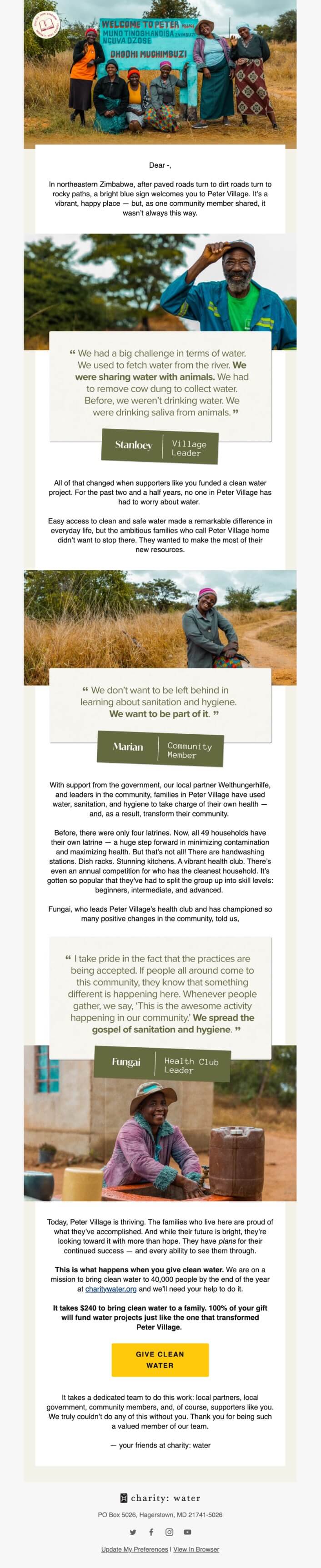
Read our collection of nonprofit email examples for more inspiration beyond the subject line.
FAQ
What makes a good fundraising email subject line?
A good subject line gives supporters a clear, honest reason to open. It should be specific, donor-centered, and consistent with the email that follows, with the cause or outcome near the beginning. Connect the message to a real action or result rather than exaggerating urgency.
How long should a fundraising subject line be?
The post does not give a specific ideal length. It does say to put the most important detail near the beginning, so shorter, more focused lines are usually easier to scan. Keep the promise aligned with the email body and donation page.
Should fundraising subject lines include the donor's name?
The post does not recommend name use specifically. It emphasizes donor-centered language, which means focusing on the reader’s role, the cause, and the outcome they can help create. Specificity matters more than personalization alone.
How do I create urgency without sounding manipulative?
Use urgency only when the deadline or need is real. State the immediate need and timeframe clearly, and avoid manufactured pressure. The subject line should match the actual situation and the email content.
What words should I avoid in a fundraising subject line?
The post does not list banned words. It does caution against exaggerating urgency and against making promises that are not supported by the email, donation page, or campaign details. Use honest, accurate language instead.
Should the preheader repeat the subject line?
The post does not directly address preheaders repeating the subject line. It does note that the preheader is one of several signals people use to decide whether to open, so it should work with the subject line rather than duplicate it. Keep the message consistent across the email.
How do I A/B-test fundraising subject lines?
The post says to write and test your own subject lines, but it does not give a detailed A/B-testing process. A practical approach is to compare different subject lines while keeping the promise aligned with the email body and donation page. Test variations based on campaign goal, such as appeal, event, Giving Tuesday, matching gift, or thank-you.
Final thoughts
Choose the campaign goal first, then select a donor-centered angle, pair it with a complementary preheader, and check that the email delivers exactly what the subject promises. Test a meaningfully different alternative and use donation or conversion results — alongside opens and clicks — to guide the next campaign.
Keep improving your nonprofit email marketing with evidence from your own audience.
 New and noteworthy on our blog