


Key takeaways
- Running a church involves more than Sunday sermons, including welcoming visitors, coordinating volunteers, and organizing events.
- Email is crucial for church communication, but most platforms are not tailored for ministries.
- The guide lists 17 best email marketing platforms for churches in 2026 with pricing, pros, and cons.
- Key factors to consider in a church email platform include ease of use for volunteers, automation, segmentation, nonprofit-friendly pricing, and integration with church management software.
Running a church means far more than Sunday sermons. You’re welcoming first-time visitors, coordinating volunteers, organizing events, and keeping hundreds (sometimes thousands) of people connected to your community. Email is still the most reliable way to do all of it.
The problem? Most email platforms were built for online stores and sales teams, not ministries. This guide breaks down the 17 best email marketing platforms for churches in 2026, with honest pricing, real pros and cons, and clear recommendations for every budget and congregation size.
TL;DR: Best email marketing platforms for churches at a glance
| Platform | Best for | Key advantage | Free plan | Starting price, billed monthly |
| Selzy | Most churches — simple, affordable, powerful | Easiest to use; unlimited sends start at $7.5/month | ✅ 100 contacts, 1,000 emails/month | $7.5/month |
| Mailchimp | Familiarity & large template library | Largest template library; most widely recognized name | ✅ 250 contacts, 500 emails/month (no automation) | $13/month |
| Constant Contact | Event management & RSVP tracking | Built-in RSVP and event management; real phone support | ❌ 60-day trial | $12/month |
| Brevo | Email + SMS on a budget | Email + SMS from one platform; pricing by volume, not list size | ✅ 300 emails/day | $9/month |
| AWeber | No-fuss reliability for small churches | Rock-solid deliverability and phone support since 1998 | ✅ Up to 500 subscribers, 3,000 emails/month | $15/month |
| ActiveCampaign | Large churches with complex automation needs | Most powerful automation engine on this list; 500+ pre-built recipes | ❌ 14-day trial | $15/month |
| MailerLite | Design quality + strong nonprofit discount | 30% nonprofit discount; best design-to-price ratio | ✅ Up to 500 subscribers, 12,000 emails/month | $10/month |
| GetResponse | Online ministry & virtual events | Webinar hosting included alongside email marketing | ✅ 500 contacts, 2,500 emails/month | $19/month |
| Klaviyo | Data-driven communication teams | Industry-leading behavioral segmentation and analytics | ✅ Up to 250 contacts | $20/month |
| HubSpot | All-in-one CRM + email for large churches | Full CRM integration; up to 40% nonprofit discount | ✅ Limited | $15/month/seat |
| Benchmark Email | Simplicity + solid A/B testing | A/B testing available on the free plan | ✅ Up to 500 contacts, 2,500 emails/month | $19/month |
| Moosend | Tight budgets with full automation | Full behavior-based automation at the lowest paid price point | ❌ 30-day trial | $9/month |
| Omnisend | Multi-channel outreach (email + SMS + push) | Email, SMS, and web push in one workflow; SMS credits included | ✅ Up to 250 contacts | $16/month |
| Zoho Campaigns | Churches already in the Zoho ecosystem | Most generous free contact limit (2,000); lowest paid price ($3/mo) | ✅ Up to 2,000 contacts | $3/month |
| SendGrid | Tech-savvy churches & developers | Best-in-class deliverability and API access for high-volume sending | ✅ 100 emails/day | $19.95/month |
| Kit | Churches with devotional/content focus | Tag-based system prevents duplicate billing; great for content series | ✅ Up to 10,000 subscribers | $39/month |
| Drip | Data-driven churches with dedicated staff | Real-time dynamic segments and sophisticated multi-step campaign logic | ❌ 14-day trial | $39/month |
What to look for in a church email marketing platform
- Ease of use for volunteers. Church communications are often managed by rotating volunteers; but a platform only the pastor can operate is a bottleneck. Prioritize drag-and-drop builders that any team member can learn in an afternoon.
- Automation. The visitor welcome sequence is the single highest-impact automation a church can run. Make sure the platform supports it.
- Segmentation. A youth group parent, a worship team volunteer, and a first-time visitor all need different messages. Look for platforms that let you tag and group contacts by ministry, role, or engagement level.
- Nonprofit-friendly pricing. Many platforms offer discounts for registered churches and nonprofits. Always ask before signing up — you typically just need to provide proof of status.
- Integration with church management software. If your church uses Planning Center, Breeze, or a similar ChMS, check whether the email platform connects with it directly or via Zapier.
17 best email marketing platforms for churches
1. Selzy — Best overall for churches
G2 ⭐ 4.7/5
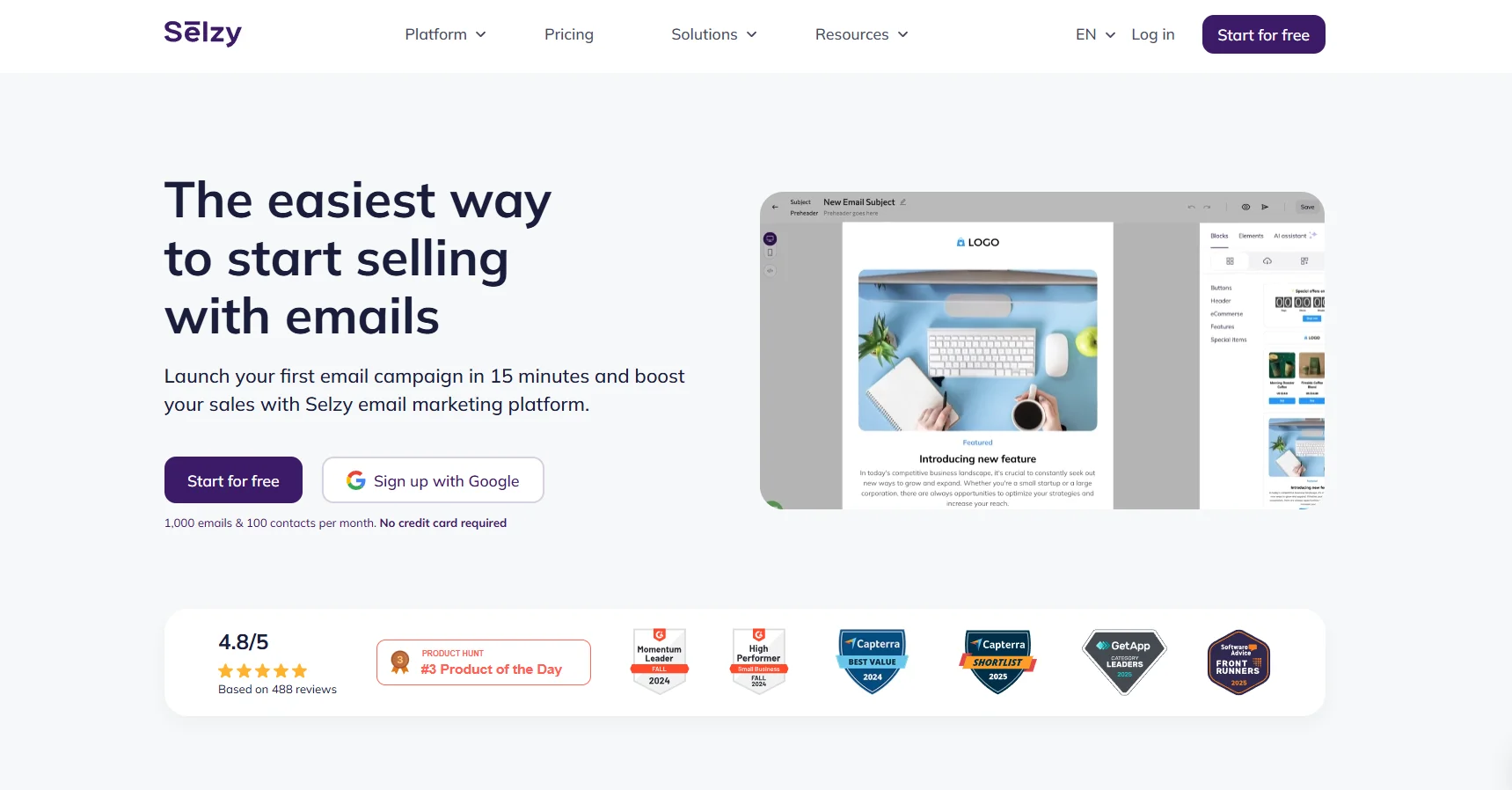
Free plan: Up to 100 contacts, 1,000 emails/month. New users can also access a 14-day trial with up to 2,000 contacts and 10,000 emails.
Paid from: $7.5/month
Best for: Churches of all sizes
Selzy earns the top spot because it gives churches exactly what they need without the bloat built for e-commerce businesses.
The drag-and-drop editor with AI capabilities is intuitive enough for any volunteer, with 1,000+ professionally designed templates suited for weekly newsletters, event invites, Easter and Christmas campaigns, and year-end giving appeals.
Automation workflows let you set up a visitor welcome sequence in minutes, and once running, it works without any manual effort week after week.
Deliverability is strong, support is available 24/7, and pricing stays affordable as your church grows.
Key features:
- AI-powered drag-and-drop editor with 1,000+ templates
- Automation workflows for welcome sequences and event follow-ups
- Contact segmentation by ministry group, role, or engagement
- A/B testing for subject lines and content
- Real-time analytics and deliverability reporting
- 24/7 customer support
- Omnichannel automation via email and Telegram chatbots
Pros:
- Exceptionally easy to use
- Affordable pricing with unlimited sends on paid plans from $7.5/month
- Strong deliverability
- 24/7 support even on the free plan
Cons:
- Smaller brand recognition than Mailchimp
- Lack of native ChMS integrations (Zapier bridges the gap)
Selzy pricing:
Selzy offers two pricing models: by contact list size or by prepaid email volume.
| Plan | Price | Key features |
| Free | $0/month | Up to 100 contacts, 1,000 emails/month, bulk emails, AI-powered email builder, personalization, analytics, 24/7 support.
New users can also access a 14-day trial with up to 2,000 contacts and 10,000 emails |
| Lite | $7.5/month | For 500 contacts, unlimited emails, Free plan’s features + A/B testing, segmentation |
| Standard | $15/month | For 500 contacts, unlimited emails, Lite plan’s features + email deliverability tips, anti-spam tips and subject line assistant, chatbots |
| Enterprise | Custom | For 500k+ contacts: dedicated manager, performance boost and more |
Why Selzy is the best church email platform:
It combines ease of use, affordability, and genuine functionality in a way that fits how churches actually operate — with lean teams, rotating volunteers, and a deep need for consistent, personal communication.

2. Mailchimp — Best for familiarity and getting started
G2 ⭐ 4.3/5
Free plan: 250 contacts, 500 emails/month (no automation)
Paid from: $13/month
Best for: Smaller churches that want a well-known platform
Mailchimp is the name most churches recognize first, and it was long a reasonable starting point for small congregations.
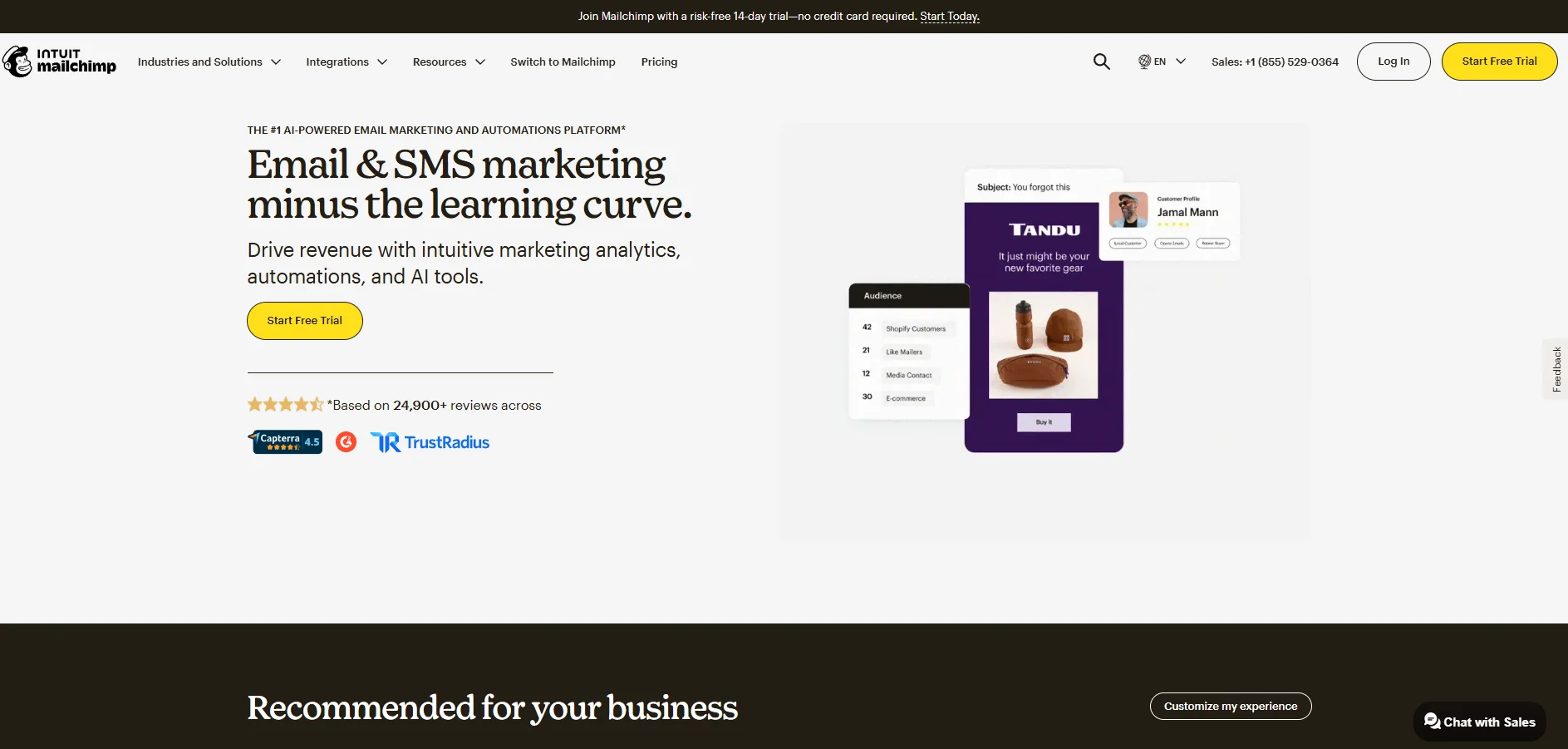
As of early 2026, however, Mailchimp cut its free plan significantly — down to just 250 contacts and 500 emails per month — and removed email automation from the free tier entirely. That makes the free plan hard to use for most churches.
The template library remains extensive, the drag-and-drop editor is easy to learn, and a 15% nonprofit discount is available on paid plans, but the days of Mailchimp being a generous free option are over.
Pros:
- Familiar interface with abundant tutorials
- Strong template library
- Canva integration for event graphics
- 15% nonprofit discount on paid plans.
Cons:
- Free plan now nearly unusable — 250 contacts, 500 emails/month, no automation
- Pricing escalates sharply with list growth
- Interface cluttered with e-commerce features irrelevant to churches.
Mailchimp pricing:
| Plan | Price | Key features |
| Free | $0/month (250 contacts) | For 500 emails/month, no automation, Mailchimp branding |
| Essentials | From $13/month | A/B testing, basic automations |
| Standard | From $20/month | Advanced automation, segmentation |
| Premium | From $350/month | Advanced segmentation, priority support |
3. Constant Contact — Best for event management
G2 ⭐ 4.1/5
Free Trial: 60 days
Paid from: $12/month
Best for: Churches that run a busy event calendar
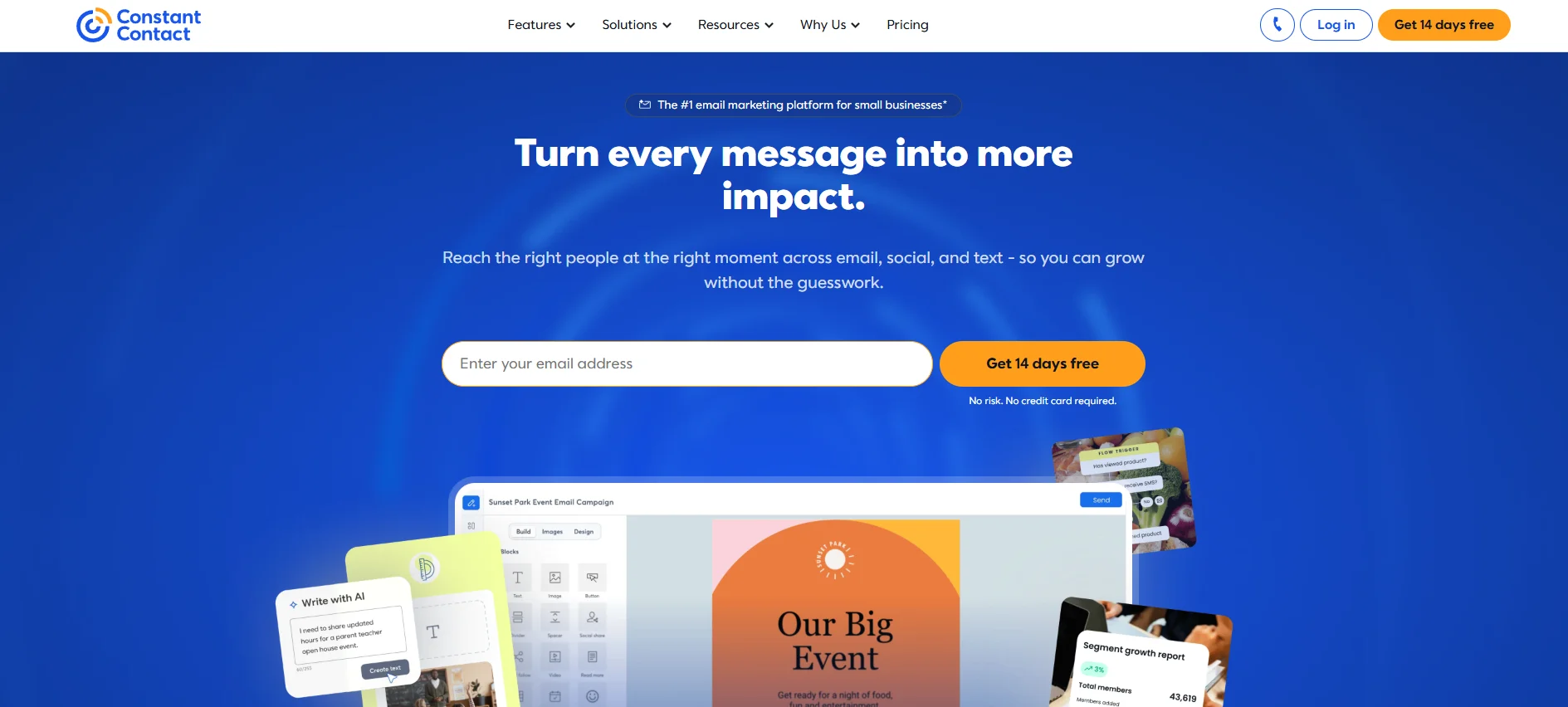
Constant Contact’s standout feature for churches is its built-in event management: you can send invitations, collect RSVPs, and manage attendance all from the same platform where you send your weekly newsletter.
It’s also one of the most volunteer-friendly tools available, backed by real phone support — when a new volunteer coordinator needs help, they can call and talk to a person. Automation is basic, but for churches that prioritize events and simplicity over complex workflows, it’s a reliable choice.
Pros:
- Built-in RSVP and event management
- Phone, chat, and email support
- 20-30% nonprofit discount
- Very easy to learn.
Cons:
- Basic automation — no behavior-based triggers
- Templates feel dated
- No free plan (60-day trial only).
Constant Contact pricing:
| Plan | Price | Key Features |
| Lite | From $12/month (500 contacts) | Email editor, welcome emails, templates |
| Standard | From $35/month (500 contacts) | A/B testing, pre-built automations, segmentation |
| Premium | From $80/month (500 contacts) | Advanced automation, dynamic content |
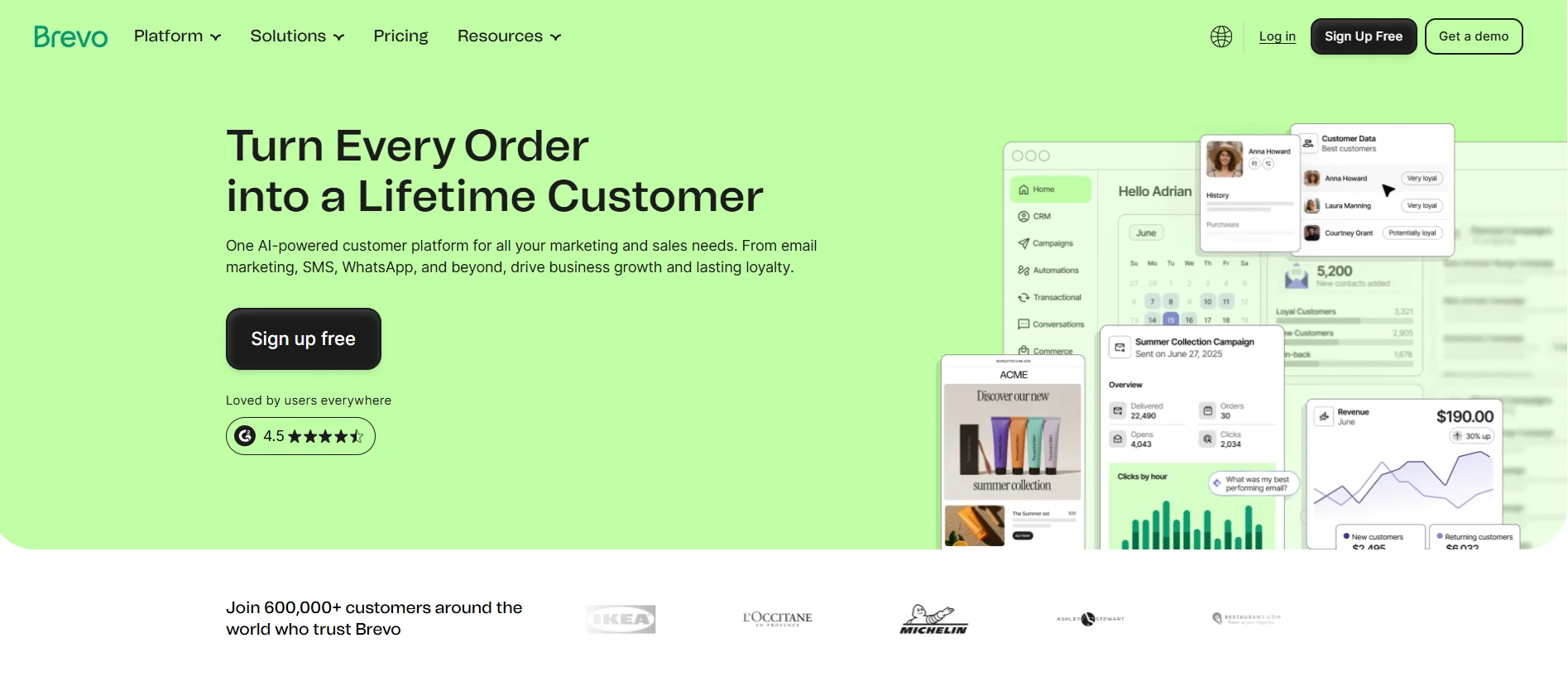
4. Brevo — Best for email and SMS on a budget
G2 ⭐ 4.3/5
Free plan: 300 emails/day, unlimited contacts
Paid from: $9/month
Best for: Churches wanting email and SMS from one platform
Brevo’s free tier covers roughly 9,000 emails per month — enough for many mid-sized churches at zero cost. When you upgrade, pricing is based on email volume rather than contact count, so you’re never penalized for keeping years of visitor records. The addition of SMS is a genuine differentiator: same-day service cancellations, urgent prayer chain alerts, or last-minute volunteer requests reach people far faster via text than email, and Brevo handles both from one dashboard.
Pros:
- Email and SMS in one platform (SMS is paid separately)
- Pricing based on volume not list size
- Generous free plan
- Works well for multilingual congregations.
Cons:
- Automation builder less intuitive than MailerLite or Selzy
- SMS pricing varies by country
- Brevo branding on free tier.
Brevo pricing:
| Plan | Price | Key features |
| Free | $0/month | For 300/day, unlimited contacts, basic CRM, Brevo branding |
| Starter | From $9/month | 5,000+ emails/month, no daily limit, basic reporting, automation |
| Professional | From $18/month | 5,000+ emails/month, advanced automation, A/B testing, landing pages |
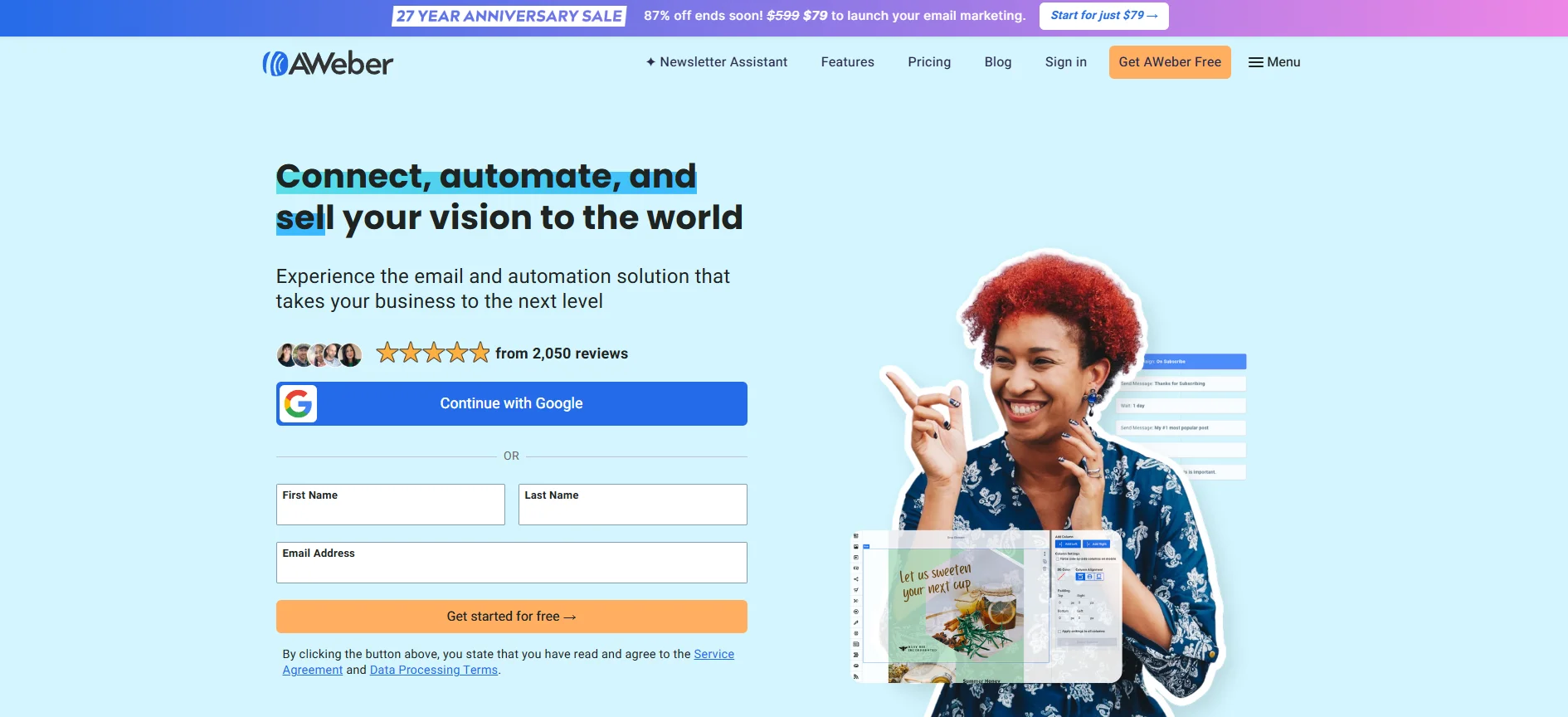
5. AWeber — Best for simplicity and reliability
G2 ⭐ 4.2/5
Free plan: Up to 500 subscribers
Paid from: $15/month
Best for: Small churches that want a dependable, no-fuss platform
AWeber has been around since 1998. It lacks modern polish, but delivers rock-solid reliability, excellent deliverability, and accessible phone support. For a church that just needs to send a consistent weekly newsletter and a simple welcome sequence without any complexity, AWeber does the job — and the free plan covers up to 500 subscribers with autoresponders included.
Pros:
- Excellent deliverability
- Phone support available
- Good free plan
- Simple interface any volunteer can manage.
Cons:
- Interface and templates feel dated
- Limited advanced automation
- Less innovation than newer platforms.
AWeber pricing:
| Plan | Price | Key features |
| Free | $0/month (500 subscribers) | Up to 500 subscribers, 3,000 emails/month, with AWeber branding included. Includes basic automation and autoresponders, with more advanced automation features available on paid plans. |
| Lite | $15/month | 1 list, basic reporting |
| Plus | $30/month | Unlimited lists and automations, remove AWeber branding |
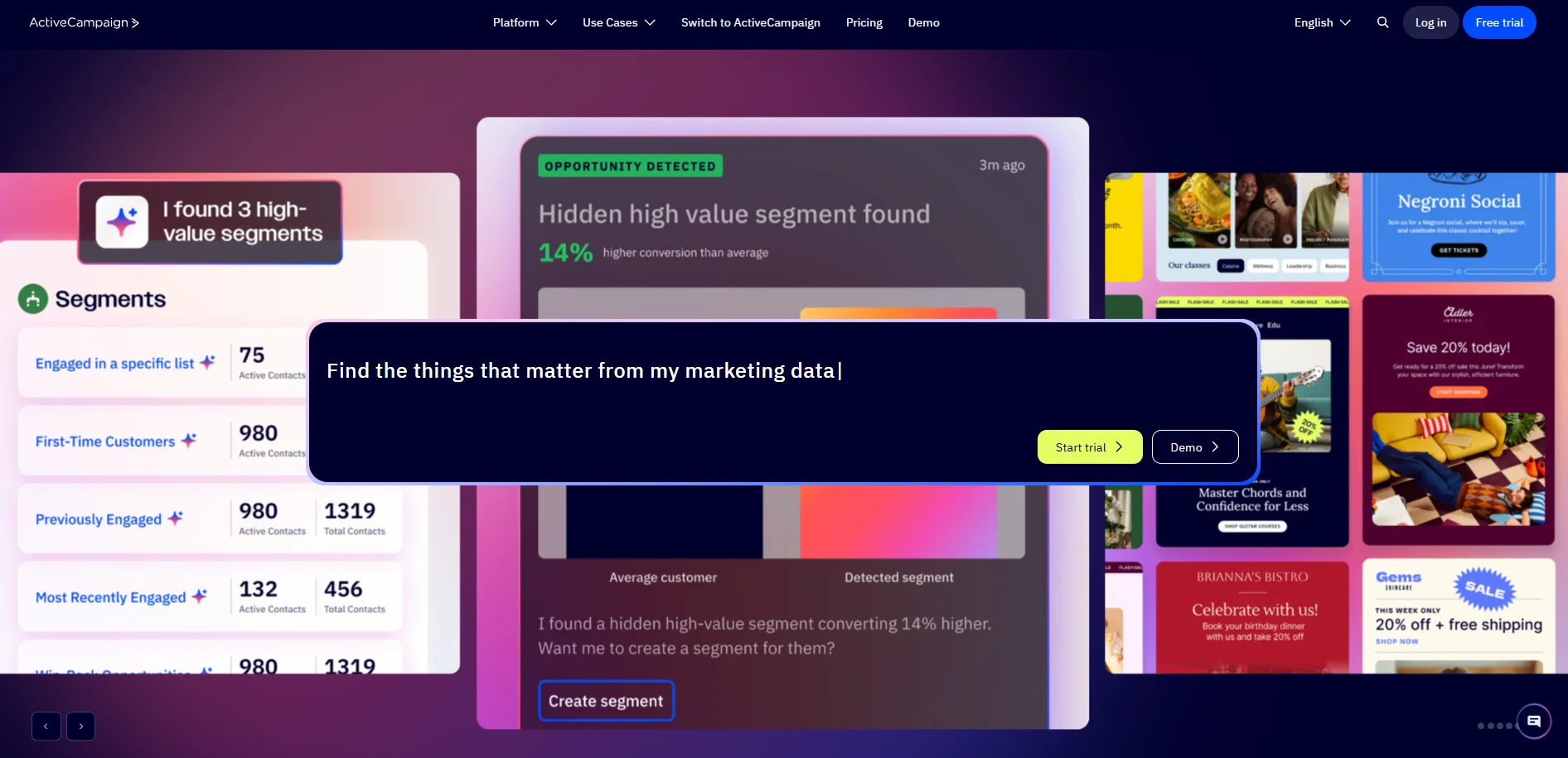
6. ActiveCampaign — Best for large churches with advanced needs
G2 ⭐ 4.5/5
Free trial: 14 days
Paid from: $15/month
Best for: Large churches (1,000+ members) with dedicated communications staff
ActiveCampaign offers the most powerful automation on this list. For large churches managing multiple ministries, tracking member engagement, and running complex follow-up pathways, its visual workflow builder with conditional logic and 500+ pre-built automation recipes are hard to match.
Note that while a basic marketing CRM is included in all plans, the full sales pipeline CRM (“Enhanced Pipelines”) is a paid add-on at $68/month.
The honest caveat: the steep learning curve makes it unsuitable for volunteer-managed communications. This is a platform for churches that treat communications as a serious, staffed discipline.
Key features:
- Visual automation builder with conditional logic and branching workflows
- A library of pre-built automation recipes for welcome series and event follow-ups
- Basic marketing CRM included
- Deep segmentation combining email behavior, event data, and custom fields
- Lead and engagement scoring to identify at-risk or highly engaged members
- WhatsApp marketing integration
- A/B testing and split automations
Pros:
- Most powerful automation engine on this list
- 500+ pre-built recipes
- Excellent for multi-ministry churches
- Great deliverability
- WhatsApp integration.
Cons:
- Steep learning curve
- Full CRM requires a paid add-on
- Overkill and expensive for smaller churches
- Complex interface.
ActiveCampaign pricing:
ActiveCampaign offers a 14-day free trial without requiring a credit card.
| Plan | Price | Key features |
| Starter | $15/month (1,000 contacts) | Email, basic automation, basic marketing CRM, A/B testing |
| Plus | $49/month (1,000 contacts) | Advanced automation, landing pages, AI tools, SMS add-on available |
| Pro | $79/month (1,000 contacts) | Unlimited automation triggers, predictive sending, advanced segmentation |
| Enterprise | $145/month (1,000 contacts) | Premium segmentation, custom reporting, dedicated support |
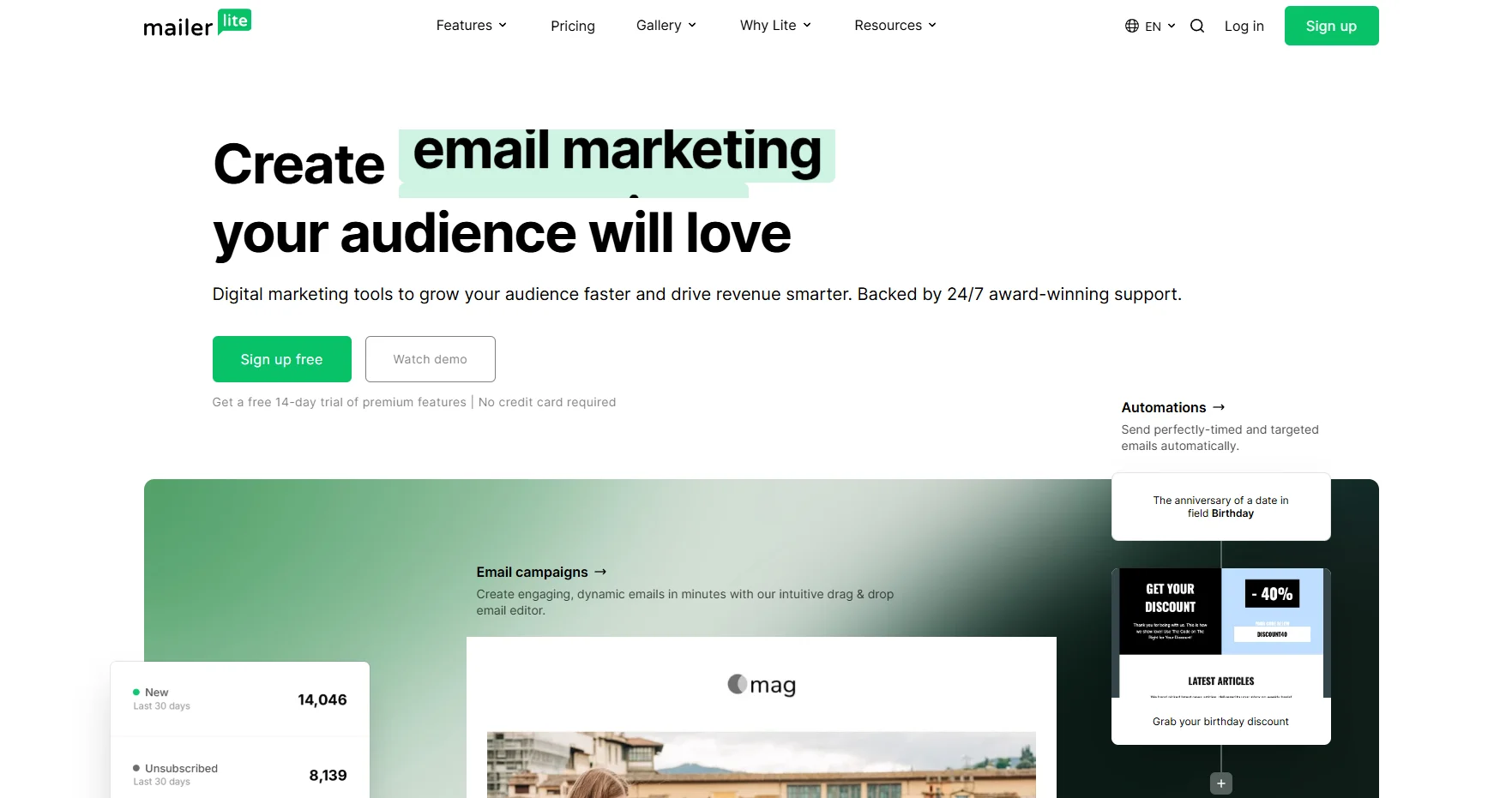
7. MailerLite — Best for design quality and nonprofit discount
G2 ⭐ 4.6/5
Free plan: Up to 500 subscribers, 12,000 emails/month
Paid from: $10/month
Best for: Churches wanting polished emails and strong value
MailerLite consistently earns high marks from churches and nonprofits for making professional-looking email genuinely easy.
The interface is clean enough that a volunteer with no design experience can build an attractive newsletter in 15 minutes.
Note that MailerLite reduced its free plan from 1,000 to 500 subscribers, but the 12,000 monthly email limit stayed the same — it remains one of the more generous free tiers available. The 30% nonprofit discount on paid plans makes it one of the best value choices on this list.
Pros:
- Exceptionally clean interface
- 30% nonprofit discount
- Generous free plan
- Good balance of design and automation.
Cons:
- Account approval can take 3-7 days
- Advanced features require the Advanced plan
- No native SMS.
MailerLite pricing:
| Plan | Price | Key features |
| Free | $0/month (500 subscribers) | Editor, automation, landing pages, 12,000 emails/month, website builder |
| Growing Business | From $10/month | Unlimited emails, extra templates, dynamic content |
| Advanced | From $21/month | Multi-trigger automations, AI writing, pop-ups |
8. GetResponse — Best for online ministry
G2 ⭐ 4.3/5
Free plan: 500 contacts, 2,500 emails/month
Paid from: $19/month
Best for: Churches hosting virtual Bible studies, prayer meetings, or live-streamed events
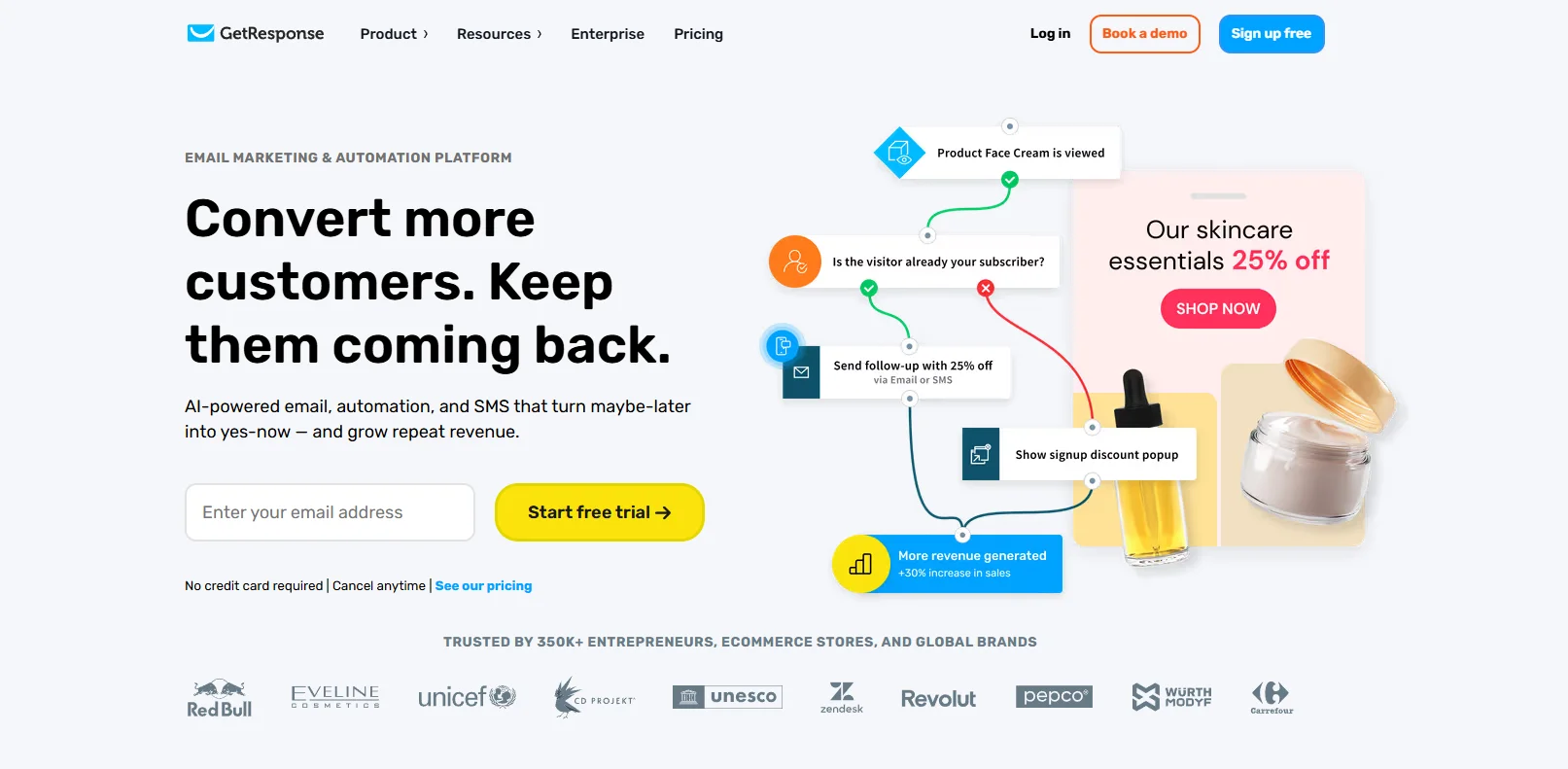
GetResponse bundles email marketing with webinar hosting in one platform — and now also offers a free forever plan for up to 500 contacts (with a 30-day premium trial on top of that). If your church runs virtual events, having your webinar tools integrated with your email list means automatic follow-up with every attendee — no manual exports or separate tools required.
Landing pages and automation workflows cover standard church communication needs alongside the online ministry features. GetResponse also offers a 50% nonprofit discount on all paid plans, making it one of the most generous nonprofit programs on this list.
Pros:
- Webinar hosting included
- Free forever plan available
- 50% nonprofit discount
- Good automation tools
- All-in-one value for digital-first churches
- AI email generator.
Cons:
- Interface can feel cluttered
- SMS only on Enterprise plan
- More expensive than simpler alternatives for mid-tier plans.
GetResponse pricing:
| Plan | Price | Key features |
| Free | $0/month (500 contacts) | 2,500 emails/month, drag-and-drop editor, website builder, 1 landing page |
| Starter | $19/month (1,000 contacts) | Unlimited emails, autoresponders, automation, landing pages, A/B testing |
| Marketer | $59/month (1,000 contacts) | Advanced automation, segmentation, webinars, push notifications |
| Creator | $69/month (1,000 contacts) | Online courses, up to 500 students, paid newsletters |
9. Klaviyo — Best for data-driven communication teams
⭐ 4.2/5
Free plan: Up to 250 contacts, 500 emails/month
Paid from: $20/month
Best for: Large, tech-forward churches with professional communications staff
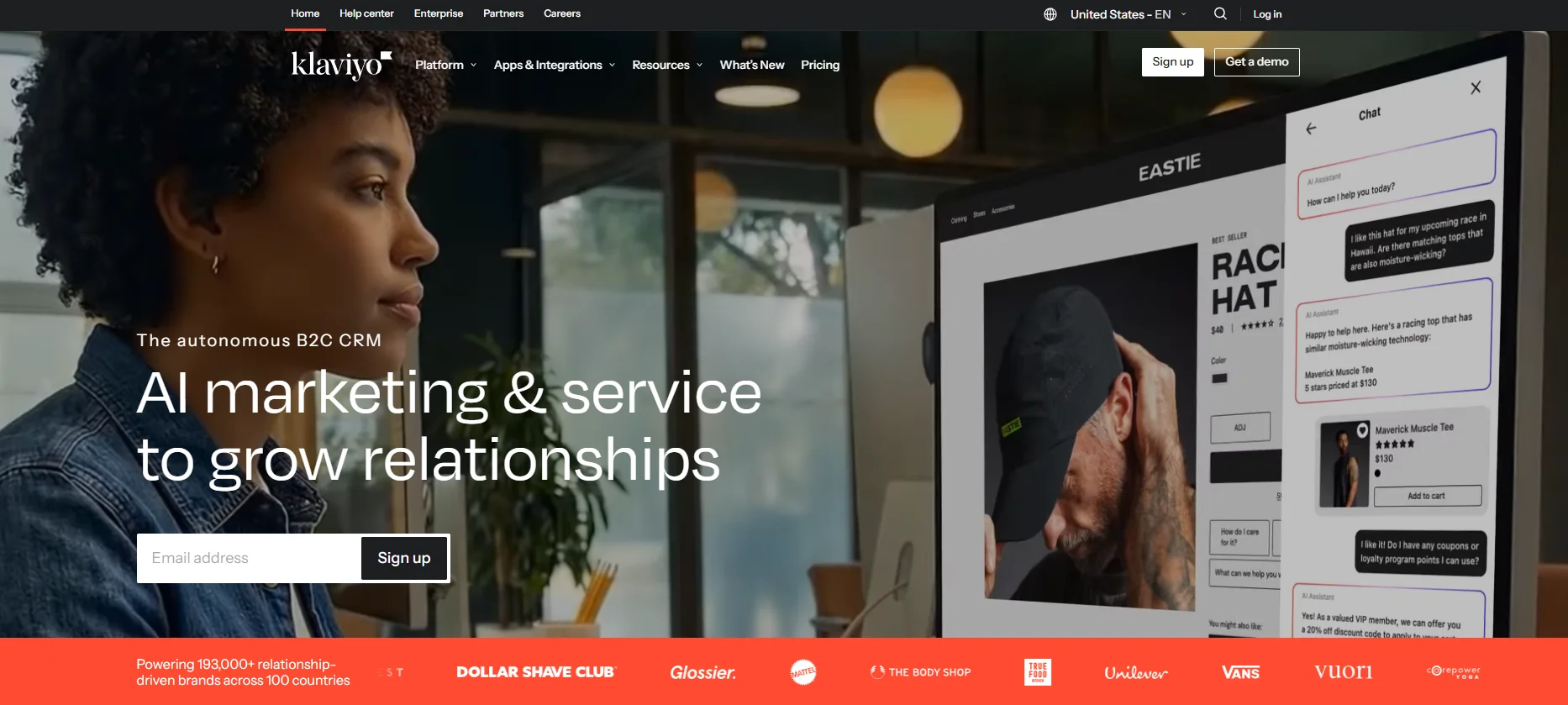
Klaviyo is primarily known as the leading e-commerce email platform, and most of its standout features — purchase tracking, cart abandonment, product recommendations — are irrelevant to churches.
That said, large congregations with dedicated communications staff may find value in its deep behavioral segmentation and advanced analytics.
For most churches, the cost and complexity don’t justify choosing it when tools like Selzy or ActiveCampaign offer comparable functionality at a fraction of the price.
Pros:
- Industry-leading segmentation
- Powerful automation with complex conditional logic
- Strong deliverability.
Cons:
- Expensive — very limited free plan
- E-commerce focus means many features are irrelevant
- Steep learning curve
- Slow support.
Klaviyo pricing:
| Plan | Price | Key Features |
| Free | $0/month | Up to 250 contacts, 500 emails/month, basic features |
| From $20/month | From 500 contacts, unlimited emails, full automation, segmentation | |
| Email + SMS | From $60/month | 1,001–1,500 contacts, adds SMS marketing capability |
10. HubSpot — Best for large churches wanting CRM + email in one place
G2 ⭐ 4.4/5
Free plan: Yes (limited)
Paid from: $15/month/seat
Best for: Large multi-campus churches with professional staff
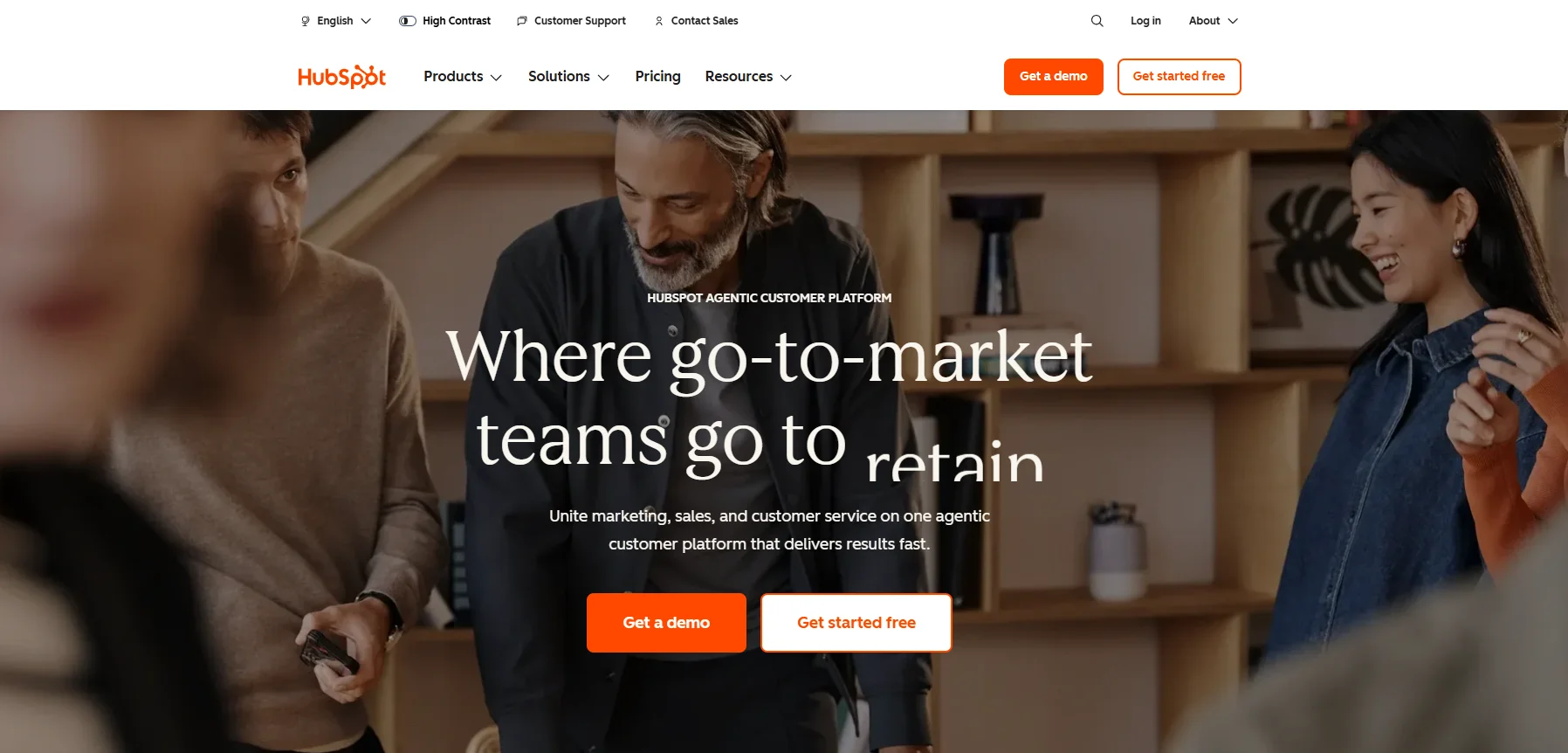
HubSpot’s value for churches lies in its CRM integration — every interaction a member has with your church (emails opened, events attended, forms submitted) lives in a single contact record. Up to 40% nonprofit discounts help justify the cost for large organizations.
The honest caveat: HubSpot was built for B2B sales teams and the complexity reflects that. For most churches, especially those managed by volunteers, it’s significant overkill.
Pros:
- Powerful CRM + email integration
- Up to 40% nonprofit discount
- Comprehensive analytics.
Cons:
- Complex and overwhelming for most church teams
- Expensive even with discount
- Overkill for churches under 1,000 members.
HubSpot pricing:
Costs increase significantly as the number of marketing contacts grows, making HubSpot more suitable for larger organizations.
| Plan | Price | Key features |
| Free | $0/month | 2,000 emails/month, basic CRM, forms, and landing pages, with a limit of 2,000 email sends per month |
| Starter | $15/month/seat | Email marketing, forms, automation |
| Professional | $800/month | Social media, omnichannel automation, lead scoring |
11. Benchmark Email — Best for simplicity and a/B testing
G2 ⭐ 4.3/5
Free plan: Up to 500 contacts, 2,500 emails/month
Paid from: $19/month
Best for: Churches that want a clean, simple experience with good testing tools
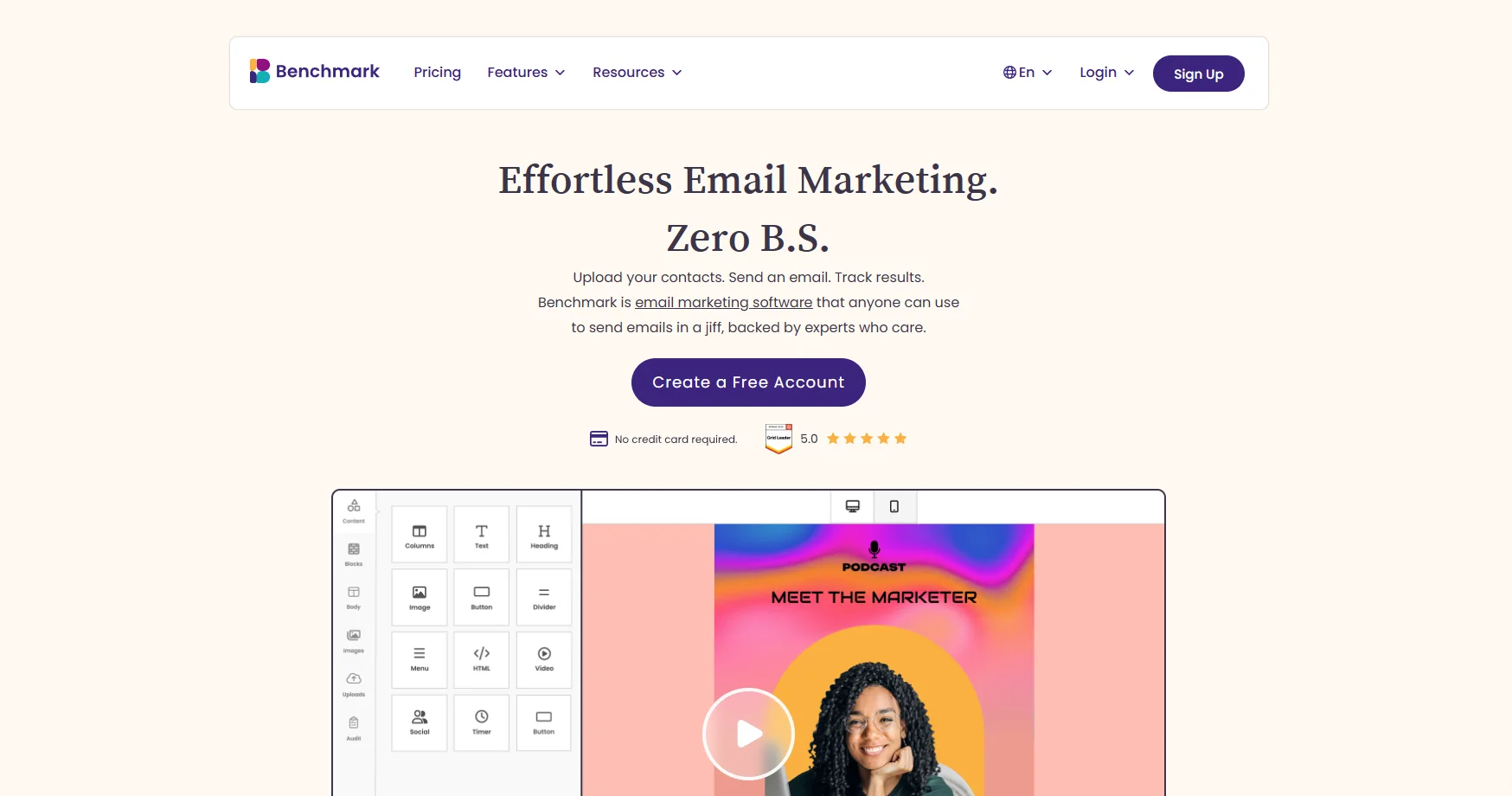
Benchmark Email offers a straightforward email experience with better-than-expected A/B testing tools at an accessible price.
The interface is uncluttered and volunteer-friendly. For churches that want to start experimenting with what subject lines or content work best — without moving to a more complex platform — Benchmark is a practical and underrated choice.
Pros:
- Clean, simple interface
- Solid deliverability
- Easy for volunteers
- A/B testing is available on paid plans
Cons:
- Fewer advanced automation features
- Smaller template library; less widely known.
Benchmark Email pricing:
| Plan | Price | Key features |
| Free | $0/month (500 contacts, 2,500 emails/month) | Editor, basic automation |
| Pro | From $19/month | Unlimited emails, advanced reporting |
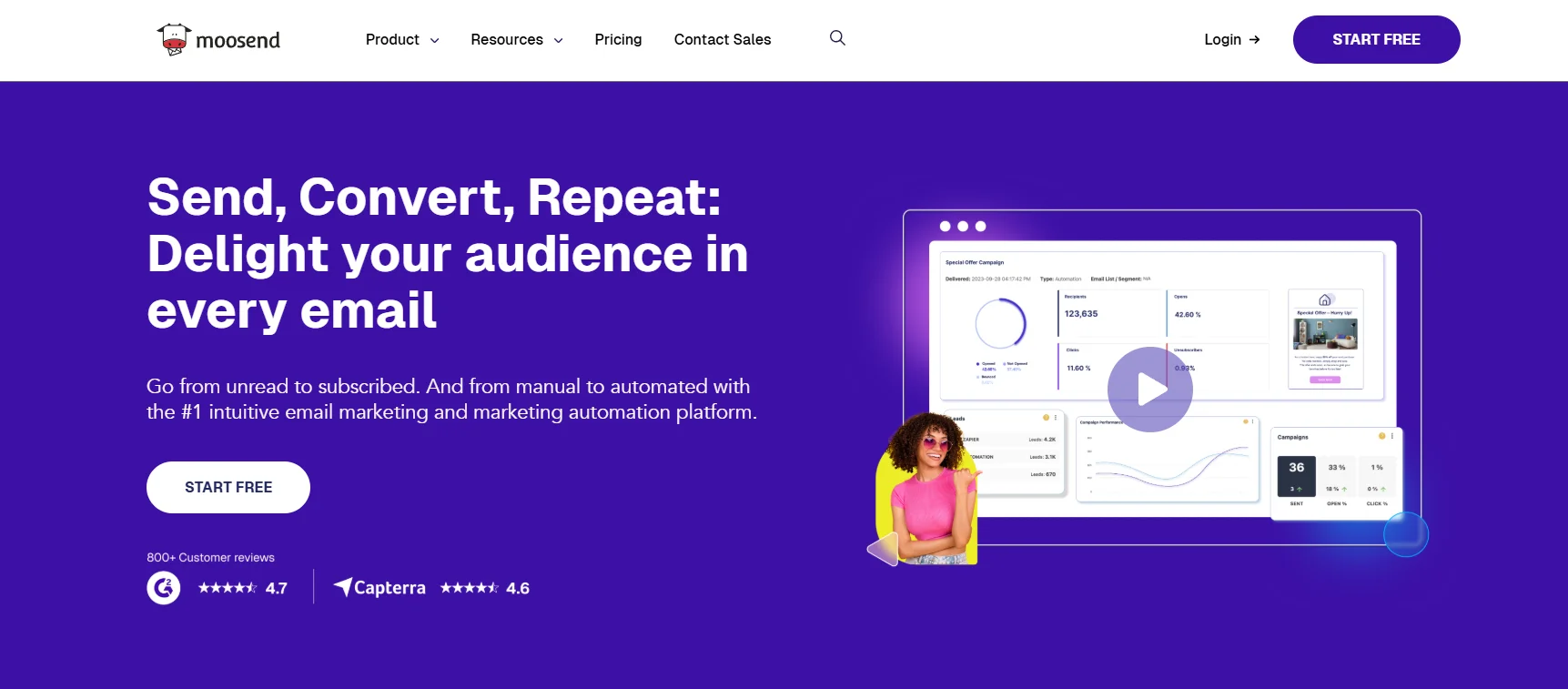
12. Moosend — Best for tight budgets with full automation
G2 ⭐ 4.7/5
Free trial: 30 days
Paid from: $9/month
Best for: Small churches that need real automation at the lowest possible price
Moosend consistently earns among the highest user ratings in this category because it delivers capabilities you’d expect from platforms twice the price.
At $9/month for unlimited email sends to 500 subscribers, with behavior-based automation triggers and landing pages included, it punches well above its weight class. Paid plans include automation workflows, landing pages, transactional email capabilities, and SMTP server access.
Pros:
- Full automation at the lowest price point on this list
- High user ratings (4.7/5)
- Behavior-based triggers
- Landing pages included.
Cons:
- No free plan (30-day trial only)
- Fewer integrations
- Smaller template library.
Moosend pricing:
Moosend offers a 30-day free trial, after which a paid plan is required to continue using the platform.
| Plan | Price | Key features |
| Lite | $9/month (500 contacts) | Unlimited emails, automation, landing pages, SMTP |
| Pro | Custom | Transactional emails, dedicated IPs, custom reports |
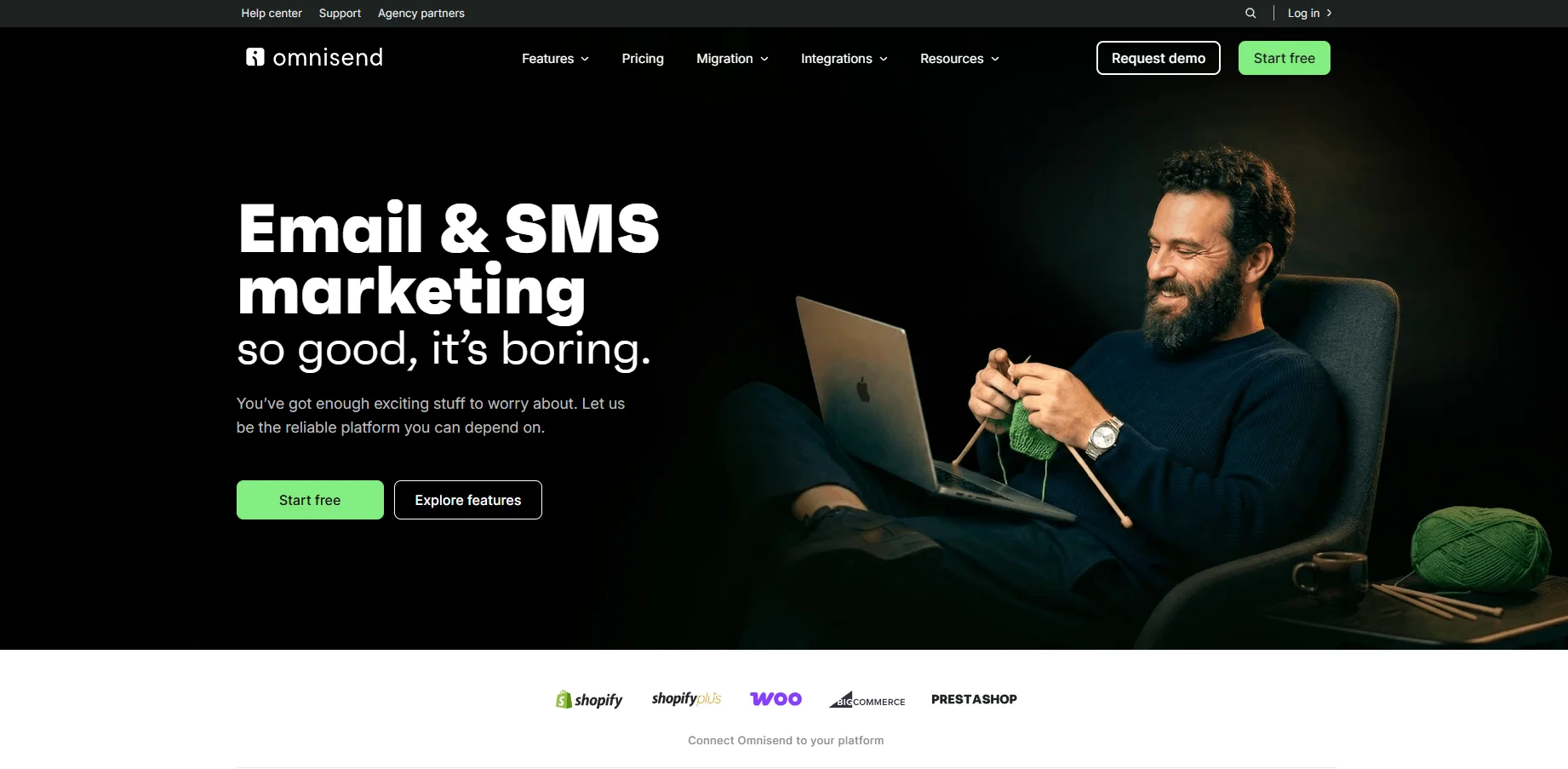
13. Omnisend — Best for multi-channel outreach
G2 ⭐ 4.6/5
Free plan: Up to 250 contacts, 500 emails/month
Paid from: $16/month
Best for: Churches wanting email, SMS, and web push notifications from one platform
Omnisend’s multi-channel approach works well for churches communicating across more than just email. A single automation can send an email Monday, an SMS reminder Friday, and a browser push notification Saturday — all from one workflow.
Limited SMS credits are included only in the Pro plan, while on other plans SMS is charged separately based on usage.
Pros:
- True multi-channel from one platform
- Strong automation
- Limited SMS credits included in paid plans.
Cons:
- Built for e-commerce — some features are irrelevant
- Limited free plan
- More expensive than single-channel alternatives.
Omnisend pricing:
| Plan | Price | Key features |
| Free | $0/month (250 contacts) | Email, automation, web push |
| Standard | $16/month (500 contacts) | 3,000 emails/month, segmentation |
| Pro | $59/month (500 contacts) | Unlimited emails, global SMS, advanced reporting |
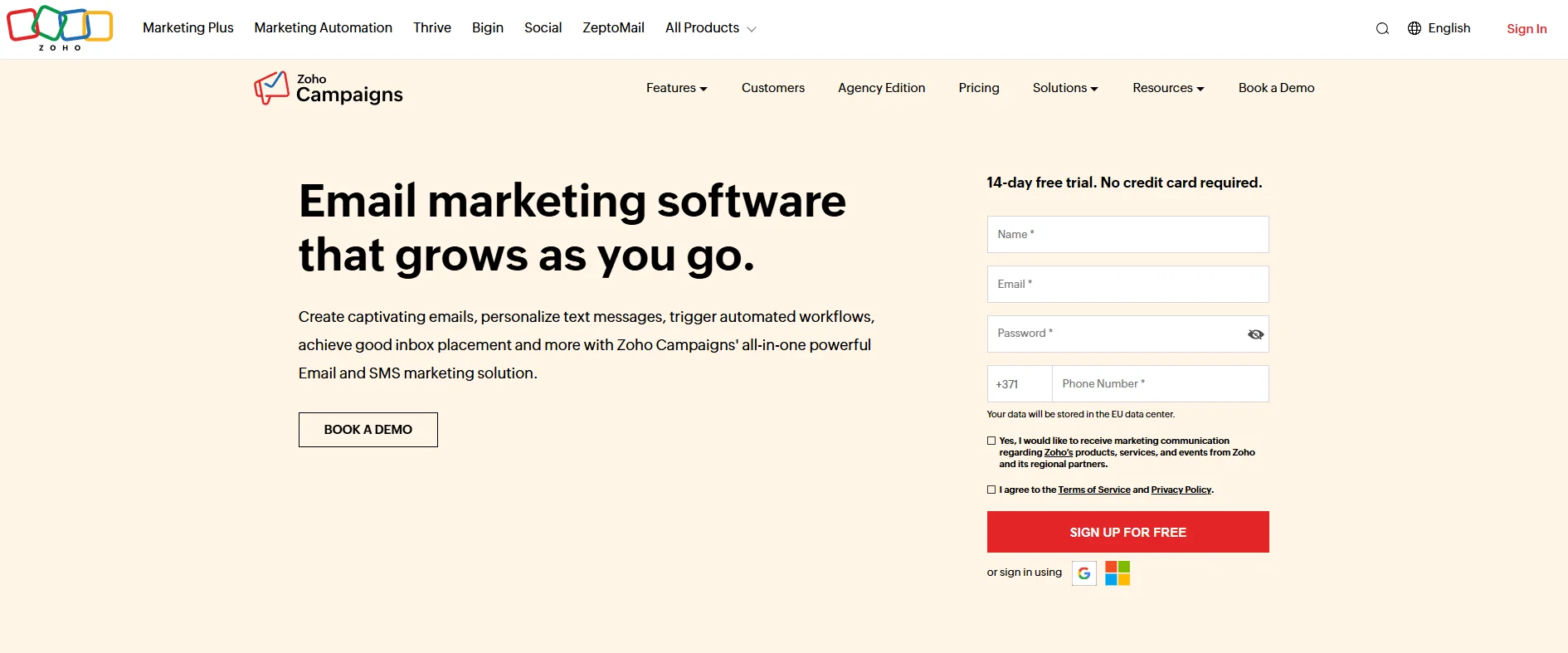
14. Zoho Campaigns — Best for multi-channel outreach
G2 ⭐ 4.3/5
Free plan: Up to 2,000 contacts, 6,000 emails/month
Paid from: $3/month
Best for: Churches already using Zoho CRM, Zoho Books, or other Zoho tools
If your church already uses Zoho products, Zoho Campaigns is the natural email choice — contact data, giving records, and event history sync automatically into your email segments.
On its own, the free plan is the most contact-generous on this list, and paid plans start at just $3/month. Outside the Zoho ecosystem, simpler tools like Selzy or MailerLite offer a better standalone experience.
Pros:
- Most generous free contact limit (2,000)
- Lowest paid starting price ($3/month)
- Excellent Zoho ecosystem integration.
Cons:
- Interface less modern than competitors
- Basic standalone automation
- Support quality varies.
Zoho Campaigns pricing:
| Plan | Price | Key features |
| Free | $0/month (2,000 contacts, 6,000 emails/month) | Editor, basic automation |
| Standard | From $3/month | Unlimited emails, A/B testing |
| Professional | From $4.50/month | Advanced automation, segmentation |
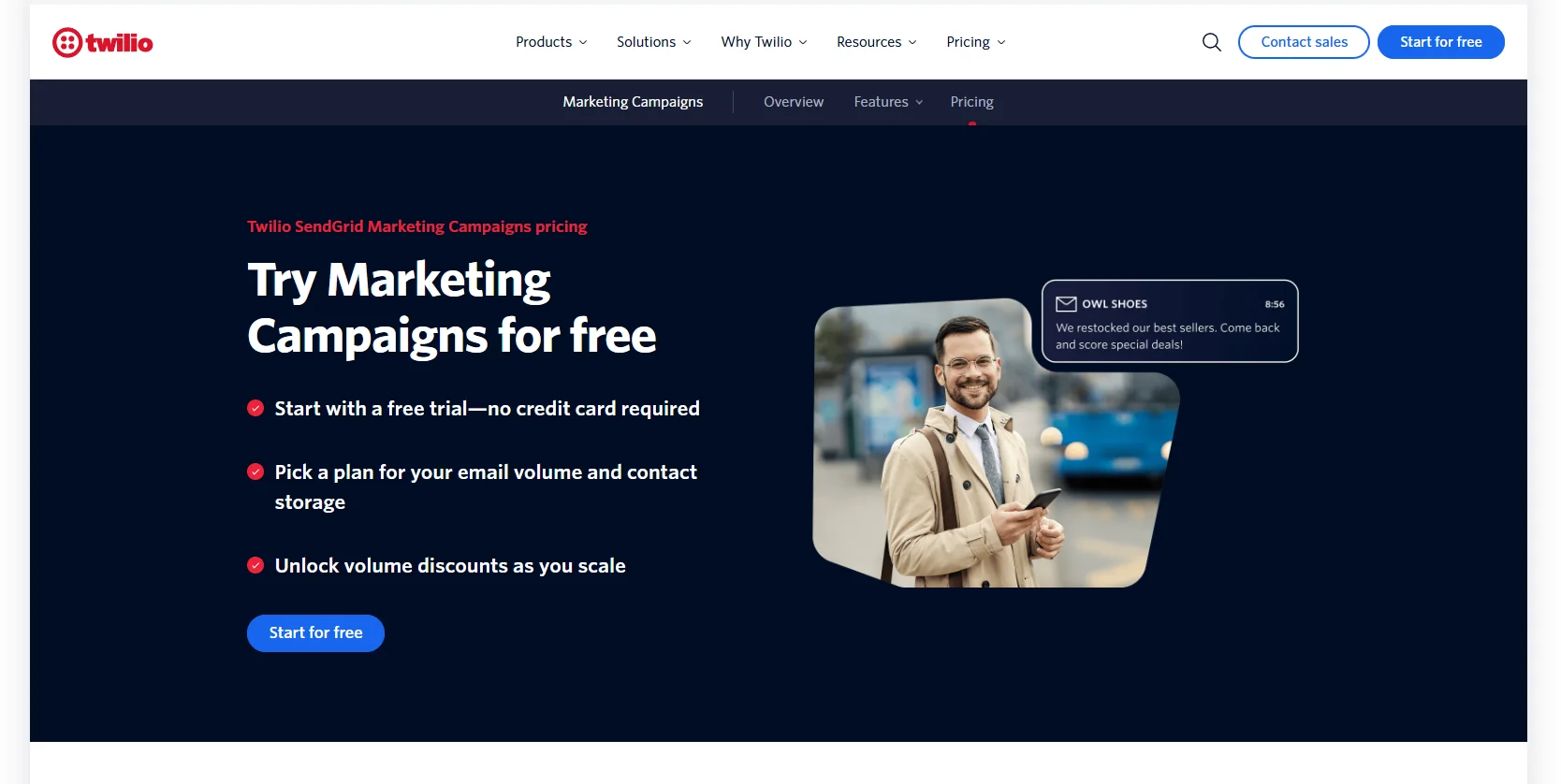
15. Twilio SendGrid — Best for tech-savvy churches and developers
G2 ⭐ 4.0/5
Free Plan: 100 emails/day
Paid from: $19.95/month
Best for: Large churches with developers on staff and high-volume or transactional email needs
Twilio SendGrid (previously just SendGrid) is not a beginner-friendly email builder — it’s primarily an email infrastructure platform (API and SMTP-based) designed for transactional and high-volume email sending, rather than a traditional email marketing tool.
For large churches managing custom communication tools, automated donation receipts, or member portal notifications at scale, Twilio SendGrid’s infrastructure is hard to beat. For everyone else, the other 16 platforms on this list are a better fit.
Pros:
- Best-in-class deliverability
- Powerful REST API
- Handles very high volumes.
Cons:
- Requires technical knowledge
- Limited visual campaign builder
- Not built for church-specific needs.
SendGrid pricing:
| Plan | Price | Key Features |
| Free | $0/month | 100 emails/day, basic analytics, SMTP relay, API access |
| Basic | From $15/month | 50,000–100,000 emails/month, analytics, deliverability tools |
| Advanced | From $60/month | Up to 2.5 million emails/month, dedicated IPs, subuser management |
16. Kit — Best for churches with a strong content focus
G2 ⭐ 4.4/5
Free Plan: Up to 10,000 subscribers
Paid from: $39/month
Best for: Churches that produce regular devotional content, podcasts, or written ministry resources
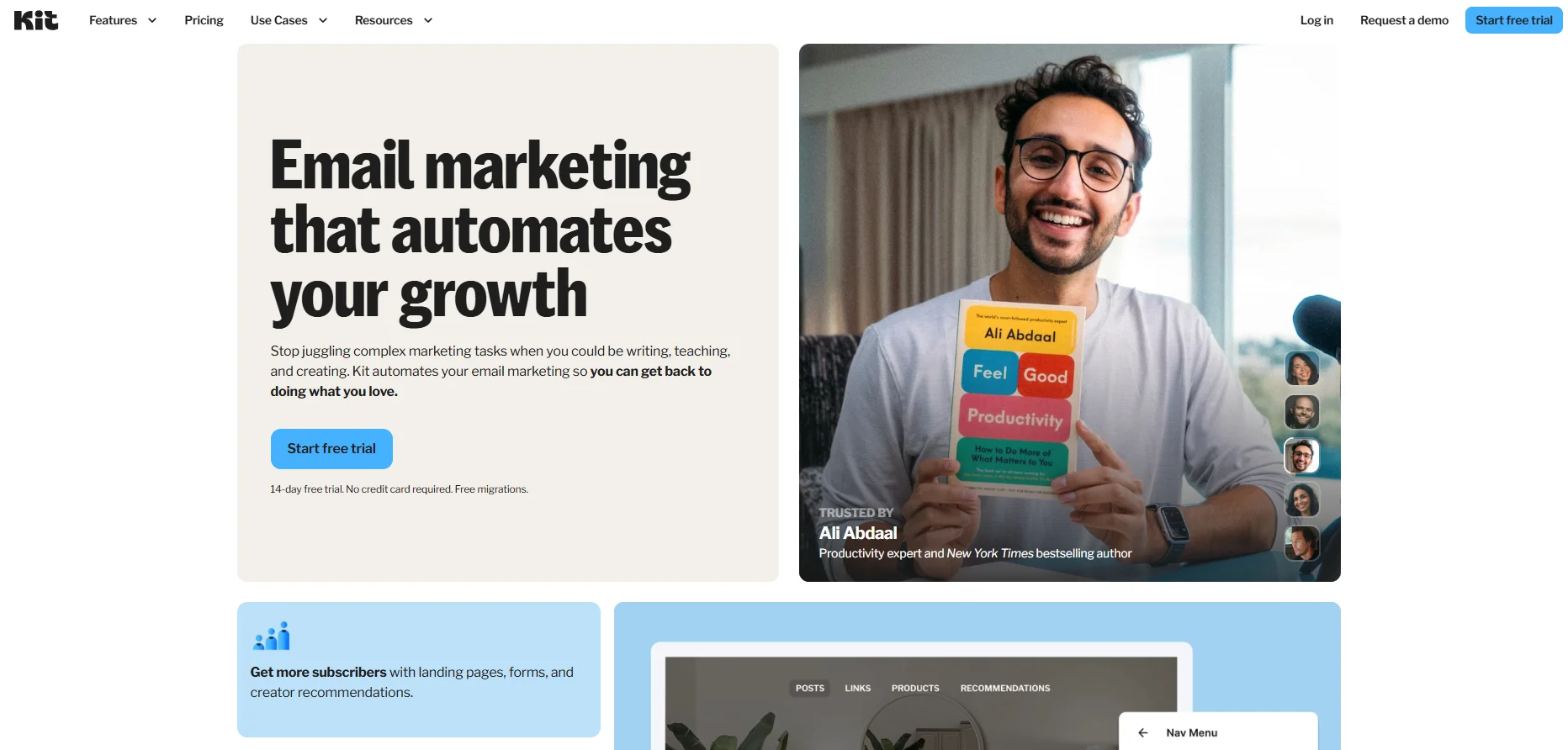
Kit was built for content creators, and that makes it a surprisingly natural fit for churches that produce consistent written or audio content beyond standard announcements.
Its free plan is one of the most generous available — up to 10,000 subscribers with unlimited broadcast emails, landing pages, and forms. If your pastor writes a weekly devotional newsletter, your church publishes a podcast, or you run a regular Bible study email series, Kit handles subscriber management and content delivery.
The tag-based subscriber system is one of Kit’s standout features for churches: rather than maintaining separate lists for different ministries, you keep one unified list and use tags to segment by ministry involvement, interest area, or engagement level. For standard church communication with event announcements and week-to-week logistics, other platforms on this list are a better fit.
Key features:
- Tag-based subscriber system — one list, no duplicate billing across segments
- Visual automation builder for subscriber journeys and content sequences
- Landing pages and signup forms included on the free plan
- Digital product sales for devotional guides, courses, or resources
- RSS-to-email for automatically delivering blog or podcast content
- Clean, distraction-free email editor optimized for written content
Pros:
- Most generous free plan on this list (10,000 subscribers with unlimited broadcast emails)
- Tag-based system prevents duplicate billing
- Great for devotional newsletters and podcast follow-up
- Intuitive visual automation on paid plans
- Sell digital products without third-party tools.
Cons:
- Minimal design customization — not ideal if visual presentation is important
- Pricing jumped significantly in September 2025 (Creator now $39/month, up from $15/month)
- Not well-suited for event-heavy or announcement-heavy church communication
- Limited analytics.
Kit pricing:
| Plan | Price | Key features |
| Newsletter (Free) | $0/month (up to 10,000 subscribers) | Unlimited emails, landing pages, forms, digital product sales, limited automation |
| Creator | $39/month (1,000 subscribers) | Unlimited automations, sequences, integrations, branding removal |
| Creator Pro | $79/month (1,000 subscribers) | Subscriber scoring, referral program, advanced reporting, priority support |
17. Drip — Best for data-driven churches running complex campaigns
G2 ⭐ 4.4/5
Free Trial: 14 days
Paid from: $39/month
Best for: Larger churches with dedicated staff who want deep behavioral segmentation and multi-channel campaign management
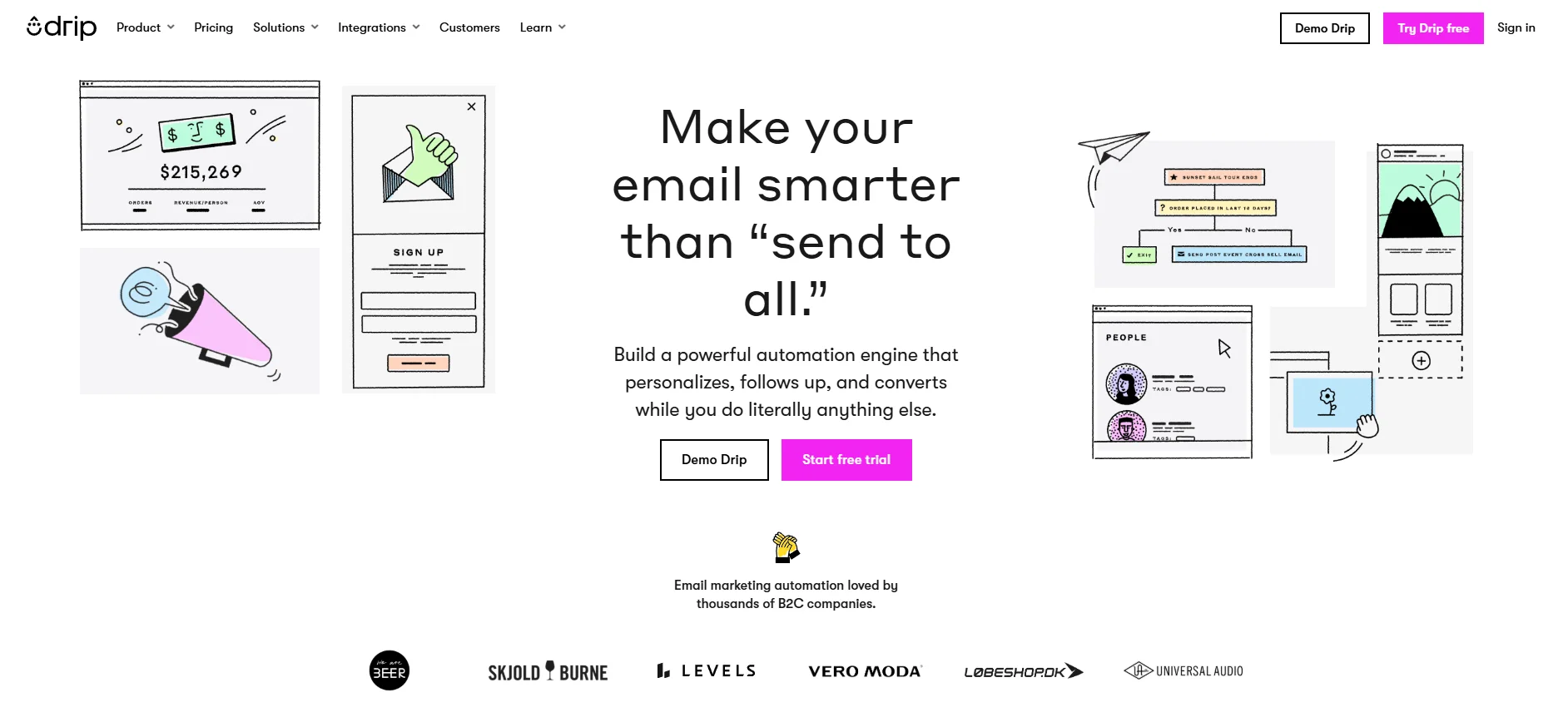
Drip is primarily an e-commerce platform, and most of its headline features — cart abandonment, revenue attribution, product recommendations — are irrelevant to the ministry. That said, for large churches with dedicated communications staff who want deep behavioral segmentation, sophisticated multi-step campaign logic, and detailed engagement analytics, Drip’s automation engine is genuinely powerful.
The honest assessment: for most churches, the $39/month starting price is hard to justify when tools like Selzy or ActiveCampaign offer comparable automation at lower cost and with less e-commerce baggage. Drip earns its place on this list for the specific church that has outgrown simpler tools, has staff who can leverage its depth, and needs a level of segmentation and campaign logic that general-purpose platforms don’t quite reach.
Key features:
- Visual workflow builder with complex branching logic and conditional splits
- Dynamic behavioral segments that update in real-time
- Multi-step campaign builder for email and onsite messaging
- Detailed engagement analytics and campaign performance tracking
- Pre-built playbooks for welcome series and re-engagement campaigns
- Open API for custom integrations with church management software
Pros:
- Powerful behavioral segmentation
- Sophisticated multi-step automation
- Strong analytics
- Good deliverability
- Unlimited sub-accounts.
Cons:
- Built for e-commerce — many features are irrelevant to churches
- Expensive starting price ($39/month)
- No built-in SMS
- Single pricing tier
- Steep learning curve
- Overkill for most congregations.
Drip pricing:
| Plan | Price | Key features |
| Standard | $39/month (up to 2,500 contacts) | Unlimited email sends, dynamic segments, open API |
| Scales up | By contact count (2,500+) | Same features, price increases with list size |
All 17 platforms compared
| Platform | Free plan | Paid from | Automation | SMS | Nonprofit discount | Best for |
| Selzy | ✅ 100 contacts, 1,000/mo | ~$7/mo | ✅ | ❌ | ✅ | Most churches |
| Mailchimp | ✅ 250 contacts, 500/mo (no automation) | $13/mo | ✅ Paid only | ❌ | ✅ 15% | Getting started |
| Constant Contact | ❌ Trial | $12/mo | ✅ Basic | ❌ | ✅ 20–30% | Events & RSVPs |
| Brevo | ✅ 300/day | $9/mo | ✅ | ✅ | ❌ | Email + SMS |
| AWeber | ✅ 500 subscribers | $15/mo | ✅ Basic | ❌ | ❌ | Simple reliability |
| ActiveCampaign | ❌ Trial | $15/mo | ✅ Advanced | ❌ | ✅ Varies | Large churches |
| MailerLite | ✅ 500 subscribers, 12,000/mo | $10/mo | ✅ | ❌ | ✅ 30% | Design + value |
| GetResponse | ✅ 500 contacts, 2,500/mo | $19/mo | ✅ | ✅ Enterprise | ✅ 50% nonprofit | Online ministry |
| Klaviyo | ✅ 250 contacts | $45/mo | ✅ Advanced | ✅ | ❌ | Data-driven teams |
| HubSpot | ✅ Limited | $15/mo/seat | ✅ Advanced | ✅ Add-on | ✅ Up to 40% | CRM + email |
| Benchmark Email | ✅ 500 contacts | $13/mo | ✅ Basic | ❌ | ❌ | A/B testing |
| Moosend | ❌ Trial | $9/mo | ✅ | ❌ | ❌ | Budget automation |
| Omnisend | ✅ 250 contacts | $16/mo | ✅ | ✅ | ❌ | Multi-channel |
| Zoho Campaigns | ✅ 2,000 contacts | $3/mo | ✅ Basic | ❌ | ❌ | Zoho ecosystem |
| Twilio SendGrid | ✅ 100/day | $15/mo | ✅ Basic | ❌ | ❌ | Developers |
| Kit | ✅ 10,000 subscribers | ~$33/mo | ✅ Basic (1 automation free) | ❌ | ❌ | Content-focused churches |
| Drip | ❌ Trial | $39/mo | ✅ Advanced | ❌ | ❌ | Data-driven large churches |
Best for data-driven churches running complex campaigns
- Small churches (under 200 members) can use free tiers from Kit (up to 10,000 subscribers), MailerLite (500 subscribers), or Zoho Campaigns (2,000 contacts) without paying anything.
Selzy’s free plan (100 contacts) works for very early-stage churches just getting started. Note that Mailchimp’s free plan is now limited to 250 contacts with no automation — no longer a practical starting point for most churches.
- Mid-sized churches (200–1,000 members) should calculate the real cost at their actual database size — not just the starting price. MailerLite’s nonprofit discount and Selzy’s flat pricing both hold up well at this scale.
- Large churches (1,000+ members) need platforms that scale affordably. ActiveCampaign is the strongest choice for staffed communications teams. Brevo’s volume-based pricing prevents costs from spiraling as your contact database grows.
Most importantly: choose the tool your team will actually use. Selzy and MailerLite are simple enough for any volunteer. ActiveCampaign and HubSpot require dedicated staff to use effectively.
FAQ about the best email marketing platforms for churches
Is email marketing expensive for churches?
It doesn’t have to be. Selzy, Kit, MailerLite, Brevo, and Zoho Campaigns all offer genuinely usable free plans. Several platforms also offer nonprofit discounts of 15–40%. Selzy’s paid plans start at ~$7/month. Most churches can start for free and only pay as their needs grow. Note that Mailchimp’s free plan has become very limited in 2026 — it now covers only 250 contacts with no automation.
What’s the best free email platform for churches?
Kit has the most generous free plan by far — up to 10,000 subscribers with unlimited broadcast emails. For a more full-featured marketing tool on the free tier, MailerLite supports 500 subscribers and 12,000 emails/month including automation. Selzy’s free plan covers 100 contacts with 1,000 emails/month and free trial with up to 10,000 emails to 2,000 contacts for new users. Mailchimp’s free plan is now largely unusable for churches — 250 contacts, 500 emails/month, with no automation.
How often should churches email their congregation?
One weekly newsletter is the baseline. Add event-specific emails when needed. Avoid more than 3–4 emails per week — beyond that, engagement drops and unsubscribes increase.
Do platforms integrate with church management software?
Several do. Mailchimp has the most native ChMS integrations. Selzy and MailerLite connect with Planning Center, Breeze, and others via Zapier.
Can email marketing help with church fundraising?
Yes. Automated donation appeals, year-end giving campaigns, and targeted outreach to lapsed givers are all well-supported use cases — especially on platforms with behavioral segmentation like Selzy and ActiveCampaign.
Final breakdown
- Best overall — Selzy. For most churches, regardless of size, Selzy is the strongest choice: easy enough for any volunteer, affordable enough for any budget, and capable enough for everything from a welcome sequence to a full annual communication calendar.
- Best budget alternative — MailerLite. The most polished experience per dollar on this list, especially with the 30% nonprofit discount applied.
- Best for events — Constant Contact. No other platform makes event invitations, RSVPs, and attendance management as seamless for churches.
- Best for large churches — ActiveCampaign. For large congregations with dedicated staff and complex automation needs, ActiveCampaign’s power is unmatched.
- Best for multi-channel — Brevo. If SMS is part of your strategy, Brevo gives you email and text from one platform at the lowest combined cost.
- Best purpose-built solution — Kit. For churches where a compelling weekly devotional or sermon-based content series is the primary communication goal, Kit’s creator-focused tools are unmatched on this list.
- Best for advanced segmentation — Drip. For large churches with dedicated staff who need deep behavioral segmentation and complex campaign logic and have outgrown simpler tools.
Pricing and features are current as of early 2026 and may be subject to change. Always verify with each platform before subscribing.
 New and noteworthy on our blog
