



Key takeaways
- Omnisend, a popular e-commerce email marketing platform, may not suit all businesses due to limitations in automation capabilities, learning curve, and pricing scalability as contact lists grow.
- The guide compares the best Omnisend alternatives for various use cases based on pricing, automation, usability, integrations, and reporting features.
- The alternatives include Selzy, Mailchimp, ActiveCampaign, Constant Contact, GetResponse, Kit, Moosend, Brevo, Drip, Klaviyo, and Netcore Cloud.
Omnisend is a popular e-commerce email marketing platform, but it’s not the right fit for every business. Some users outgrow its automation capabilities, struggle with the learning curve, or find pricing difficult to scale as contact lists grow.
In this guide, we compare the best Omnisend alternatives for different use cases — including ecommerce brands, creators, startups, and growing SMBs — based on pricing, automation, usability, integrations, and reporting features.
We evaluated each Omnisend alternative based on automation features, e-commerce integrations, pricing scalability, usability, reporting, and overall value for growing businesses.
The best alternatives to Omnisend at a glance
| Platform | Free options | Best for | Unique features | Starting price |
| Selzy | Free plan: 100 contacts, 1,000 emails/month | Startups, small and medium-sized businesses | High deliverability, affordable prices, AI email editor, courses | $7.5/month: 500 contacts, unlimited emails |
| Mailchimp | Free plan: 500 contacts, 1,000 emails/month (500 emails/day) | E-commerce, small and medium-sized businesses | Automation, website hosting, marketing CRM integration | $13/month: 500 contacts, 10x your contact list emails/month |
| ActiveCampaign | Free 14-day trial: 100 contacts, 100 emails, 1 user | E-commerce, medium-sized businesses | 900+ integrations, automation, CRM tools, AI, page builder | $15/month: 1,000 contacts, 10x your contact list emails/month |
| Constant Contact | Free 30-day trial: unlimited contacts, 100 emails | Non-profits, small businesses | Generative AI, drag-and-drop templates, event marketing, survey subscribers | $12/month: 500 contacts, 10x your contact list emails/month |
| GetResponse | Free plan: 500 contacts, 2,500 emails/month | E-commerce, solopreneurs, small to medium-sized businesses | Autoresponders, landing page builder, automation | $19/month: 1,000 contacts, unlimited monthly emails |
| Kit | Free plan: 10,000 subscribers, unlimited emails | Bloggers, creators, marketers | Visual automations, monetization tools, landing page builder | $39/month: 1,000 subscribers, unlimited emails |
| Moosend | Free 30-day trial: 1,000 subscribers, unlimited emails | E-commerce, small to medium-sized businesses | AI optimizer, automated email sequences, drag-and-drop tool, professional templates | $9/month: 500 subscribers, unlimited emails |
| Brevo | Free plan: 300 emails/day | E-commerce, small and medium-sized businesses | Email automation, landing pages, list management and segmentation, SMS | $9/month: 500, 000 contacts, 5,000 emails/month, no daily sending limit |
| Drip | Free 14-day trial: 1–2,500 contacts, unlimited emails | E-commerce, community-focused DTC | Campaign analytics, email builder, forms, segmentation | $39/month: 1-2,500 contacts, unlimited emails |
| Klaviyo | Free plan: 250 contacts, 500 emails/month; email support for 60 days | Experienced advertisers, small businesses | Built-in forms, customer profiles, integrations, SMS marketing | $20/month: 251–500 active profiles, 5,000 emails/month |
| Netcore Cloud | Startup plan with $30,000 credits; free for up to 10,000 Monthly Active Users | Enterprises, growth-focused brands, omnichannel marketers | Omnichannel engagement, AI-driven personalization & predictive segmentation, interactive emails, churn prediction, real-time triggers, advanced analytics | Custom pricing (quote-based by business needs) |
All you need to know about Omnisend
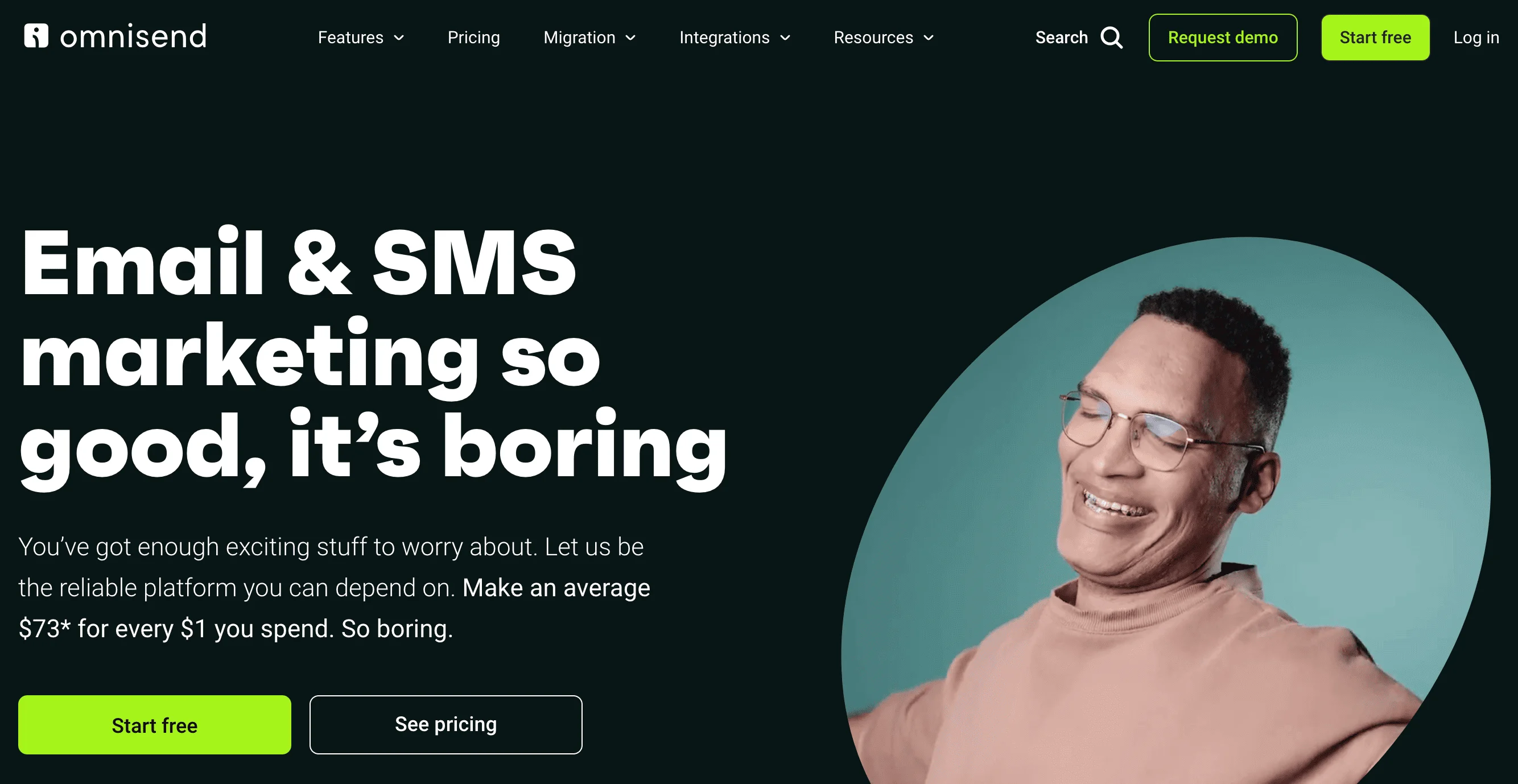
Omnisend is an advanced marketing automation service used by over 125,000 brands around the world. Entering the scene around nine years ago, the company employs more than 200 people and has three offices split between the USA and Lithuania. In 2019, Omnisend appeared in Shopify’s Top 5 apps for email marketing. Since then, it has shown up three times in Deloitte Technology’s UK Fast 50 program.
According to their website, the Omnisend team is determined to “Make Marketing Relevant” — and, based on the recognition they’ve received, that mission is going well. Their email marketing tool is a big part of this success. Packed with useful features and available for free, this service is a great option for e-commerce brands and any small or medium-sized business.
Still, there are other services out there that may fulfill your needs better than Omnisend, and we’ve pulled together 10 of the best email automation tools in this article. Before we discuss them, however, let’s take a closer look at Omnisend and what it has to offer.
Features and pricing
Omnisend has a good range of tools available across its three subscription tiers. These include email and SMS automation, pre-built e-commerce workflows, A/B testing, scheduling, segmentation, analytics and reporting, and more.
Unlike other similar services, the free plan includes access to Omnisend’s full range of features. So, even with a free account, you can still access analytics and segment your list to improve campaign efficacy. However, people using the free plan can’t have more than 250 contacts and can only send 500 emails per month.
Pricing
- Free plan: 250 contacts, 500 emails/month, 500 web push notifications/month, 50 published reviews (Shopify).
- Standard plan: starting at $16/month for 1–500 contacts, up to 6,000 emails/month, 1,000 published reviews.
- Pro plan: starting at $59/month for 2,500 contacts, unlimited emails, notifications, and published reviews, plus advanced reporting.
Pros and cons
Pros:
- The free plan includes advanced functions.
- There are dedicated features for online stores.
- Workflow automation systems to save time.
Cons:
- Has fairly limited integrations.
- Doesn’t boast particularly advanced analytics.
- There’s a significant learning curve for new users.
Why consider alternatives to Omnisend?
Omnisend works well for many e-commerce businesses, but it isn’t the best fit for every marketing team. As stores grow, some users find the platform limiting in areas like reporting depth, workflow flexibility, integrations, and long-term pricing scalability.
Businesses with more advanced automation needs may prefer tools like ActiveCampaign or Drip, while smaller teams often look for simpler and more affordable platforms with easier onboarding.
For creators and content-driven brands, Omnisend can also feel heavily e-commerce-focused compared to alternatives built around newsletters, audience growth, or digital products.
10 best Omnisend alternatives to consider
In the table at the start of this article, we presented you with a quick breakdown of the best Omnisend alternatives on the market. Now, we’ll take a closer look at each of the ten options in our list. For each of our picks, we’ve included a rundown of the best features, pricing information, and lists of pros and cons, making it easier to choose the right email marketing platform.
Most of these options are best suited to small and medium-sized businesses, but some have features specifically aimed at online retailers, creatives, and so on. In other words, regardless of your particular niche, you’ll likely find a platform that fits your workflow and budget.
Selzy — Best email marketing platform
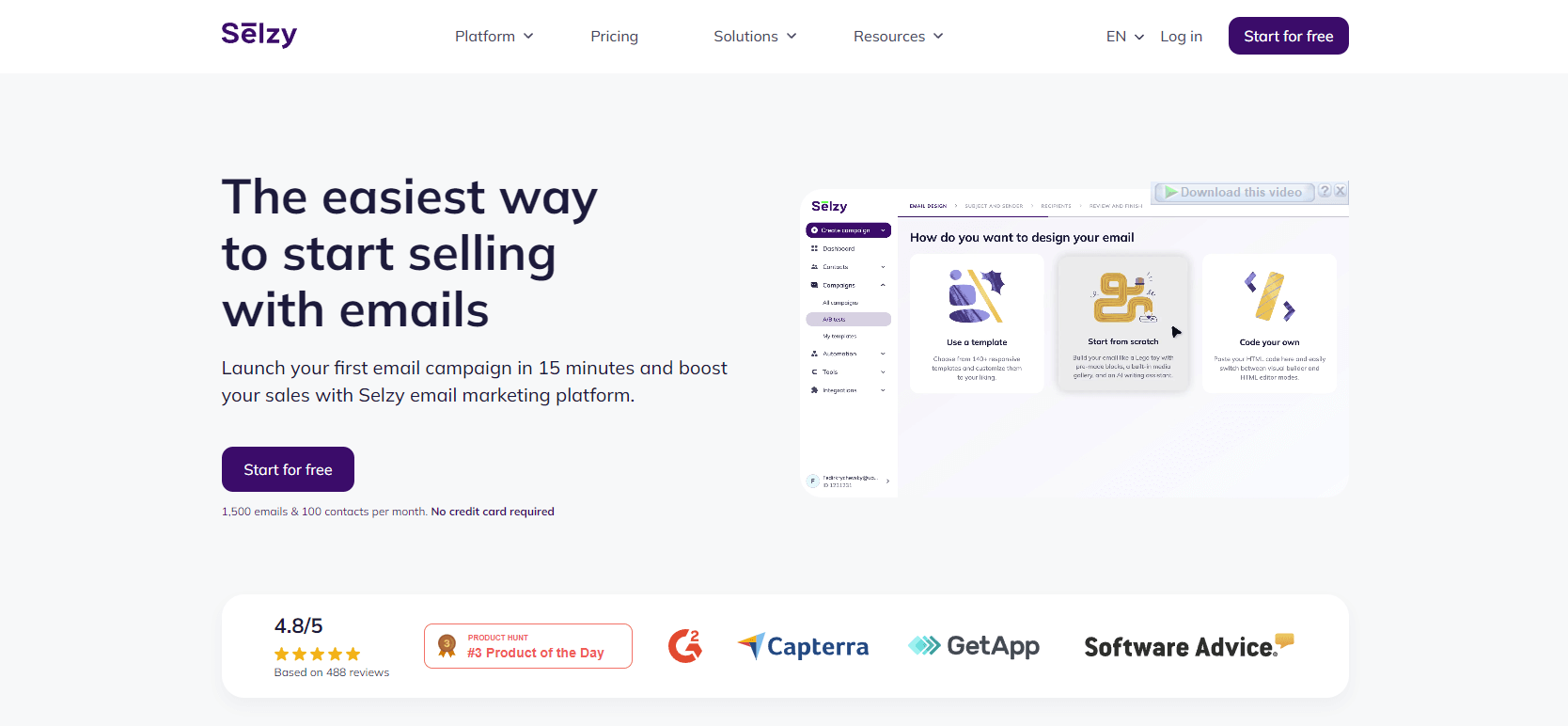
Compared to Omnisend, Selzy offers a simpler onboarding experience, lower entry pricing, and a more beginner-friendly interface. It’s a strong option for SMBs and startups that want powerful email marketing tools without the complexity of more e-commerce-heavy platforms.
But Selzy can do much more than just help you design and send emails with an AI writing and layout assistant. Users will also benefit from helpful automations designed to engage subscribers, as well as advanced audience segmentation features for more precise targeting. With analytics, reporting, and A/B testing, you can review your ongoing marketing campaigns, make data-driven decisions, and make them even more effective.
Selzy now also includes landing pages, AI-assisted email creation, Telegram chatbot tools for SMB-focused customer engagement workflows, a landing page builder, and SMS functionality.
Another advantage of using this platform is that it gives you access to a range of email marketing courses, some of which are free. These can help you make the most of Selzy’s many features, create, launch, and manage marketing campaigns. If any issues arise, the extensive Help Center and the support team will be there to assist you.
Pros
- Access email marketing courses to help you put together effective advertising campaigns.
- Create powerful, attention-grabbing emails using a state-of-the-art AI-powered email builder and ready-made expert templates.
- Get started in just 15 minutes thanks to the platform’s intuitive design and helpful 24/7 customer service team, available to all Selzy customers.
- As one of the cheaper alternatives to Omnisend, Selzy’s Standard costs less than Omnisend’s and includes unlimited emails.
Cons
- Selzy may have limited integration options.
Pricing
Please note that Selzy’s paid plans are priced according to the number of contacts:
- Free plan: 100 contacts, 1,000 emails/month. New users can also access a 14-day trial with 2,000 contacts and 10,000 emails.
- Lite plan: $7.5/month, up to 500 contacts, unlimited emails, A/B testing, segmentation.
- Standard plan: $15/month, up to 500 contacts, unlimited emails, plus anti-spam tips, subject line assistance, Telegram chatbots, and more.
- Enterprise plan: custom price, 500,000+ contacts, unlimited emails, plus access to Selzy’s full range of benefits.

Mailchimp — Best for email automation
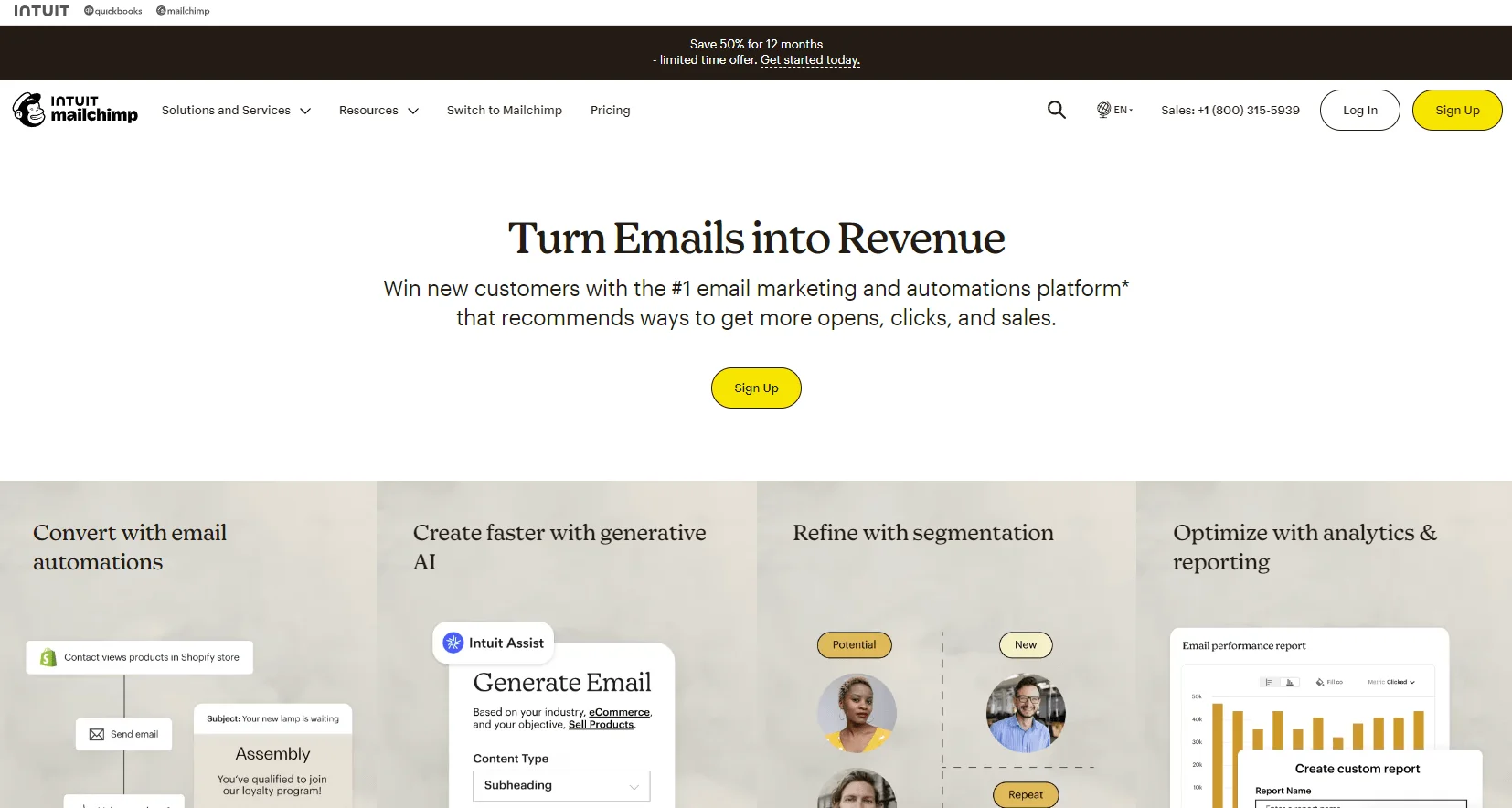
If you’re looking for other free Omnisend alternatives, Mailchimp is better suited to businesses that want a broader marketing ecosystem beyond ecommerce email automation.
Compared to Omnisend, Mailchimp offers a broader all-in-one marketing ecosystem with stronger branding, CRM, and website-building capabilities, though many advanced features require higher-tier plans.
Many regard this solution as a standard in the industry, and it is great for businesses looking to manage large contact lists and boost their performance with analytics. Additionally, with its marketing automation workflows, Mailchimp is ideal for automating repetitive tasks, freeing up time for marketers to handle the more important things.
One of the biggest downsides of Mailchimp is that many of its most useful features are only available for users at the Standard and Premium subscription tiers. The marketing calendar, custom-coded templates, and dynamic content are just a few examples. Analytics services are available across all tiers but are fairly limited for Free and Essentials subscribers.
Pros
- Easy-to-use integrated CRM features to manage your interactions with current and potential customers
- Segmentation features for better audience targeting
- Ability to import branding elements
Cons
- Limited customization options.
- Some advanced automation, behavioral targeting, and reporting features are reserved for Standard and Premium plans.
Pricing
- Free plan: 500 contacts, 1,000 emails/month.
- Essentials: $13/month for 500 contacts, a monthly email limit of 10x contacts, plus A/B testing, email scheduling, and limited analytics.
- Standard: $20/month for 500 contacts, a monthly email limit of 12x contacts, plus dynamic content, advanced segmentation, and custom reports.
- Premium: $350/month for 10,000 contacts, a monthly email limit of 15x contacts, plus priority support, unlimited users, and four onboarding sessions.
ActiveCampaign — Best for expert marketers
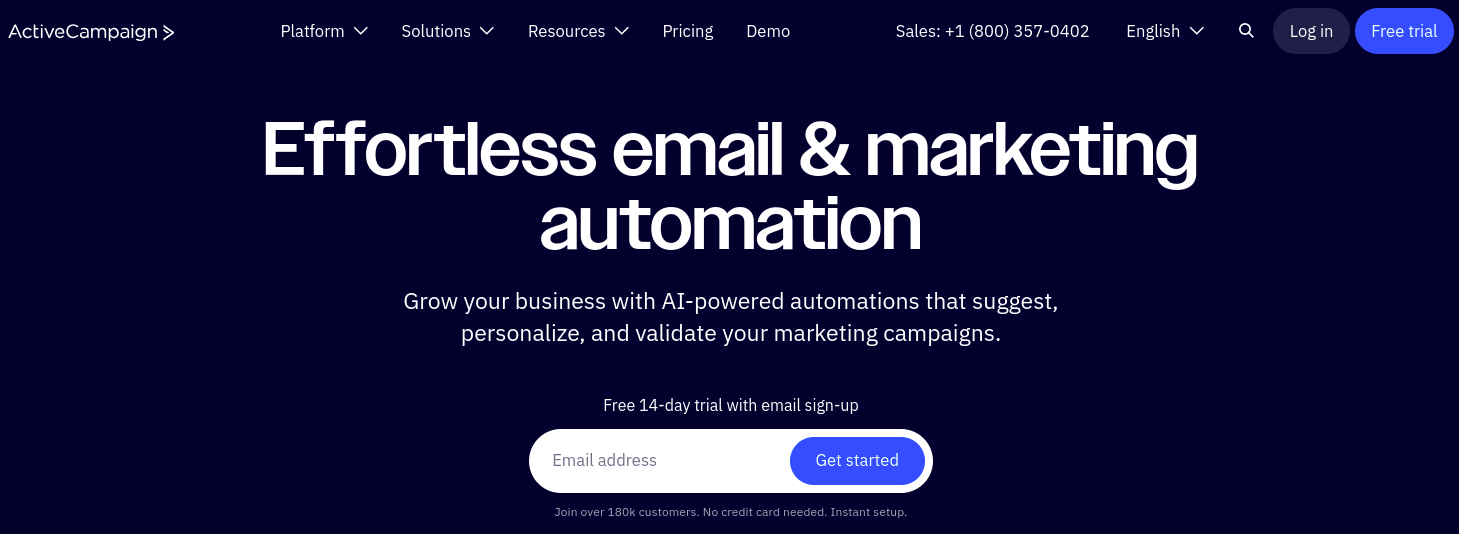
If you’re an experienced marketer or one who prioritizes automation in your advertising campaigns, ActiveCampaign is better suited to experienced marketers that need deeper automation and CRM functionality than Omnisend provides. Businesses switching from Omnisend often choose ActiveCampaign for its deeper automation logic, advanced segmentation, and built-in CRM capabilities.
Many automated workflows aren’t the only thing on offer, though. ActiveCampaign also includes an easy-to-use email editor, as well as a wide array of customizable templates. So, armed with the platform’s useful segmentation features, you’ll be able to put together effective campaigns in no time at all.
While ActiveCampaign’s advanced features are sure to be game-changing in experienced hands, those with no prior experience in marketing automation might want to look elsewhere. Even with its intuitive layout and straightforward workflows, this platform may represent a learning curve that is too steep for first-time users.
Pros
- Comprehensive automation features for experienced marketers
- Detailed analytics and insightful reporting to drive wise decisions
- Customer support staff with the necessary experience and training
Cons
- It’s more expensive at scale compared to some of the other available options.
- Unsuitable for inexperienced marketers due to the steep learning curve.
- The platform’s advanced feature set may feel overwhelming for smaller teams or beginners.
Pricing
- Starter plan: $15/month for 1,000 contacts, a monthly email limit of 10x contacts, 1 user, 5-action automation, A/B testing for emails.
- Plus plan: $49/month for 1,000 contacts, a monthly email limit of 10x contacts, 1 user, unlimited-action automation, generative AI.
- Pro plan: $79/month for 1,000 contacts, a monthly email limit of 12x contacts, 3 users, A/B testing for emails and automation, advanced segmentation.
- Enterprise plan: $145/month for 1,000 contacts, a monthly email limit of 15x contacts, 5 users, custom objects, premium CRM integrations.
Constant Contact — Best for event management
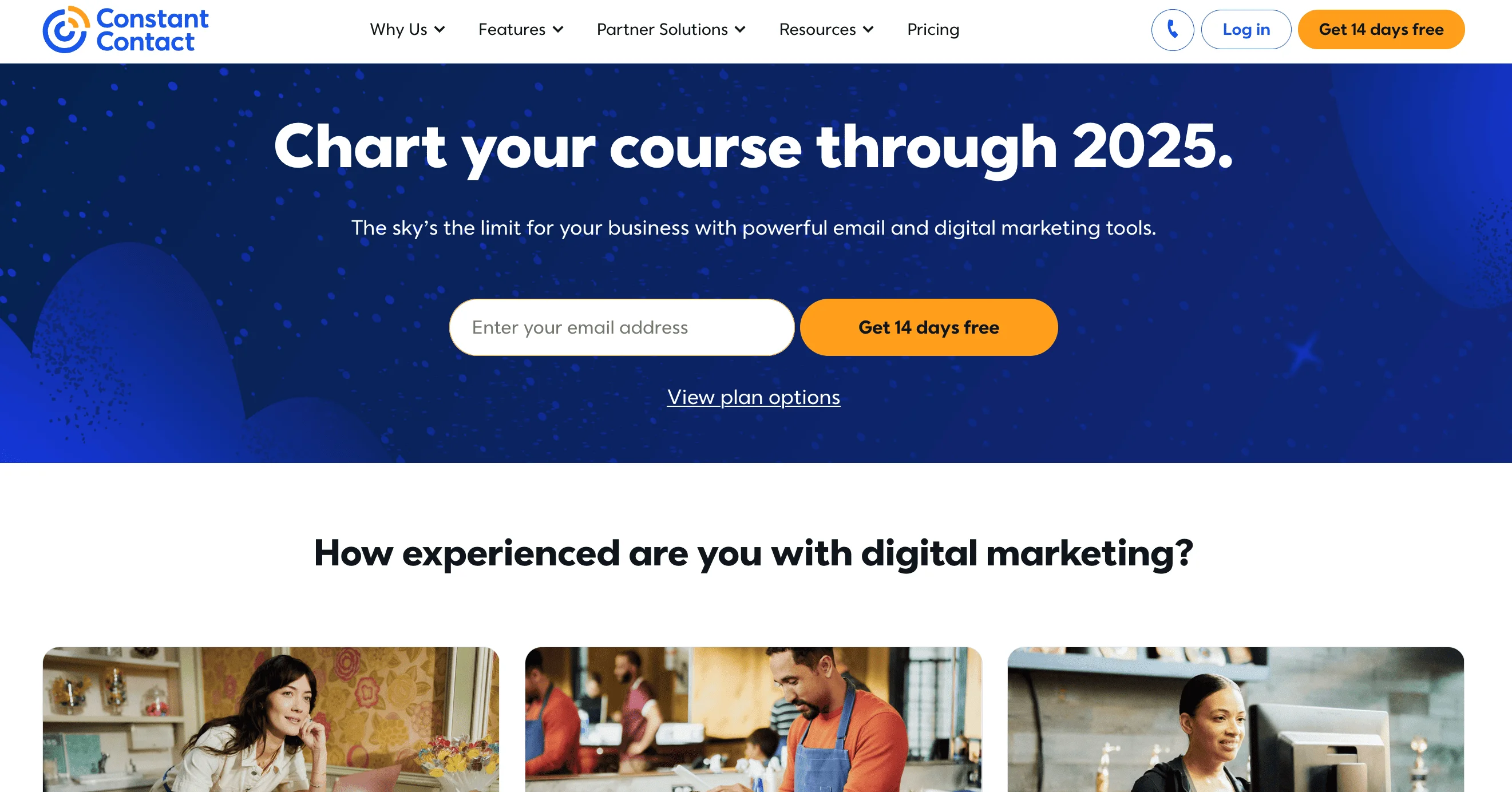
If you’re a nonprofit or small business on the hunt for companies like Omnisend, looking to connect with your subscriber base and host events, Constant Contact is a great option. Compared to Omnisend, Constant Contact focuses more heavily on ease of use, event marketing, and nonprofit-friendly tools rather than advanced e-commerce automation.
As well as having a range of email marketing tools — including an AI-powered email generator and autoresponders — this service is great for event hosting. Through Constant Contact, you can create signup forms and even promote and sell tickets. This platform’s social media integrations play a part in this, too, helping you spread the word about any upcoming meetings.
Constant Contact has expanded beyond email with AI-assisted campaign tools, social media management, and ecommerce-focused integrations for SMBs.
With all that being said, Constant Contact’s prices may prove prohibitive to some. Furthermore, given its high prices, you would expect a more robust website and landing page server on this platform.
Pros
- Customer polls and surveys.
- Generative AI to craft compelling emails and social media posts.
- Integrates with social media platforms.
Cons
- Automation capabilities are more limited than those offered by platforms like ActiveCampaign or Klaviyo.
- A/B testing is limited to subject lines.
- It is expensive, with certain features only available as paid add-ons.
Pricing
- Lite plan: $12/month for 500 contacts, a monthly email limit of 10x contacts, 1 user, drag-and-drop email templates, polls, and surveys.
- Standard plan: $35/month for 500 contacts, a monthly email limit of 12x contacts, 3 users, scheduled email sends, A/B subject line testing.
- Premium plan: $80/month for 500 contacts, a monthly email limit of 24x contacts, unlimited users, dynamic content, engagement heat map.
GetResponse — Best for content monetization
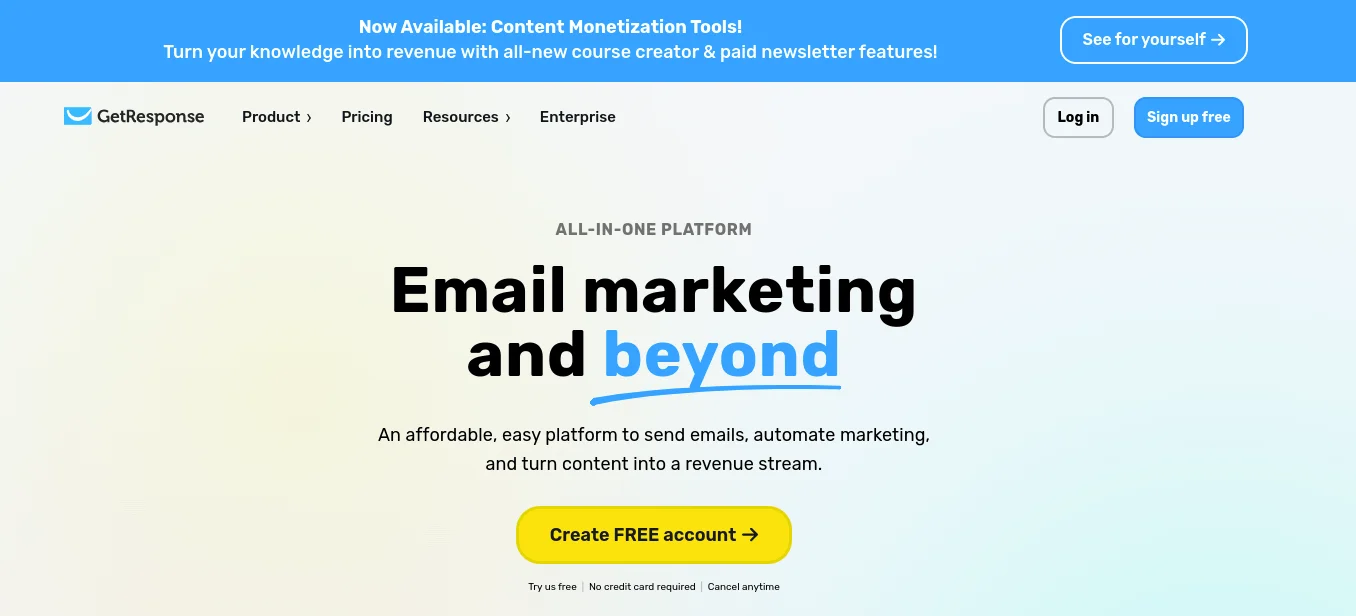
GetResponse offers robust features tailored to digital marketers; however, it caters to slightly different needs than Omnisend. Unlike Omnisend’s ecommerce-first approach, GetResponse is better suited for marketers focused on lead generation, webinars, funnels, and content monetization.
While Omnisend is an all-in-one marketing platform that helps businesses by coordinating customer engagement, GetResponse is a system suitable for advertisers and content creators. It is mainly used for email marketing and content monetization.
At GetResponse, you will be able to access a variety of professionally designed templates and create engaging newsletters without design skills. You may also set up automated email sequences to nurture leads and send follow-ups. Thanks to a landing page builder, users can design high-converting landing pages to drive traffic with no coding required.
Pros
- Sales funnels and landing pages are available with GetResponse’s Conversion Funnel feature.
- The platform’s live chat and mobile app functionalities will help you never miss a lead.
Cons
- Some advanced e-commerce and webinar features are only available on higher-tier plans.
- Many features are only available at prohibitively high prices.
Pricing
- Free plan: $0/month, 500 contacts, 2,500 emails/month.
- Starter plan: $19/month for 1,000 contacts, unlimited newsletters, plus autoresponders, landing pages, and forms.
- Marketer plan: $59/month for 1,000 contacts, unlimited newsletters, plus event-based automation workflows, newsletter revenue data, and web push notifications.
- Creator plan: $69/month for 1,000 contacts, unlimited newsletters, plus AI creator, website builder, and webinars for up to 100 attendees.
- Enterprise: $1,099/month for 1,000 contacts, unlimited emails, plus a dedicated IP address, SMS marketing, and transactional emails.
Kit — Best for creators focused on newsletters and audience monetization
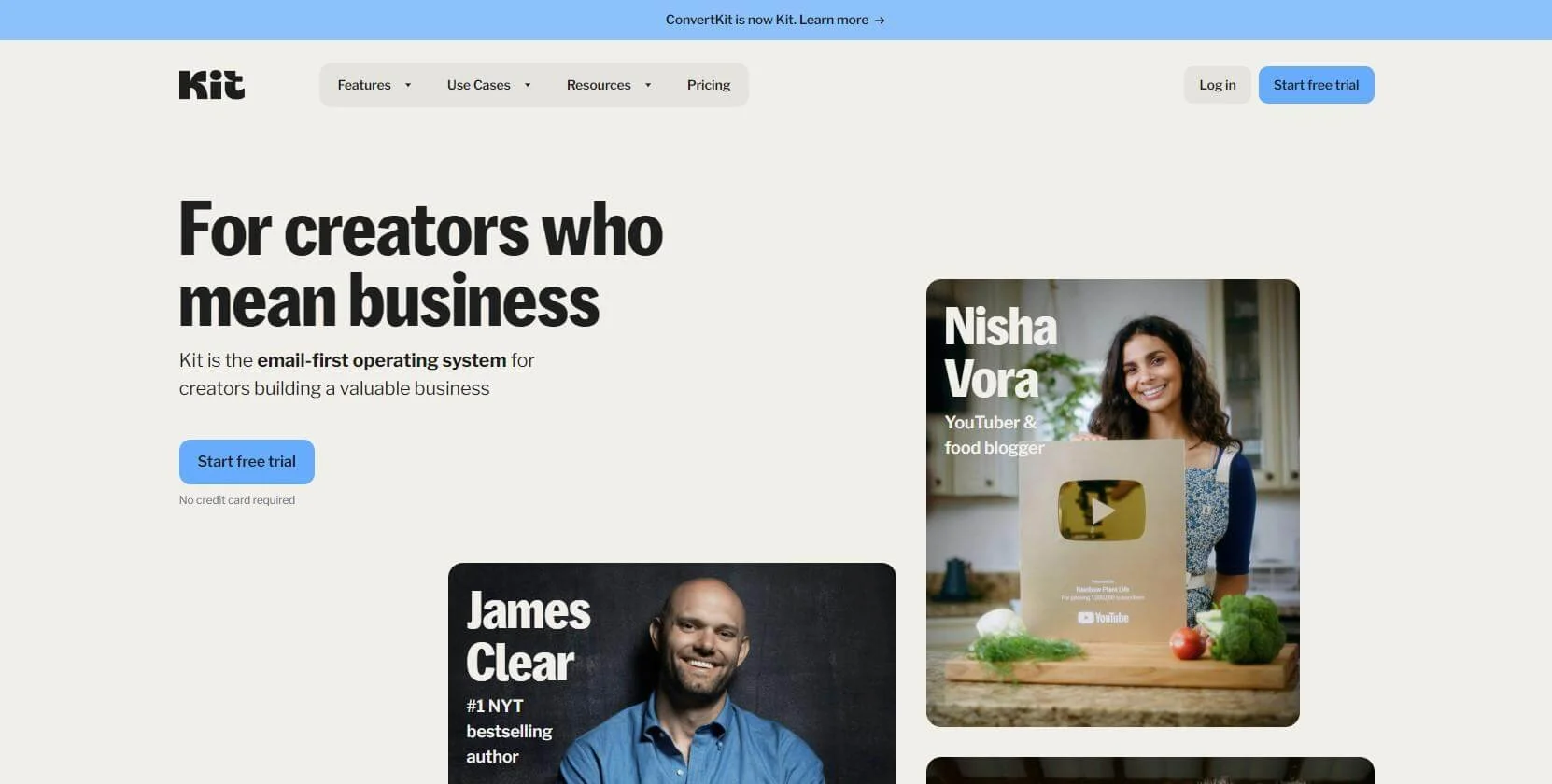
Creators often prefer Kit over Omnisend because of its simpler interface, audience-tagging system, and tools designed specifically for newsletters and digital products. With its clear, intuitive interface, Kit is beginner-friendly and has a range of features designed specifically to help users expand their reach. Such tools include content monetization, contact list management, and automations.
Unfortunately, the larger your contact list, the higher the price of using Kit. Additionally, if you use their Free plan, you’ll have to put up with Kit branding on your emails and web pages, which might be off-putting for companies trying to establish their own brand.
Pros
- Tag-based subscriber management and creator-focused audience segmentation
- Visual automation builder for creating email sequences and funnels
- Content monetization features, perfect for content creators
- Straightforward UI
Cons
- Paid plan prices increase steeply for users with 1,000+ subscribers.
- You have to use a paid plan to get rid of “Kit branding.”
Pricing
- Newsletter plan: $0/month, 1,000 subscribers, unlimited email broadcasts and landing pages, 1 user, plus 1 basic visual automation, and 1 email sequence.
- Creator plan: $39/month for 1,000 subscribers, unlimited email broadcasts and landing pages, 2 users, plus unlimited visual automation, and unlimited email sequences.
- Creator Pro plan: $79/month for 1,000 subscribers, unlimited email broadcasts and landing pages, unlimited users, plus Facebook custom audiences, insights dashboard, and priority support.
Moosend — Best for the e-commerce industry
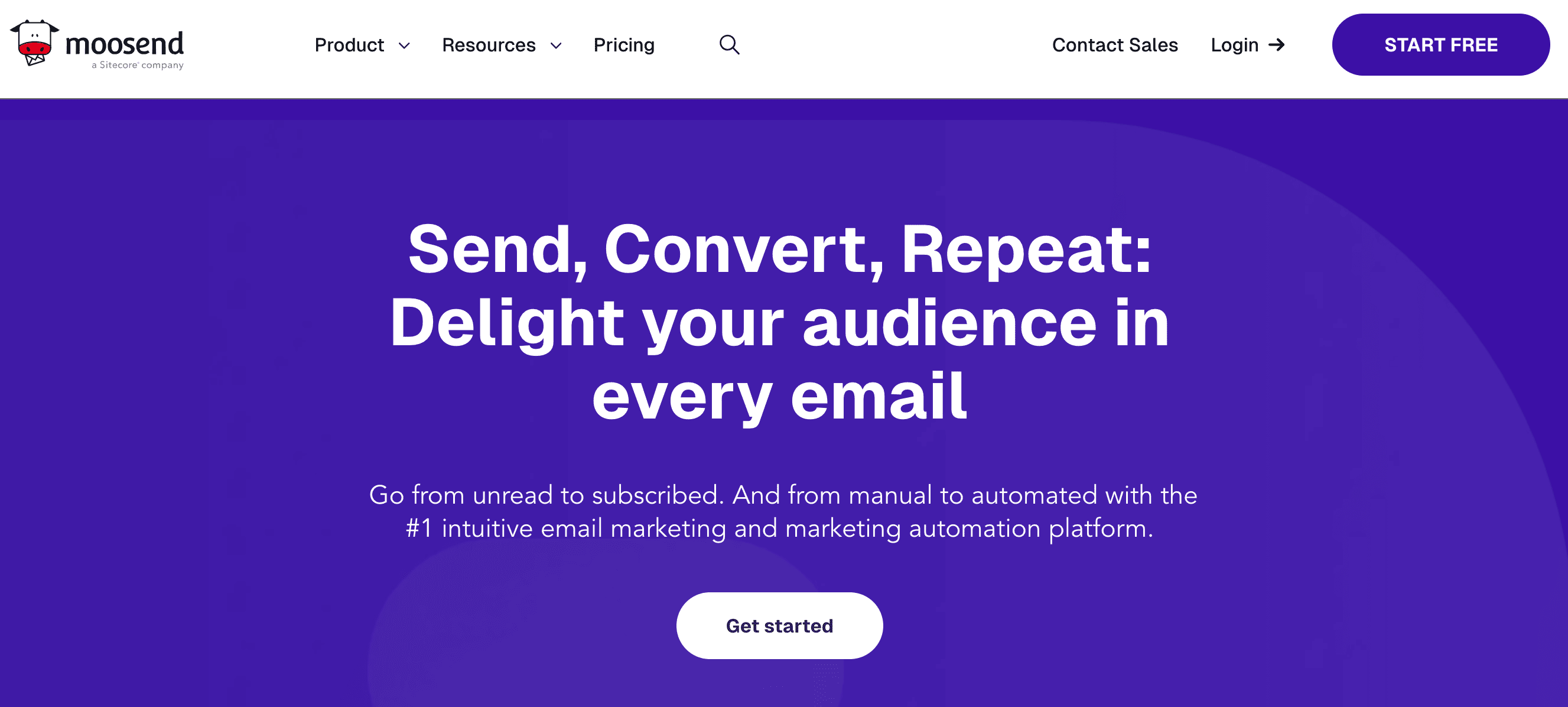
E-commerce sites may want to think about switching to Moosend if they’re looking for an email service like Omnisend. Compared to Omnisend, Moosend offers more flexible workflow automation at a lower starting price, making it appealing for e-commerce businesses focused on lifecycle campaigns.
Some of this platform’s standout features include a drag-and-drop editor, sophisticated workflow automations, and advanced segmentation functionality. In the right hands, these tools can help increase customer engagement.
Unfortunately, Moosend doesn’t have a free plan, so you’ll have to look elsewhere if that’s a deal-breaker for you. With that being said, the platform does offer a 30-day free trial, so you can always try it to see if it’s the right fit for you.
Pros
- Grants access to advanced workflow automations.
- You can track campaign performance with tailored reports.
- You can use automated email sequences to reduce cart abandonment.
- The service offers AI-powered marketing automation.
Cons
- There’s a limited selection of templates.
- No free plan is available.
Pricing
- Pro plan: $9/month for 500 subscribers, unlimited emails, automation workflows, landing pages, subscription forms.
- Moosend+ plan: custom price and subscribers, unlimited emails, all Pro features plus add-ons, including transactional emails, audience discovery, and dedicated IPs.
- Enterprise plan: custom price and subscribers, unlimited emails, all features, plus account manager, additional team members, and priority support.
Brevo — Best for CRM features
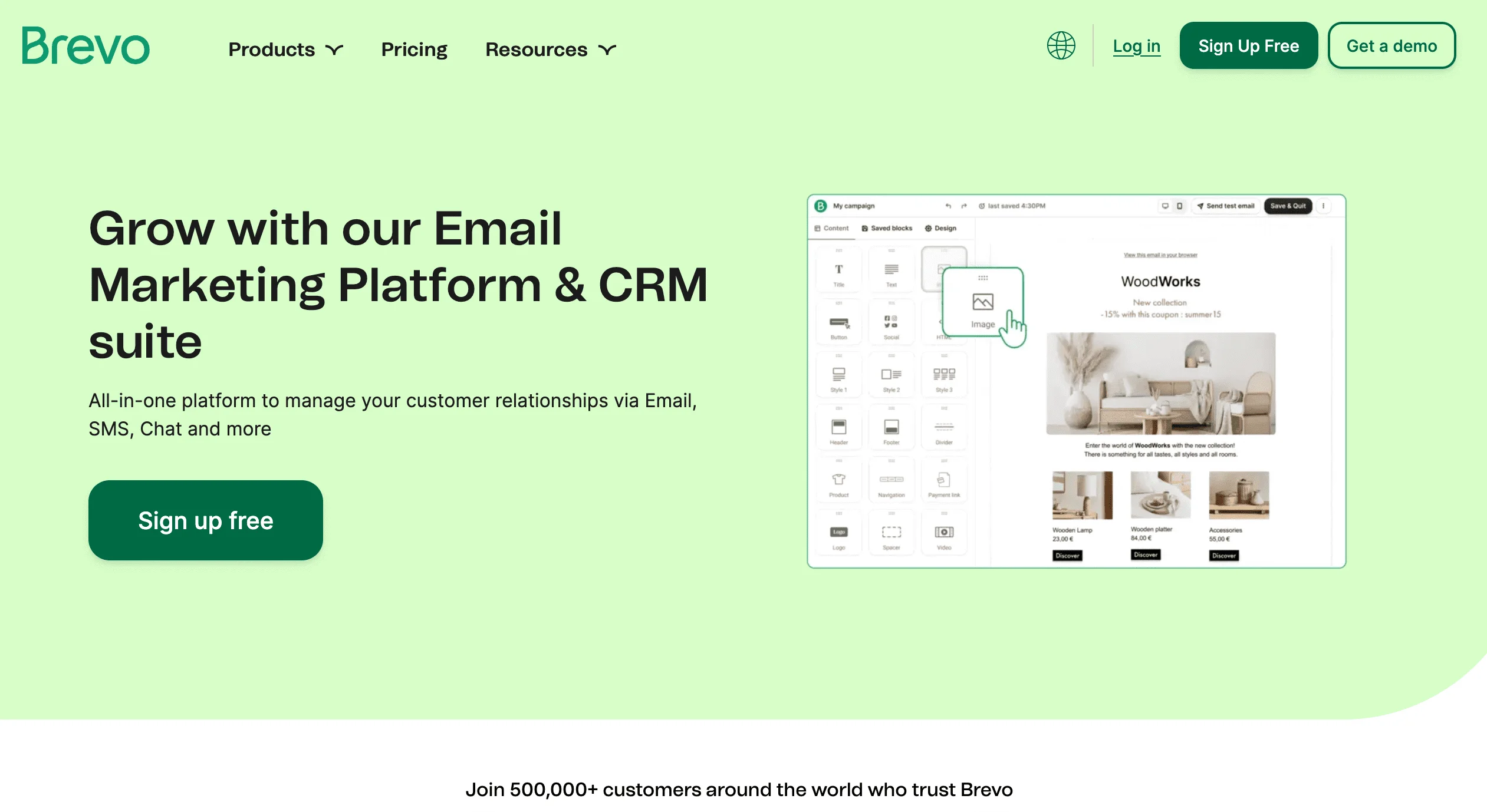
Brevo, formerly Sendinblue, is better suited to smaller teams that prioritize simplicity and multichannel messaging over advanced e-commerce automation. Businesses looking for a simpler alternative to Omnisend often choose Brevo for its built-in CRM, transactional email capabilities, and multichannel messaging features.
With its clear UI and stripped-back list of capabilities, Brevo is great for newcomers to the marketing game. Additionally, the platform includes support for both SMS and WhatsApp campaigns, allowing advertisers to reach a broader audience.
Because of its minimalist array of features, Brevo may not be the best fit for experienced marketers; such individuals would be better off looking into a more advanced platform.
Pros
- Contact list management and segmentation at your disposal
- Signup forms to manage events
- SMS and WhatsApp marketing features, web and mobile push notifications
Cons
- Limited functionality compared to other Omnisend alternatives makes it a less popular option.
- Phone and live chat support channels are not available to Free and Starter plan users.
Pricing
- Free plan: $0/month, 300 emails/day, customizable email templates, drag-and-drop template editor, personalized SMS campaigns, and more.
- Starter plan: $9/month, 500,000 contacts, unlimited emails, basic analytics and reporting, and 24/7 email support.
- Business plan: $18/month, up to 2 million contacts, unlimited emails, unlimited marketing automation, predictive sending, landing pages, A/B testing, and more.
- Enterprise plan: custom price, unlimited contacts and emails, tailored onboarding, Service Level Agreement, pop-ups, and other exclusive features.
Drip — Best for DTC businesses
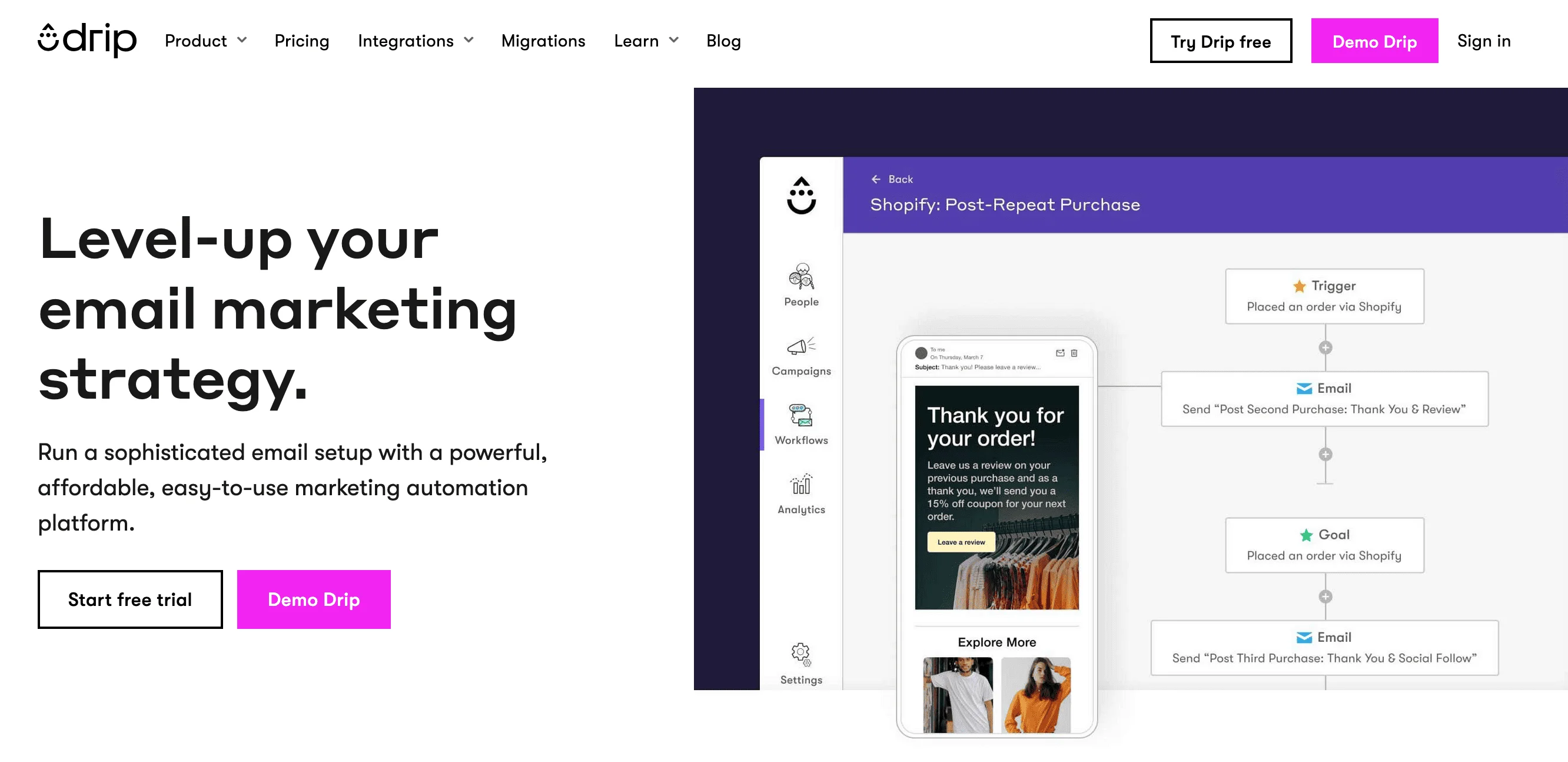
For companies looking to market themselves across a range of different channels, Drip might be the best alternative to Omnisend. Compared to Omnisend, Drip provides more advanced behavioral automation and customer lifecycle targeting for growing DTC brands.
This platform places an emphasis on sales funnel automation, making it a particularly good fit for e-commerce websites. It should be noted, however, that these features are better suited to more experienced marketers.
Drip is fairly expensive compared to other options on this list, with dynamic pricing dependent on contact list size and email volume. It doesn’t have a free option, either, though it does offer a 14-day trial with no credit card required.
Pros
- The platform allows easy contact list management.
- Analytics and reporting, including conversion and revenue rates, are comprehensive.
- You can employ useful automation sequences.
Cons
- It’s quite expensive compared to other email service providers.
- No drag-and-drop automation workflow builder.
- The learning curve may be too steep for inexperienced users.
Pricing
- Starting at $39/month, 1–2,500 contacts, unlimited email sends, email support, dynamic segments, up to 50 workflows, forms, and more.
Klaviyo — Best for multi-channel marketing
Finally, we come to Klaviyo, the last entry in this curated list of Omnisend alternatives. Businesses that outgrow Omnisend’s reporting and segmentation capabilities often migrate to Klaviyo for its deeper ecommerce analytics and personalization tools.
This platform helps marketers send automated push notifications and emails to subscribers. It has features designed to analyze customer behavior, as well as AI tools to help you design, send, and monitor promotional and transactional emails.
Unfortunately, beginner marketers may want to opt for a different service. This is because it may take a long time to learn how to use the platform. It uses many technical terms which can be off-putting for inexperienced users.
Pros
- To begin, you need to go through a 3-step setup process.
- Advanced analytics and reporting will help you manage campaigns easily.
- You can create customer profiles and subscriber segments.
Cons
- It’s more expensive than some other competitors of Omnisend.
- It’s unsuitable for inexperienced marketers.
- Software issues like slowing down when working with complex automation workflows.
Pricing
- Free plan: 0–250 active profiles, 500 emails/month, 150 free monthly SMS/MMS credits, email support for 60 days.
- Email plan: $20/month for 251–500 active profiles, 5,000 emails/month, 150 free monthly SMS/MMS credits, SMS/MMS fees, mobile push notifications.
- Email and SMS plan: $35/month for 251–500 active profiles, 5,000 emails/month, 150 free monthly SMS/MMS credits, SMS/MMS fees, mobile push notifications.
Netcore Cloud — Best for AI-Powered customer engagement
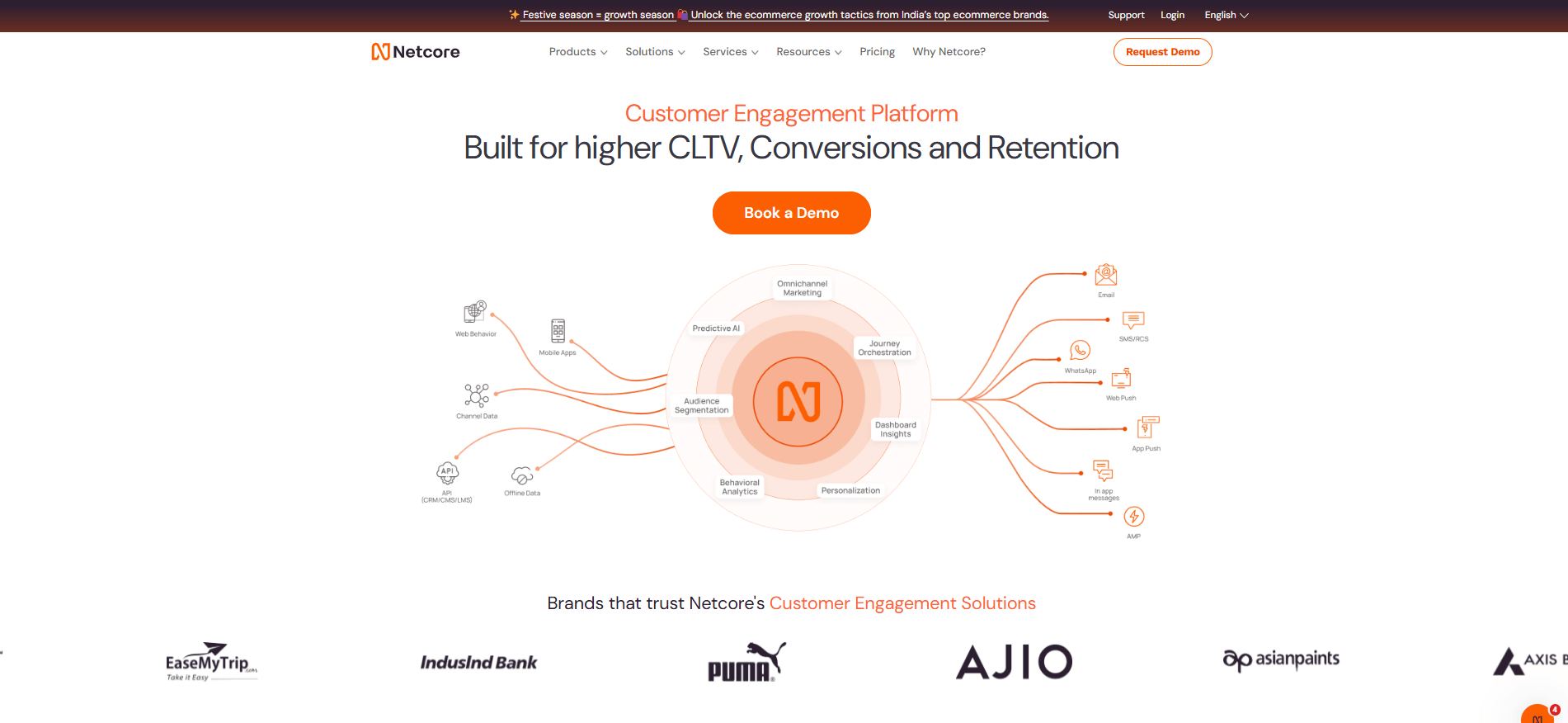
If you want more than email marketing, try Netcore Cloud. This customer engagement platform helps you connect with your audience across email, SMS, WhatsApp, RCS, web push, and in-app messages.
You can build journeys, send real-time alerts, and create personalized campaigns. These include product recommendations or even interactive emails where users can shop directly.
The platform’s AI engine studies billions of interactions to predict churn and improve conversions. It also delivers 1:1 personalization on web and mobile. You get clear and advanced insights with funnels, cohorts, and revenue reports. This makes it easier to track retention and lifetime value.
Pros
- Omnichannel support
- Industry-leading email deliverability
- Personalization and predictive segmentation
- Real-time triggers to automate customer journeys
- Detailed analytics to track churn and conversions
- APIs and webhooks to make sure messages always get delivered
Cons
- Some features may take time to learn
- Pricing is aimed at enterprises, not beginners
Pricing
Netcore Cloud offers custom pricing based on business needs.
Conclusion
There are many email platforms like Omnisend on the market. The tricky part is finding one that ticks all your boxes without breaking the bank. We hope that you’ve managed to find at least one to suit your needs in this list of ten alternatives.
The best Omnisend alternative ultimately depends on your business model, technical needs, and growth stage.
Smaller teams may prioritize affordability and ease of use, while larger ecommerce brands often need deeper automation, reporting, and customer segmentation.
For businesses looking for a balance between usability, pricing, and core email marketing functionality, Selzy is a strong option worth considering.

 New and noteworthy on our blog