


Key takeaways
- Customer acquisition cost (CAC) is crucial for tracking expenses and ensuring profitability despite high sales.
- CAC is calculated by dividing acquisition expenses by the number of new customers gained.
- Assess CAC against metrics like customers' lifetime value (LTV) and marketing ROI.
- Factors affecting CAC include company age, industry, marketing channels, sales process, and target market.
- LTV to CAC ratio should ideally be 3:1 for maximum profitability.
- Other metrics to track alongside CAC are Return on Ad Spend (ROAS) and churn rate.
Growing businesses need to attract customers, but it’s important to keep track of your expenses. Otherwise, your company may not be profitable even with a huge number of sales.
Customer acquisition cost (or CAC) is the exact metric you need to track to make sure your marketing efforts align with your overall strategy. In this article, we’ll explain what customer acquisition cost is, how to calculate it, and what you can do to reduce it.
What is customer acquisition cost?
CAC (customer acquisition cost) evaluates how much you spend on acquiring one customer. CAC is usually calculated for a certain time period — a week, a month, or the duration of a promotional campaign.
CAC helps growing businesses stay on track and reach profitability. A good CAC also shows potential investors that your business model is sustainable.
Getting new customers is important, but if the cost is too high, something definitely needs to change. For example, you might end up reassessing your marketing budget allocation or rethinking the sales efforts.
Plus, it’s helpful to assess CAC against other metrics like customers’ lifetime value (LTV) and marketing ROI.
How to calculate customer acquisition cost
To get your CAC, you need to divide the amount spent on customer acquisition over a set period by the number of new customers you gained during the same time.
Here’s the CAC formula you can use:
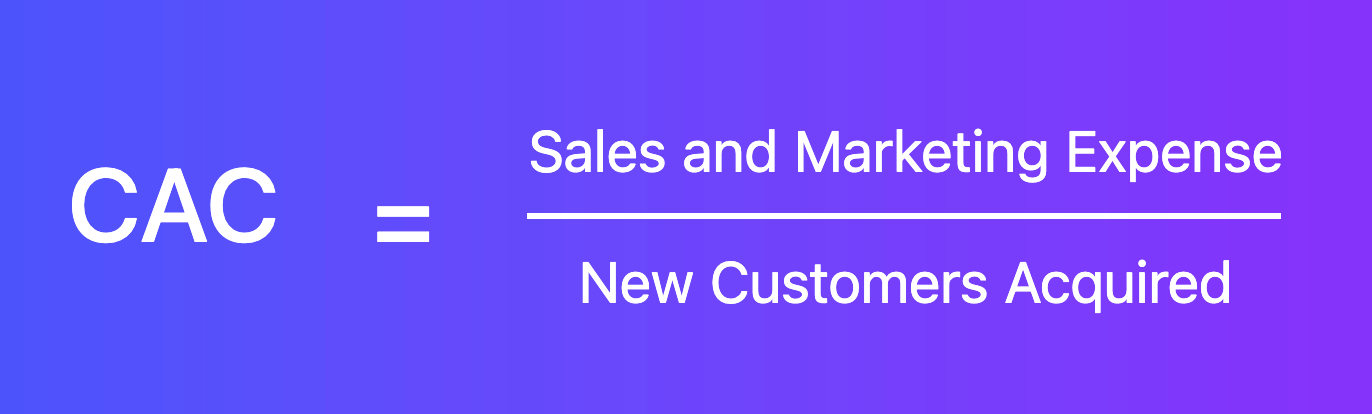
The acquisition expenses in the formula include marketing and sales expenses, while the new customers acquired usually mean those who made their first purchase.
Let’s break down the customer acquisition calculation even more. Your sales expenses need to include:
- Your sales team’s salaries and benefits, and commissions.
- Hiring and onboarding expenses for the new sales team employees.
- Sales tools costs.
As for the marketing expenses, add up the following:
- Your marketing team’s salaries, bonuses, benefits, etc.
- Costs associated with marketing software, like website hosting, email marketing software subscription, content creation tools, etc.
- Paid advertising campaigns.
- Costs for events and sponsorships.
- Samples, discounts, and free trials cost.
Depending on your business, there might be other expenses you should include.
Use our CAC calculator below to easily calculate your customer acquisition cost.
CAC Calculator
CAC is compared to the customer’s lifetime value (LTV). The only way to know whether you are getting customers profitably or at a loss is to calculate the LTV to CAC ratio.
Other aspects that affect CAC
It might be tempting to boil CAC down to just your sales and marketing expenses, but customer acquisition costs are influenced by more than just these. Your business’s CAC can be higher or lower depending on these factors:
- Company age and industry. Newer companies and those entering a new market will naturally have a higher CAC since they’re just starting out. Plus, some industries are more competitive than others, which can also increase the acquisition costs.
- Marketing channels. The cost per advertisement can differ from one platform to another. That’s why it’s a good idea to calculate CAC for each marketing channel separately and compare their effectiveness.
- Sales process. It’s beneficial to evaluate CAC in connection with the average sales cycle length. For example, if your sales cycle is longer than a month, a month-to-month CAC estimation won’t be telling. In that case, it’s best to analyze an average CAC for 3 months or half a year.
- Target market. If your business operates on a subscription model, a higher CAC is not that alarming. The acquisition may cost you more than the monthly amount of money you get from that person, but the payments are recurring, so it’s actually a normal situation.
LTV to CAC ratio
CAC is often estimated alongside the customer’s lifetime value (LTV). LTV estimates the total revenue one customer brings throughout their relationship with your business.
To calculate LTV, multiply the average revenue per customer by the average customer lifespan.
CAC and LTV go side-by-side, and the ratio between these metrics is a good indicator of how profitably your business works.
For maximum profitability, the LTV to CAC ratio should be 3:1.
This means that a customer brings your business three times as much money as you spent on acquiring them.
If the ratio skews close to 1:1, you probably spend too much on your sales and marketing efforts and aren’t getting enough value out of the customers you get.
If your LTV is significantly higher than CAC (for example, a customer gets you five or six times as much money as you spent on attracting them), you are likely not investing enough into acquisition and can benefit from doing so.
Other metrics to track alongside CAC
Besides CAC and LTV, there are other metrics you can use to keep track of the sales and marketing budgets and your efforts’ return on investment.
Return on Ad Spend (ROAS)
ROAS shows how much money a dollar spent on advertising brings you in revenue. This metric is another indicator of whether your marketing campaigns are effective and worthwhile.
To calculate ROAS, divide the revenue you get from advertising by the amount of money you spent on it, and then multiply the result by 100 to get the percentage.
The higher your ROAS, the better. So, if it is low, your advertising might need an overhaul.
Churn rate
Churn rate measures the percentage of customers or subscribers who have stopped doing business with your company after a certain period. Getting value out of staying customers can offset the acquisition expenses, so this metric is good to keep an eye on together with CAC.
To calculate churn rate, divide the number of customers you have lost (at the end of the period) by the number of customers you initially had (at the start of the period) and multiply the result by 100 to get the percentage.
The lower your churn rate is, the better. If it is high, even if your customer acquisition costs are good, your business is losing money rather than making a profit. A high churn rate indicates issues with retention, during the stages after acquisition.
Best tips to improve your CAC
If your CAC is higher than you’d like, here are some strategies to improve it.
Research your target market
Take time to get to know your customers. Where and how do they shop? What are their pain points, wants, and needs? Why are they choosing your competitors instead of you?
Conduct surveys, interviews, and focus groups and create marketing personas to know how to address your prospects most effectively.
Choose proper marketing channels
During your customer research process, make sure to analyze your target audience’s preferred channels. Meet leads where they are: maybe your customers expect digital experiences you don’t offer yet. For example, younger people might opt out of a marketing offer if they need to make a call to get it. Alternatively, you might end up getting rid of a channel if it yields few results and doesn’t match your customers’ profile.

Improve your value proposition
First of all, examine your marketing campaigns and advertising. They need to clearly show the value of your products or services. If customers can understand the benefit they’ll get from your business right away, they can make the purchase faster.
Conduct campaign A/B testing to determine which offers work best for your leads. For example, you might compare percentage discounts with dollar-off advertisements.
Prioritize good customer experience
Investing in customer relationships can help, too. Make customer experience a priority and engage with leads by offering personal communications. Optimize your landing pages so that the path to conversion is as smooth as possible.
Listen to customer feedback
Ask your customers to leave reviews, send out surveys, or conduct interviews. This way, you’ll learn your business’s strengths and weak points and then act on your findings.
You can also check review websites and forums like Reddit to learn more about public perception of your products and your company.
Use word of mouth and UGC marketing
Another strategy is to request referrals. This way, your existing customers can bring in the new ones practically for free.
Motivating your customers to create user-generated content (UGC) is a great tactic, too. Plus, it can improve your company’s image and serve as a form of social proof.
Focus on high-paying customers
Identify the most profitable customer groups and prioritize marketing campaigns that target them specifically. Use segmentation and personalization to make your offers extra specific and relevant.
Conclusion
Now that you know how to calculate CAC, monitor the rate regularly. Seeing it dynamically helps to determine which areas need to be focused on more, what works well, and what doesn’t.
 New and noteworthy on our blog