



Key takeaways
- Cold email templates are starting points that should be personalized with relevant triggers, problems, proof, and a clear next step.
- Choose templates based on the situation, not just the formula name.
- Keep emails flexible by replacing placeholders and removing irrelevant lines.
- Sales templates include timely triggers, three-sentence emails, AIDA, BAB, PAS, competitor comparisons, case studies, free trials, and samples.
- Networking templates cover shared connections, partnership pitches, and event invitations.
Cold email templates are reusable starting points, not messages to send unchanged. The best template gives you a clear structure while leaving room for a relevant trigger, a recipient-specific problem or goal, credible proof, and one simple next step. This guide includes 17 copy-ready cold email templates for sales, partnerships, careers, recruiting, and follow-ups — plus practical ways to personalize them without spending hours on every message.
How to choose the right cold email template
Choose by situation, not by formula name. Use a trigger-based email when you have a timely reason to write, a problem-led email when you can name a credible pain point, a referral email when there is a genuine shared connection, and a routing question when you are unsure who owns the problem.
- Start with relevance: Why this person, company, and moment?
- Add evidence: Use one verifiable observation, not a generic compliment.
- Make one ask: Request a reply, permission to send information, or a short conversation — not all three.
- Keep the template flexible: Replace every bracketed field and remove any line that does not fit.
Cold email templates for sales and lead generation
These examples preserve useful frameworks such as AIDA, BAB, and PAS, but make the wording easy to copy and adapt. Never invent a trigger, customer result, or pain point.
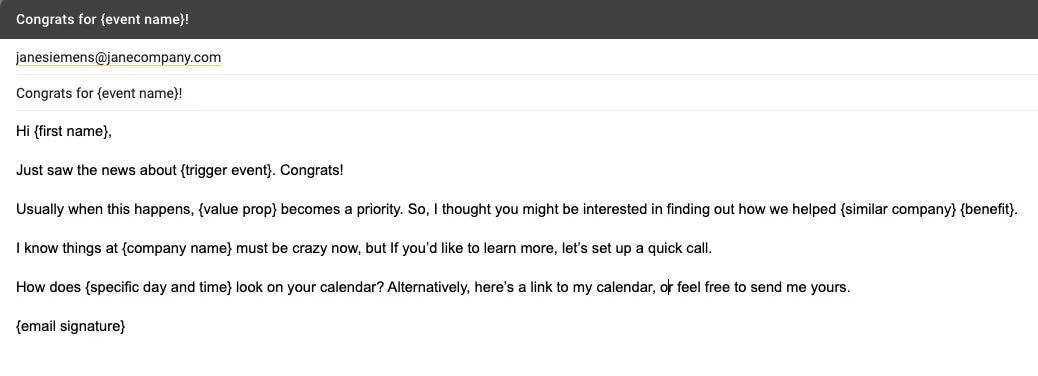
1. A timely trigger
Subject: A thought after [event or announcement]
Hi [First name],
I saw [specific event, launch, hire, or announcement]. Teams at this stage often run into [relevant problem].
We helped [similar company or role] achieve [credible result] by [brief mechanism]. Would it be useful if I sent the two ideas most relevant to [Company]?
Best,
[Name]
Best for: A prospect with a recent, verifiable reason to contact them.
Why it works: It explains why you are writing now and avoids a generic opening.
Personalize this: The trigger, likely problem, and proof point.
2. The three-sentence email
Subject: Who owns [problem] at [Company]?
Hi [First name] — I help [type of team] reduce [problem] by [mechanism].
Is this something you handle at [Company]? If not, who would be the right person to ask?
Thanks, [Name]
Best for: Finding the right contact or reaching a busy senior prospect.
Why it works: It is easy to scan and asks for a low-effort response.
Personalize this: The problem and the team you help.
3. Attention-interest-desire-action (AIDA)
Subject: A simpler way to [desired outcome]
Hi [First name],
[Relevant observation] may be making it harder for [Company] to [goal].
[Product or approach] helps [similar teams] [benefit] without [common tradeoff]. For example, [short proof point].
Would a 15-minute look at the workflow be useful next week?
Best, [Name]
Best for: A clear offer with a defensible benefit and proof.
Why it works: It moves logically from relevance to benefit and one action.
Personalize this: The observation, desired outcome, and proof.
4. Before-after-bridge (BAB)
Subject: From [current problem] to [desired state]
Hi [First name],
When [current process] depends on [friction], teams often lose [time, revenue, or visibility].
Imagine having [specific improved state] instead. [Product or service] acts as the bridge by [one-sentence explanation].
Is improving [metric or workflow] a priority this quarter?
Best, [Name]
Best for: A prospect whose current workflow and desired state are understood.
Why it works: The message stays focused on the recipient rather than product features.
Personalize this: The before state, after state, and business impact.
5. Problem-agitate-solve (PAS)
Subject: Reducing [specific problem] at [Company]
Hi [First name],
[Specific problem] can lead to [consequence], especially when [relevant condition]. Left unchecked, it often creates [second-order impact].
We help [type of team] solve this by [brief method]. Would you be open to a short example?
Best, [Name]
Best for: A well-researched pain point with a measurable consequence.
Why it works: It makes the cost of inaction clear without using fear or exaggeration.
Personalize this: The problem, consequence, and relevant condition.
6. Competitor or current-tool alternative
Subject: An alternative approach to [current tool or process]
Hi [First name],
I noticed [Company] uses [tool or process]. If [limitation] is becoming an issue, [your solution] may be worth comparing because it [specific differentiator].
Would a one-page side-by-side focused on [priority] be helpful?
Best, [Name]
Best for: A prospect whose current solution is known from a reliable source.
Why it works: It offers a comparison without attacking the competitor.
Personalize this: The current solution, limitation, and comparison criterion.
7. Relevant case study
Subject: How [similar company] improved [metric]
Hi [First name],
[Similar company] faced [problem] while trying to [goal]. After [brief change], they achieved [verified result].
The situation reminded me of [specific observation about Company]. Would you like the short case study?
Best, [Name]
Best for: Prospects who need evidence before agreeing to a meeting.
Why it works: The CTA offers useful proof instead of immediately requesting time.
Personalize this: The peer company, observation, and relevant result.
8. Free trial or useful sample
Subject: A low-risk way to test [outcome]
Hi [First name],
Based on [relevant signal], I think [Company] could benefit from [outcome].
We can offer [trial, audit, sample, or limited resource] so you can evaluate [specific capability] before making a decision. Would you like access?
Best, [Name]
Best for: A genuinely useful, clearly limited trial or sample.
Why it works: It reduces commitment while keeping the next step specific.
Personalize this: Why the offer fits and what the recipient can evaluate.

Cold email templates for networking and partnerships
A strong networking email explains the genuine connection between you and the recipient. The goal is not to manufacture familiarity but to make the mutual value and expected commitment clear.
9. Shared connection or referral
Subject: [Shared contact] suggested I reach out
Hi [First name],
[Shared contact] mentioned that you are working on [topic] and suggested I contact you. I have experience with [relevant contribution] and thought [specific idea] might be useful.
Would you be open to a brief conversation, or would you prefer I send the idea by email?
Best, [Name]
Best for: A real referral where the shared contact has given permission to be named.
Why it works: It supplies context and trust without overstating the relationship.
Personalize this: The connection, topic, and contribution.
10. Partnership pitch
Subject: Partnership idea for [Company] and [Your company]
Hi [First name],
I noticed our audiences overlap around [specific need]. A collaboration such as [concrete format] could give your audience [benefit] and ours [benefit].
If that direction fits, I can send a one-page outline with responsibilities and promotion ideas. Interested?
Best, [Name]
Best for: Co-marketing, content, integration, or referral partnerships.
Why it works: It states the mutual value and proposes a concrete next step.
Personalize this: Audience overlap, format, and benefit for each side.
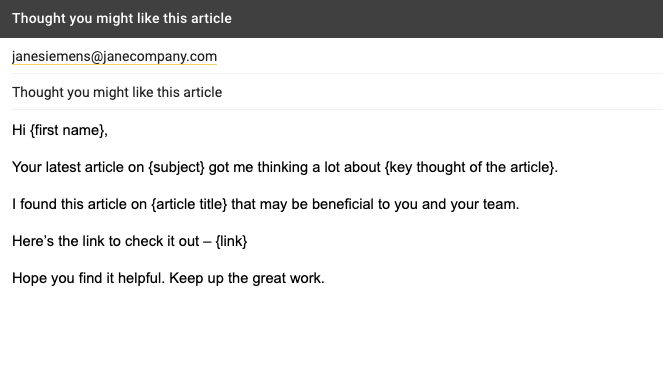
11. Event, webinar, or podcast invitation
Subject: Invitation: share your perspective on [topic]
Hi [First name],
Your work on [specific project or idea] would add a useful perspective to our [event, webinar, or podcast] about [topic]. The audience is [brief audience description], and the format is [time and format].
Would you like the full brief before deciding?
Best, [Name]
Best for: Inviting a credible guest for a defined audience and format.
Why it works: It shows why the person was chosen and makes the commitment clear.
Personalize this: Their work, audience fit, and event details.
Cold email templates for jobs, research, and recruiting
Career outreach works best when it connects your evidence to a specific team, project, or research area. Avoid broad praise and make it easy for the recipient to route your request.
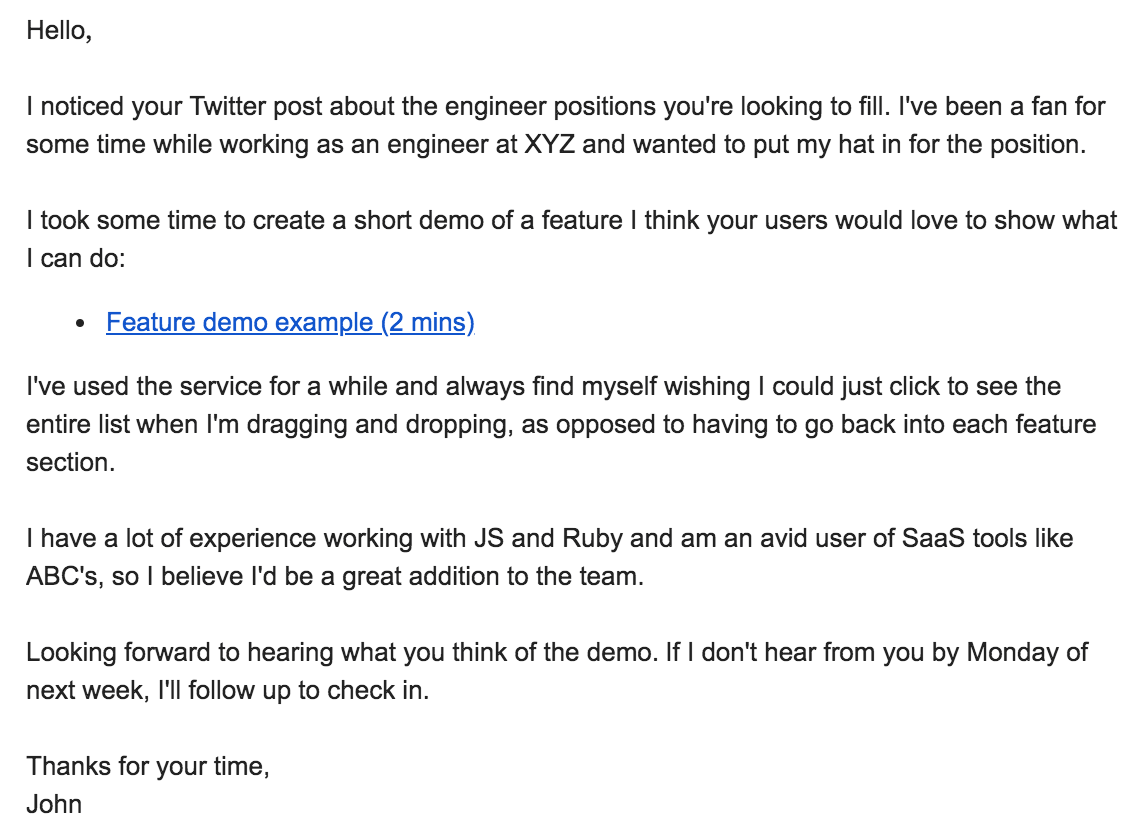
12. Job inquiry
Subject: Idea for [team or role] at [Company]
Hi [First name],
I have been following [specific company initiative]. My background in [relevant skill] includes [brief proof], and I see an opportunity to help with [specific contribution].
Are you the right person to ask about upcoming [role or team] needs? I can send a concise portfolio example.
Best, [Name]
Best for: A targeted inquiry when a suitable role may not be advertised.
Why it works: It connects evidence to a company need instead of sending a generic résumé.
Personalize this: The initiative, contribution, and proof.
13. Research or internship outreach
Subject: Research interest in [specific topic]
Dear [Title and last name],
I read your work on [specific paper or project], especially [precise detail]. I am a [student or researcher] with experience in [relevant method or subject].
I would like to contribute to [specific area] through [internship, assistantship, or project]. May I send a one-page summary of my relevant work and availability?
Sincerely, [Name]
Best for: Academic research, labs, and specialized internships.
Why it works: It demonstrates genuine subject knowledge and asks permission for the next step.
Personalize this: The work cited, research fit, and relevant method.
14. Recruiting outreach
Subject: [Role] opportunity connected to your work on [topic]
Hi [First name],
Your experience with [specific project or skill] looks relevant to a [Role] opening at [Company]. The role focuses on [two concrete responsibilities] and offers [relevant working arrangement or scope].
Would you like the full job brief and salary range before deciding whether to talk?
Best, [Name]
Best for: Recruiters contacting a candidate with a credible match.
Why it works: It gives enough information for an informed response.
Personalize this: The candidate’s work, role scope, and transparent details.
Cold follow-up email templates
A follow-up should add value or clarify timing. A practical sequence is an initial follow-up after a few business days, another message later with a useful example or resource, and a polite close-the-loop email. Adjust the timing to the context and stop when the recipient opts out.
15. Value-adding follow-up
Subject: Re: [original subject]
Hi [First name],
Following up with one detail that may help: [new insight, example, or resource related to their problem].
If [priority] is on your roadmap, I can send [specific useful item]. If not, no problem.
Best, [Name]
Best for: A first follow-up after a few business days.
Why it works: It adds information instead of merely asking whether the email was seen.
Personalize this: The new value and the recipient’s priority.
16. Close-the-loop or breakup email
Subject: Should I close the loop?
Hi [First name],
I have not heard back, so I will assume [topic] is not a priority right now and close the loop.
If the timing changes, reply with [simple word or action] and I will send the relevant information.
Best, [Name]
Best for: The final message in a short, respectful sequence.
Why it works: It removes pressure and gives the recipient control.
Personalize this: The topic and easy re-entry action.
17. Re-engagement after earlier interest
Subject: Still exploring [goal]?
Hi [First name],
When we last spoke, you were considering [goal or project] but [timing or blocker] paused it. Since then, [relevant update, resource, or change].
Is this worth revisiting, or should I check back at a different time?
Best, [Name]
Best for: A contact who previously showed genuine interest.
Why it works: It acknowledges the history and offers a useful reason to reconnect.
Personalize this: The previous context, blocker, and new development.

How to personalize a cold email template
Good personalization is useful relevance, not simply inserting a first name. Before sending, check four inputs:
- Trigger: a recent launch, role change, public project, stated priority, or other verifiable reason to write.
- Problem or goal: something connected to the recipient’s role and the evidence you found.
- Proof: one accurate customer result, example, credential, or relevant piece of work.
- CTA: one low-friction next step that matches the stage of the conversation.
Research can be brief when the fit is clear. Check the company site, the recipient’s role, and one current source. Never use AI-generated details unless you verify them. Keep the email focused on what the recipient may gain, and finish with a professional signature containing your name, role, organization, and a reliable contact method.
For more guidance, see Selzy’s guide on how to write a cold email that gets responses.
Deliverability, consent, and compliance checklist
Before launching cold outreach, protect both the recipient experience and your sender reputation:
- Have a legitimate, relevant reason to contact the person.
- Use accurate sender and subject-line information.
- Provide a clear way to opt out when required, and suppress contacts who unsubscribe.
- Verify addresses and avoid sending a large untested batch.
- Keep records of your source and the reason the contact is relevant.
- Check the rules that apply to the recipient’s region and your organization.
This is practical guidance, not legal advice. In the United States, the FTC states that CAN-SPAM applies to commercial email, including business-to-business messages, and requires accurate headers, non-deceptive subject lines, a physical postal address, and a working opt-out process. Other regions may impose additional requirements.
Wrapping up
The strongest cold email template is the one that matches the situation and still sounds like a real person wrote it. Start with a relevant reason, remove unnecessary lines, verify every claim, and ask for one reasonable next step.
| Situation | Recommended template | Personalization input | CTA type |
| Recent company event | Timely trigger | Event and likely impact | Offer to send ideas |
| Unsure who owns the problem | Three-sentence routing email | Role and problem | Ask for the right contact |
| Clear pain point | PAS | Problem and consequence | Offer a relevant example |
| Needs proof | Case study | Peer company and verified result | Offer the case study |
| Shared connection | Referral | Permission and shared context | Ask preferred next step |
| Career or research inquiry | Job/research outreach | Project and contribution | Ask permission to send work |
| No response | Value-adding follow-up | New insight or resource | Simple reply |
| Final follow-up | Close-the-loop | Topic and re-entry action | Close politely |
FAQ
What should a cold email include?
A strong cold email should include a relevant trigger or reason for writing, a recipient-specific problem or goal, one credible proof point, and one simple next step. The article also recommends making only one ask, such as a reply, permission to send information, or a short conversation. Keep the message focused on relevance rather than generic praise or multiple requests.
How long should a cold email be?
The article does not give a strict word count, but it emphasizes keeping the email easy to scan and concise. A useful rule is to use a flexible template, replace every bracketed field, and remove any line that does not fit the situation. The three-sentence format is highlighted as especially easy to read for busy recipients.
How should I personalize a cold email template?
Personalize the trigger, the likely problem, and the proof point so the email fits the person, company, and moment. Start with a verifiable observation, not a generic compliment, and never invent a trigger, customer result, or pain point. Replace every bracketed field and cut any line that does not apply.
How many follow-ups should I send?
The article mentions follow-up templates, but it does not specify how many follow-ups to send. It focuses instead on making each message relevant, simple, and easy to respond to. If you do follow up, keep using one clear ask and a specific reason for reaching out.
Are cold emails legal?
The provided content does not address the legal status of cold emails. It only explains how to write and personalize them effectively. For legal questions, you would need guidance from a source that specifically covers compliance.
 New and noteworthy on our blog
