


Key takeaways
- Back-to-school email marketing should be a short, coordinated campaign, not a single send
- Start early and segment audiences like parents, students, and teachers
- Offer value and match the offer to the audience's needs
- Use email templates for consistency and faster launch
- Provide useful content like checklists and guides
- Use emojis in subject lines intentionally
- Offer discounts, free shipping, bundles, and incentives
- Tailor subject lines to convey audience, benefit, or deadline clearly
- Use interactive elements like GIFs to engage subscribers
Back-to-school email marketing works best as a short, coordinated campaign rather than a single promotional send. Start early, segment parents, students, teachers, and other audiences, match the offer to their needs, and combine useful content with timely reminders. This guide covers the strategy, examples, and subject lines you can use to build your campaign.
Why send out back-to-school emails
Back-to-school season brings a concentrated wave of planned spending from families, college students, and teachers. It is relevant not only to school-supply retailers: fashion, electronics, food, home goods, personal care, education, and service businesses can all connect their products to new routines.
According to the National Retail Federation’s 2026 survey, 62% of back-to-school shoppers had already started by early July. Families with children in elementary through high school planned to spend an average of $863.86, with total K–12 spending expected to reach a record $43.3 billion.
Value matters. Among shoppers who had not bought at least half of their list, 46% were waiting for better deals, while 47% planned to buy only the essentials first and replenish supplies later. Half of shoppers expected to buy online.
For email marketers, these patterns point to four opportunities:
- Reach early shoppers before inbox competition peaks.
- Help budget-conscious customers compare options and find relevant deals.
- Segment messages for K–12 families, college students, teachers, and other audiences.
- Continue after the first day of school with replenishment and forgotten-essential campaigns.
Best strategies for back-to-school email marketing
A strong campaign connects timing, audience, offer, and creative. Use the framework below as a starting point, then adjust it to local school calendars, delivery times, and customer behavior.
Start early and plan a sequence
Do not wait for one last-minute blast. NRF found that 62% of shoppers had started by early July in 2026, so build a sequence that covers discovery, comparison, purchase, and replenishment.
- 4–6 weeks before school: Announce the season, share a checklist or guide, and collect preferences.
- 2–3 weeks before: Launch the main offer and recommend products by audience or use case.
- Final week: Highlight shipping cutoffs, pickup options, stock levels, and offer deadlines.
- First weeks of school: Promote forgotten essentials, refills, dorm upgrades, and complementary products.
Test the cadence against engagement. Suppress subscribers who have already purchased when the next message is no longer relevant, or move them into a post-purchase follow-up.
Segment audiences and match the offer
| Audience | Likely needs | Email angle |
| Parents of K–12 students | Essentials, clothing, lunch supplies, value | Checklists, bundles, price tiers, delivery reminders |
| College students and families | Electronics, dorm items, food, personal care | Dorm guides, compact products, student offers |
| Teachers | Classroom supplies, organization, personal purchases | Teacher appreciation, bulk options, practical resources |
| Non-school audiences | New routines and the end of summer | Productivity resets, fall refreshes, “back to routine” themes |
Go beyond demographics when your data allows it. Segment by past purchases, browsing behavior, location, engagement, preferred price range, and whether someone responded to an earlier back-to-school message.
Choose value before novelty
Price and convenience deserve a prominent place in 2026 campaigns. Make savings easy to understand, state exclusions clearly, and consider bundles, free shipping thresholds, loyalty rewards, or useful gifts. If a discount is not appropriate, compete with guidance, curation, convenience, or exclusive access.
Use cultural trends selectively
A trend can make a campaign feel current, but forced slang or an unrelated visual reference can date it quickly. Check whether the trend is recognizable to your actual audience, fits the brand, and supports the offer. Test trend-led creative against an evergreen version instead of assuming novelty will perform better.
Use email templates to launch faster
A sequence needs consistent design across several sends. Responsive email templates can reduce production time while keeping the hierarchy, CTA, and mobile layout consistent. Adapt the template to one clear goal per email rather than placing every category and offer into one message.
Add value with help and advice
Useful content can earn attention before a subscriber is ready to buy. Try packing lists, dorm checklists, lunch ideas, teacher resources, sizing guides, or “what you may have forgotten” reminders. Connect the advice to a relevant next step without turning every paragraph into a sales pitch.
Use emojis with intent
Emojis can add a visual cue to a subject line, but they are not a substitute for a clear benefit. Use one when it matches the brand and audience, check how it renders across devices, and A/B test it against a text-only version. Avoid relying on an emoji to communicate an essential deadline or condition.
Offer discounts and incentives
Free shipping, bundles, tiered savings, gifts with purchase, and loyalty rewards can all support a back-to-school offer. Match the incentive to the segment and margin, explain the value plainly, and give the reader one primary CTA.
Ideas for back-to-school email content
Back-to-school emails can be either informational or promotional. Both types serve distinct purposes and should have different subject lines and designs.
Informational emails
These campaigns are all about giving your customers useful information that will help them as they head back to school or college. It’s a way to build trust and credibility with your audience, and it can also be a valuable way to drive traffic to your website or online store.
In fact, you can come up with a lot of informative content for your back-to-school emails:
- How to be more productive in the classroom.
- Fashion trends for the coming fall.
- Gift ideas for favorite teachers.
- How to help your child adjust to a new school.
- Selections of useful studying materials.
- How to make school lunches delicious and healthy.
- Poem greetings.
- Ideas for holiday hairstyles, etc.
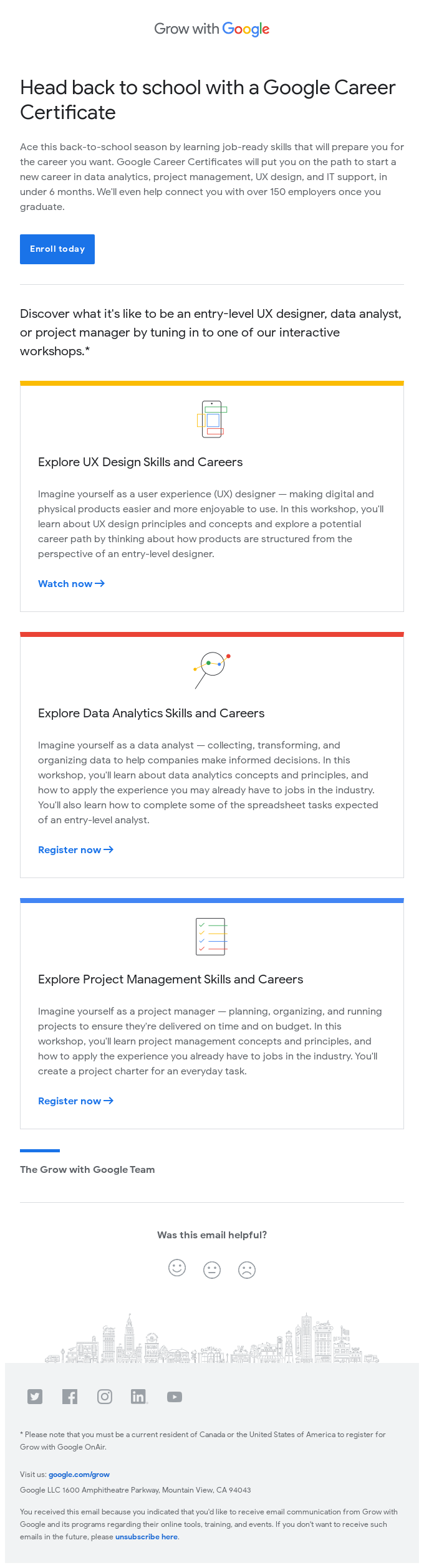
Informational email newsletters can come in handy if you’re promoting an educational organization. Here’s a great example of an informational email with resources for studying from Google:
Promotional emails
Here are some great promotional email ideas for your back-to-school campaigns:
- Give away freebies like pencils, pens, and notepads with every purchase made during the back-to-school season.
- Hold a contest for the best back-to-school photo or video and offer prizes like gift cards or discounts.
- Create a loyalty program for customers who shop with you during the back-to-school season and offer lower pricing.
- Partner with local businesses to offer discounts and promotional deals for back-to-school shoppers.
- Send out promotional emails with coupon codes and special offers for back-to-school shoppers.
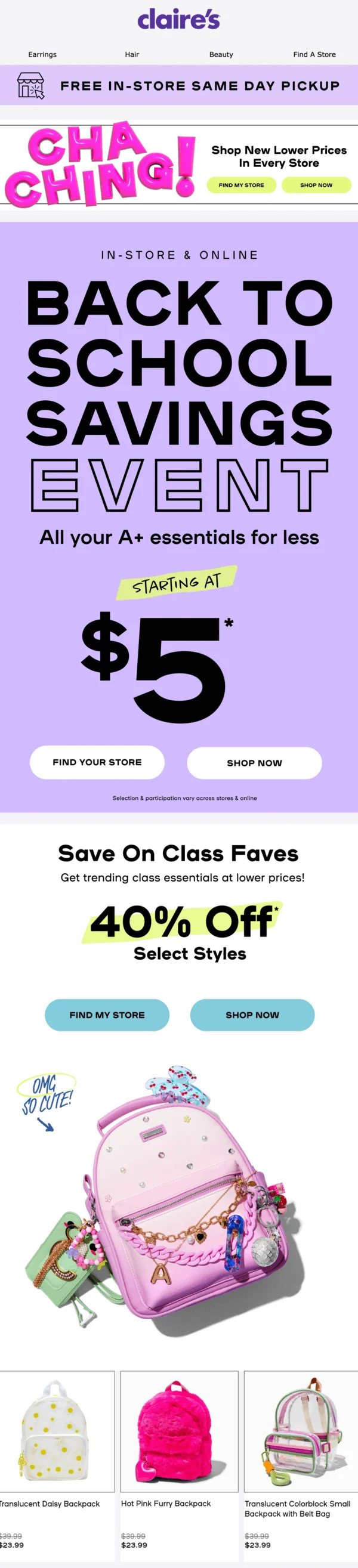
Here is a promotional campaign from Claire’s with a colorful design and a prominent banner:
Back-to-school email subject lines
The best subject line makes the audience, benefit, or deadline clear. Use these ideas as starting points and adapt the offer, product, and tone to your brand.
Early access and planning
- Your back-to-school checklist starts here
- Plan the school year without the last-minute rush
- Early access: Back-to-school favorites
- Everything you need before the first bell
- Start your back-to-school shopping early
- A smarter start to the school year
- Your first look at this year’s school essentials
- Ready, set, school: Shop the checklist
Savings and value
- Save 20% on school-day essentials
- Back-to-school value for every budget
- Build the list and save on the total
- School supplies, lower prices
- Bundle your back-to-school favorites
- Spend less on the things they need
- Free shipping on back-to-school orders
- More essentials, fewer last-minute costs
Urgency and deadlines
- Last day for delivery before school starts
- Your back-to-school offer ends tonight
- Final call for first-day essentials
- School starts soon — is your list complete?
- Order today for the first week of school
- Almost time: Finish the school list
- Don’t forget these classroom essentials
- One more thing before the first bell
College and dorm life
- Dorm essentials you’ll use all semester
- Your college move-in checklist
- Small-space picks for a better dorm
- Back to campus, ready for anything
- Study, sleep, repeat: Dorm must-haves
- College essentials beyond the syllabus
- Make move-in day easier
- Everything your dorm room is missing
Teachers and helpful content
- Teachers, this back-to-school guide is for you
- Classroom-ready picks for the new year
- A practical checklist for the first week
- Lunch ideas for busy school mornings
- What to pack for a smoother school day
- Five things families often forget
- Make the morning routine easier
- Your guide to a calmer first week
Playful options
- New year, fresh supplies ✏️
- Top marks for these school-day picks
- Backpacks packed. Lunches planned. Ready?
- Class is back in session
- Make room for a fresh start
- School-day style starts here
- Ready for the first bell? 🔔
- Consider this your back-to-school cheat sheet
Subject line and preheader pairs
- Subject: Your back-to-school checklist starts here
Preheader: Plan essentials, extras, and delivery dates in one place. - Subject: Save 20% on school-day essentials
Preheader: Shop the offer before it ends Sunday. - Subject: Dorm essentials you’ll use all semester
Preheader: Practical picks for small spaces and busy schedules. - Subject: Last day for delivery before school starts
Preheader: Order today to get everything in time. - Subject: Five things families often forget
Preheader: Check the list before the first week begins. - Subject: Teachers, this guide is for you
Preheader: Classroom-ready ideas, supplies, and time-savers.
Personalize only with reliable data, and test one meaningful variable at a time: benefit, urgency, emoji use, personalization, or offer framing. Judge the winner by downstream clicks and conversions as well as opens.

Back-to-school email campaign examples and lessons
Back to school is a great time to connect with consumers. Here are some inspirational ideas to help you make the most of this opportunity.
TOMS — Use school style
What to borrow: Use familiar school cues to make the seasonal context obvious without crowding the offer.
The typical school setting is often associated with lessons, school desks, and chalkboards. However, TOMS (a shoe company) used these same features in their newsletter to create a fun and unique design.
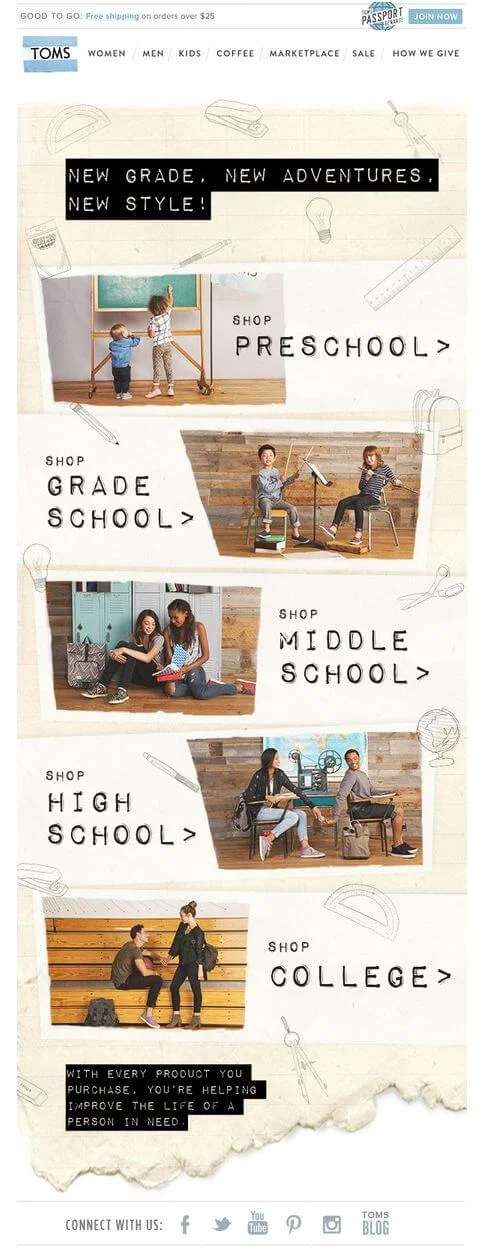
The email marketers did a great job on fall promotions by creating offers that would appeal to a wide range of people. They didn’t just focus on one group but had something for everyone. This made the email more effective and likely to result in conversions.
TOMS’ designers focus on the design of their messages, without including any information about prices or promotion duration. This creates a sense of incentive and encourages recipients to visit the website to learn more. The text of the preheader, “Free shipping”, is also prominently displayed in a different color, further highlighting this important offer.
Dresslily — Engage with GIF
What to borrow: Use motion to support urgency or demonstrate a product, and always provide a readable static fallback.
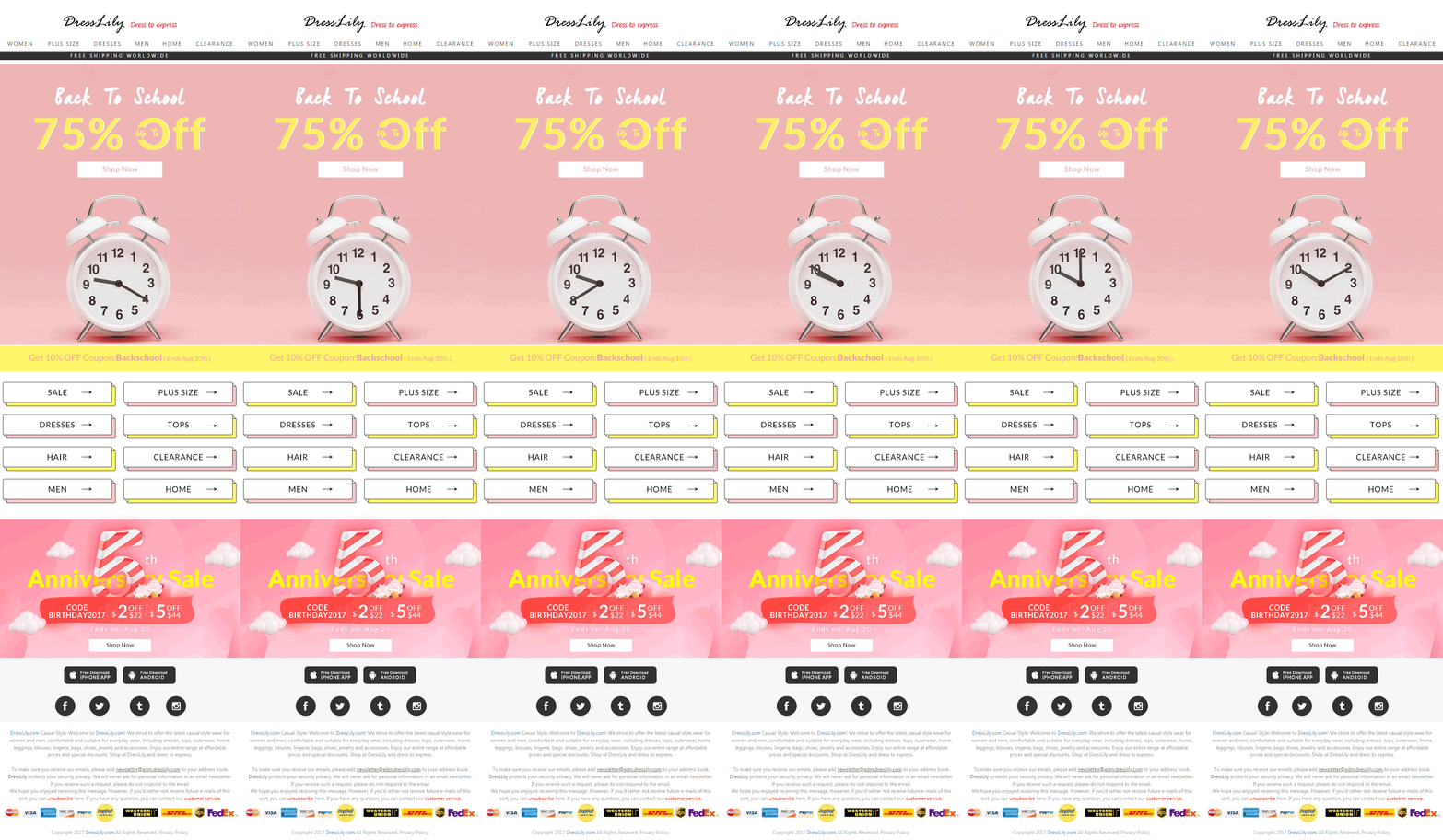
Interactive elements in email marketing can be very effective in engaging subscribers and increasing click rates. There are a few popular interactive elements that can help to enhance subscriber engagement. These include GIFs, timers, and sliders. Using videos is another great way to engage your audience.
This email from Dresslily uses a GIF of a running clock to create a sense of urgency.
Olive Ave and State — Curate products for distinct audiences
What to borrow: Let the audience determine the product mix, visual tone, and level of detail.
If you sell beauty and fashion products, make sure to do back-to-school email marketing. Choose products that complement each other to create a unified look and if you target college or university students, opt for minis or travel-appropriate formats.
For example, Olive Ave offers a selection of style inspirations perfect for young teachers or high school students.
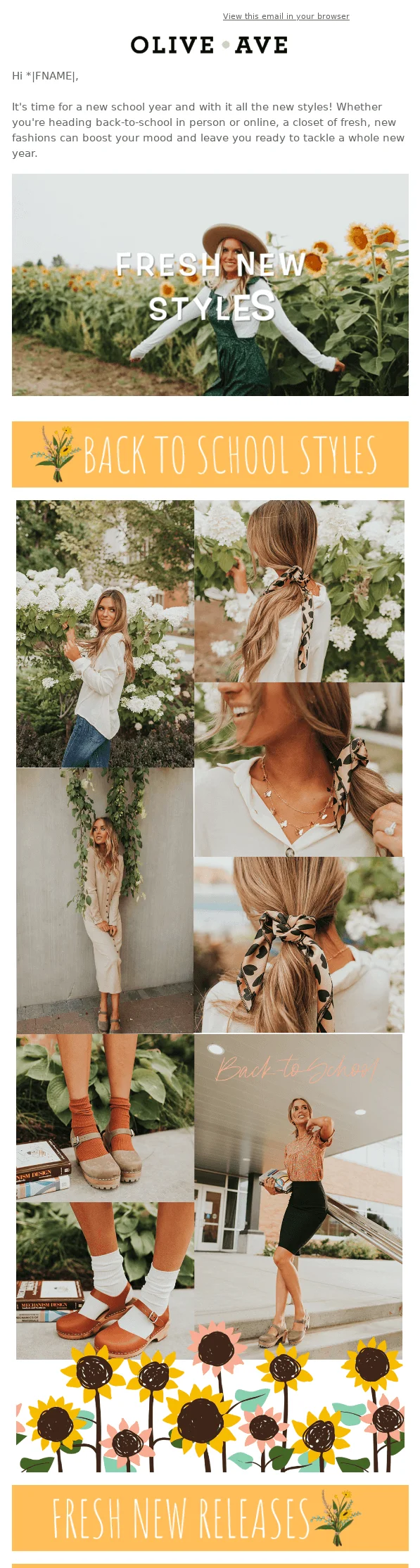
While Olive Ave clearly targets older audiences or at least those with a more mature and dress code-friendly sense of style, State focuses on kids and teenagers. Take a look at their colorful email that promotes a collection of backpacks for every taste:

Neon, printed, with flowers and dinosaurs — even the fussiest student can find something for them. We like this email because it showcases the variety of choices without being overwhelming color-wise — enough space and a calm color scheme of the whole email balances it all out.
Natural Life — Sell stationery
What to borrow: Turn expressive, identity-led products into a clear seasonal story.
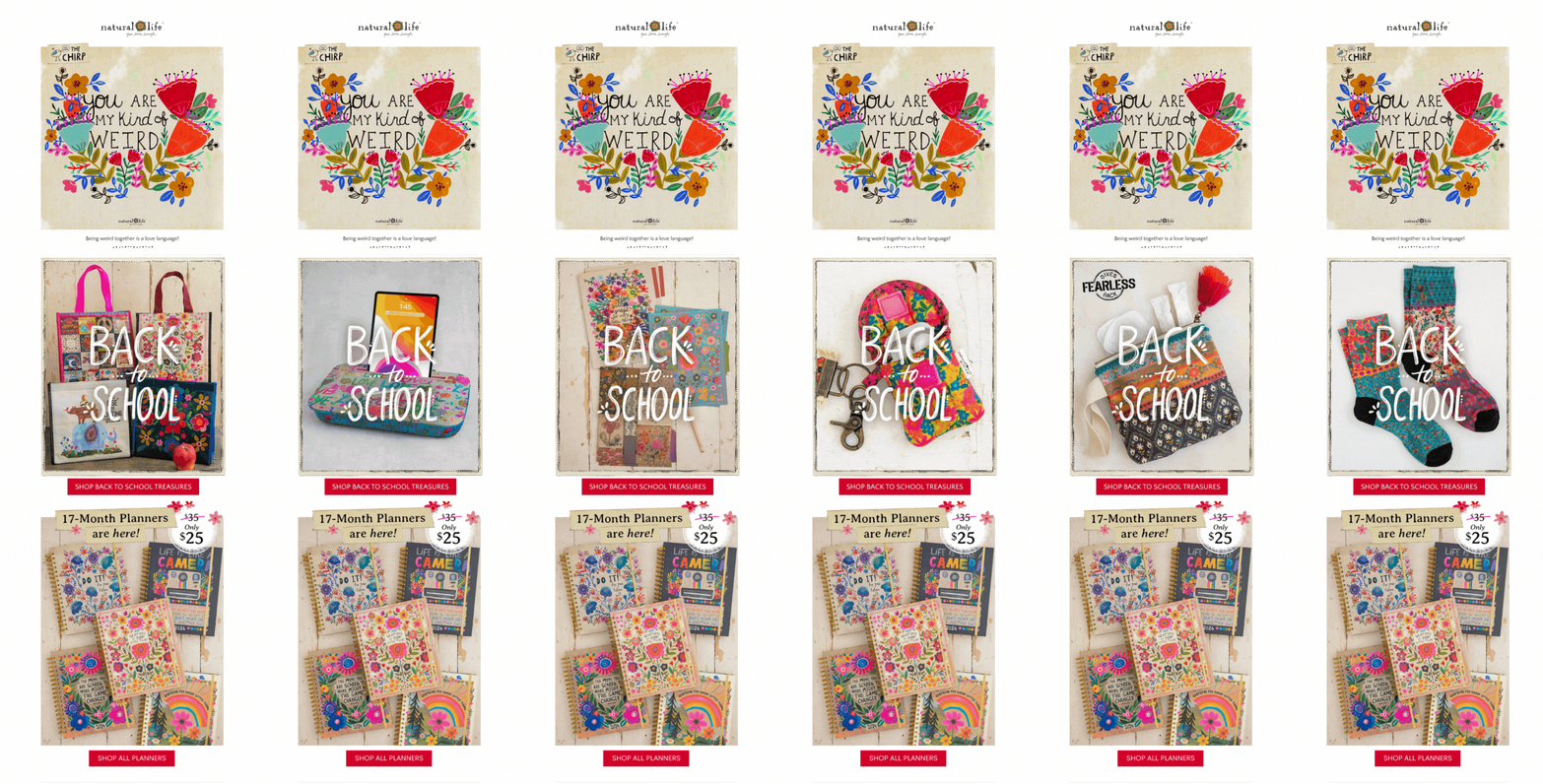
Many schools in the US and European countries have strict dress codes or even uniforms. That’s why for many school students funky notebooks and all the rest are the only means of self-expression. So, don’t neglect a back-to-school campaign if you’re selling some of these!
Here’s a great example from Natural Life. This brand of colorful planners, bags, lunch boxes, and all the rest has embraced its quirkiness and invites subscribers to be weird together.
PetSmart — Promote products that are unrelated to school
What to borrow: Connect an unrelated category to the routine change caused by the school season.
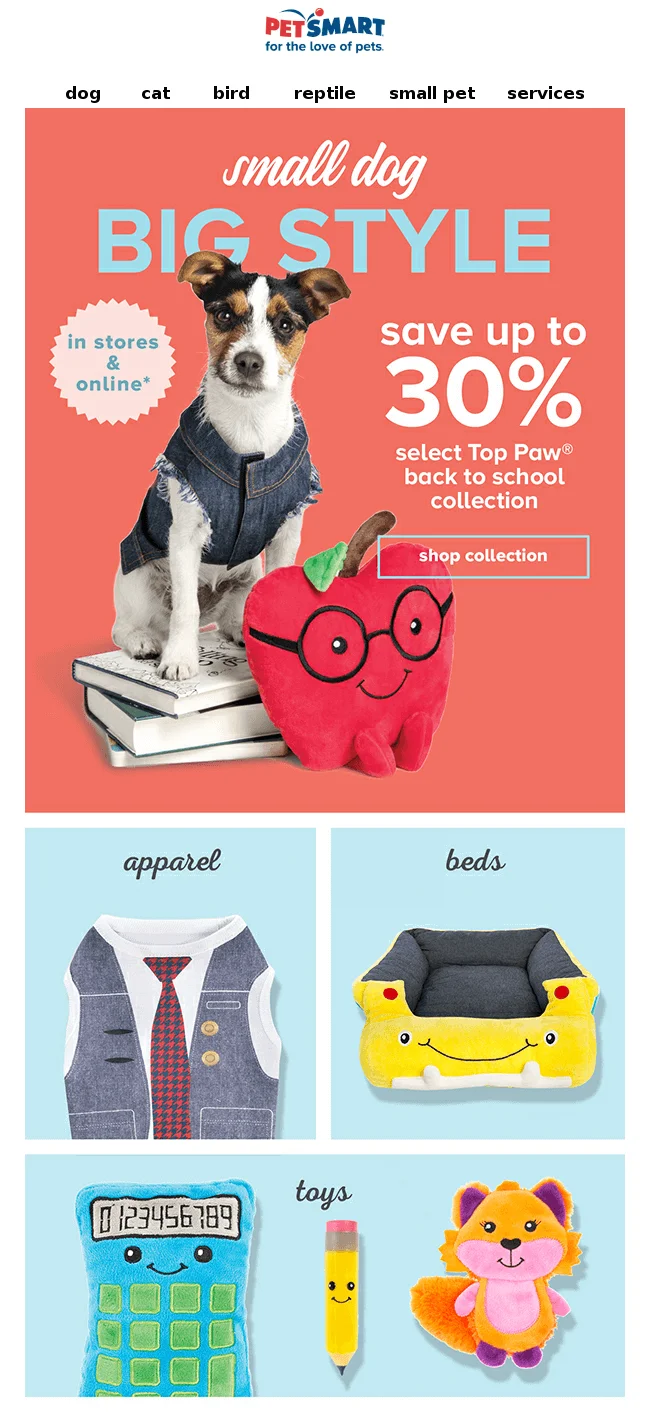
Even if you sell products that are not related to school, you can still use the back-to-school theme in your email newsletters. PetSmart provided a great example of how to use the beginning of the school year to sell dog products. In the email, the store offers products that will keep your pet from getting bored while their owner is at school.
Grammarly — Use humor
What to borrow: Pair entertainment with a relevant offer so the message still supports a business goal.
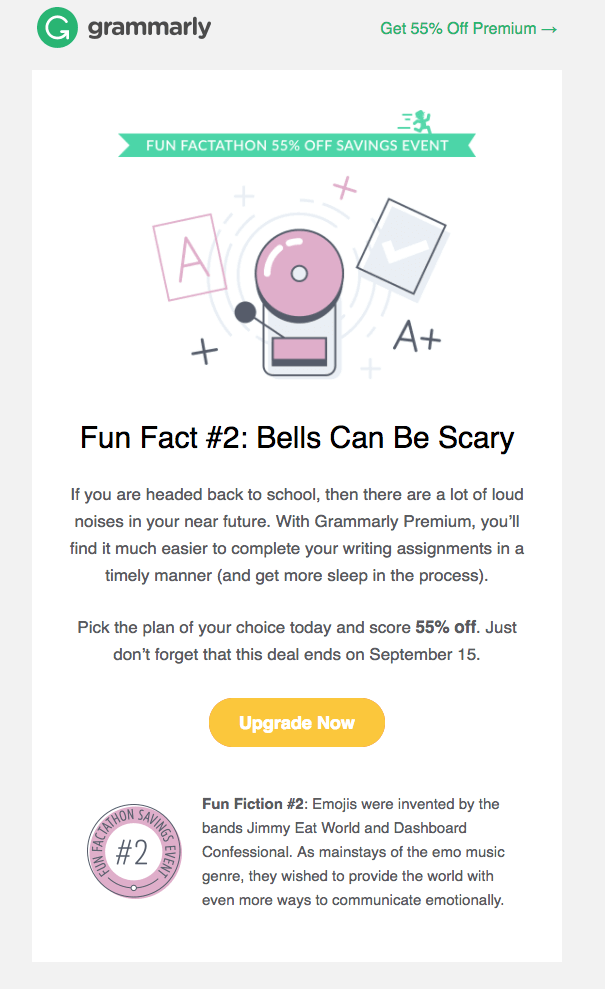
Grammarly’s back-to-school marketing campaign isn’t a typical hard sell. Instead, they sent a series of email drip campaigns with fun facts about the school. This educational approach won them customers’ loyalty, who appreciated the valuable content instead of feeling like they were being sold to.
Caraway — Create a checklist
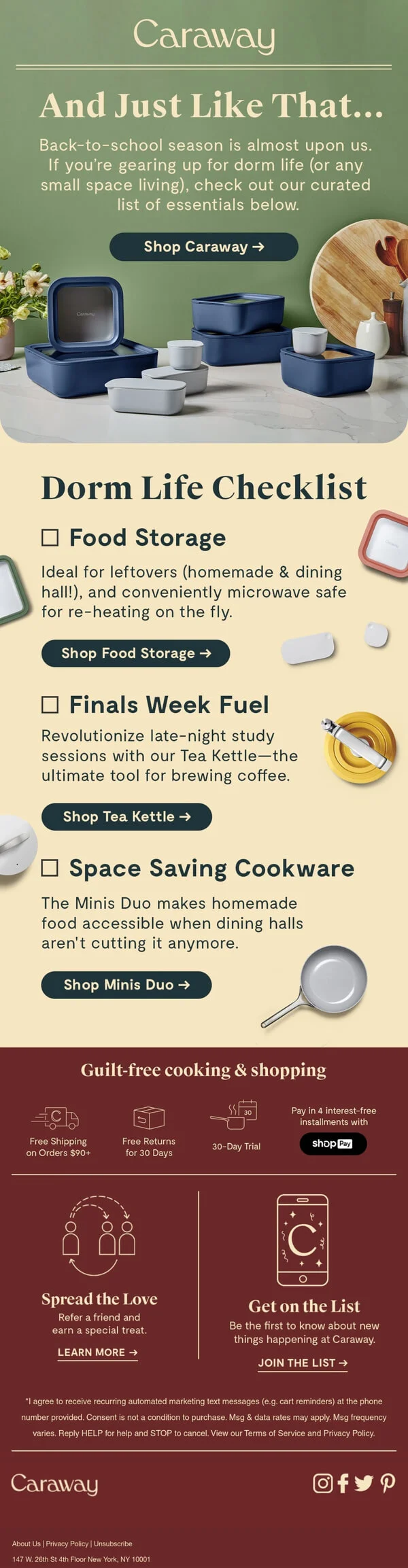
What to borrow: Use a checklist to organize products around jobs the reader needs to complete.
Another email design idea you can adopt for one of your back-to-school email campaigns is a checklist. It can suit a variety of brands and newsletters. For example, Caraway, a cookware and bakeware brand, promotes products relevant to a student’s life in a dorm:
Final thoughts
Back-to-school email marketing performs best when it reflects how people actually shop: they start early, compare value, buy for different age groups, and often return for forgotten items or replenishment. Build a short sequence around those behaviors instead of relying on one broad promotional email.
Start with audience and timing, then choose the content, offer, and creative. Segment parents, college shoppers, teachers, and “back to routine” audiences where relevant. Give each email one main job, make deadlines and delivery details clear, and use examples or trends only when they support that job.
Finally, test the elements that can change the outcome: subject line, offer framing, send time, product mix, and CTA. Use clicks, conversions, revenue, and unsubscribes to evaluate the campaign, not open rate alone.
Back-to-school email marketing FAQ
When should you start a back-to-school email campaign?
Start early, since many shoppers begin by early July. Build a sequence that covers discovery, comparison, purchase, and replenishment rather than waiting for one last-minute send. A practical timeline is 4–6 weeks before school for checklists and preference collection, 2–3 weeks before for the main offer, the final week for shipping deadlines, and the first weeks of school for forgotten essentials and refills.
How many back-to-school emails should you send?
A short, coordinated sequence works better than a single promotional email. The content recommends planning multiple sends across the season so you can reach early shoppers, support purchase decisions, and follow up after school starts. You should also test cadence against engagement and suppress subscribers who have already purchased when messages are no longer relevant.
What should a back-to-school email include?
Back-to-school emails should combine useful content with timely reminders. Depending on the stage, include checklists or guides, product recommendations by audience, shipping cutoffs, pickup options, stock levels, offer deadlines, and post-purchase reminders for forgotten essentials or replenishment. Value should be clear, with savings, bundles, free shipping thresholds, loyalty rewards, or helpful gifts explained plainly.
How do you segment a back-to-school campaign?
Segment by audience first: parents of K–12 students, college students and families, teachers, and non-school audiences. Then refine further using past purchases, browsing behavior, location, engagement, preferred price range, and whether someone responded to an earlier back-to-school message. Match the email angle to each group’s likely needs, such as checklists and bundles for parents or dorm guides and student offers for college shoppers.
What subject lines work for back-to-school emails?
The content emphasizes using subject lines that match the offer and audience, especially when timing is urgent or value-focused. For example, subject lines should reflect checklists, bundles, shipping deadlines, stock levels, student offers, or “back to routine” themes for non-school audiences. Keep them aligned with the email’s purpose so the message feels timely and relevant.
 New and noteworthy on our blog
