The list is not one audience. At one end, a developer on a free community server with a handful of devices. At the other, a private deployment running inside an oil major. Community users alone sit in more than 150 countries, and the industries run from agriculture to utilities to oil and gas.
Once a year that spread turns up in one place. IoT Sparks is LORIOT’s own conference: two days in Valencia, 35+ speakers, 500+ people from both sides of the IoT market, and two hands-on workshops of thirty seats each, one run by IBM and one by LORIOT.
The invitation did not start in September. The first email naming the date of IoT Sparks went out on 10 March, nearly seven months before the doors opened. From there the conference ran through every monthly digest and through campaigns of its own, again and again, to the last reminder before the deadline.
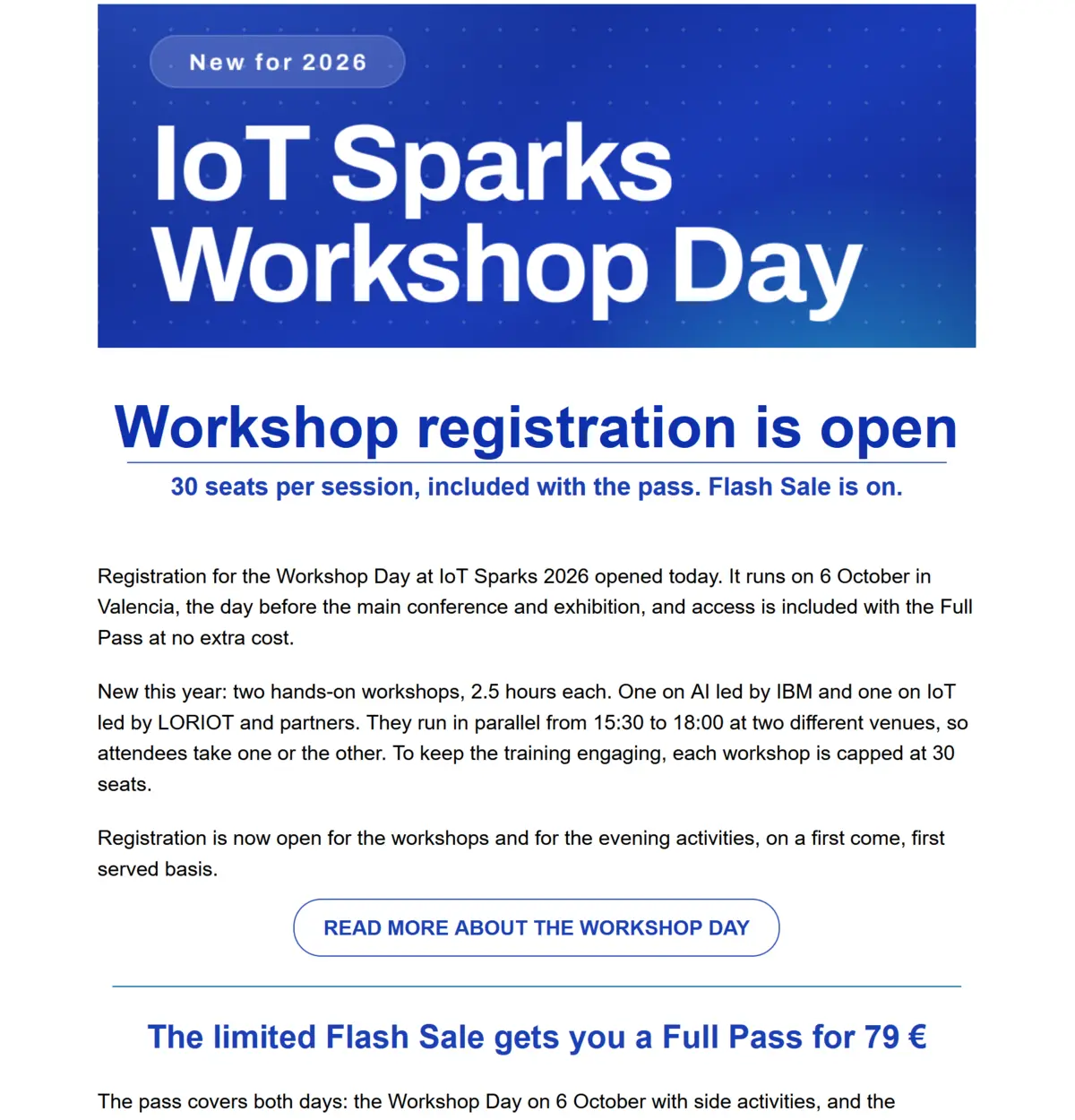
And the reminders were not the same reminder. On 2 September the workshop news went out twice in one day, to two different parts of the list. People who already held a ticket were told they were officially attendees, and that a pass does not hold a workshop seat, that one they book themselves. Everyone else got the same news with the flash sale beside it, a full pass at 79 € instead of 349 €. Nobody was sold a ticket they had already bought.
We love Selzy’s drag-and-drop block builder. It is incredibly easy to use and to adapt to different brandings, whether we are creating a LORIOT newsletter or an IoT Sparks digest.
Once one IoT Sparks ends, work on the next one begins. The first email goes out as soon as we confirm the date and the venue, and as the event gets closer, we reveal more: surprises, side activities, what’s new each year.
Segmentation in Selzy is simple too. We export everyone who already has a ticket from our ticketing platform and exclude them from our main mailing lists. No one receives two different emails.

Between events the monthly digest keeps the list warm and the subscription forms bring new addresses in. Lists and tags cut the audience by event, by interest and by whether someone has already registered, anyone who misses a campaign can be sent it again, and every send comes back with its own report next to Selzy’s industry benchmark.
58% of the people who got the flash-sale email opened it. Selzy’s benchmark puts the average for IT at 10.7%. The two workshop letters opened at 65% and 51%. Across the whole run-up there was not one spam complaint, against the 0.1% Gmail asks bulk senders to stay under, and unsubscribes you could count on one hand.
None of it was a push in the final fortnight. The date went out in March and it kept going out, each time to the part of the list that needed to hear it, right up to the morning the doors opened in Valencia. Two days, 35+ speakers, 500 people in the room.