


Key takeaways
- Email preview text is a short snippet displayed in the inbox next to or below the subject line to help recipients understand the message content.
- A strong preview complements the subject line, front-loads useful information, and remains meaningful when truncated.
- Preview text differs from a preheader, with the former being what recipients see in the inbox listing and the latter being content at the top of the email.
- To add preview text, most email platforms provide a dedicated field to enter the copy while writing the subject line.
Email preview text is the short inbox snippet displayed next to or below an email subject line. It helps recipients understand what the message contains before they open it.
A strong preview complements the subject line, front-loads useful information, and stays meaningful when an inbox truncates it. This guide explains how preview text differs from a preheader, how to add it, what length to use, and how to write effective subject-and-preview pairs.
What is email preview text?
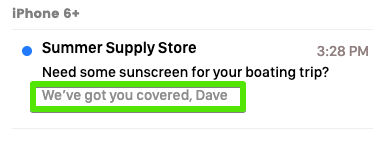
Email preview text is the snippet an email client shows in the inbox after the sender name and subject line. Depending on the device, inbox, layout, and user settings, it may appear beside the subject or on a separate line.
It acts like supporting copy for the subject line. The subject earns attention; the preview clarifies the value, supplies a detail, or creates a reason to open without simply repeating the same words.
Quick definition
Preview text is the inbox display result. A preheader is content placed at the beginning of the email. Marketers often use a hidden preheader to control preview text, but the terms do not describe exactly the same thing.

Preview text vs preheader: what is the difference?
The two terms are often used interchangeably because a preheader commonly supplies the inbox preview. The distinction is useful when you build or troubleshoot a campaign:
- Preview text is what the recipient sees in the inbox listing.
- Preheader is content at the top of the email, above or before the main message.
- Hidden preheader is email content designed to feed the inbox snippet without appearing as a prominent line in the opened message.
If you do not define preview text, the inbox may pull the first available content from the email. That can be the opening paragraph, navigation, image alt text, a view-in-browser link, or another fragment you did not intend to feature.

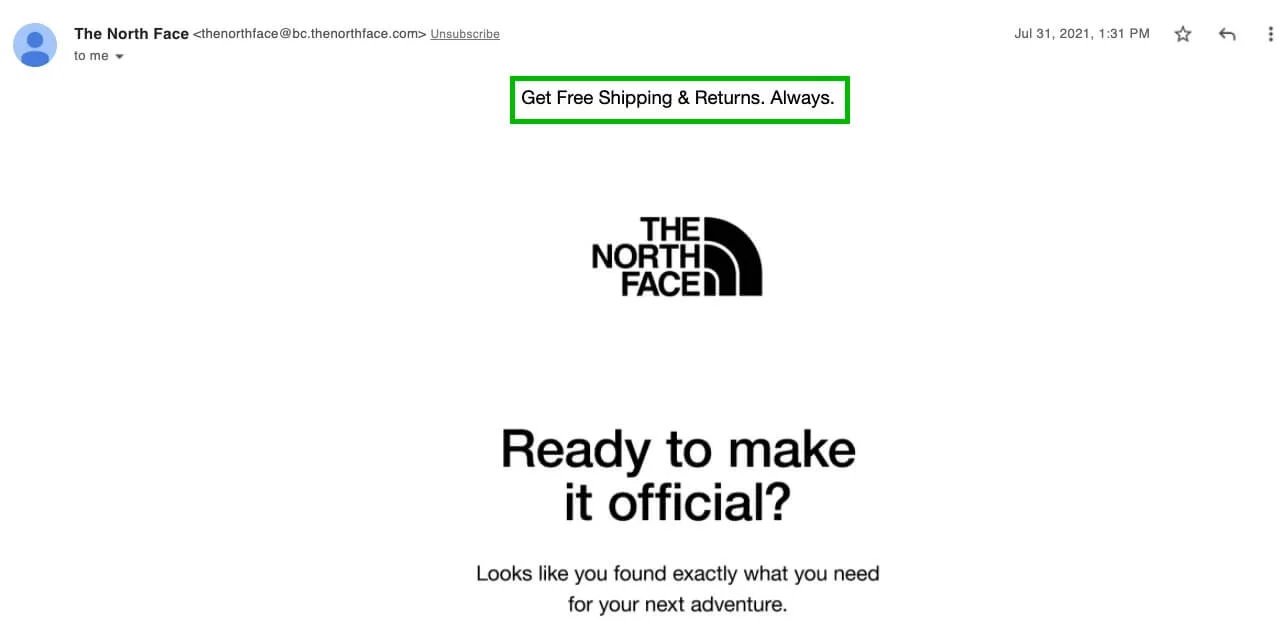
Email preview text can support opens and clicks when it gives recipients a clearer reason to engage. GetResponse benchmark data also compares results for messages with and without preheaders: review the email marketing benchmarks.
How to add preview text to an email
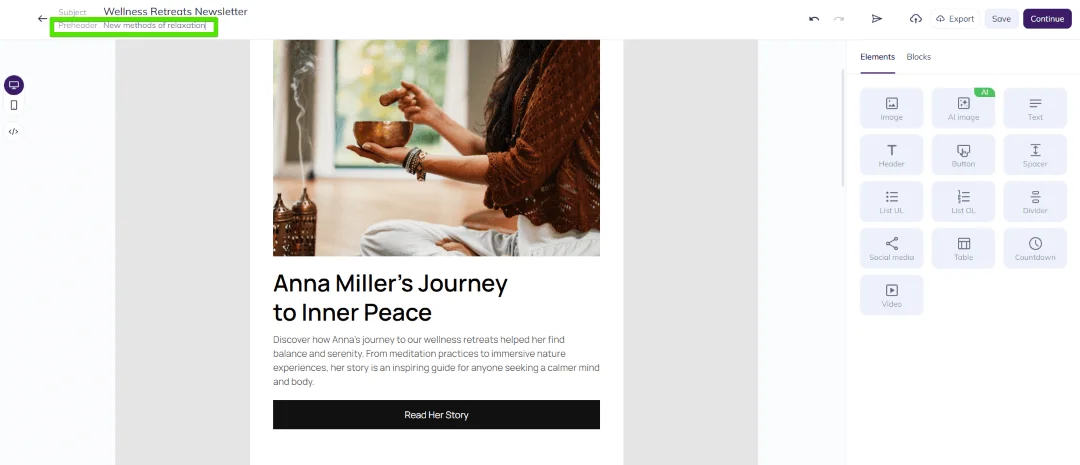
Most email platforms provide a dedicated preview-text or preheader field. Add the copy while you write the subject line so the two elements work as one message.
In Selzy, enter the preheader in the campaign settings shown below. Keep the first words useful because some recipients will see only the beginning.
- Write the subject line and preview text together.
- Put the most important benefit, detail, or deadline first.
- Send a test message to several inboxes and check desktop and mobile views.
- Confirm that the snippet does not pull navigation, alt text, or footer copy after your intended message.
- Test a different subject-and-preview pair when the campaign is important enough to justify an experiment.
If your platform does not have a dedicated field, a developer can add a hidden preheader at the start of the HTML email. Hidden content requires careful testing: CSS support differs between email clients, and whitespace-padding tricks can create awkward blank snippets or accessibility problems.
Email preview text examples and best practices
The best preview text completes the thought started by the subject line. It does not need to summarize the whole email. Use it to add specificity, surface the next useful detail, or clarify the action the recipient can take.
| Email type | Subject line | Preview text | Why it works |
| Promotion | 25% off ends tonight | Use your code before midnight and save on every order. | Adds the deadline and explains the value. |
| Newsletter | Your June marketing brief | Five ideas, three examples, and one experiment to try this week. | Previews the contents without repeating the subject. |
| Welcome | Welcome to the community | Set your preferences and choose what you want to receive. | Gives the new subscriber a clear next step. |
| Webinar | Your seat is confirmed | Join us Thursday at 11 a.m. and bring your questions. | Surfaces the essential event detail. |
| Abandoned cart | You left something behind | Your cart is saved, but popular items may sell out. | Combines reassurance with honest urgency. |
| Product update | A faster way to build campaigns | See the new editor tools now available in your account. | Names the benefit and invites exploration. |
| Event reminder | We start in one hour | Your joining link and agenda are inside. | Front-loads time-sensitive information. |
| Re-engagement | Still want to hear from us? | Update your preferences or pause emails in one click. | Sets a transparent expectation and offers control. |
Make the subject line and preview text work together
Read both elements as a pair. They can form one sentence, set up a question and answer, or divide the message into a promise and supporting detail. Avoid copying the subject into the preview because repeated text wastes limited inbox space.

Front-load the value
Lead with the information a recipient needs most: the benefit, deadline, topic, confirmation, or next step. Do not begin with filler such as “Open this email to learn more.” The most useful words should survive truncation.

Avoid keyword stuffing. Preview text is written for the recipient, not as a place to repeat search terms. Forced repetition sounds spammy and makes the subject-and-preview pair harder to scan.
Use incentives and urgency honestly
An incentive can make the value concrete, while a genuine deadline can help a recipient decide when to act. State the condition clearly and avoid manufactured urgency that the body of the email cannot support.
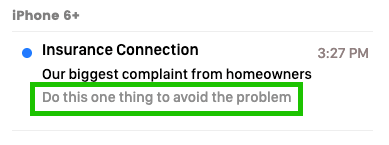
Curiosity works best when the recipient still understands the topic. Hint at the answer, but give enough context to set an accurate expectation.
Add a clear action when it helps
For an offer, event, or account notification, the preview can name the next step: reserve a seat, finish checkout, review a report, or update preferences. The action should match what the recipient finds after opening.



Personalize only with reliable data
A first name, location, product, or recent action can make the snippet more relevant. Use personalization only when the data is complete and trustworthy, and define a natural fallback so recipients never see an empty field or raw merge tag.

Common preview text mistakes and how to fix them
| Problem | Why it hurts | Better approach |
| Repeating the subject line | Wastes the second line of inbox space | Add a supporting detail or next step |
| Putting value at the end | The useful part may be truncated | Front-load the benefit, date, or topic |
| Leaving the field blank | The inbox may pull navigation, alt text, or footer copy | Write intentional preview text and send a test |
| Using broken personalization | Raw tags and blanks reduce trust | Validate data and set a readable fallback |
| Adding too many emojis | The snippet becomes noisy and may render differently | Use one relevant emoji only when it fits the brand |
| Using misleading urgency | Creates disappointment and weakens trust | State real limits and conditions |
| Relying on padding hacks | Can create blank or inconsistent snippets | Use the platform field and test client behavior |
How long should email preview text be?
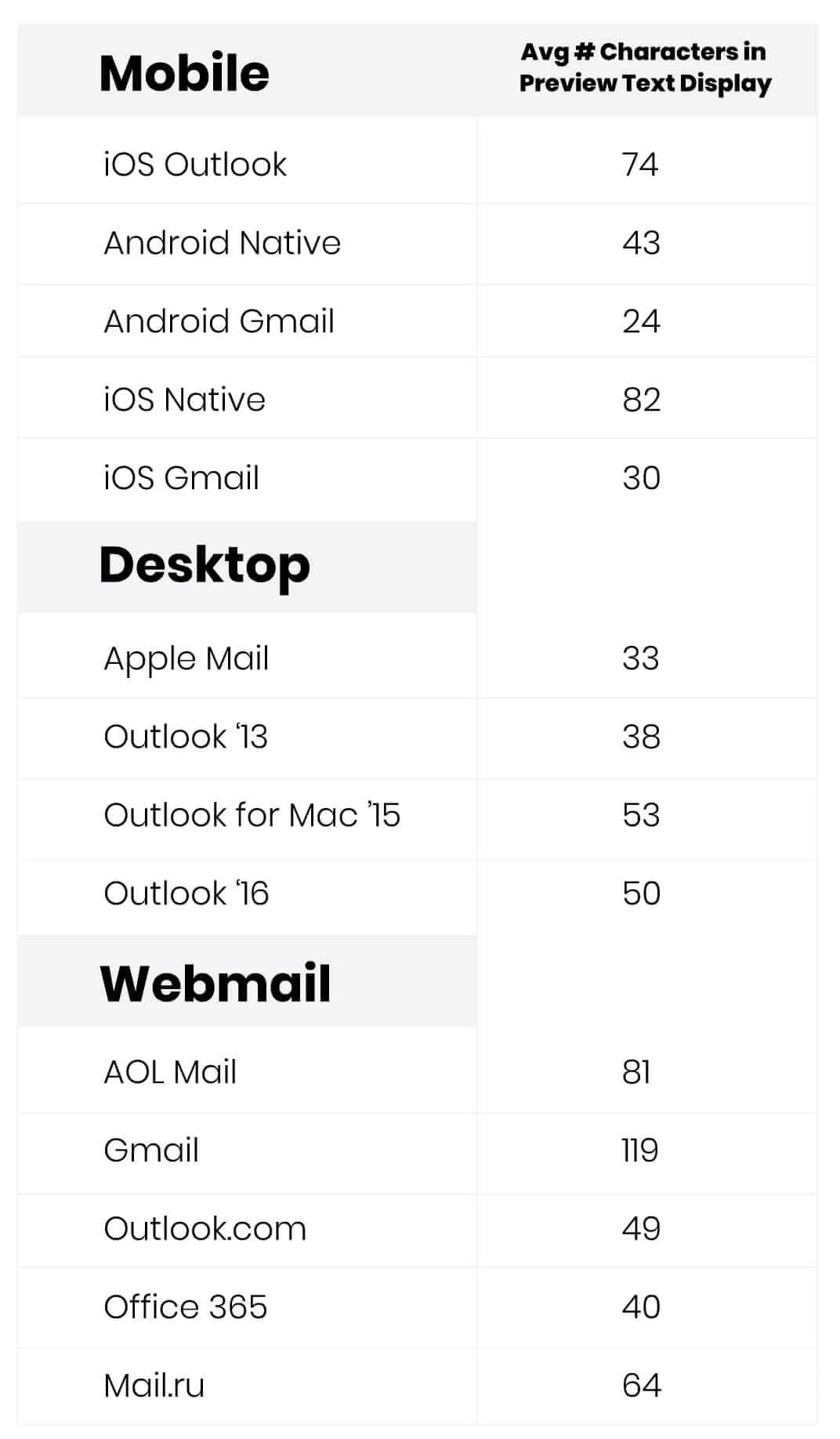
There is no universal character limit. The visible amount changes with the email client, device width, inbox layout, subject-line length, font settings, and whether other interface elements share the row.
As a practical starting point, write roughly 40 to 90 useful characters and put the essential idea first. A longer line is not automatically wrong, but it should still make sense when only the beginning appears. Test actual messages instead of treating a client-length chart as permanent.
Use campaign analytics and A/B tests to learn which subject-and-preview combinations work for your audience. Compare meaningful variants rather than changing several unrelated elements at once.
Final email preview text checklist
- Complement the subject line instead of repeating it.
- Put the main value or detail first.
- Keep the wording accurate and specific.
- Use personalization only with a reliable fallback.
- Check what appears when the snippet is truncated.
- Send tests to multiple inboxes on desktop and mobile.
- Confirm that navigation, alt text, and footer copy do not leak into the preview.
- Test subject-and-preview pairs when performance matters.
Preview text is small, but it occupies valuable inbox space. Write it at the same time as the subject line, test the pair in real inboxes, and use campaign results to refine the next send.
Email preview text FAQ
What is email preview text?
Email preview text is the inbox snippet shown next to or below the subject line. It helps recipients quickly understand what the email is about before they open it, and it should support the subject rather than repeat it.
How is preview text different from a preheader?
Preview text is the snippet the recipient sees in the inbox listing, while a preheader is content placed at the top of the email. A hidden preheader is often used to control the inbox snippet without showing a prominent line in the opened email.
How long should email preview text be?
A practical starting point is roughly 40 to 90 useful characters, with the value front-loaded first. Because inboxes can truncate text, the opening words should quickly deliver the key benefit, detail, or deadline.
What happens if preview text is left blank?
If preview text is not defined, the inbox may pull the first available content from the email. That can be the opening paragraph, navigation, image alt text, a view-in-browser link, or another fragment you did not intend to feature.
Can you use emojis or personalization in preview text?
Yes - one relevant emoji can be used when it fits the brand. Personalization should only be used when the data is reliable, and a natural fallback helps avoid blank fields or raw merge tags.
 New and noteworthy on our blog
